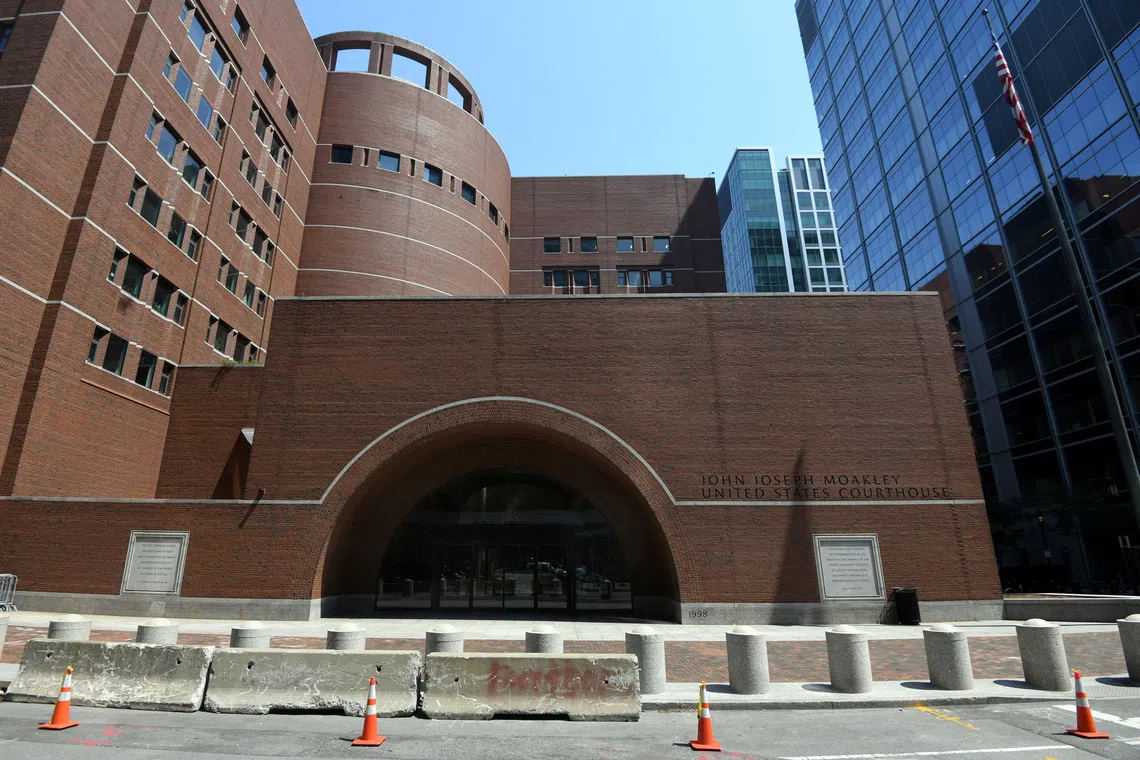
Photo via Times of India

US court blocks Trump administration's four-year visa rule for international students and researchers

Read the original at Times of India ↗
Cite

Kably, L. (2026, September 15). US court blocks Trump administration's four-year visa rule for international students and researchers. Times of India. https://timesofindia.indiatimes.com/nri/us-canada-news/us-court-blocks-trump-administrations-four-year-visa-rule-for-international-students-and-researchers/articleshow/134255892.cms

Dated when The Aporia collected the article, usually within hours of publication. Check the original for its exact date and byline.

Times of India · collected 2026-09-15 · by Lubna Kably

Quick Summary

A federal district court in Massachusetts has temporarily blocked the Trump administration's rule that would restrict international students and researchers' stay in the U.S. to a fixed four-year period, instead keeping the existing "duration of status" system intact indefinitely. The ruling came after several organizations challenged the legality of the new rule scheduled to take effect on September 15. This decision impacts F-1 visa holders (students) and J-1 visa holders (researchers), allowing them to remain in the U.S. as long as they are enrolled in studies or research programs, without needing fixed admission periods.
Written by AI on 2026-09-15, from this article's own text only (the story summary below draws on all the coverage).
See how they differ ↓

AI analysis

Story summary

On September 14, 2026, U.S. District Judge F. Dennis Saylor in Boston blocked the Trump administration's rule that would have limited how long foreign students and journalists could remain in the United States without applying for extensions. The judge found the Department of Homeland Security’s rationale to be “exceptionally weak,” questioning its justification based on national security concerns and visa fraud prevention. Universities, unions, and advocacy groups had filed a lawsuit challenging the rule before it was set to take effect on September 15. Saylor wrote that the policy would likely cause significant damage to the higher education system and the U.S. economy, potentially costing universities hundreds of millions in dollars due to declining enrollments. The judge postponed the new rules indefinitely while legal challenges continue, effectively maintaining the previous “duration of status” framework for foreign students and journalists.

Written for “Judge Blocks Trump Visa Limits” on 2026-11-20, grounded in this article and the 4 other(s) covering the same event.

How they differ

5 outlets covered “Judge Blocks Trump Visa Limits”.

What each outlet says

One AI summary per outlet of its latest article on this story, written from that article alone and checked against it. Open the article for the outlet's own words.

Times of IndiaThis outlet15 Sep

A federal district court in Massachusetts has temporarily blocked the Trump administration's rule that would restrict international students and researchers' stay in the U.S. to a fixed four-year period, instead keeping the existing "duration of status" system intact indefinitely. The ruling came after several organizations challenged the legality of the new rule scheduled to take effect on September 15. This…

US court blocks Trump administration's four-year visa rule for international students and researchers (this article)
The Hindu14 Sep

On September 14, 2026, a U.S. District Judge in Boston blocked President Donald Trump’s administration from implementing a rule that would have limited the stay of foreign students and journalists to four years and 240 days respectively without extensions. The judge cited "exceptionally weak" rationales given by DHS for national security concerns, noting that the policy change did not consider less burdensome…

U.S. Judge blocks Trump limits on how long foreign students, journalists can stay →
South China Morning Post15 Sep

A US judge in Boston has blocked President Trump’s restrictions on student and journalist visas as part of a legal challenge initiated by university groups and labor unions. Judge F. Dennis Saylor ruled that the rationale for the visa caps was weak, noting that the Department of Homeland Security had based its case primarily on anecdotal evidence rather than concrete connections to broader issues. The decision…

US judge blocks Trump’s ‘absurd’ visa caps for students, journalists →
Al Jazeera15 Sep

A federal judge in Boston has halted a Trump administration proposal that would have imposed strict time limits on visas for foreign students and journalists, citing concerns over national security and fraud prevention but noting these reasons as "exceptionally weak." Meanwhile, 22 states plus Washington D.C., along with six cities and counties, have filed lawsuits against another regulation that aims to broaden the…

Trump administration suffers double legal setback over immigration policy →
The Straits Times15 Sep

On September 14, a U.S. federal judge delayed the implementation of stricter visa rules for foreign students and journalists proposed by the Department of Homeland Security (DHS). Originally set to take effect the next day, these regulations would have limited student stays to four years with no automatic extensions beyond that period, while journalist visas would be capped at 240 days or shorter in some cases…

US judge postpones new visa rules for foreign students, journalists →

Where they agree and split

Framing

How the first headlines put it

Stated as fact5
The headlines (5)

U.S. Judge blocks Trump limits on how long foreign students, journalists can stay The Hindu · stated as fact

US judge blocks Trump’s ‘absurd’ visa caps for students, journalists South China Morning Post · stated as fact

US court blocks Trump administration's four-year visa rule for international students and researchers Times of India · stated as fact

Trump administration suffers double legal setback over immigration policy Al Jazeera · stated as fact

US judge postpones new visa rules for foreign students, journalists The Straits Times · stated as fact

The full story: what happened, how it changed, and all 5 articles →

Compared with similar articles

This article reads leans left and hedges 20% of its claims. Each row says how that neighbour differs.
The Straits Times
Leans strongly left further left than this Hedges 3 of 19 claims Outlet record 64/100
The Hindu
Leans strongly left further left than this Hedges 0 of 14 claims Outlet record 60/100
South China Morning Post
Leans strongly left further left than this Hedges 0 of 3 claims Outlet record 62/100
Al Jazeera
Leans left Hedges 2 of 19 claims Outlet record 60/100
Dawn
Leans left Hedges 0 of 10 claims Outlet record 67/100
“The articles describe different actions by the Trump administration: one blocks a rule for international students and researchers, while the other extends an executive order regarding H-1B visa fees.”
Fox News
Leans left Hedges 7 of 51 claims Outlet record 66/100
“The articles describe two different legal actions: one by a federal court blocking a visa rule for international students and researchers, and another involving 20 states suing over a public charge immigration rule.”
The Straits Times
Leans left Hedges 2 of 12 claims Outlet record 64/100
“The articles describe two separate court rulings against Trump-era policies, one concerning international students and researchers, and the other regarding deportations to third countries.”
The Straits Times
Leans left Hedges 3 of 17 claims Outlet record 64/100
“The articles describe different court decisions related to policies implemented by the Trump administration, each concerning distinct legal challenges.”

Story

Judge Blocks Trump Visa Limits
Crime & Law · 5 article(s) covering the same event. Compare every outlet's account →
How this article was measured signals, leaning charts, publisher record, byline, topics and claims

Signals How these are calculated →

Claims extracted
85
sentences that state something as happening or true
Uncertain
20%
17 of 85 hedged ("reportedly", "may", "according to")
Leaning
Leans left
of the writing, not the subject · beta estimate
Publisher signals
59/100
Times of India's corrections and hedging, across everything collected from it. Not a measure of accuracy.
Outlets on this story
5
Crime & Law
Same framing elsewhere
1
articles that frame the event the way this one does
Analyzed 2026-09-15 · how these are computed

How this is being covered How these are calculated →

Article leaning vs. publisher reliability
Source leaning vs. consistency

Publisher

Times of India · 5434 article(s) · 6 correction(s) detected
Running correction rate · 6 correction(s)

Who wrote this

Lubna Kably
1 article(s) here · 1 carrying a prediction
In a major reprieve for international students, researchers, academics and foreign journalists, a US federal district court has blocked the Trump administration from implementing a new rule that would replace the longstanding ‘duration of status’ system with fixed periods of admission.
The only article under this byline in the corpus.

Topics

DHS Massachusetts TOI the Department of Homeland Security’s the Trump administration

Subjects

DHS ORG · 3× Massachusetts GPE · 2× Association of International Educators ORG · 1× F Dennis Saylor IV PERSON · 1× NAFSA ORG · 1× TOI ORG · 1× Trump PERSON · 1× the Department of Homeland Security’s ORG · 1× the Presidents’ Alliance on Higher Education and Immigration ORG · 1× the Trump administration ORG · 1×

Narrative

District court questions DHS's justification Judge Saylor's order found that the plaintiffs were likely to succeed in their challenge under the Administrative Procedure Act (APA), which requires agencies to act reasonably, consider relevant evidence and explain the connection between the facts they identify and the policies they adopt. The district court identified four principal deficiencies in DHS's rulemaking.
framing: assertive · carried by 1 article(s) · first seen 2026-09-15
In a major reprieve for international students, researchers, academics and foreign journalists, a US federal district court has blocked the Trump administration from implementing a new rule that would replace the longstanding ‘duration of status’ system with fixed periods of admission.

Claims (85 extracted, 17 hedged)

In a major reprieve for international students, researchers, academics and foreign journalists, a US federal district court has blocked the Trump administration from implementing a new rule that would replace the longstanding ‘duration of status’ system with fixed periods of admission. asserted
that → block → admission
The district court’s order means that the new framework, which was scheduled to take effect on Sept 15, cannot be implemented for now. asserted
which → mean → Sept
The existing duration-of-status framework therefore remains in place nationwide. asserted
framework → exist → place
US District Judge F Dennis Saylor IV of the District of Massachusetts on Monday granted preliminary relief to organisations representing higher education institutions, international educators, journalists and others. asserted
IV → grant → institutions
The district court postponed the effective date of the Department of Homeland Security’s (DHS) final rule, while litigation challenging its legality continues. asserted
litigation → postpone → legality
TOI had earlier analysed the new rule. asserted
TOI → analyse → rule
Also read: Trump administration limits visa tenure of students to a fixed period of four years and limits academic flexibilityInternational students were allowed to stay in the US, as long as they were studying. asserted
they → read → US
The new rule eliminated this ‘duration of status’ concept and subjected international students (F1 visa holders), exchange visitors (J visa holders) and representatives of foreign media to fixed periods of stay. asserted
rule → eliminate → stay
In a double whammy, the new rule also introduced new restrictions on academic flexibility for international students. asserted
rule → introduce → students
The rule was challenged in the district court by the Presidents’ Alliance on Higher Education and Immigration, NAFSA: Association of International Educators, the Association of Independent Colleges and Universities in Massachusetts, the American Federation of Teachers, The NewsGuild-CWA, and others. asserted
rule → challenge → Teachers
The ruling is particularly significant for international students pursuing lengthy or evolving academic programmes, including doctoral candidates, as well as researchers and scholars whose work may extend beyond a fixed admission period. uncertain
work → pursue → period
What the rule sought to change Under the duration of status system, international students admitted on F-1 visas may generally remain in the US while pursuing a full course of study and authorised practical training, provided they maintain their immigration status. J-1 exchange visitors, including researchers, professors, teachers and trainees, are similarly admitted for the duration of their approved programme or activity. uncertain
visitors → seek → programme
The district court noted that duration of status for F visa holders dates back to 1978, while the corresponding system for J visa holders was introduced in 1985. asserted
system → note → 1985
DHS's final rule, published on July 17, sought to replace this arrangement with fixed periods of admission. asserted
rule → publish → admission
F-1 and J-1 visa holders would generally be subject to a maximum four-year admission period, regardless of the anticipated length of their educational programme or research. asserted
holders → anticipate → programme
Those requiring additional time would have to apply to US Citizenship and Immigration Services (USCIS) for an extension of stay, generally using Form I-539. asserted
Those → require → I-539
The rule also provided for a 240-day limit for foreign media representatives holding I visas, subject to an extension process. asserted
rule → provide → process
For students, the proposed change would have had consequences beyond the need to seek extensions. asserted
change → propose → extensions
The rule placed restrictions on academic flexibility. asserted
rule → place → flexibility
Graduate students would generally be prohibited from changing their educational objectives or transferring between institutions, subject to limited exceptions for extenuating circumstances. asserted
students → prohibit → circumstances
International students would also generally be required to pursue a subsequent programme at a higher educational level, preventing them from undertaking another programme at the same or a lower level while retaining F-1 status. asserted
students → require → status
The rule also reduced the post-completion departure period for F and J visa holders who completed their programmes early to 30 days. asserted
who → reduce → days
District court questions DHS's justification Judge Saylor's order found that the plaintiffs were likely to succeed in their challenge under the Administrative Procedure Act (APA), which requires agencies to act reasonably, consider relevant evidence and explain the connection between the facts they identify and the policies they adopt. The district court identified four principal deficiencies in DHS's rulemaking. asserted
court → question → rulemaking
- First, it said DHS had failed to conduct a reasoned assessment of the costs and benefits of the new framework. asserted
DHS → say → framework
In particular, the agency had not adequately accounted for the potential impact on international student enrolment, research, teaching and the travel of foreign journalists. asserted
agency → account → journalists
- Second, DHS had not meaningfully considered less burdensome alternatives to replacing duration of status. asserted
DHS → consider → status
- Third, the agency had failed to respond adequately to significant public comments raising concerns about the rule's consequences. asserted
agency → fail → consequences
- Fourth, it found that DHS had not demonstrated a rational connection between the rule and its stated objectives of protecting national security and preventing fraud and abuse. “The use of such labels does not, however, give DHS license to ignore its statutory obligations,” the judge said, referring to the agency's reliance on national security and border protection. asserted
judge → find → security
In his order the judge also questioned whether the weak connection between the rule and its stated rationales raised concerns about other, undisclosed objectives, including “greater government control over academic institutions and the press”. asserted
connection → question → institutions
The district court stressed that its role was not to decide whether the Trump administration had adopted a wise or unwise policy. asserted
administration → stress → policy
Its task was to determine whether DHS had complied with the law when promulgating the regulation. asserted
DHS → determine → regulation
Impact on international students and US universities The ruling comes at a time when US universities are heavily dependent on international students, particularly at the graduate level and in science, technology, engineering and mathematics (STEM) disciplines. The district court noted that there are approximately 1.6 million individuals in F status and about 500,000 in J status. asserted
court → come → status
More than half of all international students major in STEM fields, according to data cited in the order. uncertain
half → major → order
The judge also highlighted the contribution of international students and scholars to American research, innovation and economic growth. asserted
judge → highlight → research
The order referred to evidence that international student alumni had founded 143 of 582 billion-dollar US start-ups, or 25%. asserted
alumni → refer → ups
The potential impact of the rule was reflected in comments submitted during the rulemaking process. asserted
impact → reflect → process
A survey of 1,039 current international students, cited by NAFSA, found that 49% said they would not have enrolled in the US had duration of status been replaced with a fixed admission period. asserted
duration → cite → period
A separate survey of 611 prospective students found that 16% fewer respondents said they were likely to enrol under such a system. asserted
they → find → system
The new rule adversely impacted Indian students, as they are the largest contingent of international students. asserted
they → impact → students
Experts point out that while the numbers of new students from India is falling, the cohort of Indian students will continue to be significant. asserted
cohort → point → students
…and 45 more, not listed.
Give feedback · no sign-in needed

No sign-in needed for now. Your note is sent without a name, so it cannot be answered.

History Support