Photo via The Globe and Mail

Mixed results on Alberta referendum questions highlight urban-rural divide

Read the original at The Globe and Mail ↗
Cite

Scace, M., & Wang, C. (2026, October 23). Mixed results on Alberta referendum questions highlight urban-rural divide. The Globe and Mail. https://www.theglobeandmail.com/canada/alberta/article-mixed-results-alberta-referendum-highlight-urban-rural-divide/

Dated from the outlet's own feed. Check the original for its byline.

The Globe and Mail · collected 2026-10-23 · by Matthew Scace, Chen Wang

Quick Summary

Danielle Smith, Alberta’s Premier, faced mixed results from Monday’s provincial referendum regarding immigration control and constitutional amendments. While proposals related to immigration received narrow majorities between 52% and 55%, those for constitutional changes fell short at below 50%. The proposal for proof-of-citizenship requirements garnered the highest support with 58%. These outcomes highlight a rural-urban divide, as urban areas tended to oppose some proposals. Elections Alberta completed counting over 20 million ballots by Thursday afternoon, making this the largest electoral event in Alberta’s history.
Written by AI on 2026-10-23, from this article's own text only (the story summary below draws on all the coverage).
See how they differ ↓

AI analysis

Story summary

On October 19, 2026, Albertans voted in a referendum that included ten questions, primarily focusing on immigration and constitutional issues. The last question asked if the Government of Alberta should commence legal steps to hold a second binding referendum on separation from Canada. Voting began with advance polls on October 13 at 311 polling stations.

The results released later showed that three-quarters of Albertans voted against pursuing separation, with strong support for remaining in Canada. However, there was a noticeable rural-urban divide, where questions pertaining to immigration and constitutional changes garnered more support from rural areas compared to urban centers like Calgary and Edmonton.

Premier Danielle Smith's request for "strong mandates" on the nine ballot questions did not materialize as expected, with most provincial ridings rejecting many of the proposed measures. This has left her government hesitant about swift action despite winning majorities in some areas related to immigration policies.

Written for “Alberta Referendum Results” on 2026-11-21, grounded in this article and the 104 other(s) covering the same event.

How they differ

19 outlets covered “Alberta Referendum Results”.

What each outlet says

One AI summary per outlet of its latest article on this story, written from that article alone and checked against it. Open the article for the outlet's own words.

The Globe and MailThis outlet23 Oct

Danielle Smith, Alberta’s Premier, faced mixed results from Monday’s provincial referendum regarding immigration control and constitutional amendments. While proposals related to immigration received narrow majorities between 52% and 55%, those for constitutional changes fell short at below 50%. The proposal for proof-of-citizenship requirements garnered the highest support with 58%. These outcomes highlight a…

Mixed results on Alberta referendum questions highlight urban-rural divide (this article)14 articles from The Globe and Mail on this story
Toronto Star23 Oct

A union representative from Cargill’s beef processing plant near Calgary warns of potential labour shortages if recent Alberta referendum proposals limiting access to or charging for provincially funded services based on immigration status are implemented. With 98% of polls reporting, the referendum narrowly passed with slim majority support for these changes, despite Premier Danielle Smith's government arguing that…

Advocates flag contributions, not costs, of newcomers in Alberta referendum aftermath →30 articles from Toronto Star on this story
Global News23 Oct

Following Alberta’s referendum where a majority voted for policies limiting access to provincially funded services based on immigration status, union representatives are highlighting the contributions of immigrant workers rather than focusing on costs. Faduma Ahmed from the United Food and Commercial Workers Local 401 at Cargill’s abattoir in High River emphasized that these workers, many of whom hold temporary…

Advocates flag contributions, not costs, of newcomers in Alberta referendum aftermath →14 articles from Global News on this story
CBC27 Oct

Alberta's recent referendum saw most provincial ridings reject Danielle Smith’s ballot questions, despite her seeking strong mandates for her proposals. Of the nine questions, seven would have lost in a riding-by-riding contest, with only Questions 1 and 5 receiving majority support. Edmonton and Calgary showed particular opposition to restricting services for temporary residents, while rural areas largely supported…

Nopes to the nine? Blue walls? Five takeaways from Alberta's referendum results →12 articles from CBC on this story
National Post25 Oct

This article compiles letters discussing Alberta's recent referendum on sovereignty. Writers express mixed views: while some see it as a positive development that may prompt federal attention to Western Canada, others fear it could embolden separatist movements elsewhere, like Quebec. One letter criticizes U.S. Ambassador Pete Hoekstra for lecturing Canadian politicians about interfering in American politics, citing…

Letters: The good and bad of Alberta’s vote →8 articles from National Post on this story
Euronews21 Oct

Alberta voters overwhelmingly rejected starting the process toward separation from Canada in a recent referendum, with about 75% supporting unity. This outcome gives Prime Minister Mark Carney a boost as he pushes for national unity amid US President Donald Trump’s trade war and annexation threats, which have rallied Canadians around their flag. Edmonton voter Shawn Campbell explained his vote: “It sends a message…

Alberta’s “no” to separation gives Carney a boost as Trump pressure unites Canadians →4 articles from Euronews on this story
Show 13 more outlets
BBC20 Oct

Albertans have voted overwhelmingly to stay part of Canada in a recent referendum, with over two-thirds of voters choosing unity despite calls for separation from some groups. Prime Minister Mark Carney celebrated the outcome as a victory for national unity, while provincial leader Danielle Smith acknowledged the results and suggested a path forward. Proponents of independence had argued that Alberta’s economic…

Alberta votes overwhelmingly to remain part of Canada →3 articles from BBC on this story
CBS News20 Oct

Voters in Alberta rejected a proposal to start the process toward independence from Canada, with 76% choosing to remain part of the country and only 23% supporting the path towards separation. The referendum was held due to tensions between Alberta and the Canadian federal government over issues like oil regulations and trade policies. Despite some support for separatism, particularly among conservatives who feel…

Voters reject separation of Alberta from Canada in referendum →2 articles from CBS News on this story
Al Jazeera20 Oct

In Alberta's first-ever independence referendum on Monday, 76% of voters chose to remain part of Canada, with results showing an overwhelming support for staying within the country. This outcome is seen as a significant victory for Canadian Prime Minister Mark Carney, who campaigned against separation, while disappointing those advocating for Alberta’s independence due to long-standing grievances with Ottawa. The…

Alberta rejects separation referendum: What’s next for Canadian province? →2 articles from Al Jazeera on this story
The Guardian20 Oct

Alberta voters rejected a proposal to initiate a process toward independence from Canada, with CBC projecting that about 76% of votes supported remaining in Canada while only 23% favored beginning the separation process. With over a million votes counted early Tuesday morning and nearly a third of ballots tallied, this outcome marks a significant victory for Canadian unity and Prime Minister Mark Carney. The ballot…

Alberta voters reject plan for referendum to leave Canada, CBC projects →2 articles from The Guardian on this story
The Straits Times20 Oct

On October 19, Canada awaited results from a divisive independence vote in Alberta, with less than one-quarter of voters reportedly supporting separation according to polls. Mitch Sylvestre, leader of the separatist movement, remained optimistic despite low polling numbers, stating his goal was to ignite provincial spirit regardless of initial outcomes. With 3.1 million eligible voters and 1.4 million advance…

Canada awaits result in Alberta independence vote →2 articles from The Straits Times on this story
Dawn19 Oct

Alberta is holding a non-binding referendum on Monday where residents will vote on ten questions related to separation from Canada and provincial governance. Premier Danielle Smith announced this after months of campaigning by separatists who argue that Alberta's wealth subsidizes other parts of the country and hinders its economy. The final question asks if Albertans want to remain in Canada or start a process for…

What does Alberta's referendum on separation from Canada mean? →2 articles from Dawn on this story
The Independent20 Oct

Voters in Alberta, Canada's oil-rich province, decisively rejected a move toward independence, with CBC projecting that about 76 percent of voters supported remaining within Canada, while only 23 percent backed the process towards separation. More than one million votes were counted from over 1.35 million cast, representing 43 percent of eligible voters. The vote reflects deep-seated tensions between Alberta and the…

Alberta rejects independence and votes to remain in Canada, CBC projects →2 articles from The Independent on this story
NPR20 Oct

In Alberta’s recent referendum, voters overwhelmingly rejected proposals toward provincial independence with 76% supporting remaining part of Canada and only 23% backing the process for potential separation. The vote came as tensions rose due to U.S. President Donald Trump's trade policies and annexation threats. Despite strong sentiment against Ottawa in some circles, a majority of Albertans chose unity, reflecting…

Alberta voters reject a move toward independence in referendum backing Canadian unity →2 articles from NPR on this story
South China Morning Post20 Oct

Alberta voters rejected the idea of separating from Canada in an overwhelming referendum, with 77% supporting staying within the country while 23% favored initiating a path toward separation. Early results provided a significant boost for Canadian Prime Minister Mark Carney's efforts to maintain national unity amid tensions with the US over trade and annexation threats.

Alberta voters choose Canada over independence in boost for Carney →2 articles from South China Morning Post on this story
Washington Examiner18 Oct

Alberta residents are set to vote in a referendum on October 19 that could lead to discussions about the province's potential independence from Canada. The ballot does not directly decide Alberta’s separation but asks if the provincial government should initiate the necessary steps for a future binding referendum on independence. This vote has significant implications for Canada's political structure and its…

What to know about the Alberta referendum on leaving Canada →
Fox News19 Oct

Alberta residents started voting on Monday in a non-binding referendum to decide if the western-Canadian province should separate from Canada. The poll involves about three million eligible voters amid tensions following recent military incidents in Alberta. Despite a majority of decided voters favoring remaining in Canada according to polls, nearly 30% support initiating the process for a binding referendum on…

Alberta holds non-binding separation vote as independence fight grips Canada →
New York Post20 Oct

Alberta residents voted to remain part of Canada in a recent referendum, with 76% supporting unity as initial results showed. The nonbinding vote, announced by Premier Danielle Smith in May, came amid growing calls for separation from a small but vocal group advocating for Alberta’s independence due to perceived economic injustices and bureaucratic impediments from the federal government. Prime Minister Mark Carney…

Alberta votes to remain part of Canada, rejects independence →
Daily Mail20 Oct

Alberta, Canada’s oil-rich province, voted overwhelmingly against separation from the country in a recent referendum, with 76% of voters supporting unity. Despite this outcome, Albertans also approved measures to tighten immigration laws and restrict access to social benefits for non-permanent residents. The vote reflects ongoing tensions between Alberta and the federal government over environmental policies and…

Oil-rich Canadian province of Alberta votes to remain part of the country... but demands immigration is slashed and voter ID laws are tightened →

Where they agree and split

Agreed

AI · cited, from two or more outlets

  • The referendum vote was not a direct decision on independence but would have set Alberta on a path toward a future vote on separation if passed.35
  • More than two-thirds of voters in the province chose to remain part of Canada rather than pushing for independence according to unofficial results from Elections Alberta.45
Quoted from the coverage (4)

With more than 1 million votes counted, about 76% supported remaining in Canada, compared with 23% who backed beginning a process that could lead to separation.

8 outlets

Prime Minister Mark Carney said on Tuesday that "it's a great result for Canada" and he is "thrilled that Albertans have chosen unity".

8 outlets

Alberta Premier Danielle Smith, a conservative, said she voted against independence but called the referendum to settle an issue that has divided the province.

6 outlets

Carney, who grew up in Alberta, has called the referendum “a dangerous bluff” as US President Donald Trump imposes punishing tariffs and levels annexation threats aimed – the prime minister says – at breaking Canadian resolve.

6 outlets

Disputed

Picked by our model, which is sometimes wrong

  • Separatist leaders vow to continue fighting for separation despite the referendum results, whereas Prime Minister Carney celebrates unity.45

Framing

How the first headlines put it

  • The Toronto Star frames the event as a timeline of events leading up to the vote, while CBS News presents it as a decisive rejection of separation.13
  • CBC highlights the rural-urban divide on additional referendum questions, whereas The Globe and Mail focuses on presenting the results of those nine other questions.67
The full story: what happened, how it changed, and all 105 articles →

Compared with similar articles

This article reads leans left and hedges 15% of its claims. Each row says how that neighbour differs.
Global News
Leans strongly right further right than this Hedges 12 of 52 claims Outlet record 63/100
The Globe and Mail
Leans left Hedges 0 of 21 claims Outlet record 51/100
The Globe and Mail
Hedges 3 of 38 claims Outlet record 51/100
Toronto Star
Leans strongly left further left than this Hedges 3 of 40 claims Outlet record 65/100
Global News
Hedges 2 of 26 claims Outlet record 63/100
NPR
Hedges 5 of 54 claims Outlet record 60/100
The Globe and Mail
Hedges 0 of 3 claims Outlet record 51/100
The Globe and Mail
Leans right further right than this Hedges 1 of 30 claims Outlet record 51/100
The Globe and Mail
Leans right further right than this Hedges 1 of 29 claims Outlet record 51/100

Story

Alberta Referendum Results
Politics · 105 article(s) covering the same event. Compare every outlet's account →
How this article was measured signals, leaning charts, publisher record, byline, topics and claims

Signals How these are calculated →

Claims extracted
33
sentences that state something as happening or true
Uncertain
15%
5 of 33 hedged ("reportedly", "may", "according to")
Leaning
Leans left
of the writing, not the subject · beta estimate
Publisher signals
51/100
The Globe and Mail's corrections and hedging, across everything collected from it. Not a measure of accuracy.
Outlets on this story
105
Politics
Same framing elsewhere
1
articles that frame the event the way this one does
Analyzed 2026-10-23 · how these are computed

How this is being covered How these are calculated →

Article leaning vs. publisher reliability
Source leaning vs. consistency

Publisher

The Globe and Mail · 1306 article(s) · 50 correction(s) detected
Running correction rate · 50 correction(s)

Who wrote this

Matthew Scace
30 article(s) here · 1 carrying a prediction
Alberta Premier Danielle Smith’s government has introduced legislation that will force a vote on a proposed new electoral map that contains controversial changes to key provincial ridings and has fuelled accusations of gerrymandering.
“When you’re on the opposite side of the world it’s just about the last thing you would expect,” he told The Globe and Mail.
They might have a different level of intensity, but they’re not outliers.”
Ms. Smith’s governing United Conservative Party voted on Wednesday night to approve a motion that will result in the government creating a bill to put the map into law.
Premier Danielle Smith is rejecting allegations that an independent panel has torqued the province’s electoral map to favour her United Conservative Party, saying the recommended changes to redraw the boundaries are reasonable and would give voters better representation.
Mr. McClure said Elections Alberta’s resources are strained and pursuing a different avenue would protect “the readiness and successful delivery of Alberta’s next provincial general election.”
Alberta’s electoral boundaries are expected to be tabled in the provincial legislature on Monday and, if approved, would be used for next year’s election.
Two days after the vote, Ms. Smith asked members to accept the result and said that those wishing to turn the UCP into a separatist party would not be welcome.
Alberta’s new electoral boundaries are expected to be released next week, setting up a contentious battle over the map that will define the province’s political playing field for the next decade – a process that has been plagued by accusations of gerrymandering.
Alberta Premier Danielle Smith appears to have fended off a leadership challenge and is looking to smother discord within her United Conservative Party by requiring those seeking a seat on its provincial board to pledge they will respect the majority vote against holding a separation referendum.
Also by Matthew Scace
Nothing else under this byline is closely related to this article, so these are simply their most recent.
All 30 articles by Matthew Scace →
Chen Wang
3 article(s) here · 1 carrying a prediction
The stranger explained how Mr. Wu could make some easy money off a landmark class-action settlement.
The results also underline a stark divide between rural and urban voters on her proposals, which could pose political risks for the Premier as she campaigns toward next year’s provincial election.
Five months after Alberta Premier Danielle Smith announced her government would call a vote on whether the province should pursue secession from Canada, Albertans at last know the results of its historic referendum.
2026-10-21 · assertive framing · The Alberta referendum by the numbers
Also by Chen Wang
The Alberta referendum by the numbers
2026-10-21 · The Globe and Mail
Nothing else under this byline is closely related to this article, so these are simply their most recent.

Topics

Alberta Albertans Calgary Edmonton Senate

Subjects

Alberta GPE · 7× Smith PERSON · 6× Calgary GPE · 3× Edmonton GPE · 3× Albertans NORP · 2× Canada GPE · 2× Danielle Smith PERSON · 1× Mark Carney PERSON · 1× Ottawa ORG · 1× Senate ORG · 1×

Narrative

Ms. Smith, claiming victory on the immigration proposals, said in the referendum’s immediate aftermath that she would continue her push to give Alberta more autonomy and defend the province’s jurisdiction. But she hedged the next day when asked how she would proceed on immigration.
framing: assertive · carried by 1 article(s) · first seen 2026-10-23
The results also underline a stark divide between rural and urban voters on her proposals, which could pose political risks for the Premier as she campaigns toward next year’s provincial election.
2026-10-23 · The Globe and Mail
Mixed results on Alberta referendum questions highlight urban-rural divide · assertive framing

Claims (33 extracted, 5 hedged)

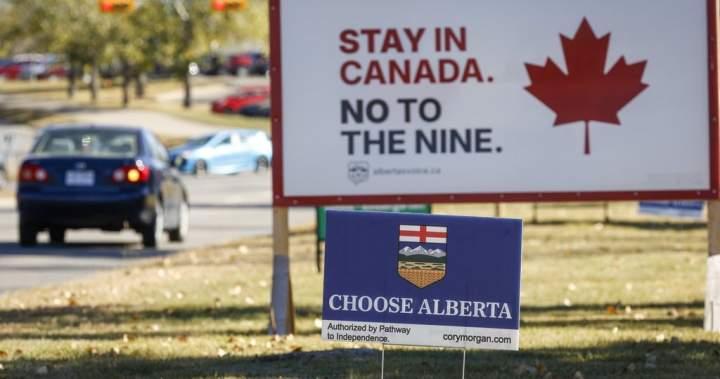
Alberta Premier Danielle Smith won’t be armed with a strong mandate to challenge the federal government for more powers after her proposals on immigration and constitutional issues were either defeated or received slim majorities in Monday’s referendum. asserted
proposals → arm → referendum
The results also underline a stark divide between rural and urban voters on her proposals, which could pose political risks for the Premier as she campaigns toward next year’s provincial election. uncertain
she → underline → election
“Certain areas of Calgary and Edmonton supported some [proposals], and certain areas did not,” Ms. Smith told reporters on Wednesday. asserted
Smith → support → Wednesday
“So, I take that as, ‘Let’s proceed with caution.’ asserted
’s → take → caution
” Elections Alberta continued to hand-count ballots on Thursday, surpassing its 48-hour deadline to tally the votes. asserted
Alberta → continue → votes
The count nevertheless continued as the agency worked toward the finish line of the largest electoral event in Alberta history, with 20 million ballots counted and 99 per cent of voting areas accounted for by Thursday afternoon. asserted
cent → continue → afternoon
Unofficial results showed that the four referendum questions centred around Alberta taking greater control over immigration were set to earn narrow majorities by Thursday night, ranging between 52 and 55-per-cent support. asserted
Alberta → show → support
Meanwhile, four proposals focused on pushing for constitutional amendments, such as judicial appointments and abolishing the federal Senate, sat below 50 per cent. asserted
proposals → focus → cent
Finally, one proposal, to make proof-of-citizenship mandatory at provincial election polls, was receiving 58-per-cent support – the top performer among the nine. asserted
proof → make → nine
The results leave Ms. Smith without the mandate she explicitly sought from Albertans in the run-up to the referendum, spending $4-million in public money encouraging them to vote Yes on the nine questions. asserted
she → leave → questions
Over the past month, Ms. Smith has pointed to the proposals as the best way to extract concessions from Ottawa, contrasting separatists who argued that a future secession vote would provide ultimate leverage. asserted
vote → point → leverage
On Monday night, Albertans rejected the prospect of separation, with roughly 75 per cent of voters preferring to remain in Canada rather than hold a second, binding secession vote. asserted
cent → reject → vote
Ms. Smith, claiming victory on the immigration proposals, said in the referendum’s immediate aftermath that she would continue her push to give Alberta more autonomy and defend the province’s jurisdiction. But she hedged the next day when asked how she would proceed on immigration. asserted
she → claim → immigration
Two of those questions propose charging health and education premiums to some non-permanent residents and limiting their access to social services. asserted
Two → propose → services
“I take that as a general indication that [voters] want us to work with the federal government on getting this balance right,” Ms. Smith said. asserted
Smith → take → government
Prime Minister Mark Carney showed openness this week to working with provinces on the issue. asserted
Carney → show → issue
On the separation question, 41 per cent of rural voters endorsed holding a second, binding vote on leaving Canada, whereas Edmonton and Calgary polled 15 and 18 per cent, respectively. asserted
Edmonton → endorse → cent
A similar dynamic played out on the other nine questions. In Edmonton, a majority of voters rejected all nine proposals. asserted
majority → play → proposals
In Calgary, a majority of electors voted against the nine questions except for the citizenship proposal. asserted
majority → vote → proposal
In midsize cities such as Red Deer, Lethbridge and Medicine Hat, a majority of voters endorsed seven of the nine questions as of Thursday evening. asserted
majority → endorse → evening
Two proposals – one on judicial appointments and the other on federal funding – were hovering around 49-per-cent support in midsize cities. asserted
proposals → hover → cities
In rural Alberta, meanwhile, support for all nine questions surpassed 60-per-cent support. asserted
support → surpass → support
Varying appetites for the government’s proposals will be a consideration for Ms. Smith’s United Conservative Party heading into next October’s general election, which she described on Wednesday as “the only fight that matters.” asserted
that → head → fight
Much of that fight will be waged in Calgary. asserted
Much → wag → Calgary
In the 2023 provincial election, the NDP swept Edmonton while Calgary almost evenly split support for the New Democrats and UCP. asserted
Calgary → sweep → Democrats
The UCP won the rest of the province, with the exception of two seats. asserted
UCP → win → seats
Matt Solberg, a political adviser who sat on Ms. Smith’s transition team when she became Premier in 2022, said many of the Calgary ridings up for grabs in the next provincial election rejected the immigration proposals. asserted
many → sit → proposals
“There is a deep level of electoral math that you can do on these to say, ‘well, this message may resonate in rural Alberta, but it’s not going to resonate in these other ridings,’ ” said Mr. Solberg, partner at New West Public Affairs. uncertain
Solberg → be → Affairs
Mr. Solberg suggested that the most logical avenue for Ms. Smith will be to strike a deal on immigration with Mr. Carney. uncertain
avenue → suggest → Carney
Saskatchewan and Newfoundland joined Alberta’s push for more immigration powers this week. asserted
Saskatchewan → join → powers
Quebec and Ottawa have shared a unique agreement since 1991, allowing the province to exclusively control the selection of incoming economic migrants, which Ms. Smith has frequently pointed to as her desired immigration model. asserted
Smith → share → model
Melissa Caouette, principal at MC Consulting and former special assistant to Alberta premier Jim Prentice, suggested working with Ottawa toward a similar agreement and potentially punting the other immigration questions. uncertain
Caouette → suggest → questions
She added that an agreement with Ottawa may address some of the concerns sitting with voters who endorsed the slate of immigration proposals. uncertain
who → add → proposals
Give feedback · no sign-in needed

No sign-in needed for now. Your note is sent without a name, so it cannot be answered.

History Support