Photo via Reason

He Won a City Council Seat by Openly Admitting How Little He Wants the Job

Read the original at Reason ↗
Cite

Lancaster, J. (2026, October 23). He Won a City Council Seat by Openly Admitting How Little He Wants the Job. Reason. https://reason.com/2026/10/23/he-won-a-city-council-seat-by-openly-admitting-how-little-he-wants-the-job/

Dated from the outlet's own feed. Check the original for its byline.

Reason · collected 2026-10-23 · by Joe Lancaster

Quick Summary

Brady Rogers won a seat on the Kelowna City Council by openly admitting how little he wanted the job and his lack of qualifications. Running as one of 37 candidates for eight available seats, Rogers used unconventional campaign tactics like signs featuring sullen expressions with slogans such as "I barely want to do this." Despite his indifferent attitude, he placed fourth in the election and beat three incumbents. His policy platform focuses on addressing homelessness by better utilizing existing resources rather than increasing spending and notes that Kelowna taxes land and improvements at the same rate, which Rogers believes is inefficient.
Written by AI on 2026-10-23, from this article's own text only (the story summary below draws on all the coverage).
See how they differ ↓

AI analysis

Story summary

Brady Rogers, a 33-year-old small business owner and engineer from Kelowna, B.C., won a city council seat in the recent municipal election despite running a satirical campaign that emphasized his reluctance to take office. Rogers used humorous slogans like "How hard could it be?" and "Just trying to pay my rent" on his election signs, which garnered international attention. He received 12,635 votes, making him the fourth most popular candidate among 37 contenders. Despite initially considering running for council "laughable," Rogers concluded he had the necessary skills to contribute positively. His unconventional approach resonated with voters who appreciated his fresh perspective on local politics.

Written for “Viral Sign Candidate Elected” on 2026-11-21, grounded in this article and the 2 other(s) covering the same event.

How they differ

3 outlets covered “Viral Sign Candidate Elected”.

What each outlet says

One AI summary per outlet of its latest article on this story, written from that article alone and checked against it. Open the article for the outlet's own words.

ReasonThis outlet23 Oct

Brady Rogers won a seat on the Kelowna City Council by openly admitting how little he wanted the job and his lack of qualifications. Running as one of 37 candidates for eight available seats, Rogers used unconventional campaign tactics like signs featuring sullen expressions with slogans such as "I barely want to do this." Despite his indifferent attitude, he placed fourth in the election and beat three incumbents…

He Won a City Council Seat by Openly Admitting How Little He Wants the Job (this article)
CBC20 Oct

Brady Rogers, a 33-year-old candidate in Kelowna's municipal election, won fourth place with 12,635 votes after running a satirical campaign with humorous slogans like "How hard could it be?" and "I barely want to do this." Despite his initially reluctant approach, Rogers's authentic humor and serious policy proposals on housing, transit, taxation, and homelessness resonated with voters. An expert noted that Rogers…

'How hard could it be?': Kelowna, B.C., candidate with viral signs gets elected →
Daily Mail20 Oct

Brady Rogers, 33, an engineer and small business owner from Kelowna, Canada, won his city council election despite openly stating he felt unqualified and lacked interest in politics. His satirical campaign messages like "I barely want to do this" resonated with voters, leading him to secure 12,635 votes and the fourth-most popular candidate spot. Rogers now believes his fresh perspective is needed in local politics…

Local man wins city council election saying he isn't qualified, just needs rent money, and has no idea about politics, which he hates: 'I barely want to do this' →

Where they agree and split

Framing

How the first headlines put it

Stated as fact2
The headlines (2)

'How hard could it be?': Kelowna, B.C., candidate with viral signs gets elected CBC · stated as fact

Local man wins city council election saying he isn't qualified, just needs rent money, and has no idea about politics, which he hates: 'I barely want to do this' Daily Mail · stated as fact

The full story: what happened, how it changed, and all 3 articles →

Compared with similar articles

This article reads unscored and hedges 6% of its claims. Each row says how that neighbour differs.
CBC News
Hedges 2 of 24 claims Outlet record 72/100

Story

Viral Sign Candidate Elected
Politics · 3 article(s) covering the same event. Compare every outlet's account →
How this article was measured signals, leaning charts, publisher record, byline, topics and claims

Signals How these are calculated →

Claims extracted
36
sentences that state something as happening or true
Uncertain
6%
2 of 36 hedged ("reportedly", "may", "according to")
Leaning
withheld
no quote in the article backed the model's score
Publisher signals
67/100
Reason's corrections and hedging, across everything collected from it. Not a measure of accuracy.
Outlets on this story
3
Politics
Same framing elsewhere
1
articles that frame the event the way this one does
Analyzed 2026-10-23 · how these are computed

How this is being covered How these are calculated →

Article leaning vs. publisher reliability
Source leaning vs. consistency

Publisher

Reason · 1464 article(s) · 4 correction(s) detected
Running correction rate · 4 correction(s)

Who wrote this

Joe Lancaster
18 article(s) here · 1 carrying a prediction
"For the first time in Department history, clean audit opinions will cover more than 56 percent of DoW assets and over 90 percent of its liabilities."
With more than 95 percent of votes tallied, it seems that former Democratic Rep. Mary Peltola will win Alaska's U.S. Senate seat, defeating the incumbent, Republican Sen. Dan Sullivan.
2026-11-16 · assertive framing · Alaska (Once Again) Votes To Keep Ranked Choice Voting
This week, a White House official suggested that conducting investigations, or even threatening to do so, could be illegal.
"Mr. Sullivan might not even claw back half of a point in ranked-choice tabulation, which would not be enough to overcome Ms. Peltola's expected advantage," reports The New York Times.
Even if given a choice between Hitler and Mao as major-party candidates and saints running on third-party or independent tickets, voters will almost always confine their votes to one or the other incarnation of evil.
Granted, a president's party is expected to lose seats in the midterms.
But along with Republican Sen. Dan Sullivan and Democratic challenger Mary Peltola, the ballot will include two other candidates, including a second Dan Sullivan—retired schoolteacher Daniel J. Sullivan.
"If the Republicans win the House of Representatives and the United States Senate, both of them," Trump pledged in September, "I will issue a dividend to every adult citizen in the United States of America for $5,000."
Then earlier this year, Rogers again got the feeling that he could be doing something beneficial with his talents.
Even if the complaint were valid, it would be difficult to enforce without violating the First Amendment.
Also by Joe Lancaster
Nothing else under this byline is closely related to this article, so these are simply their most recent.
All 18 articles by Joe Lancaster →

Topics

British Columbia Kelowna Reason The Rogerie the Kelowna City Council

Subjects

Rogers ORG · 9× Kelowna GPE · 4× Reason ORG · 2× Brady Rogers PERSON · 1× British Columbia GPE · 1× J.D. Tuccille PERSON · 1× The Rogerie ORG · 1× the Kelowna City Council ORG · 1×

Narrative

The irony of Rogers' outwardly indifferent attitude is that he actually does have a policy platform: On his website, he advocates finding solutions to homelessness not necessarily by spending more money but by making better use of the resources that the city and province already provide.
framing: assertive · carried by 1 article(s) · first seen 2026-10-23
Then earlier this year, Rogers again got the feeling that he could be doing something beneficial with his talents.

Claims (36 extracted, 2 hedged)

To many people, but especially libertarians, voting can feel dispiriting: By definition, every person on the ballot wants in some way to exert control over your life. asserted
person → vote → life
Perhaps that's why it's refreshing to see a candidate for office who truly seems not to want the job. asserted
who → see → job
Brady Rogers worked as a robotics engineer for four years, but he quit in 2019 after deciding the corporate world wasn't for him. asserted
world → work → him
"It was just a bit unfulfilling," Rogers tells Reason. asserted
Rogers → tell → Reason
"I wanted to do something a little more impactful with my skills… asserted
I → want → skills
I left to find something else that felt worthwhile." asserted
that → leave → something
He started The Rogerie, a retail store in his hometown of Kelowna, British Columbia, a city of about 170,000 people. asserted
He → start → people
Rogers and his wife collect shredded plastic waste and extrude it into filament for 3D printers, which they use to create new housewares to sell in the shop. asserted
they → collect → shop
Then earlier this year, Rogers again got the feeling that he could be doing something beneficial with his talents. uncertain
he → get → talents
This time, it meant running for the Kelowna City Council. asserted
it → mean → Council
But he had to stand out in a crowded field—he would be one of 37 candidates running, and only the top eight would win a seat. asserted
eight → have → seat
So, he settled on a strategy: openly admit his lack of qualifications and how little he even wanted the job. asserted
he → settle → job
"I guess I'm running for Kelowna city council," read his campaign website. asserted
website → guess → council
"I don't like meetings, I don't like having to be certain places at certain times, and I'm allergic to stuffy offices. asserted
I → like → offices
But unfortunately, I happen to like Kelowna, and think I can help do some good." "Do I enjoy politics? asserted
I → happen → politics
No," he adds. asserted
he → add → ?
"Do I know what I'm doing? asserted
I → know → what
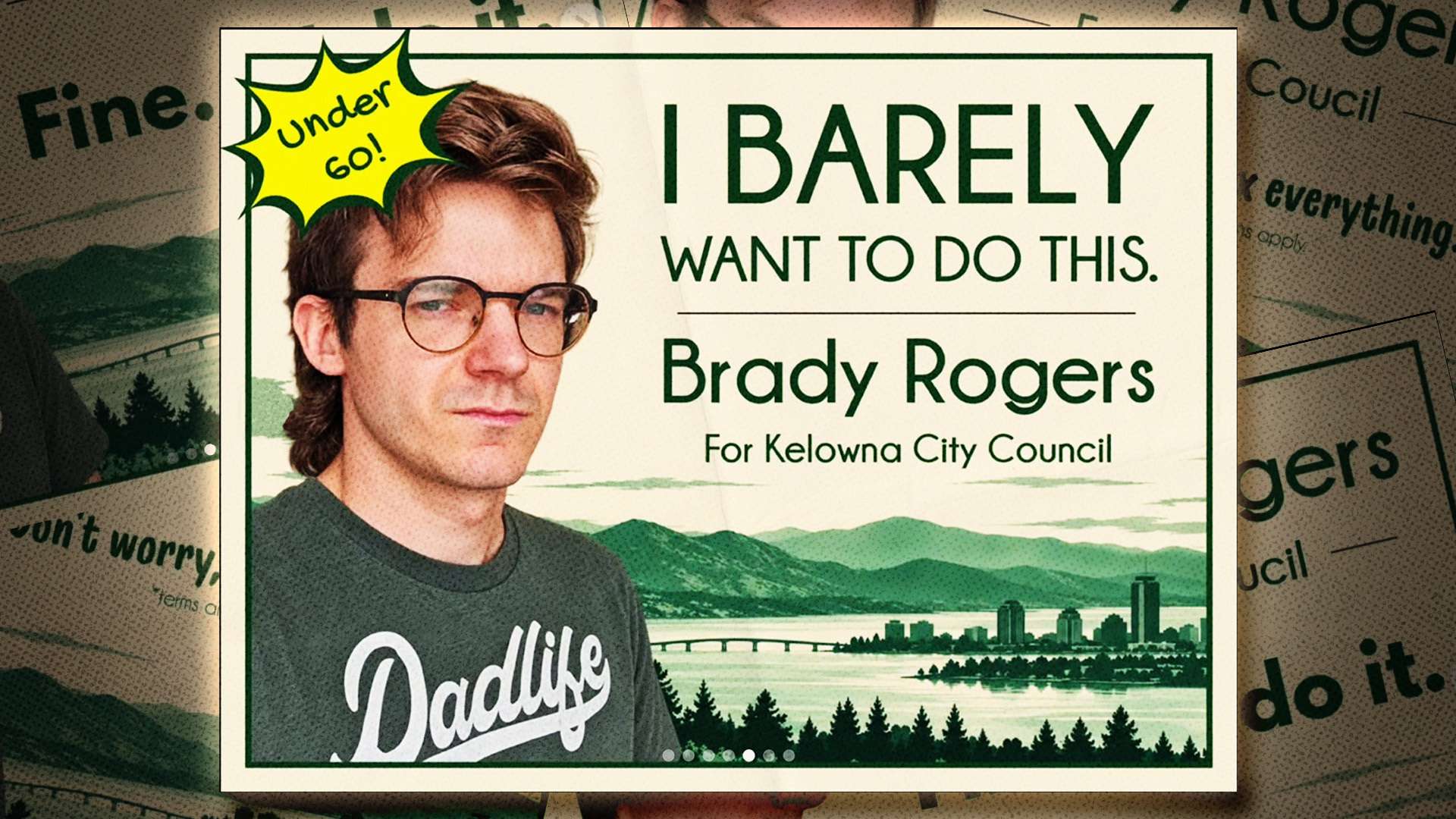
That lackadaisical attitude carried over into his campaign signage: Yard signs featured pictures of Rogers with sullen, shrugging expressions, alongside slogans like "I barely want to do this" and "Let's see what happens?" asserted
what → carry → this
In a winking reference to political gerontocracy, one sign even bragged that he was "Under 60!" asserted
he → wink → 60
The ploy worked, and the campaign went viral. asserted
campaign → work → ?
"I certainly thought it was clever. asserted
it → think → ?
I thought it would work, but it was really just how I honestly felt when I started," asserted
I → think → ?
Rogers admits. asserted
Rogers → admit → ?
"I was pretty conflicted about committing to a four-year thing that I didn't even really fully understand the ins and outs of, but at the same time I saw the opportunity to have a bigger impact. asserted
I → commit → impact
So, I was conflicted, and I figured that's a good, honest place to start a campaign." asserted
that → figure → campaign
Ultimately, he won a seat: He placed fourth out of 37 total candidates and even beat three incumbents, one of whom lost her seat. asserted
one → win → seat
The irony of Rogers' outwardly indifferent attitude is that he actually does have a policy platform: On his website, he advocates finding solutions to homelessness not necessarily by spending more money but by making better use of the resources that the city and province already provide. asserted
city → have → that
He also notes that Kelowna taxes land and improvements at the same rate, which "means we tax someone for improving their property while relatively rewarding someone who sits on valuable, underused land." asserted
who → note → land
Writing this week at Reason, J.D. Tuccille made a similar point. asserted
Tuccille → write → point
Of course, Rogers' underqualified and disinterested campaign persona is only partially true—he did, after all, want the job, or at least he saw it as a viable means of improving his city. asserted
he → want → city
Still, it's refreshing for a candidate to treat public office as something less than a higher calling. asserted
candidate → treat → calling
Ultimately, Rogers thinks that authenticity is why his campaign caught on and was ultimately successful with voters, when many campaigns struggle to create viral moments or capitalize on social media trends. asserted
campaigns → think → trends
Perhaps other people could even learn from him. uncertain
people → learn → him
"I think why mine worked so profoundly is that it is a little bit of humor, but immediately behind it was a legitimate platform and me as a real person with the skills and a real desire to do something," Rogers says. asserted
Rogers → think → something
"And I think that resonated. asserted
that → think → ?
I think people [have] an appetite for a new kind of politics." asserted
people → think → politics
Give feedback · no sign-in needed

No sign-in needed for now. Your note is sent without a name, so it cannot be answered.

History Support