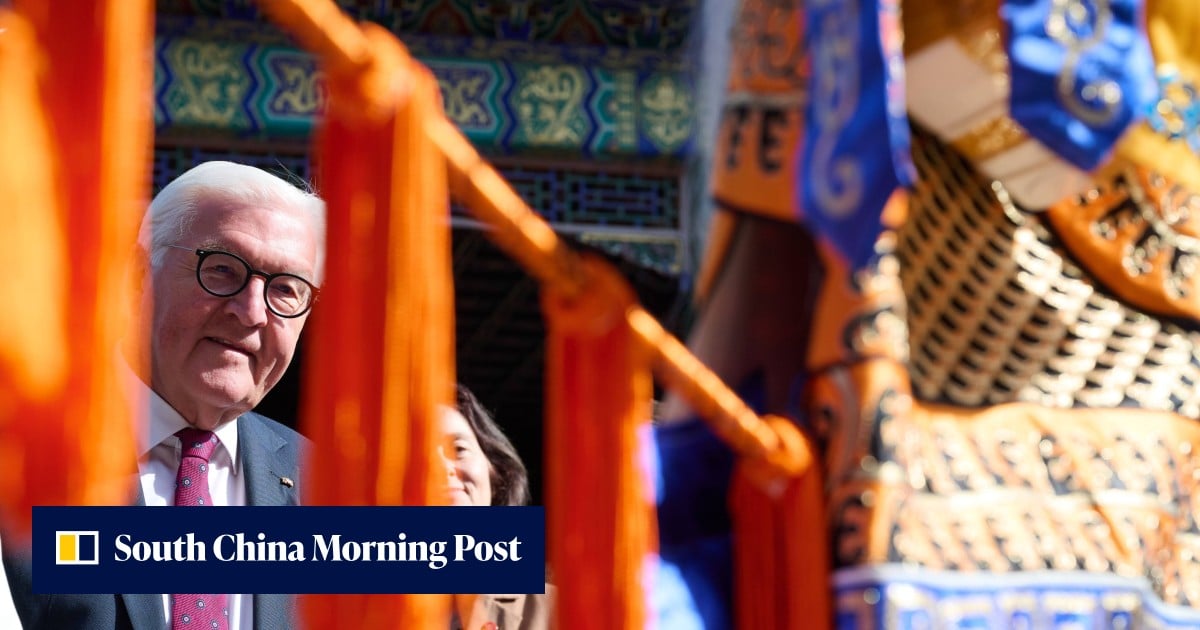
Photo via South China Morning Post

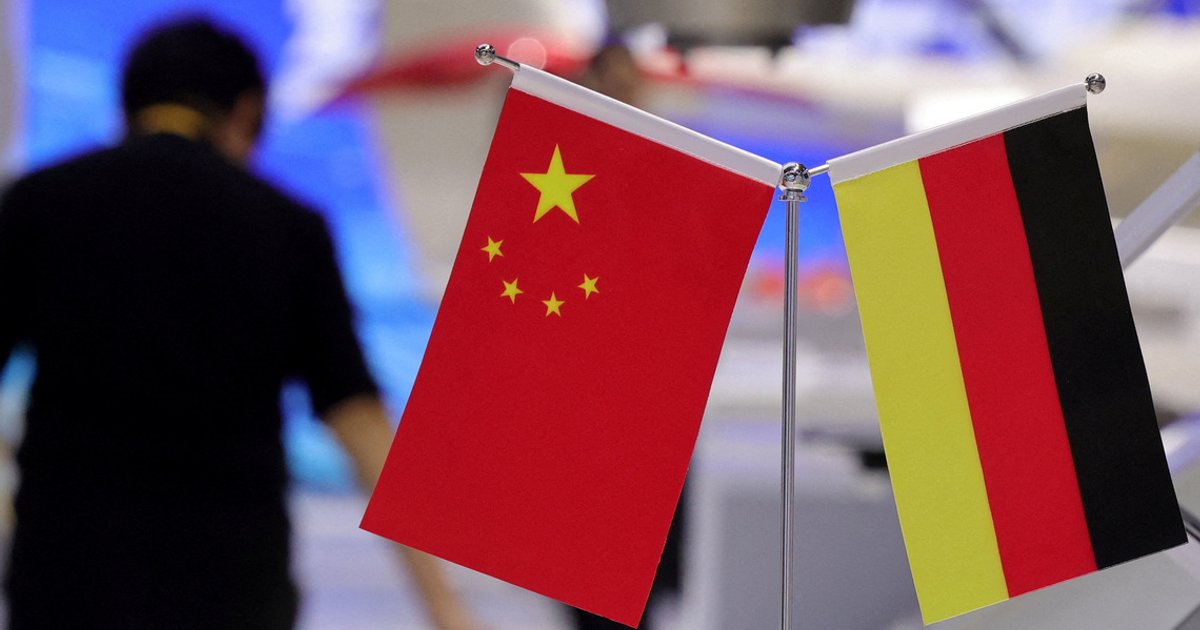
We don’t want China decoupling – but we must defend our interests, German president warns

Read the original at South China Morning Post ↗
Cite

Yang, C. (2026, October 29). We don’t want China decoupling – but we must defend our interests, German president warns. South China Morning Post. https://www.scmp.com/news/china/diplomacy/article/3372562/we-dont-want-china-decoupling-we-must-defend-our-interests-german-president-warns

Dated from the outlet's own feed. Check the original for its byline.

South China Morning Post · collected 2026-10-29 · by Carol Yang

Quick Summary

German President Frank-Walter Steinmeier emphasized during a speech at Peking University in Beijing that Germany does not aim for economic decoupling from China but seeks to defend its interests and reset the partnership on a more equitable basis. He stressed that while Europe wants to avoid a win-lose situation, it also aims to ensure that the relationship is fair and balanced.
Written by AI on 2026-10-29, from this article's own text only (the story summary below draws on all the coverage).
See how they differ ↓

AI analysis

Story summary

German President Frank-Walter Steinmeier warned in Beijing on October 29 that China must avoid creating one-sided economic benefits, speaking at Peking University before meeting with Chinese President Xi Jinping the next day. Steinmeier emphasized that while it is understandable for China to pursue self-sufficiency, this should not lead to dependence and vulnerability for other markets. He noted that European companies struggle to enter the Chinese market, while Europe faces large amounts of state-subsidized Chinese imports and controls on raw materials exports from China. Germany does not seek to decouple from China but aims to reset their economic relationship on a fairer basis, as Chancellor Friedrich Merz also stated during his tour of neighboring countries.

Written for “Germany Defends Interests Against China” on 2026-11-21, grounded in this article and the 1 other(s) covering the same event.

How they differ

2 outlets covered “Germany Defends Interests Against China”.

What each outlet says

One AI summary per outlet of its latest article on this story, written from that article alone and checked against it. Open the article for the outlet's own words.

South China Morning PostThis outlet29 Oct

German President Frank-Walter Steinmeier emphasized during a speech at Peking University in Beijing that Germany does not aim for economic decoupling from China but seeks to defend its interests and reset the partnership on a more equitable basis. He stressed that while Europe wants to avoid a win-lose situation, it also aims to ensure that the relationship is fair and balanced.

We don’t want China decoupling – but we must defend our interests, German president warns (this article)

The Straits Times29 Oct

German President Frank-Walter Steinmeier called on China during a speech at Peking University on October 29 to avoid creating one-sided dependencies in its economic relationships, particularly with Europe. He warned that while China seeks self-sufficiency, it should not harm other economies' stability and noted the growing trade imbalance between China and Europe as unsustainable. Steinmeier emphasized the need for…

Germany’s Steinmeier says China must avoid one-sided benefits in economic ties →

Compared with similar articles

This article reads leans right and hedges 0% of its claims. Each row says how that neighbour differs.
The Straits Times
Leans strongly right further right than this Hedges 1 of 10 claims Outlet record 64/100
Toronto Star
Hedges 0 of 3 claims Outlet record 65/100
“Article A describes Steinmeier's speech at Peking University, while Article B discusses a tea reception with Peng Liyuan and Elke Budenbender, indicating different events during his visit.”
South China Morning Post
Hedges 1 of 3 claims Outlet record 62/100
“The articles describe different meetings and statements made on separate days by Steinmeier and Xi Jinping, not a single incident.”

Story

Germany Defends Interests Against China
Politics · 2 article(s) covering the same event. See how they differ ↑
How this article was measured signals, leaning charts, publisher record, byline, topics and claims

Signals How these are calculated →

Claims extracted
3
sentences that state something as happening or true
Uncertain
0%
0 of 3 hedged ("reportedly", "may", "according to")
Leaning
Leans right
of the writing, not the subject · beta estimate
Publisher signals
62/100
South China Morning Post's corrections and hedging, across everything collected from it. Not a measure of accuracy.
Outlets on this story
2
Politics
Same framing elsewhere
1
articles that frame the event the way this one does
Analyzed 2026-10-29 · how these are computed

How this is being covered How these are calculated →

Article leaning vs. publisher reliability
Source leaning vs. consistency

Publisher

South China Morning Post · 4214 article(s) · 8 correction(s) detected
Running correction rate · 8 correction(s)

Who wrote this

Carol Yang
32 article(s) here · 0 carrying a prediction
Xi and Trump set for Apec talks, but major deliverables expected to wait for G20
As Congress threatens his agenda at home, Trump may become even more aggressive overseas and reliant on executive orders The loss is expected to steer the White House towards a more aggressive foreign policy and even greater reliance on executive orders.
In Asia, midterms spark worries about diplomatic uncertainty, economic pressure For US allies, there are concerns that a lame-duck Trump administration might squeeze them to score some easy diplomatic wins Observers expect the “blue wave” midterm results will push the Trump administration to heighten pressure on Washington’s Asian allies for greater US investment and increased defence cost-sharing.
“China has always regarded the European Union as a partner,” Xi said, according to state broadcaster CCTV, adding that cooperation between the two sides outweighed competition. “As long as [both sides] stay anchored to their partnership and engage in dialogue on an equal footing, differences and challenges can always be resolved and will not stand in the way of China-EU relations moving forward,” the Chinese leader said.
“We would like to see that the rules of outer space governance keep pace with exploration, reflect broad participation and benefit all countries,” Wang told an audience of nearly 400 representing more than 90 nations.
The China-Djibouti communique marks a diplomatic escalation, but experts say that Chinese naval operations are still unlikely Chinese analysts said the situation in the Red Sea has not yet escalated to a level that warrants direct naval escorts, though Beijing will closely monitor the region and may take action in the event the country’s shipping comes under threat. “The two sides emphasised the importance of safeguarding freedom of navigation in the Red Sea and the Bab al-Mandeb Strait and stressed that the navigation rights exercised by merchant vessels of all countries in accordance with international law should be respected,” read the communique released after Chinese Foreign Minister Wang Yi and his Djiboutian counterpart Abdoulkader Houssein Omar met in Beijing on Wednesday.
“China expresses serious concern over this and has lodged solemn representations with the British side,” the embassy said, noting that it would continue to urge Britain to stop the arbitrary detention and questioning of Chinese citizens.
“I asked the president, ‘Could you get me some for the Rose Garden?’
Vehicle may have sparked Mongolia wildfire, putting China rescuers on high alert 3,400 emergency personnel deployed to the Chinese side of the border to combat the latest environmental threat from its neighbour The blaze, which erupted on October 8 in the inland country’s easternmost Dornod province bordering Russia and China, advanced rapidly towards China’s Inner Mongolia autonomous region, driven by strong autumn winds and drought conditions.
Also by Carol Yang
Nothing else under this byline is closely related to this article, so these are simply their most recent.
All 32 articles by Carol Yang →

Topics

Beijing China German Germany Peking University

Subjects

China GPE · 3× Frank-Walter Steinmeier PERSON · 2× German NORP · 2× Peking University ORG · 2× Beijing GPE · 1× Europeans NORP · 1× Friedrich Merz PERSON · 1× Germany GPE · 1× Steinmeier PERSON · 1×

Narrative

Germany is not seeking to decouple from China, but must defend its economic interests, visiting German President Frank-Walter Steinmeier said in Beijing on Thursday, echoing the line taken by Chancellor Friedrich Merz during his tour of neighbouring countries. Speaking at Peking University, Steinmeier insisted that Europe’s goal was not to sever ties with the world’s second-largest economy, but to reset the relationship on a fairer footing.
framing: assertive · carried by 1 article(s) · first seen 2026-10-29
2026-10-29 · South China Morning Post
We don’t want China decoupling – but we must defend our interests, German president warns · assertive framing

Claims (3 extracted, 0 hedged)

We don’t want China decoupling – but we must defend our interests, German president warns Frank-Walter Steinmeier calls for fairer partnership, telling audience at Peking University that ‘win-win must not turn into win-lose’ asserted
win → want → lose
Germany is not seeking to decouple from China, but must defend its economic interests, visiting German President Frank-Walter Steinmeier said in Beijing on Thursday, echoing the line taken by Chancellor Friedrich Merz during his tour of neighbouring countries. Speaking at Peking University, Steinmeier insisted that Europe’s goal was not to sever ties with the world’s second-largest economy, but to reset the relationship on a fairer footing. asserted
goal → seek → footing
We do not want decoupling from China,” he told students and academic staff. asserted
he → want → students
Give feedback · no sign-in needed

No sign-in needed for now. Your note is sent without a name, so it cannot be answered.

History Support