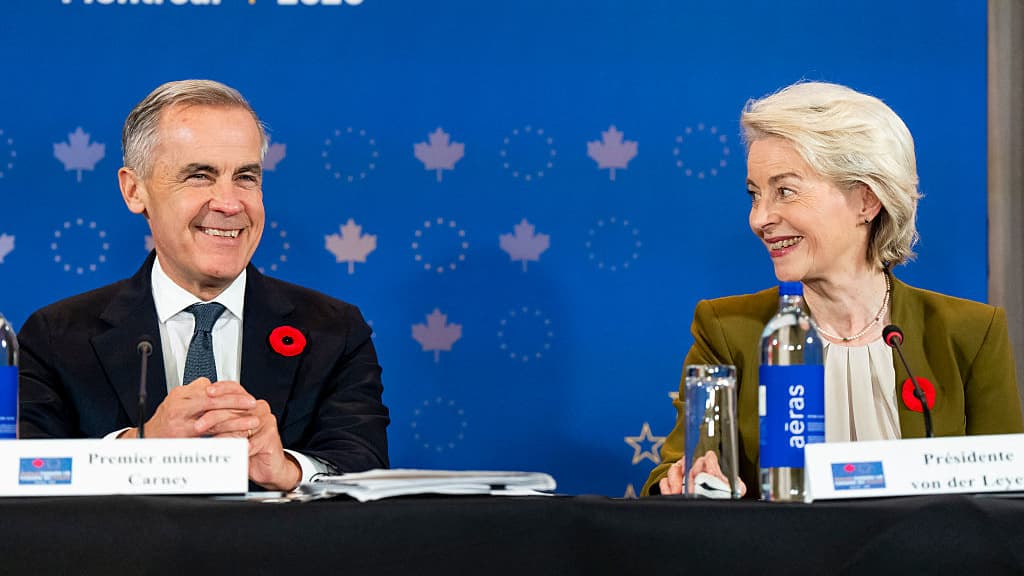
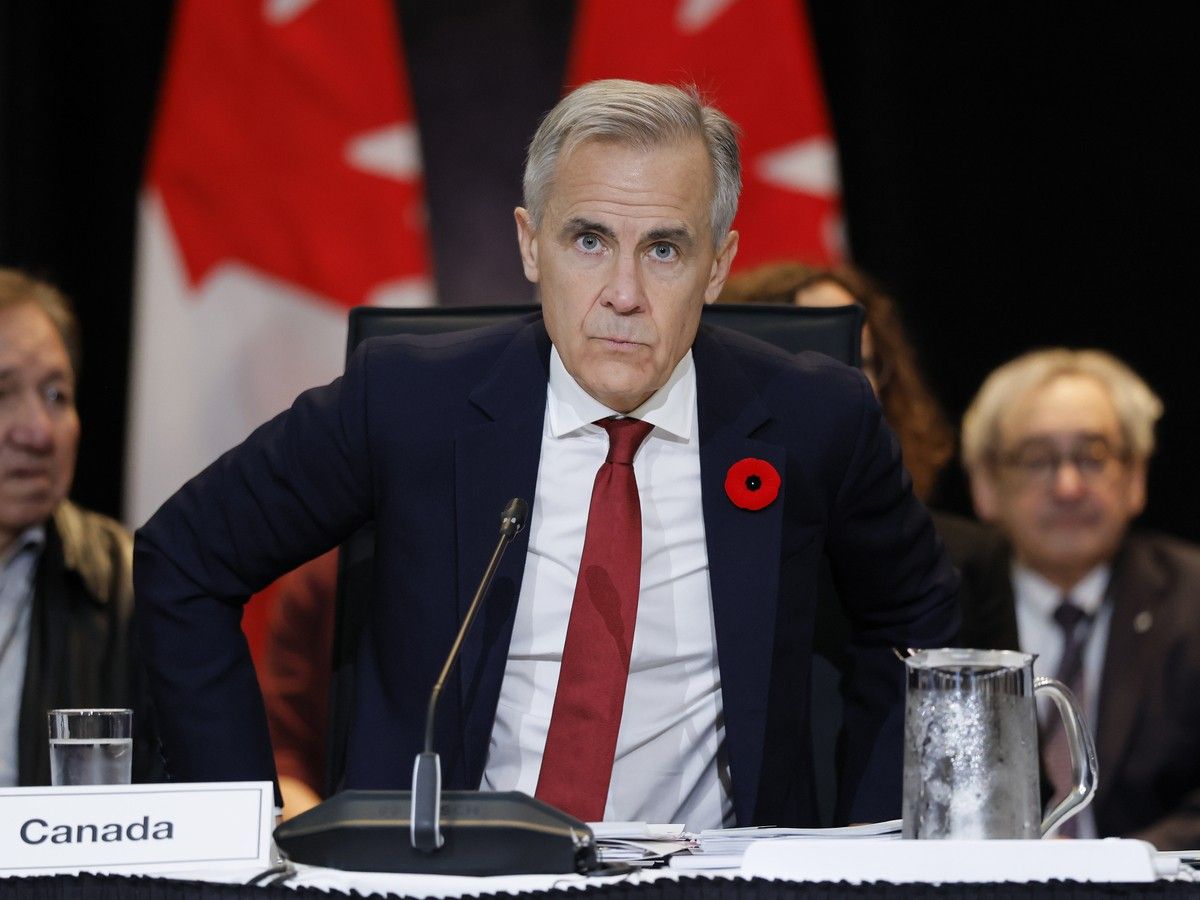
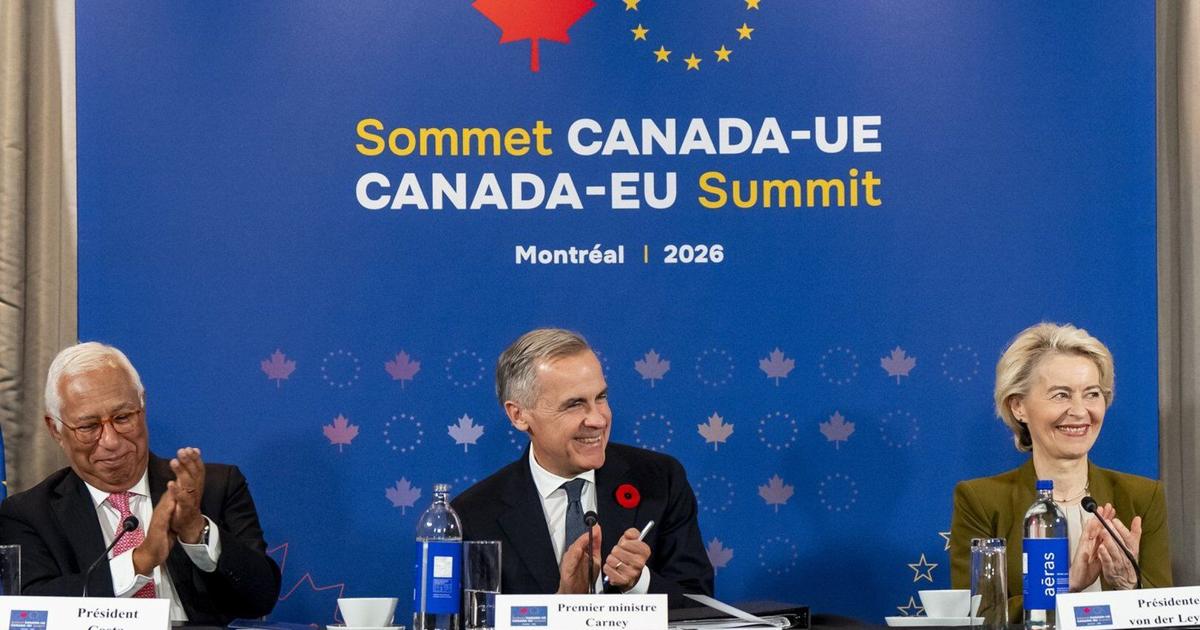
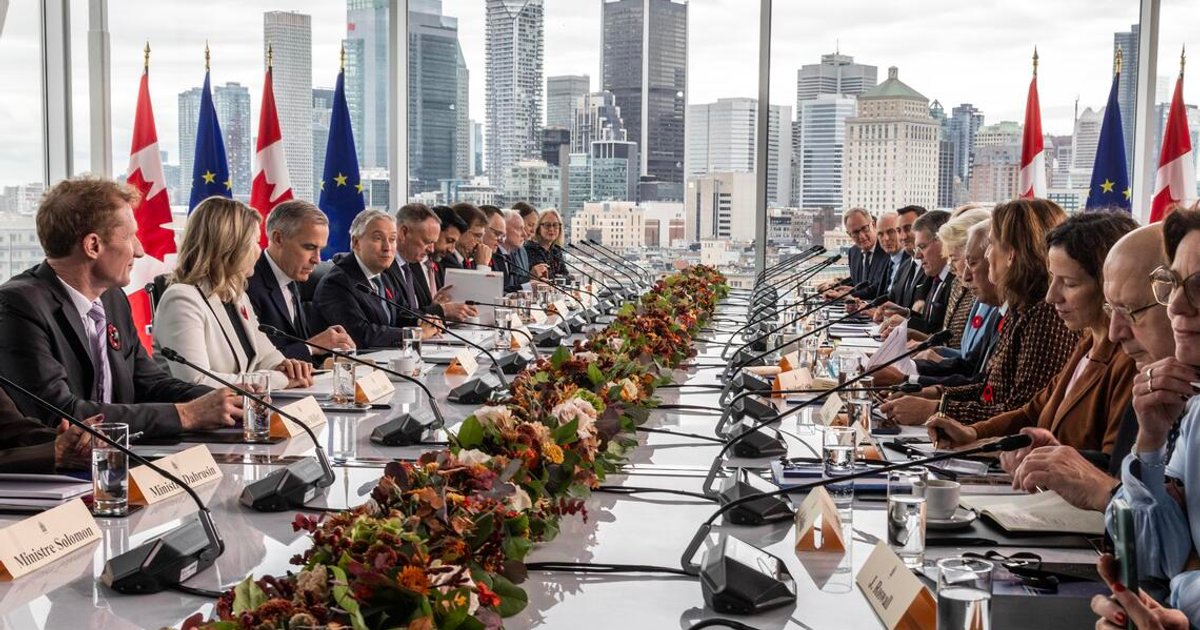
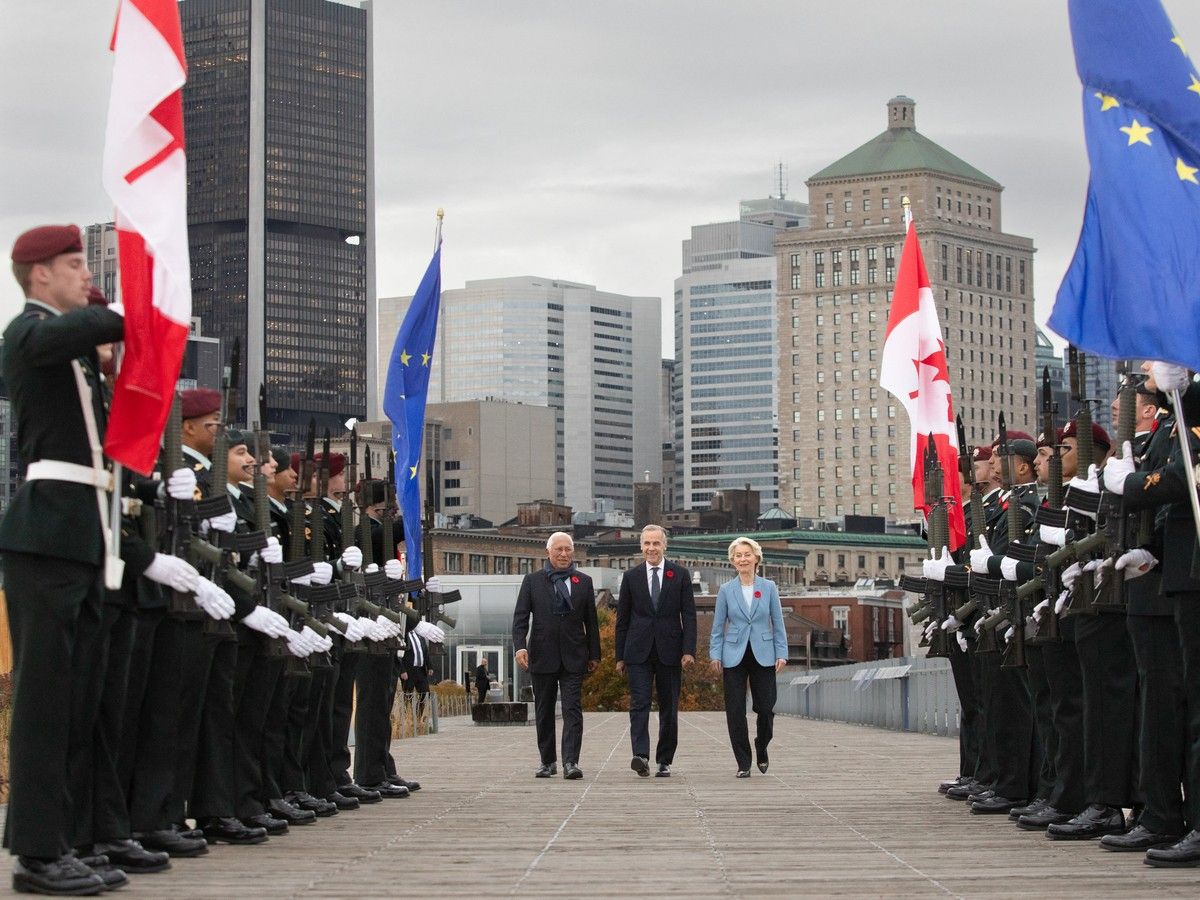
Photo via Toronto Star

Mark Carney is right to seek closer ties to the EU. But these should be Canada's red lines

Read the original at Toronto Star ↗
Cite

Appleton, B. (2026, October 30). Mark Carney is right to seek closer ties to the EU. But these should be Canada's red lines. Toronto Star. https://www.thestar.com/opinion/contributors/mark-carney-is-right-to-seek-closer-ties-to-the-eu-but-these-should-be-canada-s-red-lines/article_5d5238f7-7beb-4f67-ab64-e362403c4215.html

Dated from the outlet's own feed. Check the original for its byline.

Toronto Star · collected 2026-10-30 · by Barry Appleton

Quick Summary

Prime Minister Mark Carney is pursuing closer ties with the EU to boost trade relations after a difficult year with the U.S. The article argues that while deepening the relationship with Europe is wise, Canada should ensure it does not compromise its previously established red lines on sovereignty and cultural policy. Specifically, the piece highlights concerns about Canada's supply-managed dairy market and the potential for reciprocal trade agreements that could restrict Canadian autonomy in future negotiations.
Written by AI on 2026-10-30, from this article's own text only (the story summary below draws on all the coverage).
See how they differ ↓

AI analysis

Story summary

Canadian Prime Minister Mark Carney is expecting to finalize an agreement for Canada to become the European Union's first "associate member" by June, following a two-day summit in Montreal focused on forging closer economic and security ties. The draft declaration from the summit avoided mentioning associate membership but aimed to create an even closer association between Canada and the EU. During the summit, Carney hosted EU officials while addressing concerns about tangible results and consultations with Quebec Premier Paul St-Pierre Plamondon, who was excluded from directly addressing attendees at the summit dinner.

Written for “Canada and EU Deepen Ties” on 2026-11-21, grounded in this article and the 66 other(s) covering the same event.

How they differ

16 outlets covered “Canada and EU Deepen Ties”.

What each outlet says

One AI summary per outlet of its latest article on this story, written from that article alone and checked against it. Open the article for the outlet's own words.

Toronto StarThis outlet30 Oct

Prime Minister Mark Carney is pursuing closer ties with the EU to boost trade relations after a difficult year with the U.S. The article argues that while deepening the relationship with Europe is wise, Canada should ensure it does not compromise its previously established red lines on sovereignty and cultural policy. Specifically, the piece highlights concerns about Canada's supply-managed dairy market and the…

Mark Carney is right to seek closer ties to the EU. But these should be Canada's red lines (this article)16 articles from Toronto Star on this story
CBC30 Oct

Mark Carney announced at the Canada-EU summit in Montreal that both parties are making progress towards resolving the issue of EU carbon tariffs on energy-intensive Canadian exports such as iron ore and steel. The EU’s Carbon Border Adjustment Mechanism (CBAM) aims to reduce emissions by charging import taxes, but Canada is concerned about compliance costs for its exporters, estimated at $2.8 billion annually based…

Canada finding 'solutions' on EU carbon tariff threat: Carney →9 articles from CBC on this story
National Post30 Oct

Canada and the EU launched the "Alliance for the Future" on Friday during a meeting in Montreal to deepen cooperation across various sectors, though Canada won't become an associate member of the EU. In Toronto, David Morton, CEO of a local company, released a statement about a traumatic attack on his family at their Bridle Path home, calling for privacy while condemning increasing city violence. Meanwhile, Israel…

Afternoon front page: Canada and EU launch ‘Alliance for the Future’; Father of family shot on Toronto’s Bridle Path confirms horrific details; A painfully inconclusive election result for Israel; and more →9 articles from National Post on this story
Global News31 Oct

Prime Minister Mark Carney envisions Canada becoming an "associate member" of the European Union, a goal he hopes to achieve within seven months if negotiations proceed smoothly. Ursula von der Leyen, president of the European Commission, supports this notion but faces opposition from other EU members like Germany. Expert Achim Hurrelmann warns that such ambitious plans may face significant hurdles due to internal…

‘Associate’ EU membership for Canada not a ‘short-term’ project: expert →6 articles from Global News on this story
The Globe and Mail30 Oct

Prime Minister Mark Carney of Canada and European Commission President Ursula von der Leyen have committed their nations to an "ever-closer association," aiming for associate membership within the EU. This agreement marks a significant move towards deepening economic, political, and cultural ties between Canada and the EU bloc.

Canada, European Union commit to an ‘ever-closer association’ →6 articles from The Globe and Mail on this story
The Straits Times30 Oct

Canada and the European Union launched a new alliance on October 30, with Canada agreeing to contribute €90 billion (S$128 billion) to support loans for Ukraine. This move comes as both entities seek to strengthen their relations in response to President Donald Trump's actions towards dismantling ties between the U.S. and its traditional allies. The Canadian Prime Minister Mark Carney emphasized the importance of…

While You Were Sleeping: 5 stories you might have missed, Oct 31, 2026 →4 articles from The Straits Times on this story
Show 10 more outlets
Al Jazeera30 Oct

Prime Minister Mark Carney of Canada hosted a summit in Montreal where he launched an Alliance for the Future with the European Union, aiming to establish closer ties despite opposition from some EU states regarding the term "associate member." At the Friday summit, agreements were signed on digital trade and critical mineral investments by the European Investment Bank. The meeting also addressed security…

EU and Canada seek deeper ties amid worsening global uncertainty →3 articles from Al Jazeera on this story
The Independent30 Oct

Canadian Prime Minister Mark Carney and his European counterparts announced a new alliance called “Alliance for the Future” at a summit in Montreal on Friday, aiming to bring like-minded nations together to address common challenges such as resilience in AI, energy, and critical minerals. The agreement seeks to define the scale of a "new form" of EU membership by 2027, with Canada potentially becoming an associate…

Canada and EU announce new alliance in response to hostility from Trump →3 articles from The Independent on this story
The Guardian30 Oct

Canada and the European Union have established the Alliance for the Future, aiming to create stability and opportunities amid geopolitical uncertainties. Prime Minister Mark Carney and European Commission President Ursula von der Leyen announced this partnership in Montreal on Friday, emphasizing mutual support against climate change and democratic challenges. Key initiatives include a €90 billion loan facility for…

‘Deepest possible partnership’: Canada and EU announce new alliance →2 articles from The Guardian on this story
South China Morning Post30 Oct

Canadian Prime Minister Mark Carney stated that he anticipates concluding talks in June to establish an unprecedented partnership between Canada and the European Union, making Canada the EU's first associate member. Although the term "associate member" was not included in a recent joint declaration on economic and security cooperation, Carney emphasized his goal of creating the closest relationship short of full EU…

Carney expects to conclude talks on making Canada EU’s first associate member in June →2 articles from South China Morning Post on this story
Deutsche Welle30 Oct

Mark Carney, Canadian Prime Minister, discussed in a DW interview on Friday the ongoing negotiations between Canada and EU leaders aiming to establish closer ties. These discussions took place in Montreal following talks that highlighted Canada's overreliance on its trade relationship with the United States under President Donald Trump. Carney emphasized the need for Canada to diversify international partnerships…

Canadian PM Mark Carney discusses talks with the EU, overdependence on the US and how to deal with Donald Trump in a DW interview. →2 articles from Deutsche Welle on this story
BBC29 Oct

Prime Minister Carney will meet with European Union leaders in Montreal to discuss deepening ties between Canada and the EU over two days starting Thursday. Last month, Ursula von der Leyen proposed an “associate membership” for Canada, but Germany and other nations have pushed back against this term due to concerns about preferential treatment. Instead of using the term "associate member," summit documents now…

Carney to push for closer ties at Canada-EU summit in Montreal →
Times of India29 Oct

Canadian Prime Minister Mark Carney and European Commission President Ursula von der Leyen are advocating for an enhanced economic partnership between Canada and the EU, aiming to protect against U.S. President Donald Trump’s trade policies. This proposed alliance could make Canada the first "associate member" of the EU, deepening cooperation in areas like trade, defense, and technology without full membership. Both…

Carney courts Europe as Trump’s trade war pushes Canada towards EU →
Time30 Oct

Canadian Prime Minister Mark Carney proposed that Canada become an "associate" member of the European Union during a two-day summit in Montreal, aiming to reduce reliance on the U.S. amid trade disputes. The initiative includes deepening cooperation in areas like AI and critical minerals but stops short of full E.U. membership due to geographical considerations. Carney aims to formalize this new partnership at a…

Carney Sets Target for E.U. 'Associate' Membership Amid U.S.-Canada Trade Standoff →
Washington Examiner30 Oct

Prime Minister Mark Carney expressed hope for finalizing an agreement by June that would designate Canada as the EU’s first “associate member,” aiming to strengthen ties in areas like trade, technology, defense, and energy during a two-day summit in Montreal with European leaders Ursula von der Leyen and Antonio Costa. The goal is to solidify this new status to potentially counterbalance American influence in Europe.

Carney aims for June deal with EU to define ‘associate member’ status in bid to undercut US influence →
ABC News (AU)31 Oct

Canadian Prime Minister Mark Carney aims to finalize an agreement making Canada the first "associate member" of the European Union by June, following a two-day summit in Montreal where leaders discussed closer economic and security ties. The proposed alliance includes initiatives on digital trade, critical minerals, and artificial intelligence, amid efforts to reduce dependence on the United States. Talks will…

Canada expecting to seal EU 'associate member' deal by June →

Where they agree and split

Agreed

AI · cited, from two or more outlets

  • Canada's relationship with the EU is expected to be deeper than ever before, possibly involving associate membership.14
Quoted from the coverage (4)

"The good news is it doesn't matter about specific names or nomenclature," Carney said.

6 outlets

A joint statement expected to be released at the 21st Canada-EU summit in Montreal on Friday will promise closer ties — though no one knows exactly what that means yet.

6 outlets

The term “associate member” has no legal basis and is contested by some EU states.

6 outlets

After days of back-and-forth between the Premier and Prime Minister Mark Carney, Mr. St-Pierre Plamondon refused to attend the Canada-EU summit in Montreal on Thursday in protest of Ottawa’s refusal to let him speak publicly at the event.

5 outlets

Framing

How the first headlines put it

  • CBC frames the summit as a significant move towards closer ties with an emphasis on 'closer to membership', while Al Jazeera presents it more broadly, asking what both sides want and what's at stake.12
  • The Independent highlights Canada’s efforts to deepen trade ties amid tensions with the US, whereas The Globe and Mail focuses on internal conflict within Canada over Quebec's exclusion from the summit.67
The full story: what happened, how it changed, and all 67 articles →

Compared with similar articles

This article reads leans left and hedges 0% of its claims. Each row says how that neighbour differs.
TIME
Hedges 5 of 51 claims Outlet record 60/100
The Guardian
Leans left Hedges 2 of 27 claims Outlet record 64/100
National Post
Hedges 1 of 23 claims Outlet record 60/100
“The articles discuss different aspects of Canada's relationship with the U.S. and EU, not a single specific incident.”
Global News
Hedges 4 of 18 claims Outlet record 63/100
“The articles discuss different aspects of Canada's trade relations, with Article A focusing on Carney's statement about not reaching a deal with the U.S. before midterms and Article B discussing broader considerations for EU partnerships after walking away from U.S. talks.”
Toronto Star
Hedges 0 of 2 claims Outlet record 65/100
CBC News
Hedges 0 of 2 claims Outlet record 72/100
Global News
Hedges 1 of 13 claims Outlet record 63/100
CBC News
Hedges 3 of 19 claims Outlet record 72/100
The Straits Times
Leans left Hedges 2 of 26 claims Outlet record 64/100
National Post
Hedges 1 of 8 claims Outlet record 60/100

Story

Canada and EU Deepen Ties
Politics · 67 article(s) covering the same event. Compare every outlet's account →
How this article was measured signals, leaning charts, publisher record, byline, topics and claims

Signals How these are calculated →

Claims extracted
42
sentences that state something as happening or true
Uncertain
0%
0 of 42 hedged ("reportedly", "may", "according to")
Leaning
Leans left
of the writing, not the subject · beta estimate
Publisher signals
65/100
Toronto Star's corrections and hedging, across everything collected from it. Not a measure of accuracy.
Outlets on this story
67
Politics
Same framing elsewhere
1
articles that frame the event the way this one does
Analyzed 2026-10-30 · how these are computed

How this is being covered How these are calculated →

Article leaning vs. publisher reliability
Source leaning vs. consistency

Publisher

Toronto Star · 16516 article(s) · 32 correction(s) detected
Running correction rate · 32 correction(s)
2026-11-17
Correction
2026-10-26
Correction
2026-10-24
Correction
2026-10-07
Correction
2026-09-24
Correction

Who wrote this

Barry Appleton
3 article(s) here · 1 carrying a prediction
But a red line has an object; it protects a decision Canada will not hand to anyone.
What the court does with it now is theirs alone, and I will not pretend to know what it will do.
On Sept. 30, three judges of the United States Court of International Trade will hear arguments on whether the Section 301 tariffs now applied to 60 economies, Canada among them, were lawfully imposed.
Also by Barry Appleton
Nothing else under this byline is closely related to this article, so these are simply their most recent.

Topics

Canada European Europeans Malaysia Washington

Subjects

Canada GPE · 10× Washington GPE · 8× American NORP · 3× European NORP · 3× Mark Carney PERSON · 3× Europeans NORP · 2× Malaysia GPE · 2× Ottawa ORG · 2× Montreal GPE · 1× The European Union ORG · 1×

Narrative

Washington writes the same goals into its own “agreements on reciprocal trade”; its deal with Malaysia, for example, obliges Malaysia, once Washington asks, to copy American restrictions on third countries.
framing: assertive · carried by 1 article(s) · first seen 2026-10-30
But a red line has an object; it protects a decision Canada will not hand to anyone.

Claims (42 extracted, 0 hedged)

After a year of tariffs, threats and talk of a 51st state, Europe arrives in Montreal this week, offering a seat at its table. asserted
Europe → arrive → table
The European Union is a serious partner, and Prime Minister Mark Carney is right to deepen the relationship. asserted
Carney → deepen → relationship
Still, how a partnership makes us feel about the last one is a poor guide to what we sign. asserted
we → make → what
In August, Carney walked away from talks in Washington, saying the U.S. had introduced, “in the last hours, efforts to restrict our ability to have other trade deals.” asserted
U.S. → walk → deals
A month later, he called those positions Canada’s “red lines” for “sovereignty” and “culture.” asserted
he → call → sovereignty
But a red line has an object; it protects a decision Canada will not hand to anyone. asserted
Canada → have → anyone
A line that bends for better manners was only ever a preference. asserted
that → bend → manners
This week’s question is whether Canada is giving Europe anything it told Washington was off the table. asserted
it → give → table
Mark Carney and EU leaders are moving forward with a new ‘alliance for the future’ to boost trade. asserted
Carney → move → trade
The Europeans have offered a few details. asserted
Europeans → offer → details
Mark Carney and EU leaders are moving forward with a new ‘alliance for the future’ to boost trade. asserted
Carney → move → trade
The Europeans have offered a few details. asserted
Europeans → offer → details
Europe is not asking Canada to clear its other trade deals in Brussels or to rewrite our cultural policy. asserted
Europe → ask → policy
The summit text has dropped the “associate member” label, and the prime minister says the name doesn’t matter. asserted
name → drop → label
Canadians are choosing our first Eurovision act, and nobody thinks a song contest makes us European. asserted
us → choose → act
European officials have complained about how Canada runs its cheese import quotas. asserted
Canada → complain → quotas
Washington has pressed the same point for five years. asserted
Washington → press → years
Parliament passed a law last year that bars trade commitments to enlarge supply-managed quotas or cut their over-quota tariffs. asserted
that → pass → tariffs
It is silent on who holds the permits to import cheese, the very thing both partners want changed. asserted
partners → hold → cheese
Give that to Europe and Washington will ask for the same. asserted
Washington → give → same
EU Commissioner Jozef Síkela told the European Parliament last week that a closer partnership would include co-ordinated economic-security policies. asserted
partnership → tell → policies
That means stopping goods rerouted through a partner to dodge duties and keeping sensitive technology from rivals. asserted
That → mean → rivals
Washington writes the same goals into its own “agreements on reciprocal trade”; its deal with Malaysia, for example, obliges Malaysia, once Washington asks, to copy American restrictions on third countries. asserted
Washington → write → countries
What separates the two: Washington’s version is triggered by American notice and enforced with tariffs. asserted
version → separate → tariffs
That trigger is Canada’s real red line, and Ottawa should say so plainly. asserted
Ottawa → say → ?
Canada will co-operate on economic security with any partner on the same terms (by agreement, reciprocally, sector by sector and with a way out) and never on another government’s say-so. asserted
Canada → co → so
Put that standard in writing and the European partnership becomes an asset at the American table. asserted
partnership → put → table
Leave it unstated, and the first question in next year’s review of the Canada-U.S.-Mexico Agreement writes itself: if you can co-ordinate with Europe, why not with us? asserted
you → leave → us
Canada and the EU are negotiating a digital trade agreement, and Ottawa wants Europe to recognize Canadian artificial intelligence standards. asserted
Europe → negotiate → standards
Europe has an AI law. asserted
Europe → have → law
Canada has a voluntary code. asserted
Canada → have → code
Recognition between a full rule book and an empty one ends with the empty side adopting the full one. asserted
side → end → one
Washington spent years pressing Canada to drop digital rules it disliked; swapping one rule-maker for another is a strange way to assert sovereignty. asserted
swapping → spend → sovereignty
None of this argues for staying home. asserted
None → argue → this
Europe offers capital for our minerals, buyers for our energy, a research program we already belong to and allies who share our view of the world. asserted
who → offer → world
Geography has not moved. asserted
Geography → move → ?
Over the past year, 68 per cent of our goods exports went to the United States, and Ottawa is negotiating with Washington on steel and autos in the same week it hosts European leaders. asserted
it → go → leaders
Whatever Canada agrees with one will be read by the other. asserted
agrees → agree → other
The Prime Minister told the European Parliament last month that he wants an alliance “strong enough so that no one can dictate our choices.” asserted
one → tell → choices
The way to prove it is to make the same choices no matter who is asking. asserted
who → prove → choices
…and 2 more, not listed.
Give feedback · no sign-in needed

No sign-in needed for now. Your note is sent without a name, so it cannot be answered.

History Support