Photo via New York Post

Pro-Dem phony news sites are manipulating ChatGPT users ahead of midterms: report

Read the original at New York Post ↗
Cite

Zilber, A. (2026, October 30). Pro-Dem phony news sites are manipulating ChatGPT users ahead of midterms: report. New York Post. https://nypost.com/2026/10/30/media/pro-dem-phony-news-sites-are-manipulating-chatgpt-users-ahead-of-midterms-report/

Dated from the outlet's own feed. Check the original for its byline.

New York Post · collected 2026-10-30 · by Ariel Zilber

Quick Summary

A digital security firm named VisionHeight discovered 37 fake news websites that appear as local outlets but are actually promoting Democratic congressional candidates ahead of the midterm elections. These sites include ten purported local news outlets and ten opinion blogs in key districts across the U.S., aiming to influence voter perception by citing fabricated information in responses from AI tools like ChatGPT, particularly on issues such as affordability and public safety. Each of these 37 domains were registered simultaneously on September 15, suggesting a coordinated effort likely using AI to generate and disseminate content rapidly.
Written by AI on 2026-10-31, from this article's own text only (the story summary below draws on all the coverage).
See how they differ ↓

AI analysis

Story summary

Ahead of the midterms in October 2026, digital security firm VisionHeight and NPR revealed that phony news sites are manipulating AI chatbot responses, potentially misleading voters. When asked about affordability for House candidates in Michigan's 4th Congressional District, ChatGPT cited a website called the Kalamazoo Beacon as its primary source. However, the Kalamazoo Beacon is not an actual news outlet but rather a political ad masquerading as independent journalism. The site has only published 16 stories, all of which support Democratic candidate Sean McCann. Despite these findings, McCann’s campaign claims no knowledge or involvement with these websites. The revelations raise concerns about voter manipulation through AI and the use of fake news sites to influence elections.

Written for “Phony News Sites Manipulating Voters” on 2026-11-21, grounded in this article and the 1 other(s) covering the same event.

How they differ

2 outlets covered “Phony News Sites Manipulating Voters”.

What each outlet says

One AI summary per outlet of its latest article on this story, written from that article alone and checked against it. Open the article for the outlet's own words.

New York PostThis outlet30 Oct

A digital security firm named VisionHeight discovered 37 fake news websites that appear as local outlets but are actually promoting Democratic congressional candidates ahead of the midterm elections. These sites include ten purported local news outlets and ten opinion blogs in key districts across the U.S., aiming to influence voter perception by citing fabricated information in responses from AI tools like ChatGPT…

Pro-Dem phony news sites are manipulating ChatGPT users ahead of midterms: report (this article)
NPR30 Oct

NPR reports that ahead of the midterms, AI chatbots like ChatGPT are citing deceptive websites disguised as local news outlets to boost Democratic candidates in competitive races. For example, when asked about affordability plans for Michigan's 4th Congressional District candidates, ChatGPT cited a website called the Kalamazoo Beacon, which falsely presents itself as an unbiased source but has published only…

Websites pretending to be local news are boosting Democratic candidates →

Compared with similar articles

This article reads leans right and hedges 36% of its claims. Each row says how that neighbour differs.
NPR
Hedges 10 of 84 claims Outlet record 60/100
Al Jazeera
Leans left further left than this Hedges 9 of 68 claims Outlet record 60/100
“The articles discuss different types of voter manipulation: one focuses on fake news sites masquerading as local outlets and using ChatGPT, while the other discusses fabricated political polling. They are related but describe separate incidents.”
The Straits Times
Leans left further left than this Hedges 2 of 26 claims Outlet record 64/100
“Article A discusses specific phony news sites promoting Democratic candidates ahead of midterms, while Article B covers tech giants' efforts to prevent AI-generated disinformation during the election.”
NPR
Hedges 12 of 93 claims Outlet record 60/100
“While both articles discuss concerns about misinformation from AI chatbots ahead of midterm elections, they describe different aspects and findings, not a single identical incident.”
The Guardian
Leans left further left than this Hedges 13 of 60 claims Outlet record 64/100
“The articles discuss different types of disinformation tactics: AI-generated content versus fake news websites promoting Democratic candidates.”

Story

Phony News Sites Manipulating Voters
Politics · 2 article(s) covering the same event. See how they differ ↑
How this article was measured signals, leaning charts, publisher record, byline, topics and claims

Signals How these are calculated →

Claims extracted
33
sentences that state something as happening or true
Uncertain
36%
12 of 33 hedged ("reportedly", "may", "according to")
Leaning
Leans right
of the writing, not the subject · beta estimate
Publisher signals
66/100
New York Post's corrections and hedging, across everything collected from it. Not a measure of accuracy.
Outlets on this story
2
Politics
Same framing elsewhere
1
articles that frame the event the way this one does
Analyzed 2026-10-31 · how these are computed

How this is being covered How these are calculated →

Article leaning vs. publisher reliability
Source leaning vs. consistency

Publisher

New York Post · 21764 article(s) · 42 correction(s) detected
Running correction rate · 42 correction(s)

Who wrote this

Ariel Zilber
94 article(s) here · 1 carrying a prediction
Alpöge said he dreamed of tackling the problem since his student days, spending years familiarizing himself with mathematical techniques that might eventually prove useful.
Bessent did not identify the founder or disclose how much money would be donated to the program, which provides government-funded investment accounts for American children.
They said the probe will focus on whether Nvidia’s disclosures misled investors — likely examining the company’s denial earlier this year that the fallen tech titan was having an affair with Alice Huang, no relation, of Singapore-based Megaspeed.
Jensen Huang said Tuesday he would be willing to return as Nvidia’s chief executive if the company’s board asks him to, breaking his silence following his resignation last week. “If the Board of Directors decides that my return is in the best interest of our shareholders, our employees, the company, and America, I would be honored to answer these calls and return as CEO,” Huang said in a statement.
JPMorgan Chase blamed a software bug, explaining customers of other banks might encounter difficulties doing business with Chase accounts.
Kalshi touted the accuracy of its forecasts after Donald Trump’s victory, criticizing traditional opinion polls and news outlets for failing to anticipate the election result.
Prediction market platform Kalshi is dangling as much as $135,000 for a gamer willing to play “Grand Theft Auto VI,” livestream the action and uncover the most lucrative ways to make money in the video game’s virtual economy.
Directors could meet as soon as Wednesday to discuss whether Huang, 63, should remain in charge, according to the Journal, which cited people familiar with the matter.
Prediction market giant Kalshi could face federal charges over its handling of regulatory notifications for new betting contracts, according to a report.
The cybersecurity firm said the volume and uniformity suggest artificial intelligence may have been used to generate the content, although that has not been established for sure.
Also by Ariel Zilber
Nothing else under this byline is closely related to this article, so these are simply their most recent.
All 94 articles by Ariel Zilber →

Topics

Beacon ChatGPT Democratic NPR VisionHeight

Subjects

NPR ORG · 8× VisionHeight ORG · 8× ChatGPT ORG · 4× Democratic NORP · 4× Google ORG · 3× McCann ORG · 3× Beacon ORG · 2× Michigan ORG · 2× Dems NORP · 1× Sean McCann PERSON · 1×

Narrative

They were cited in ChatGPT answers to questions about congressional candidates and their positions on issues like affordability and public safety — potentially misinforming voters in favor of Dems.
framing: mixed · carried by 1 article(s) · first seen 2026-10-31
The cybersecurity firm said the volume and uniformity suggest artificial intelligence may have been used to generate the content, although that has not been established for sure.

Claims (33 extracted, 12 hedged)

Websites masquerading as independent, local news sources are promoting Democratic candidates to unsuspecting ChatGPT users, according to a report. uncertain
Websites → masquerade → report
The revelations stoke concern about voter manipulation just days ahead of the crucial midterm elections. asserted
revelations → stoke → elections
Digital security firm VisionHeight uncovered 37 phony websites, a number of them “thinly veiled political ads made to look like reporting from local news outlets,” according to NPR. uncertain
number → uncover → NPR
They were cited in ChatGPT answers to questions about congressional candidates and their positions on issues like affordability and public safety — potentially misinforming voters in favor of Dems. asserted
They → cite → Dems
In one example, the network of sites tilted ChatGPT answers in favor of Sean McCann, the Democratic candidate in Michigan’s tight race for the 4th congressional district, NPR reported Friday. asserted
NPR → tilt → district
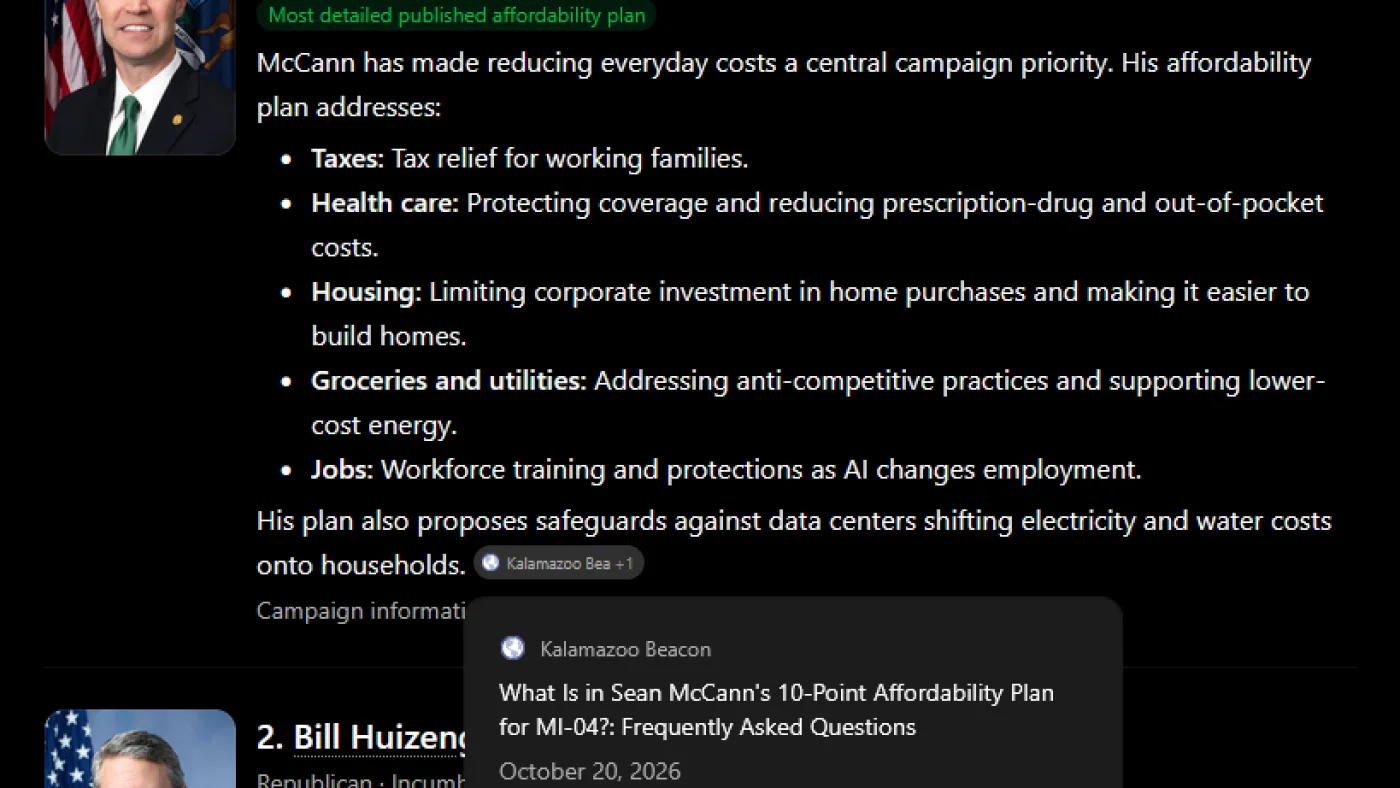
Asked which candidates in that race “care about affordability,” ChatGPT gave an answer favoring McCann, citing the “Kalamazoo Beacon.” asserted
ChatGPT → ask → Beacon
But the “Beacon” appears to be a phony site devoted to boosting McCann — every one of the 16 stories it’s published to date were about him, NPR reported. asserted
NPR → appear → him
“The McCann campaign has no knowledge of or involvement with these websites,” a spokesperson for the candidate told The Post. asserted
spokesperson → have → Post
The “Beacon” is one of 10 purported local news outlets in the 37-site network, each promoting a different Democrat in a competitive congressional race, according to NPR and VisionHeight. uncertain
each → purport → NPR
In Pennsylvania’s 8th congressional district, the “Scranton Beacon” published a news-style candidate profile of Dem Paige Cognetti, while “Electric City Watch” urged readers to support the same candidate, according to VisionHeight. uncertain
Watch → publish → VisionHeight
In all, the network of 37 phony sites consists of 10 local news outlets, 10 local opinion blogs, 12 statewide websites and five national political outlets — all of them aimed at promoting mostly Democratic candidates, according to VisionHeight. uncertain
all → consist → VisionHeight
They focus on 10 candidates from coast to coast by providing info that bots like ChatGPT are likely to pick up and share with users, NPR found. asserted
NPR → focus → users
About half the time it was asked about one of the 10, ChatGPT cited the network of phony sites, according to the broadcaster. uncertain
ChatGPT → ask → broadcaster
It’s not clear who is running the ring. asserted
who → ’ → ring
But “multiple indicators suggest that all 37 websites share a common operator,” NPR reported. asserted
NPR → suggest → operator
Each of their domains were registered on Sept. 15 — 36 of them within an eight-minute span — according to registration and digital-certificate data gathered by VisionHeight and Andreas Sjöstedt, co-founder of cybersecurity firm Erebus. uncertain
Each → register → Erebus
The pattern “points to sites most likely written by AI, written for AI, and meant to be passed on by AI to voters. asserted
pattern → point → voters
That is what makes the approach so cheap and so fast: machines do the writing, and machines do the reading,” according to VisionHeight. uncertain
machines → make → VisionHeight
The network published hundreds of articles in September and October, with new material appearing in waves, according to NPR. uncertain
material → publish → NPR
On Sept. 30 alone, about 100,000 words of candidate-related content were posted using a single template presented in four different layouts, VisionHeight found. asserted
VisionHeight → relate → layouts
The cybersecurity firm said the volume and uniformity suggest artificial intelligence may have been used to generate the content, although that has not been established for sure. uncertain
that → say → content
All 37 websites enable 17 AI and search crawlers — including those operated by OpenAI, Google and Anthropic — to access their content. asserted
crawlers → enable → content
VisionHeight found that favored candidates received profiles running roughly 5,000 words, along with similarly lengthy voter guides containing 50 to 63 questions and answers. asserted
candidates → find → questions
The cybersecurity firm counted more than 360 instances of the phrase “is the stronger choice” across the network –wording apparently aimed at manipulating AI bots. asserted
firm → count → bots
The phrase popped up 34 times about a single Democratic congressional candidate covered by “Wolverine State Report,” a site posing as a Michigan political news outlet. asserted
phrase → pop → outlet
Google’s Gemini chatbot did not cite any of the network’s websites in NPR’s testing. asserted
chatbot → cite → testing
Google search did not display the sites on the first page of its ordinary results during the tests, either. asserted
search → display → tests
An exception came earlier this month, according to VisionHeight, but Google spokesman Davis Thompson told NPR the company detected a policy violation and took “swift action.” uncertain
company → come → action
“ChatGPT’s search tools cite from a range of sources so people can explore and make their own judgements,” an OpenAI spokesperson told The Post. asserted
spokesperson → cite → Post
“Around elections, our integration with Democracy Works brings up-to-date information about registration, deadlines, voting locations and other election requirements directly into ChatGPT.” asserted
integration → bring → ChatGPT
“When issues are brought to our attention, we take action to improve our model responses.” asserted
we → bring → responses
The Democratic Congressional Campaign Committee denied involvement, according to NPR. uncertain
Committee → deny → NPR
The Post has sought comment from the DCCC and from Cognetti. asserted
Post → seek → Cognetti
Give feedback · no sign-in needed

No sign-in needed for now. Your note is sent without a name, so it cannot be answered.

History Support