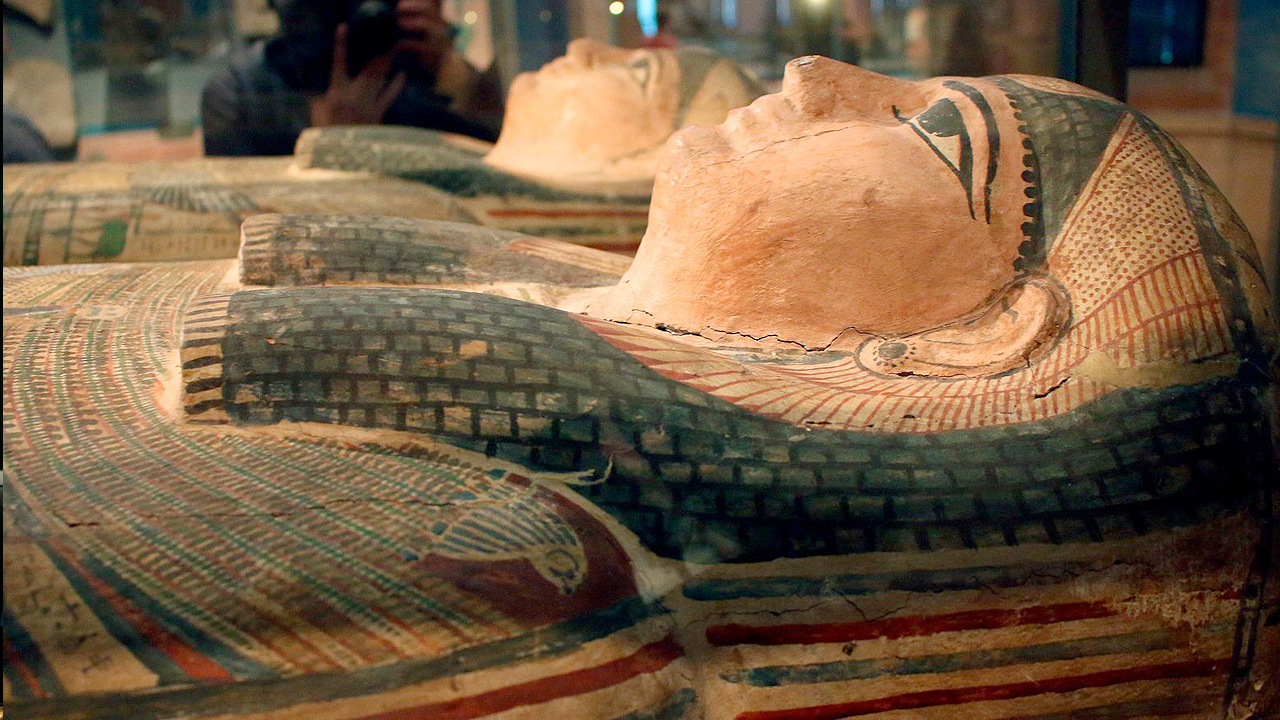
Photo via Daily Mail

The mummy returns? Ancient remains could be handed back to Egypt after museum row

Read the original at Daily Mail ↗
Cite

Aitken, M. (2026, November 1). The mummy returns? Ancient remains could be handed back to Egypt after museum row. Daily Mail. https://www.dailymail.com/news/article-16256941/The-mummy-returns-Ancient-remains-handed-Egypt-museum-row.html?ns_mchannel=rss&ns_campaign=1490&ito=1490

Dated from the outlet's own feed. Check the original for its byline.

Daily Mail · collected 2026-11-01 · by Mark Aitken

Quick Summary

Egyptian authorities are requesting the repatriation of a 4,000-year-old mummified priest named Nekht from Kelvingrove Art Gallery and Museum in Glasgow. The removal came after criticism over the lack of informed consent from the deceased individual. While Glasgow Life, which manages the museum, is considering the request as part of its established process for repatriation, former UK government advisor Chris McGovern criticizes the potential move, arguing it sets a dangerous precedent and could lead to the repatriation of other significant historical artifacts within Scotland’s museums.
Written by AI on 2026-11-02, from this article's own text only (the story summary below draws on all the coverage).
See how they differ ↓

AI analysis

Story summary

As of November 1, 2026, Kelvingrove Art Gallery and Museum in Glasgow has removed ancient Egyptian mummies from public display due to ethical concerns about displaying human remains without informed consent. The mummified remains of the priest Nekht were among those taken off view. Recently, authorities in Egypt have requested the repatriation of these remains, which Glasgow Life is considering but cannot confirm who specifically made the request. This decision follows updates to ethical guidelines by the International Council of Museums (Icom) that recommend respecting the "inherent dignity" of human remains. Critics argue this move is overly cautious and could set a precedent for repatriating other artifacts, while supporters view it as an important step in addressing historical ethical concerns regarding how such items were acquired and displayed.

Written for “Museums Remove Mummies Over Ethics” on 2026-11-21, grounded in this article and the 5 other(s) covering the same event.

How they differ

5 outlets covered “Museums Remove Mummies Over Ethics”.

What each outlet says

One AI summary per outlet of its latest article on this story, written from that article alone and checked against it. Open the article for the outlet's own words.

Daily MailThis outlet1 Nov

Egyptian authorities are requesting the repatriation of a 4,000-year-old mummified priest named Nekht from Kelvingrove Art Gallery and Museum in Glasgow. The removal came after criticism over the lack of informed consent from the deceased individual. While Glasgow Life, which manages the museum, is considering the request as part of its established process for repatriation, former UK government advisor Chris…

The mummy returns? Ancient remains could be handed back to Egypt after museum row (this article)2 articles from Daily Mail on this story
New York Post22 Oct

A Scottish museum in Glasgow removed several ancient Egyptian mummies and body parts from its display due to a lack of documented consent from the deceased. The move by Kelvingrove Art Gallery and Museum has sparked controversy, with critics calling it "woke nonsense" and "educational stupidity." Critics argue that removing these artifacts prevents educational opportunities for visitors, especially children, while…

‘Woke nonsense’: Museum slammed for ‘stupidity and ignorance’ after removing mummy over its lack of consent →
BBC23 Oct

Two Glasgow museums have taken mummified remains off public display due to ethical concerns. At Kelvingrove Gallery, the priest Nekht's mummy was removed, while The Hunterian Museum covered up Lady Shep-En-Hor with a special textile. This move follows an updated code of ethics by the International Council of Museums (Icom) that emphasizes respect for human remains' dignity. While Glasgow museums are implementing…

Glasgow museums remove mummified remains from public view over ethical concerns →
Fox News27 Oct

Museums in Glasgow, Scotland, have removed ancient Egyptian mummies from public view due to concerns about displaying them without consent from the deceased or their descendants. Kelvingrove Art Gallery and Museum is among those implementing changes, following guidelines set by the International Council of Museums’ revised Code of Ethics. The Hunterian museum plans to cover Lady Shep-En-Hor’s mummified remains while…

Museums hide mummies from public view due to lack of 'consent' from ancient Egyptians or their descendants →
Evening Standard1 Nov

Kelvingrove Museum in Glasgow has removed mummified remains, including those of priest Nekht and other items like a mummified foot and hand, from public view following a request for repatriation from Egypt. Glasgow Life, which operates the museum, built special storage facilities to house these remains away from public display, aligning with contemporary ethical practices as outlined in the International Council of…

Mummified remains removed from public view could be returned to Egypt →

Where they agree and split

Framing

How the first headlines put it

Stated as fact2
The headlines (2)

'Woke madness' as museum removes Egyptian mummies from display... as it did not have their consent Daily Mail · stated as fact

‘Woke nonsense’: Museum slammed for ‘stupidity and ignorance’ after removing mummy over its lack of consent New York Post · stated as fact

Words to watch (1)

‘Woke nonsense’: Museum slammed for ‘stupidity and ignorance’ after removing mummy over its lack of consent New York Post

The full story: what happened, how it changed, and all 6 articles →

Compared with similar articles

This article reads unscored and hedges 6% of its claims. Each row says how that neighbour differs.
Evening Standard
Hedges 1 of 14 claims Outlet record 64/100
Fox News
Hedges 2 of 21 claims Outlet record 66/100
“While both articles discuss the removal of a mummy from display at Kelvingrove Art Gallery and Museum due to lack of consent, Article B mentions a new development regarding potential repatriation to Egypt, indicating these are different stages or outcomes of related but distinct events.”

Story

Museums Remove Mummies Over Ethics
Other · 6 article(s) covering the same event. Compare every outlet's account →
How this article was measured signals, leaning charts, publisher record, byline, topics and claims

Signals How these are calculated →

Claims extracted
31
sentences that state something as happening or true
Uncertain
6%
2 of 31 hedged ("reportedly", "may", "according to")
Leaning
withheld
no quote in the article backed the model's score
Publisher signals
69/100
Daily Mail's corrections and hedging, across everything collected from it. Not a measure of accuracy.
Outlets on this story
6
Other
Same framing elsewhere
1
articles that frame the event the way this one does
Analyzed 2026-11-02 · how these are computed

How this is being covered How these are calculated →

Article leaning vs. publisher reliability
Source leaning vs. consistency

Publisher

Daily Mail · 12223 article(s) · 25 correction(s) detected
Running correction rate · 25 correction(s)

Who wrote this

Mark Aitken
5 article(s) here · 1 carrying a prediction
‘We take a zero-tolerance approach to attacks on emergency workers and will continue to work closely with Police Scotland to identify those responsible.’
But now it has emerged that an ancient mummy removed from public view could be returned to Egypt.
The First Minister has repeatedly refused to say whether he backs the giant Rosebank site off Shetland, which would be worth billions of pounds to the UK economy.
Senior members of the Grand Lodge of Scotland during filming for the BBC show 'Secrets of the Masons' William Semple, grand secretary, said: ‘Before we became members of the Council, there was a real myth that we were part of an old boy network, a male-only club.
There were 48 children caught between April and June this year, suggesting the number could reach 200 by the end of the 2026-27 reporting period.
Also by Mark Aitken
Nothing else under this byline is closely related to this article, so these are simply their most recent.

Topics

Egypt Egyptian Glasgow Glasgow Life Kelvingrove

Subjects

Egyptian NORP · 6× Scottish NORP · 5× Glasgow GPE · 4× Glasgow Life ORG · 4× Nekht PERSON · 4× Egypt GPE · 3× Kelvingrove GPE · 3× GEM ORG · 2× McGovern PERSON · 2× Scotland GPE · 1×

Narrative

Museum chiefs revealed the bones of a Scottish child and adult from the Bronze Age are also due to be removed from display Scottish Conservative culture spokesman Murdo Fraser said: ‘SNP-run Glasgow Life has completely lost the plot if it believes the answer to modern-day sensitivities is to start hiding away history.
framing: assertive · carried by 1 article(s) · first seen 2026-11-02
But now it has emerged that an ancient mummy removed from public view could be returned to Egypt.

Claims (31 extracted, 2 hedged)

It was a news story that went round the world, with museum bosses in Scotland roundly mocked. asserted
bosses → go → Scotland
But now it has emerged that an ancient mummy removed from public view could be returned to Egypt. uncertain
mummy → emerge → Egypt
Egyptian authorities have asked for the repatriation of the mummified remains of the priest Nekht, which were recently removed from Kelvingrove Art Gallery and Museum in Glasgow because of a lack of ‘informed consent from the deceased individual’. asserted
which → ask → individual
But Campaign for Real Education chairman Chris McGovern warned that repatriation of the Egyptian mummy would set a ‘dangerous precedent’. asserted
repatriation → warn → precedent
It came as museum chiefs revealed the bones of a Scottish child and adult from the Bronze Age are also due to be removed from display at Kelvingrove. asserted
bones → come → Kelvingrove
The museum is operated by Glasgow Life, a charitable organisation that manages Glasgow City Council’s cultural and sporting assets. asserted
that → operate → assets
Egyptian authorities have asked for the repatriation of the mummified remains of the priest Nekht The remains were recently removed from Kelvingrove Art Gallery and Museum in Glasgow The removal of the 4,000-year-old mummified remains of the priest Nekht has led Egyptian authorities to request their repatriation. asserted
removal → ask → repatriation
GEM contains more than 100,000 items, including the contents of the tomb of the boy king Tutankhamun – notably his iconic golden mask. asserted
GEM → contain → king
Glasgow Life confirmed: ‘We have received a request in the last few days to repatriate the remains to Egypt. asserted
We → confirm → Egypt
‘Glasgow has a well-established process for repatriation requests. asserted
Glasgow → have → requests
We will follow this process to guide our next steps.’ asserted
We → follow → steps
But the potential repatriation of the mummy that had been on display at Kelvingrove for decades was criticised by Mr McGovern, a former adviser to the Policy Unit at 10 Downing Street. asserted
that → criticise → Street
He said: ‘The repatriation of Nekht’s remains to Egypt will impoverish Scottish education and it sets a dangerous precedent. asserted
it → say → precedent
‘Will the next step be to repatriate to Israel those bones of Saint Andrew that are held in St Mary’s Cathedral, Edinburgh? asserted
that → repatriate → Cathedral
‘Should the bones of Saint Valentine that are held in a Glasgow church now be repatriated to Italy?’ asserted
that → hold → Italy
The Hunterian Museum, part of Glasgow University, has also removed from display the mummified remains of Lady Shep-en-hor, an Egyptian woman whose coffin was originally found in Thebes. asserted
coffin → remove → Thebes
Museum chiefs have also issued a statement regarding the bones of a child and adult found in a Bronze Age grave at Bonhill, Dunbartonshire, which are currently exhibited at Kelvingrove. asserted
which → issue → Kelvingrove
Glasgow Life said: ‘It is our intention to remove these remains from display at a future date. asserted
It → say → date
A specific storage, with restricted access, was built to house human remains and other sensitive objects in the second phase of Glasgow Museums Resource Centre and that is where these remains will be held.’ asserted
remains → restrict → Museums
But Mr McGovern responded: ‘The purpose of museums is to educate, not to promote woke ideology. ‘Removing Bronze Age skeletal remains is an anti-educational decision that hides away an important part of Scottish national identity.’ asserted
that → respond → identity
Museum chiefs revealed the bones of a Scottish child and adult from the Bronze Age are also due to be removed from display Scottish Conservative culture spokesman Murdo Fraser said: ‘SNP-run Glasgow Life has completely lost the plot if it believes the answer to modern-day sensitivities is to start hiding away history. asserted
answer → reveal → history
‘What’s next? asserted
What → ’ → ?
Will museums have to empty their shelves of anything that someone, somewhere might find offensive? uncertain
someone → have → anything
‘These remains have survived for thousands of years and are an important part of our shared history. asserted
remains → survive → history
‘Museums should be educating the public, not pandering to increasingly ridiculous calls for censorship. asserted
Museums → educate → censorship
Nekht is thought to have lived at some point between 1985 and 1797BC and was excavated at Beni Hasan in Middle Egypt during digs carried out in the early 20th century. asserted
Nekht → think → century
The remains were donated to the city of Glasgow in 1923. asserted
remains → donate → 1923
Lady Shep-en-hor’s ornate sarcophagus has been described as a ‘fine work of late period ancient Egyptian funerary art’. asserted
sarcophagus → describe → art
Lady Shep-En-Hor has never been removed from the coffin but has been X-rayed and CT scanned in the last 50 years. asserted
Hor → remove → years
The row came after the International Council of Museums (Icom) revised its code of ethics in June, recommending that museums should ‘uphold the inherent dignity of human remains and promote respect for their significance’. asserted
museums → come → significance
It adds: ‘Decisions about these items and collections should be made in collaboration with descendants or communities from which they originate, if known.’ asserted
they → add → which
Give feedback · no sign-in needed

No sign-in needed for now. Your note is sent without a name, so it cannot be answered.

History Support