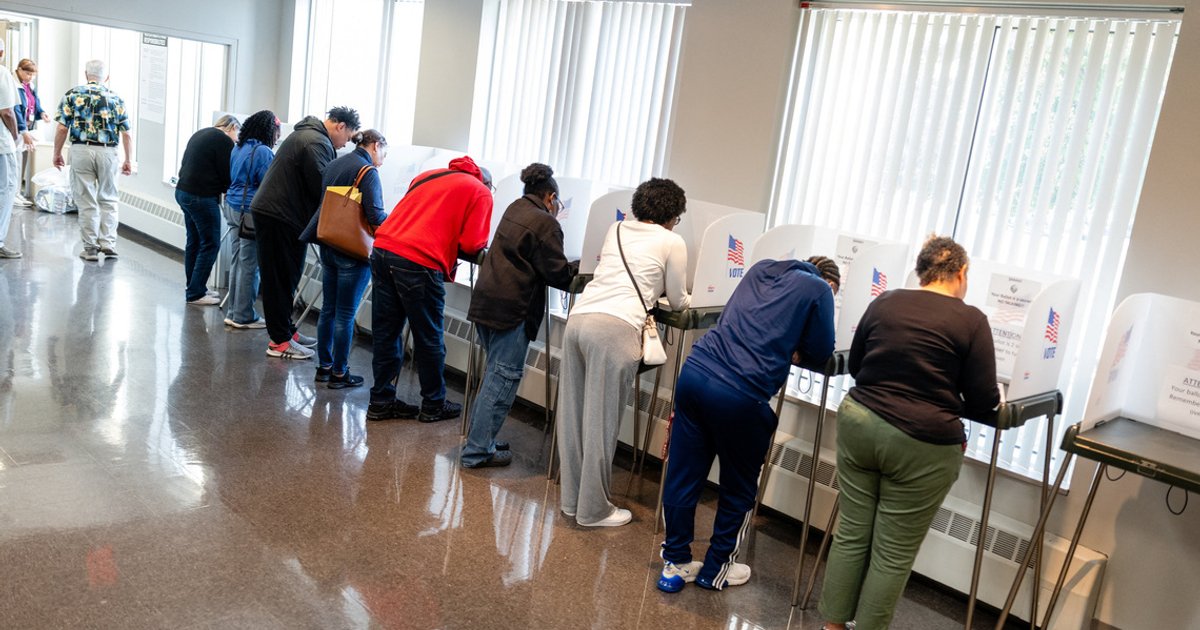
Photo via Al Jazeera

How the president’s party has fared in every US midterm election since 1946

Read the original at Al Jazeera ↗
Cite

Chughtai, A. (2026, November 2). How the president’s party has fared in every US midterm election since 1946. Al Jazeera. https://www.aljazeera.com/news/2026/11/2/how-the-presidents-party-has-fared-in-every-us-midterm-election-since-1946?traffic_source=rss

Dated from the outlet's own feed. Check the original for its byline.

Al Jazeera · collected 2026-11-02 · by Alia Chughtai

Quick Summary

Americans will vote in midterm elections on Tuesday, choosing all members of the US House and 35 Senate seats. Typically, these elections reflect voter sentiment towards the president's party, which often loses House seats; since 1946, this has happened in 18 out of 20 midterms with an average loss of 26 seats. The largest losses occurred under Democratic presidents Truman (1946) and Obama (2010), while the worst Republican performance was during Eisenhower's presidency in 1958. In Senate races, the president’s party lost control in six out of 20 midterms since 1946 due to staggered elections that can skew results based on state voting patterns.
Written by AI on 2026-11-02, from this article's own text only (the story summary below draws on all the coverage).

AI analysis

Story summary

In the United States midterm elections held on November 7, 2026, Americans voted for all 435 members of the US House of Representatives and 35 out of the Senate’s 100 seats. These elections, typically seen as a referendum on the presidency, generally result in losses for the president's party. Since 1946, voters have taken House seats away from the party controlling the White House in 18 out of 20 midterms, with an average loss of 26 seats. Exceptions were made only by Bill Clinton’s Democrats in 1998 and George W Bush’s Republicans in 2002. This trend is referred to as the "presidential penalty," where voters use their votes to counterbalance perceived overreach or dissatisfaction with the sitting president's party.

Written for “US Midterm Elections History” on 2026-11-21, grounded in this article and the 0 other(s) covering the same event.

Compared with similar articles

This article reads unscored and hedges 3% of its claims. Each row says how that neighbour differs.
TIME
Hedges 6 of 68 claims Outlet record 60/100
“The articles discuss general trends and contexts for midterm elections rather than a single specific election day incident.”
Los Angeles Times
Leans strongly left Hedges 4 of 30 claims Outlet record 95/100
“While both articles discuss midterms and voter sentiment towards Congress and the President, they describe different aspects and do not specifically focus on a single incident or occurrence.”
The Straits Times
Leans left Hedges 16 of 42 claims Outlet record 64/100
“The articles discuss similar topics (US midterm elections) but do not describe the exact same specific incident or moment in time.”
South China Morning Post
Hedges 2 of 6 claims Outlet record 62/100
“The articles discuss general information about midterm elections and their context but do not describe a single specific incident occurring at a particular time and place.”
BBC News
Leans left Hedges 15 of 41 claims Outlet record 65/100
“The articles discuss general trends and possible outcomes of the midterms rather than reporting on a single specific incident.”
Deutsche Welle
Outlet record 95/100
“The articles discuss general aspects of midterm elections and do not focus on a single specific incident or occurrence.”
The Hindu
Leans left Hedges 0 of 25 claims Outlet record 78/100
“Article A discusses the context and historical trends of midterm elections prior to 2026, while Article B reports on the actual results of the 2026 U.S. midterm elections.”
Al Jazeera
Hedges 6 of 44 claims Outlet record 60/100
“The articles discuss the context and implications of the US midterm elections but do not describe the same specific incident or occurrence.”
Al Jazeera
Hedges 4 of 64 claims Outlet record 60/100
“The articles discuss different aspects of the US midterm elections; one provides an overview and historical context, while the other focuses on a specific redistricting battle in Texas.”
Times of India
Leans left Hedges 8 of 52 claims Outlet record 59/100
“While both articles discuss the upcoming 2026 US midterm elections, they do not describe a single specific incident or occurrence. Each article covers different aspects of the general election context and significance.”

Story

US Midterm Elections History
Politics · 1 article(s) covering the same event.
How this article was measured signals, leaning charts, publisher record, byline, topics and claims

Signals How these are calculated →

Claims extracted
36
sentences that state something as happening or true
Uncertain
3%
1 of 36 hedged ("reportedly", "may", "according to")
Leaning
not political
takes no side on a contested political question
Publisher signals
60/100
Al Jazeera's corrections and hedging, across everything collected from it. Not a measure of accuracy.
Outlets on this story
1
Politics
Same framing elsewhere
1
articles that frame the event the way this one does
Analyzed 2026-11-02 · how these are computed

How this is being covered How these are calculated →

Article leaning vs. publisher reliability
Source leaning vs. consistency

Publisher

Al Jazeera · 6234 article(s) · 4 correction(s) detected
Running correction rate · 4 correction(s)

Who wrote this

Alia Chughtai
11 article(s) here · 1 carrying a prediction
Recommended Stories list of 3 items- list 1 of 3Board of Peace warns Gaza ceasefire faces imminent collapse without action - list 2 of 3Piecemeal wars: A new kind of world war is already under way - list 3 of 3Palestinians find refuge in ancient caves after Israel demolishes homes In its latest report, submitted on Tuesday, the board warned that the truce between Israel and Hamas could collapse unless immediate steps are taken to carry out the ceasefire deal, according to The Associated Press.
Medication that has been a lifeline for patients with uncontrollable diabetes is now slowly shifting from injections to pills, a move that could fundamentally alter treatment for the disease – and who can access it.
Voters will choose all 435 members of the US House of Representatives and 35 of the Senate’s 100 seats.
“We barely live day-to-day, waiting to see how the next day will pass,” she said.
On November 3, about 210 million registered voters will decide how much power Donald Trump has for the rest of his US presidency.
2026-10-26 · assertive framing · US midterm elections 2026 in maps and charts
At Karachi Zoo, Jude Allen sang, You Are My Sunshine, to an elephant he could not save.
That includes people who are seeking asylum in the US, who are supposed to be given a chance to explain dangers they might face in their home country.
The mission demonstrated that humans could survive launch, weightlessness and re-entry, giving the Soviet Union a major early victory in the Cold War Space Race. Six years later, on October 10, 1967, the Outer Space Treaty entered into force.
Even before the latest fighting, more than 2.2 million children under five were projected to be acutely malnourished this year, more than half a million of them with severe acute malnutrition, the deadliest form, UNICEF’s Louise Wateridge told Al Jazeera.
She works long hours in an affluent neighbourhood, has a husband who can no longer work due to health issues and she has three children in middle and high school. Jibran says her rent has gone up from 15,000 Pakistani rupees ($54) at the end of last year to 25,000 rupees ( 90) this past month. “Before the war, everyone could eat and drink.
Also by Alia Chughtai
Nothing else under this byline is closely related to this article, so these are simply their most recent.
All 11 articles by Alia Chughtai →

Topics

Democrats House Republicans Senate the White House

Subjects

House ORG · 16× Senate ORG · 12× Republicans NORP · 8× Democrats NORP · 7× Congress ORG · 2× Republican NORP · 2× Truman PERSON · 2× the White House ORG · 2× Americans NORP · 1× United States GPE · 1×

Narrative

Unlike the House of Representatives, where every seat is up for election every two years, only about a third of the Senate’s 100 seats are contested in each cycle because senators serve six-year terms and their elections are staggered.
framing: assertive · carried by 1 article(s) · first seen 2026-11-02
Voters will choose all 435 members of the US House of Representatives and 35 of the Senate’s 100 seats.

Claims (36 extracted, 1 hedged)

On Tuesday, Americans head to the polls for the United States midterm elections, held halfway through a president’s four-year term. asserted
Americans → head → term
Voters will choose all 435 members of the US House of Representatives and 35 of the Senate’s 100 seats. asserted
Voters → choose → seats
The voting will decide which party controls Congress for the next two years. asserted
party → decide → years
Although the president’s name won’t appear on the ballot, the vote is widely seen as a verdict on the presidency, and the president’s party almost always pays the price. asserted
party → appear → price
In 18 of the 20 midterms held from 1946 to 2022, voters took House seats away from the party in control of the White House. asserted
voters → hold → House
Only Bill Clinton’s Democrats in 1998 and George W Bush’s Republicans in 2002 bucked the trend. asserted
Democrats → buck → trend
Political scientists call this the “presidential penalty”, or the “midterm penalty”. asserted
scientists → call → this
The president’s party tends to lose seats simply because it holds power as voters use the midterms to put a check on the White House. asserted
voters → tend → House
The House: 18 losses in 20 midterms The chart below shows how many House seats the president’s party has won or lost in each midterm since 1946 from Harry S Truman to Joe Biden. asserted
party → show → Biden
Democratic presidents have suffered the biggest midterm defeats since 1946. asserted
presidents → suffer → 1946
On average, their party has lost about 29 House seats in a midterm, compared with about 23 under Republican presidents. asserted
party → lose → presidents
The largest loss came in 2010, two years after Barack Obama became the first African American elected president, when Democrats lost 64 House seats and Republicans took control of the chamber. asserted
Republicans → come → chamber
The Democrats under Truman lost 56 seats in 1946, and under Clinton, they lost 54 in 1994, each time losing control of the House. asserted
they → lose → House
The worst Republican defeats came under Dwight D Eisenhower when the party lost 50 seats in 1958 and Gerald Ford when it lost 48 in 1974. asserted
it → come → 1974
Donald Trump’s first midterm in 2018 cost Republicans 42 seats and control of the House. asserted
midterm → cost → House
Big losses often cost the president’s party its majority. asserted
losses → cost → majority
In seven of the 20 midterms since 1946 (1946, 1954, 1994, 2006, 2010, 2018 and 2022), the House changed hands. asserted
House → change → hands
The Senate: 13 losses in 20 midterms The president’s party has lost Senate seats in 13 of the 20 midterms since 1946 but lost control of the chamber in only six: 1946, 1954, 1986, 1994, 2006 and 2014. asserted
party → lose → six
Unlike the House of Representatives, where every seat is up for election every two years, only about a third of the Senate’s 100 seats are contested in each cycle because senators serve six-year terms and their elections are staggered. asserted
elections → contest → terms
That means which states are voting can matter as much as the national mood. asserted
voting → mean → mood
Eisenhower’s Republicans suffered the biggest Senate loss in the period, giving up 13 seats in 1958. asserted
Republicans → suffer → 1958
Truman’s Democrats lost 12 in 1946, and Obama’s Democrats lost nine in 2014, handing control of the chamber to Republicans. asserted
Democrats → lose → Republicans
At times, the two chambers have moved in opposite directions. asserted
chambers → move → directions
In 1982, Ronald Reagan’s Republicans lost 26 House seats but gained one in the Senate. asserted
Republicans → lose → Senate
In 2018, Trump’s Republicans lost the House but added a Senate seat, and in 2022, Biden’s Democrats lost the House while gaining one seat in the Senate. asserted
Democrats → lose → Senate
These split results show that a backlash against the president does not land evenly across Congress. asserted
backlash → show → Congress
A party can hold its ground on a favourable Senate map while losing competitive House districts. asserted
party → hold → districts
What does it mean to lose the House or Senate? asserted
it → mean → House
Losing seats and losing control are not the same thing. asserted
Losing → lose → control
Lyndon Johnson’s Democrats lost 47 House seats in 1966 but kept their majority. asserted
Democrats → lose → majority
Twenty years later, Reagan’s Republicans lost only four House seats but lost the Senate after an eight-seat setback. asserted
Republicans → lose → setback
Control of the chambers decides who sets the agenda and passes legislation. asserted
who → decide → legislation
A bill must pass both chambers before it reaches the president for his approval or veto, so an opposition majority in either can block the president’s plans. asserted
majority → pass → plans
A House majority can also mean a party is able to launch investigations and impeach a president while a Senate majority can reject the president’s nominees, including federal judges, who serve for life. asserted
who → mean → life
This year, Democrats need to gain three seats to win the House and four to win the Senate. asserted
Democrats → need → Senate
A 50-50 split in the Senate would leave Republicans in control because Vice President JD Vance may cast tie-breaking votes. uncertain
Vance → leave → votes

Give feedback · no sign-in needed

No sign-in needed for now. Your note is sent without a name, so it cannot be answered.

History Support