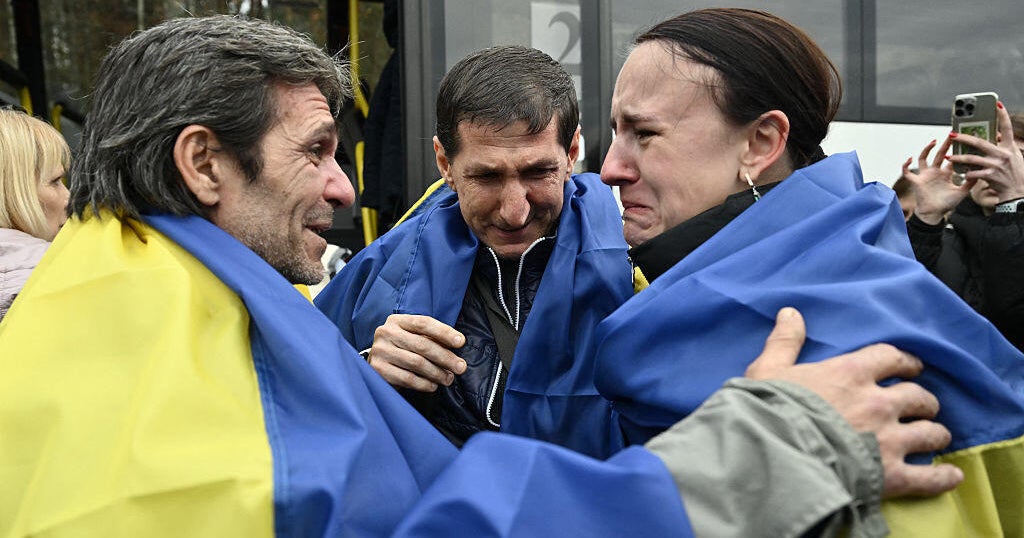
Photo via CBS News

Hacked alert apps send Ukrainians, Russians fake attack warnings

Read the original at CBS News ↗
Cite

Stretch, A. (2026, November 2). Hacked alert apps send Ukrainians, Russians fake attack warnings. CBS News. https://www.cbsnews.com/news/ukraine-russia-war-app-hack-cyberattack-fake-nuclear-chemical-alerts/

Dated from the outlet's own feed. Check the original for its byline.

CBS News · collected 2026-11-02 · by Aidan Stretch

Quick Summary

On Sunday night, emergency alert apps in Ukraine and Russia were hacked, sending false warnings about radiation, chemical attacks, and nuclear strikes to users. In Ukraine, the Air Alert app sent out these messages at 10:47 p.m., causing panic before being confirmed as fake by the Ukrainian Air Force ten minutes later. Similarly, Russia’s Emergencies Ministry app was compromised around 2:45 a.m. Moscow time, sending alerts about nuclear warheads in 33 regions. Developers of both apps temporarily disabled notifications following the incidents.
Written by AI on 2026-11-02, from this article's own text only (the story summary below draws on all the coverage).
See how they differ ↓

AI analysis

Story summary

On November 1, 2026, Ukraine’s air force announced that the country's public air raid alert app had been hacked. The hack caused the app to falsely warn residents in Kyiv and other areas about imminent nuclear attacks, radiation hazards, chemical threats, and street combat. While initial reports suggested the issue was isolated to Ukraine, Russian officials also reported their own emergency warnings app suffered a "massive cyberattack." Both sides accused each other of carrying out these attacks as tensions escalated following the end of a long truce between them. Ukrainian citizens received false alerts via multiple apps, leading to brief unease but not widespread panic, given their familiarity with frequent air raid drills. Cybersecurity experts note this incident represents an escalation in digital warfare tactics used by both countries.

Written for “Hacked Emergency Alert Apps Spread Fake Warnings” on 2026-11-21, grounded in this article and the 23 other(s) covering the same event.

How they differ

15 outlets covered “Hacked Emergency Alert Apps Spread Fake Warnings”.

What each outlet says

One AI summary per outlet of its latest article on this story, written from that article alone and checked against it. Open the article for the outlet's own words.

CBS NewsThis outlet2 Nov

On Sunday night, emergency alert apps in Ukraine and Russia were hacked, sending false warnings about radiation, chemical attacks, and nuclear strikes to users. In Ukraine, the Air Alert app sent out these messages at 10:47 p.m., causing panic before being confirmed as fake by the Ukrainian Air Force ten minutes later. Similarly, Russia’s Emergencies Ministry app was compromised around 2:45 a.m. Moscow time, sending…

Hacked alert apps send Ukrainians, Russians fake attack warnings (this article)
The Independent3 Nov

Russia launched a series of cyberattacks on Ukraine on Sunday night, sending fake emergency alerts via the Ukrainian government's Air Alarm app, warning citizens about radiation and chemical threats. This was shortly followed by Russia claiming that Ukraine had hacked its systems to warn its own people of imminent nuclear strikes. Both countries have not officially claimed responsibility for these incidents, which…

Why Russia’s latest cyberattack on Ukraine is a desperate attempt to sow panic →3 articles from The Independent on this story
BBC2 Nov

On Sunday night, Ukrainian citizens received alarming notifications through their phone’s alert app suggesting imminent nuclear strikes and chemical attacks from Russia. However, these alerts were soon identified as a hacking attempt by a suspected hacker group linked via Telegram, leading to doubts among recipients about the messages' authenticity. Within 15 minutes of the initial scare, Ukraine's Air Force…

Fake nuclear warning from hacked app sparks unease but not panic in Ukraine →2 articles from BBC on this story
The Straits Times1 Nov

Ukraine’s Air Force announced on November 1 that a public air raid alert app had been hacked, sending out false alerts about nuclear and chemical threats in Kyiv and other areas. The erroneous message incorrectly stated that Russia's Oreshnik hypersonic missile was deployed. In response to the incident, Ukraine’s Ministry for Digital Transformation clarified that while the app was down due to hacking, alternative…

Ukrainian air force says public air raid alert app sent erroneous alerts after being hacked →2 articles from The Straits Times on this story
Daily Mail2 Nov

Russian and Ukrainian hackers have engaged in a cyber attack that resulted in fake nuclear war alerts being issued to millions of people in both countries. Ukraine's air raid app, used daily by 6.7 million people, was targeted first, with messages warning of a hypersonic missile strike and chemical threats. Shortly after, Russian emergency networks were hit, sending out false warnings of imminent nuclear attacks…

Hacker wars: Rival Russian and Ukrainian cyber groups claim credit for attacks on each country's air raid systems that saw some civilians alerted to fake nuclear and chemical warfare →2 articles from Daily Mail on this story
Al Jazeera2 Nov

Russia and Ukraine have exchanged accusations over hacked emergency alert systems that falsely warned citizens about nuclear radiation, chemical threats, and imminent attacks. These incidents occurred shortly after a localized ceasefire in Kherson ended on Sunday. Both countries’ civil defense apps were compromised, sending alarming messages to users before authorities clarified the alerts as false. The Ukrainian…

Nuclear radiation in Russia, Ukraine? No, just hacked warning alerts →2 articles from Al Jazeera on this story
Show 9 more outlets
ABC News (AU)2 Nov

Ukraine’s public air raid alert system experienced hacking incidents that triggered false warnings about nuclear and chemical threats in certain regions. Meanwhile, Russia reported a significant cyberattack on its emergency services app. Both countries have noted these breaches but did not provide specific details on the extent of damage or ongoing response measures.

Ukrainian air raid alert app sends false warnings after being hacked →2 articles from ABC News (AU) on this story
The Guardian2 Nov

Hackers sent fake nuclear threat alerts through Ukraine's emergency app in Kyiv late Sunday night, causing panic and confusion among residents. The alert warned of potential nuclear radiation and chemical threats, written in both English with errors and Ukrainian. While many ignored the messages due to their suspicious nature, others were frightened into believing an imminent attack was underway. The Ukrainian…

Hackers send fake nuclear threat alert to Ukraine emergency app →2 articles from The Guardian on this story
The Hindu2 Nov

After a five-day truce that ended on November 1, 2026, both Russia and Ukraine reported cyberattacks on their emergency warning systems. Moscow’s emergencies ministry noted a “massive cyberattack” on its app designed to warn of drone attacks and other threats, while Ukraine suspected Russian involvement in hacks that posted false alerts about radiation dangers on its air raid alert system. The renewed hostilities…

Cyber attacks hit Russia, Ukraine after truce ends →
Fox News2 Nov

Ukraine officials reported that their air-raid alert system was hacked, leading to false alerts in Kyiv about radiation and chemical attacks on Sunday. The app warned residents not to go outside due to these alleged threats, though Ukraine’s Air Force later confirmed the messages were fake and there was no actual danger. Russia's Emergencies Ministry also announced a cyberattack that allowed for spreading…

Ukraine says air alert system hacked after false radiation warning in Kyiv →
Sydney Morning Herald2 Nov

On Sunday night, Ukraine’s public air raid alert app was hacked and sent false alerts about nuclear, chemical threats, and street combat to users in Kyiv and other areas. The Ukrainian Air Force acknowledged the breach within 10 minutes, assuring there was no actual radiation threat and advising calm. About an hour later, all-clear messages were issued as normal operations resumed through alternative alert systems…

‘Stay calm’: Ukraine says public air raid alert app sent false alerts after being hacked →
NBC News2 Nov

On Sunday night, Ukrainian residents received false emergency alerts warning of nuclear danger, radiation threats, and street combat through their Air Alert application, which authorities confirmed had been hacked. Hours later, Russia reported that its own alert system was also targeted in a cyberattack, amid the end of a humanitarian ceasefire between Ukraine and Russia. Both countries’ systems were temporarily…

Fake alerts warn of nuclear danger as Ukraine and Russia report emergency app hacks →
CBC2 Nov

On Sunday, emergency alert systems in Ukraine and Russia faced cyberattacks that spread false alarms through mobile apps. In Ukraine, users received warnings about high radiation levels in Kyiv, while Russian authorities reported similar fake alerts on their app. Both countries' officials advised caution and confirmed the Ukrainian system was restored quickly without impacting military operations. Authorities in…

Ukraine, Russian alert systems hit by cyberattacks that spread alarming messages →
New York Post2 Nov

Emergency alert apps in Ukraine and Russia were hacked overnight, spreading false warnings of nuclear attacks. In Ukraine, the air raid alert channel confirmed unauthorized breaches that led to alarming posts about high radiation levels and chemical attacks in Kyiv. Similar incidents occurred in Russia, where users received fake alerts urging them to stock up on food and take shelter due to supposed nuclear launches…

Hackers breach emergency alert apps in Ukraine and Russia with fake warnings of nuclear attacks →
Times of India2 Nov

Hackers sent fake emergency alerts through government mobile apps in both Ukraine and Russia, falsely warning about nuclear threats and high radiation levels. In Ukraine, the messages appeared in multiple languages with grammatical errors; one reference was made to a Russian ballistic missile. While there were no reports of widespread panic, Ukrainian authorities temporarily suspended their app before restoring it…

Fake nuclear threat alert sent to Ukrainians after emergency app hacked →

Compared with similar articles

This article reads unscored and hedges 6% of its claims. Each row says how that neighbour differs.
The Sydney Morning Herald
Hedges 1 of 19 claims Outlet record 61/100
New York Post
Hedges 1 of 12 claims Outlet record 66/100
ABC News (AU)
Hedges 0 of 4 claims Outlet record 67/100
ABC News (AU)
Hedges 0 of 3 claims Outlet record 67/100
The Guardian
Hedges 4 of 33 claims Outlet record 64/100
BBC News
Hedges 1 of 3 claims Outlet record 65/100
NBC News
Hedges 3 of 28 claims Outlet record 74/100
The Straits Times
Hedges 0 of 7 claims Outlet record 64/100
CBC News
Hedges 3 of 29 claims Outlet record 60/100

Story

Hacked Emergency Alert Apps Spread Fake Warnings
Technology · 24 article(s) covering the same event. See how they differ ↑
How this article was measured signals, leaning charts, publisher record, byline, topics and claims

Signals How these are calculated →

Claims extracted
16
sentences that state something as happening or true
Uncertain
6%
1 of 16 hedged ("reportedly", "may", "according to")
Leaning
not political
takes no side on a contested political question
Publisher signals
66/100
CBS News's corrections and hedging, across everything collected from it. Not a measure of accuracy.
Outlets on this story
24
Technology
Same framing elsewhere
1
articles that frame the event the way this one does
Analyzed 2026-11-02 · how these are computed

How this is being covered How these are calculated →

Article leaning vs. publisher reliability
Source leaning vs. consistency

Publisher

CBS News · 5978 article(s) · 11 correction(s) detected
Running correction rate · 11 correction(s)

Who wrote this

Aidan Stretch
12 article(s) here · 0 carrying a prediction
Zelenksyy told journalists on Friday he had been asked for the first time whether he would withdraw from the eastern region of Donbas in exchange for membership to the military alliance.
Kyrylo Budanov, the head of Ukraine's Presidential Office, expressed "restrained optimism" there could be progress made toward an eventual meeting between Volodymyr Zelenskyy and Vladimir Putin next weekUkrainian, Russian and American delegations will meet in Abu Dhabi on Nov. 10 and 11 for the and the first since a heated back-and-forth over SpaceX's Starshield .
"They first struck people who had come to receive humanitarian aid, and then first responders and police officers who arrived at the scene," Zelenskyy wrote, noting that rescue efforts were still ongoing Wednesday afternoon, and "more than 30 people may still be under the rubble."
The ceasefire began at 3 a.m. Tuesday and is expected to continue through Sunday evening.
Everyone who wishes to leave Oleshky will be given the opportunity to leave safely.
"I couldn't say that all other air defenses stopped working, no.
God willing, this will be restored."
The principal says they could become a permanent fixture, as repairs would cost $500,000.
Ukrainian President Volodymyr Zelenskyy is prepared to sign the deal on the sidelines of the United Nations General Assembly this week in New York City, but the sources said the deal may instead be finalized at a later date, when the U.S. is ready to sign.
"When the full-scale invasion started, a lot of people had to review what could be their personal impact," she said.
Also by Aidan Stretch
Nothing else under this byline is closely related to this article, so these are simply their most recent.
All 12 articles by Aidan Stretch →

Topics

Kyiv Russia Telegram Ukraine Ukrainian

Subjects

Ukraine GPE · 4× Kyiv GPE · 3× Russia GPE · 3× Telegram ORG · 3× Ukrainian NORP · 3× Russian NORP · 2× The Ukrainian Air Force ORG · 2× Ukrainians NORP · 2× Ajax Systems ORG · 1× Stfalcon ORG · 1×

Narrative

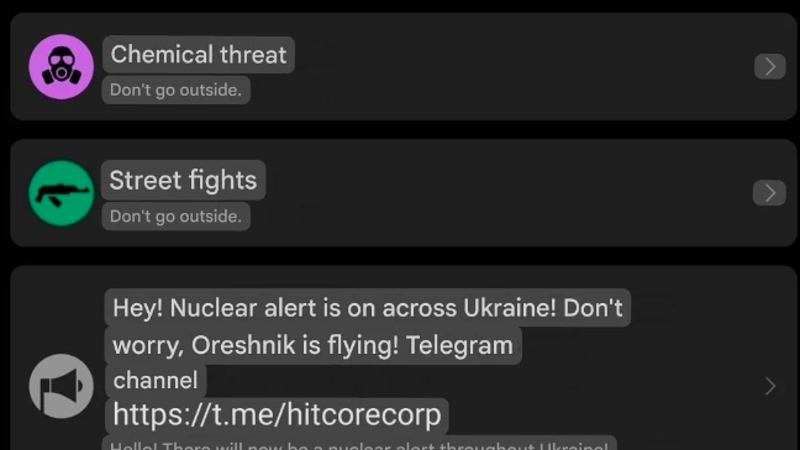
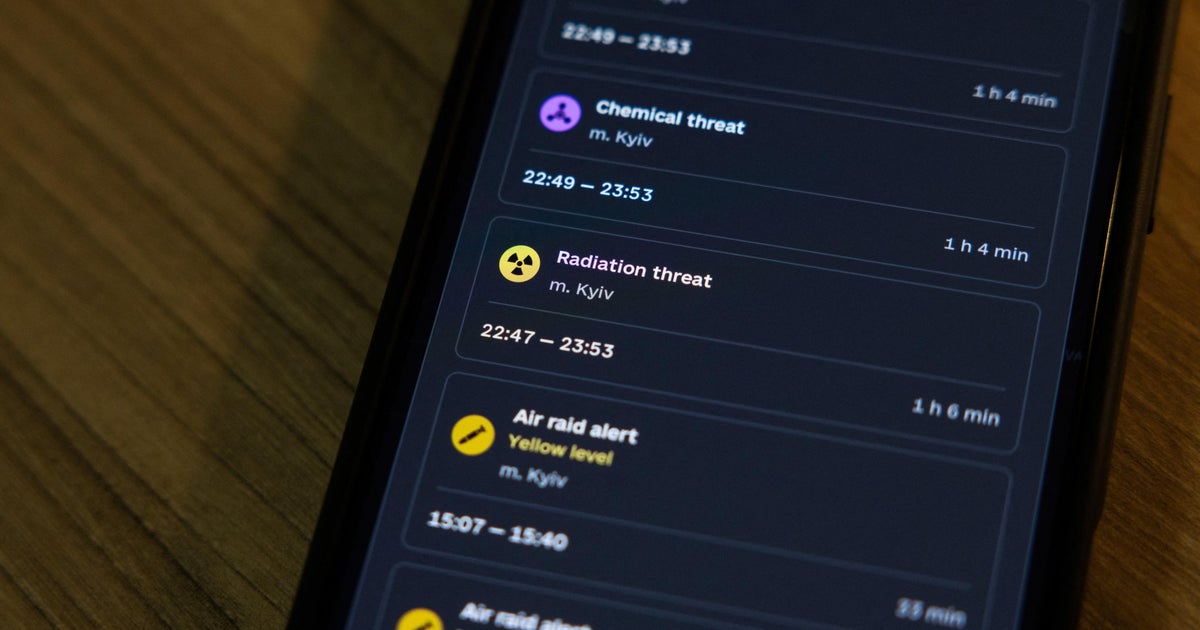
At 10:47 p.m. local time (3 p.m. Eastern), Air Alert, a Ukrainian app developed by Ajax Systems and Stfalcon with support from Ukraine's Ministry of Digital Transformation, started sending out false warnings of radiation, chemical threats, a nuclear attack and even street fighting in Kyiv.
framing: assertive · carried by 1 article(s) · first seen 2026-11-02
2026-11-02 · CBS News
Hacked alert apps send Ukrainians, Russians fake attack warnings · assertive framing

Claims (16 extracted, 1 hedged)

Kyiv — Ukrainian and Russian emergency alert apps used to warn civilians of incoming missiles, drones and other military attacks were hacked hours apart on Sunday night, sending out false messages about radiation, chemical attacks and nuclear strikes. asserted
apps → use → radiation
At 10:47 p.m. local time (3 p.m. Eastern), Air Alert, a Ukrainian app developed by Ajax Systems and Stfalcon with support from Ukraine's Ministry of Digital Transformation, started sending out false warnings of radiation, chemical threats, a nuclear attack and even street fighting in Kyiv. asserted
Alert → develop → Kyiv
Some Ukrainians rely on the app to decide whether or not to take shelter ahead of . asserted
Ukrainians → rely → shelter
Many also rely on the social media platform Telegram, however, where the country's Air Force and security analysts share more specific information about incoming strikes. asserted
Force → rely → strikes
The Ukrainian Air Force confirmed just 10 minutes later, at 11:02 p.m. local time, on multiple platforms, that the notifications were false. asserted
notifications → confirm → platforms
"The Air Alert app appears to have been subjected to hostile interference. asserted
app → appear → interference
There is no radiation threat!" the Air Force said in a message shared on Telegram, urging Ukrainians to remain calm and follow official updates. asserted
Force → be → updates
Some Kyiv residents told CBS News they immediately knew the notifications were fake after checking Telegram channels. asserted
notifications → tell → channels
A couple of hours later, at 2:45 a.m. in Moscow (6:45 p.m. Eastern), Russia's Emergencies Ministry app was also hacked. asserted
app → hack → Moscow
False alerts were sent to users in 33 regions, according to Russia's tightly controlled media, which said the messages warned of "nuclear warheads" being launched across the country and instructed residents to stock up on food for three weeks and shelter in basements. uncertain
messages → send → basements
The Russian ministry said attackers had exploited a vulnerability in its app's administrative panel, prompting officials to disconnect and isolate affected services. asserted
attackers → say → services
Developers of the Air Alert app in Ukraine said "unauthorized interference" had occurred and temporarily disabled push notifications and the app itself. asserted
interference → say → notifications
Yurii Ihnat, a spokesman for the Ukrainian Air Force, said the hack had no impact on Ukraine's security operations and that the Air Alert app is not affiliated with the country's military command systems. asserted
app → say → systems
The hacks came as a at 10:59 p.m. Ukraine time on Sunday in and around Oleshky, a southern Ukrainian city that has been occupied by Russia since 2022.The truce, and Pope Leo, began on Oct. 27. asserted
Leo → come → Oct.
It allowed humanitarian aid into the city and some civilians to evacuate. asserted
civilians → allow → city
Ukraine's human rights commissioner Dmytro Lubinets said both sides had observed the agreement and were discussing further humanitarian measures. asserted
sides → say → measures
Give feedback · no sign-in needed

No sign-in needed for now. Your note is sent without a name, so it cannot be answered.

History Support