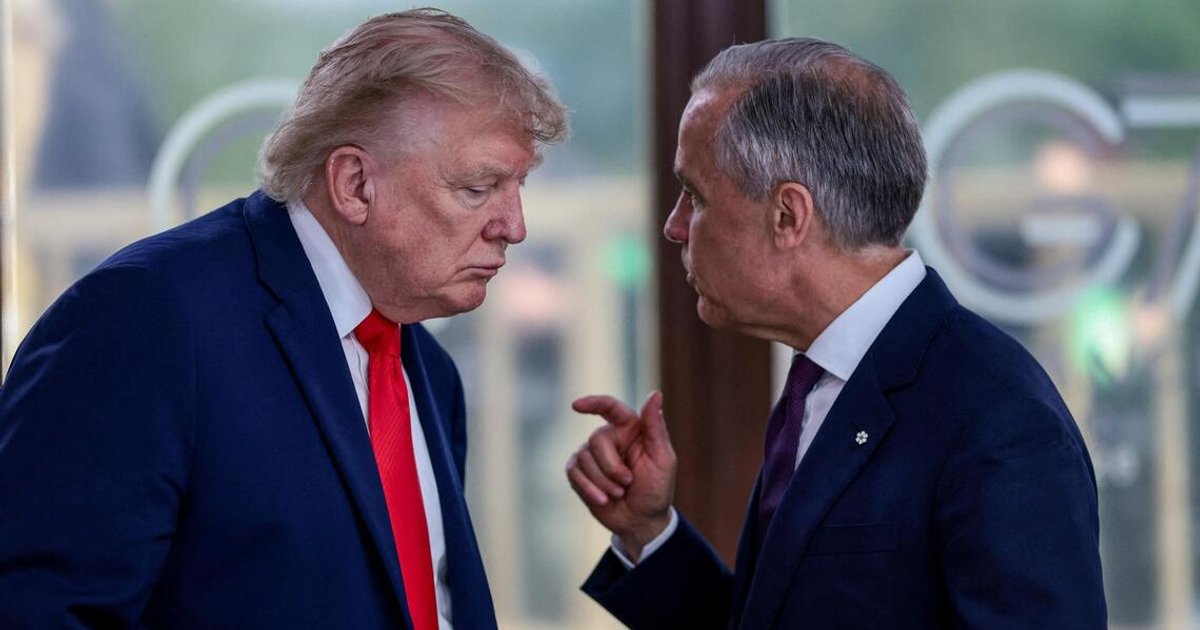
Photo via The Sydney Morning Herald

Trump has lost control of his war with Canada

Read the original at The Sydney Morning Herald ↗
Cite

Bartholomeusz, S. (2026, November 3). Trump has lost control of his war with Canada. The Sydney Morning Herald. https://www.smh.com.au/business/the-economy/trump-has-lost-control-of-his-war-with-canada-20261103-p61asr.html?ref=rss&utm_medium=rss&utm_source=rss_feed

Dated from the outlet's own feed. Check the original for its byline.

The Sydney Morning Herald · collected 2026-11-03 · by Stephen Bartholomeusz

Quick Summary

No summary of this article yet; the story summary below covers the event.
See how they differ ↓

AI analysis

Story summary

As of November 3, 2026, U.S. President Donald Trump stated that the U.S. is close to finalizing a trade deal with Canada, while Canadian Prime Minister Mark Carney said more work remains to be done despite some progress. After halting formal trade talks in August due to disagreements over tariffs on nearly $28 billion worth of Canadian goods, both leaders engaged in "good conversations" following Trump's comments about Canada working hard to reach a deal. Carney noted that Washington had dropped some earlier demands and was now offering more flexibility, with negotiations described as becoming more intense. The discussions come ahead of the U.S. midterm elections on November 3, where the ongoing trade dispute has been a key issue among candidates.

Written for “Canada-US Trade Talks Intensify” on 2026-11-21, grounded in this article and the 15 other(s) covering the same event.

How they differ

9 outlets covered “Canada-US Trade Talks Intensify”.

What each outlet says

One AI summary per outlet of its latest article on this story, written from that article alone and checked against it. Open the article for the outlet's own words.

Toronto Star4 Nov

Prime Minister Mark Carney announced more intense trade negotiations have commenced between Canada and the United States since a recent call with President Donald Trump. During an interview in St. John’s, Antigua and Barbuda, Carney indicated that some of Canada's previous non-negotiable issues have been reconsidered but emphasized ongoing discussions are necessary to finalize the deal. Trump separately told Fox…

Intense trade negotiations have begun, the U.S. is 'asking for less' and 'offering more,' Carney says →3 articles from Toronto Star on this story
The Globe and Mail2 Nov

President Donald Trump stated on Sunday that his administration has an idea for a new trade agreement with Canada, though he did not provide any specifics about the proposal. The announcement came without detailed information or timelines regarding negotiations or expected outcomes.

Trump says U.S. and Canada have 'concept' of a new trade deal →3 articles from The Globe and Mail on this story
CBC3 Nov

Prime Minister Mark Carney of Canada stated that progress has been made in trade negotiations with the U.S., noting that the American side is now "asking less and offering more." This shift includes the removal of certain contentious issues for Canada, such as language protections and limitations on striking deals with other countries. The talks have intensified since they collapsed in August due to disagreements…

Carney says U.S. 'asking less and offering more' with 'more intense' trade talks underway →2 articles from CBC on this story
Global News3 Nov

Prime Minister Mark Carney announced today from St. John’s, Antigua and Barbuda, that more intense trade negotiations with the U.S., following his call with President Trump, have commenced. Some previously non-negotiable Canadian positions, such as language rights and cultural protections, are no longer on the table. Carney noted progress on restricting Canada's ability to negotiate other international trade deals…

Carney says ‘more intense’ trade negotiations with U.S. have begun →2 articles from Global News on this story
The Straits Times1 Nov

US President Donald Trump said a US-Canada trade deal is “very close” after speaking with Canadian Prime Minister Carney. Both leaders expressed optimism about reaching a mutually beneficial agreement that would create jobs and boost affordability for families. They plan to work on finalizing the details over the coming weeks, despite previous disputes over tariffs and language regulations.

Trump says US-Canada trade deal is close after talks with Carney →2 articles from The Straits Times on this story
Al Jazeera1 Nov

Canadian Prime Minister Mark Carney announced progress in trade talks with the United States on Sunday, two days before the US midterm elections. The announcement follows recent tensions between the countries due to imposed tariffs; Canada responded to US levies of $20 billion by imposing equivalent tariffs on US goods. Carney emphasized ongoing negotiations and a mutual goal of reaching a beneficial trade deal…

Carney signals progress on Canada-US trade deal talks as midterms loom →
Show 1 more outlets
The Hindu1 Nov

Canadian Prime Minister Mark Carney stated on Sunday, November 1, 2026, that he had a positive conversation with U.S. President Donald Trump about future trade relations between the two countries. The leaders discussed the possibility of reaching a mutually beneficial deal that would boost job creation and improve affordability while respecting Canada's cultural sovereignty. Tariffs imposed by both nations in recent…

Canada PM Carney says he had good conversation with Trump on trade →

Where they agree and split

Framing

How the first headlines put it

Attributed to a source3
Stated as fact4
The headlines (7)

Carney says Canada, U.S. working in coming weeks towards trade deal Global News · attributed to a source

Canada PM Carney says he had good conversation with Trump on trade The Hindu · attributed to a source

Trump says US-Canada trade deal is close after talks with Carney The Straits Times · attributed to a source

Donald Trump continues to daydream about swallowing Canada whole Toronto Star · stated as fact

Carney has 'good conversation' with Trump on future of Canada-U.S. trade as midterms near CBC · stated as fact

Carney had ‘good conversation’ with Trump, trade talks to continue The Globe and Mail · stated as fact

Carney signals progress on Canada-US trade deal talks as midterms loom Al Jazeera · stated as fact

The full story: what happened, how it changed, and all 16 articles →

Compared with similar articles

This article reads leans strongly left and hedges 11% of its claims. Each row says how that neighbour differs.
The Straits Times
Leans left further right than this Hedges 0 of 18 claims Outlet record 64/100
“Article A discusses a concept of a trade deal between Trump and Canada, while Article B reports on Canada unveiling a budget to reduce reliance on the US, indicating different specific events.”
CBC News
Hedges 0 of 3 claims Outlet record 72/100
Global News
Hedges 3 of 15 claims Outlet record 63/100
Toronto Star
Leans left further right than this Hedges 2 of 23 claims Outlet record 64/100
The Dispatch
Leans left further right than this Hedges 0 of 3 claims Outlet record 61/100
“Article A discusses Trump's use of an outdated trade law to impose tariffs on Canada, while Article B mentions a concept for a potential trade deal between the U.S. and Canada.”
The Globe and Mail
Hedges 4 of 35 claims Outlet record 51/100
The Globe and Mail
Hedges 0 of 2 claims Outlet record 51/100
“The articles discuss different aspects of trade relations between the U.S. and Canada; Article A focuses on Trump's statement about a 'concept' for a new deal, while Article B elaborates on potential friction and mutual concepts from both sides.”
CBC News
Hedges 1 of 11 claims Outlet record 72/100
The Straits Times
Hedges 1 of 9 claims Outlet record 64/100
South China Morning Post
Hedges 0 of 4 claims Outlet record 62/100

Story

Canada-US Trade Talks Intensify
Politics · 16 article(s) covering the same event. Compare every outlet's account →
How this article was measured signals, leaning charts, publisher record, byline, topics and claims

Signals How these are calculated →

Claims extracted
38
sentences that state something as happening or true
Uncertain
11%
4 of 38 hedged ("reportedly", "may", "according to")
Leaning
Leans strongly left
of the writing, not the subject · beta estimate
Publisher signals
61/100
The Sydney Morning Herald's corrections and hedging, across everything collected from it. Not a measure of accuracy.
Outlets on this story
16
Politics
Same framing elsewhere
1
articles that frame the event the way this one does
Analyzed 2026-11-03 · how these are computed

How this is being covered How these are calculated →

Article leaning vs. publisher reliability
Source leaning vs. consistency

Publisher

The Sydney Morning Herald · 7770 article(s) · 16 correction(s) detected
Running correction rate · 16 correction(s)

Who wrote this

Stephen Bartholomeusz
29 article(s) here · 1 carrying a prediction
Nvidia has delivered a third-quarter result that outperformed expectations, raised its forecasts for the current quarter and was very bullish about its prospects in its next financial year.
Donald Trump “wouldn’t mind” if he regained the role.
If you were looking for a single barometer of the state of the world – or of a particular copper-rich sector – it would be hard to go past the copper price.
It now appears inevitable that the Fed will deliver its second rate rise in this cycle – the first was in September – after the US inflation rate came in above expectations for the third successive month.
If he were to be removed – either by his board, which has said it will conduct an inquiry, or by external pressure – could Nvidia function as effectively?
The “blue tsunami” that destroyed Republican control of Congress last week may have a silver lining for some of the key companies caught up in the scramble for artificial intelligence supremacy and for investors exposed to what appeared to be a swelling bubble.
Musk quipped on his X social media platform that his “election-interfering space lasers didn’t work,” but it was another post that shows the real damage that the failure of his efforts to influence the outcome of the elections will do.
The midterm elections could knock out one, if not two, of the pillars supporting that dominance.
Those “concepts” could produce even more trade friction.
2026-11-03 · assertive framing · Trump has lost control of his war with Canada
Alphabet and Meta have, between them, raised almost $US90 billion of new equity since June and have programs that could raise a further $US100 billion.
2026-11-02 · assertive framing · Wall Street on edge after $1.4 trillion wipeout
Also by Stephen Bartholomeusz
Nothing else under this byline is closely related to this article, so these are simply their most recent.
All 29 articles by Stephen Bartholomeusz →

Topics

America American Canada Canadian the European Union

Subjects

Canada GPE · 14× Trump PERSON · 5× Carney PERSON · 4× America GPE · 2× American NORP · 2× Canadian NORP · 2× the European Union ORG · 2× China GPE · 1× Donald Trump PERSON · 1× Mark Carney PERSON · 1×

Narrative

Since that tit-for-tat exchange, there has been some shift in the composition of the US tariffs, albeit not their value, as Trump lowered some and raised others to try to limit the damage they were doing to the Republican causes in border states with deep economic links with Canada, like Michigan and Maine, which were trending Democrat in the lead up to this week’s midterm elections. The trade negotiations earlier this year broke down at the eleventh hour after last-minute demands from the US negotiators – abolishing Canada’s French language local content rules and quotas, gaining exclusive access to Canadian minerals and restrictions on its ability to strike trade deals with other countries – caused Carney to end the talks and the US to immediately impose its tariffs.
framing: assertive · carried by 1 article(s) · first seen 2026-11-03
Those “concepts” could produce even more trade friction.
2026-11-03 · The Sydney Morning Herald
Trump has lost control of his war with Canada · assertive framing

Claims (38 extracted, 4 hedged)

Donald Trump has “the concept” of a trade deal with Canada. asserted
Trump → have → Canada
Canada has its own concept of a closer economic relationship with the European Union. asserted
Canada → have → Union
Those “concepts” could produce even more trade friction. uncertain
concepts → produce → friction
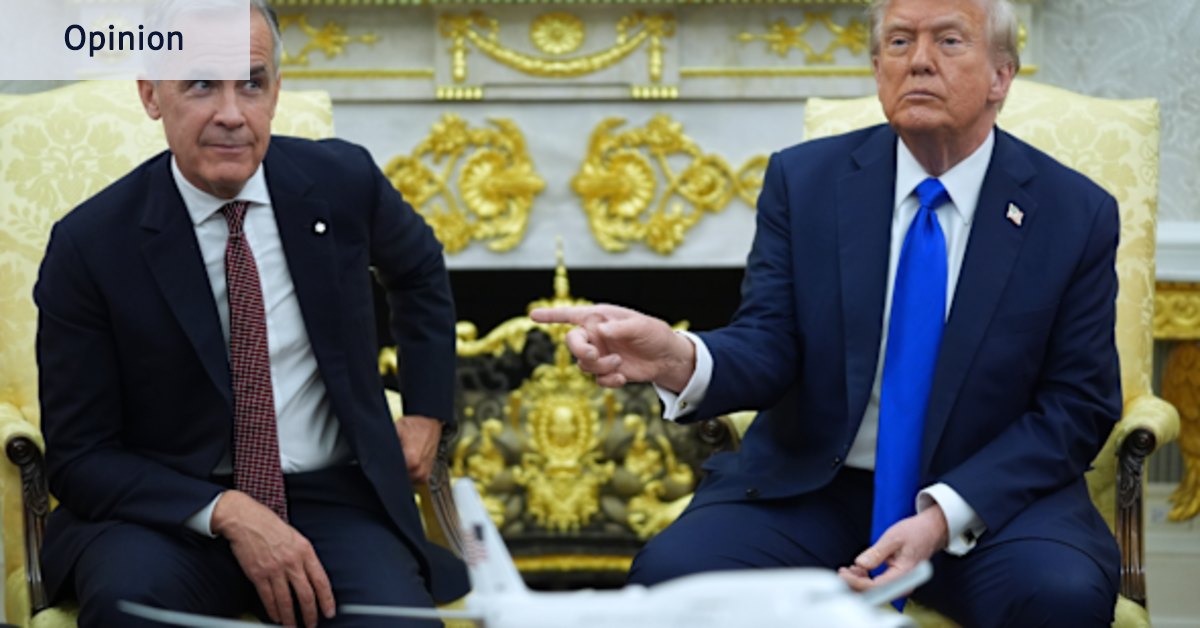
Trump said at the weekend that, after speaking to Canadian prime minister Mark Carney, that there was a concept of a deal “that’s going to be great for our farmers, great for our country, and it will be fine for Canada.” asserted
it → say → Canada
Carney referred on social media to “constructive” discussions on a “mutually beneficial” trade deal that would create jobs, improve affordability and “fully respect Canada’s languages, culture and sovereignty.” asserted
that → refer → languages
The warmer tone from both leaders suggests a thawing of a relationship that fractured in September when earlier trade talks broke down and the US slapped new tariffs on about $US20 billion ($29 billion) of Canada’s exports to the US. uncertain
US → suggest → US
Canada responded immediately with tariffs on a similar value of imports from the US, making it the only country other than China to stand up to Trump’s trade bullying. asserted
it → respond → bullying
Since that tit-for-tat exchange, there has been some shift in the composition of the US tariffs, albeit not their value, as Trump lowered some and raised others to try to limit the damage they were doing to the Republican causes in border states with deep economic links with Canada, like Michigan and Maine, which were trending Democrat in the lead up to this week’s midterm elections. The trade negotiations earlier this year broke down at the eleventh hour after last-minute demands from the US negotiators – abolishing Canada’s French language local content rules and quotas, gaining exclusive access to Canadian minerals and restrictions on its ability to strike trade deals with other countries – caused Carney to end the talks and the US to immediately impose its tariffs. asserted
US → lower → tariffs
Those tariffs, along with Trump’s regular verbal assaults on Canada, his quips about making it America’s 51st state and his purported renaming of Lake Ontario as “Lake America” have been a talking point in the midterms, and not one favourable to the Republicans, which may explain why the Americans reopened the negotiations. uncertain
Americans → make → negotiations
The negotiations weren’t, however, concluded in time for the midterms and, it appears, the parties are still some distance from an agreement. asserted
parties → conclude → agreement
Trump’s notion of a fair trade deal, of course, is one tilted massively in America’s favour, so there is no certainty there will be an agreement. asserted
notion → tilt → agreement
In the meantime, Carney has said he is prepared to wait for a new US president if necessary to finalise a new deal. asserted
he → say → deal
“We’ll have to, if that’s what it takes, and American families, American businesses, will lose out because of that. asserted
families → have → that
They’re not winners in this circumstance.” asserted
They → ’re → circumstance
Carney isn’t sitting on his hands, waiting for 2029 and a new president. asserted
Carney → sit → 2029
Last Friday Canada and the European Union held a summit in Montreal at which they signed agreements on investment, digital trade, competition, computing and border security and agreed to negotiate a broader and deeper partnership next year. asserted
they → hold → partnership
The European Commission president, Ursula von der Leyen, has talked about Canada becoming an “associate member” of the EU, although pushback from some EU members, notably Germany, that term – for which there is neither precedent nor definition – has been quietly dropped from public discussions about the possible future relationship. asserted
pushback → talk → relationship
What they are talking about isn’t Canada joining the EU – Canada’s economic integration with the US, the destination for 70 per cent of its exports, and geography rules that out – but greater integration of the economies and their policies. asserted
geography → talk → economies
The matters being canvassed include a new bank payments system that would bypass the US dominance of the current global system, more co-operation on digital and national security, science and space programs, greater trade and investment and more student exchanges and freedoms for young Canadians and Europeans to live and work in the two economies. asserted
Canadians → canvass → economies
New fibre optic cables linking Canada, Europe and Asia that would reduce dependence on US cable infrastructure are also being canvassed. asserted
that → link → infrastructure
The discussions with the US fit with Carney’s ambition of doubling Canadian exports to non-US markets by 2035 and reducing Canada’s over-dependence on the US and the vulnerabilities that Trump’s trade wars and threats to Canada’s sovereignty have exposed. asserted
wars → fit → sovereignty
Trump, naturally, isn’t happy about the prospect of deeper economic ties between Canada and the EU, threatening more tariffs – “very heavy tariffs” – on the EU, or even a complete cessation of trade, if an agreement is struck with “bad intentions.” asserted
agreement → threaten → intentions
He has dismissed the idea of Canadian associate membership of the EU as “laughable,” while labelling Canada – historically America’s closest trading partner and ally – as “a terrible trading partner.” asserted
He → dismiss → partner
Carney has shown courage in standing up to Trump, given that he doesn’t have China’s dominance of strategic minerals to use as leverage against Trump’s trade threats and that he knows that the relative sizes of the two economies – America’s dwarfs Canada’s – means that the fallout from the trade war is asymmetrically painful for his economy. asserted
fallout → show → economy
He has the support of a majority of Canadians in his efforts to diversify his country’s trading relationships and build a coalition of middle powers to blunt the impact of America’s newfound belligerence towards its traditional trading partners and allies on trade and other issues. asserted
He → have → trade
He has been crisscrossing the world to try to strike new trade deals with the EU, India, Japan, Türkiye and others. asserted
He → crisscross → EU
The envisaged relationship with the EU, which he says would form “the closest association between any country and the European in the world,” is at the centre of Canada’s new trade strategy. asserted
he → envisage → strategy
Trump’s notion of a fair trade deal, of course, is one tilted massively in America’s favour, so there is no certainty there will be an agreement. asserted
notion → tilt → favour
At the same time, he has seized the moment provided by Trump to make significant changes within Canada, including the fast-tracking of major infrastructure and resource projects, particularly oil and gas projects and pipelines. asserted
he → seize → projects
His priority is the construction of a new pipeline from Canada’s massive oil sands resources in Alberta to the west coast, which would carry a million barrels of oil a day and open up Asia and other markets for the first time. asserted
which → carry → time
’s also fast-tracking gas projects that could see Canada exports to non-US markets double by 2030. uncertain
exports → track → 2030
At present, about 90 per cent of Canada’s oil exports go to US refineries in the mid-West that have been set up especially to handle Canada’s heavy sour crude. asserted
that → go → crude
Most of its gas exports also go to the US. asserted
Most → go → US
In a world where energy importers – and even Middle East refiners – want to diversify their supplies of oil and gas away from the Middle East after the US-Israel attacks on Iran and America’s ongoing war have destabilised the region, Canada has, Carney said last month, the potential to be “an energy superpower.” asserted
Carney → want → potential
Even if hostilities in the Middle East were to end tomorrow, the energy markets would have been fundamentally and permanently changed by the conflict and the vulnerabilities it exposed to an over-reliance on Middle East oil and safe passage through the Strait of Hormuz. asserted
it → end → Hormuz
Similarly, even if Trump is eventually replaced by a trade “dove” who unwinds most of the tariffs imposed during his second term, Canadians, Europeans, Australians and others will have permanently lost faith and trust in the US to deal fairly with them and honour its traditional leadership of a global economic, trade and security system that it played such a central role in creating. asserted
it → replace → role
Canada, the EU and China aren’t alone in wanting to escape, or at least dilute, the brutish and coercive economic power of Trump’s America, even if China and Canada have been the most assertive. asserted
China → want → America
The Business Briefing newsletter delivers major stories, exclusive coverage and expert opinion. asserted
newsletter → deliver → stories
Give feedback · no sign-in needed

No sign-in needed for now. Your note is sent without a name, so it cannot be answered.

History Support