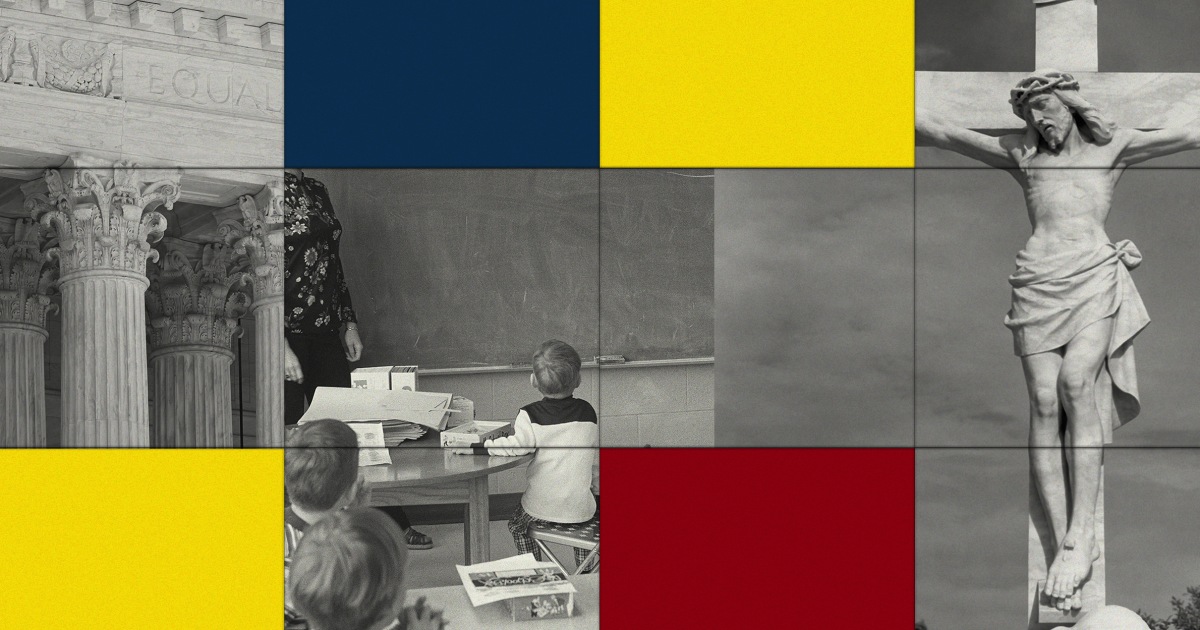
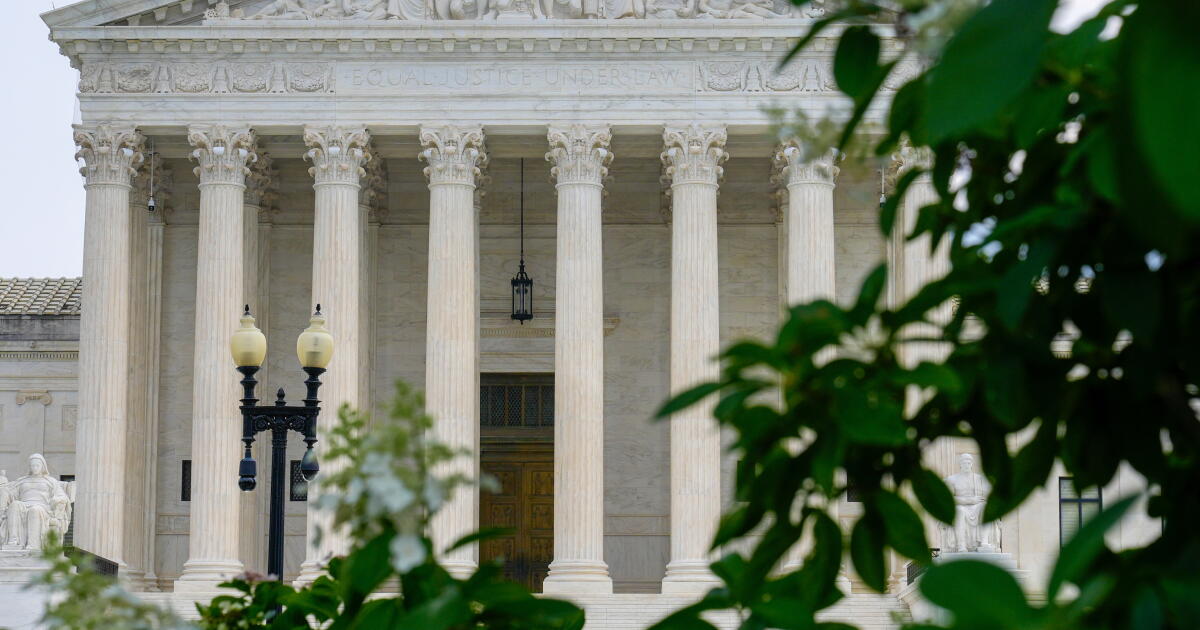
Photo via Mother Jones

SCOTUS Looks Ready to Let Public Money Fund Religious Discrimination

Read the original at Mother Jones ↗
Cite

Levy, P. (2026, November 3). SCOTUS Looks Ready to Let Public Money Fund Religious Discrimination. Mother Jones. https://www.motherjones.com/politics/2026/11/supreme-court-religious-descrimination-mary-catholic-parish-roy/

Dated from the outlet's own feed. Check the original for its byline.

Mother Jones · collected 2026-11-03 · by Pema Levy

Quick Summary

The Supreme Court appears ready to allow taxpayer money to fund religious schools that discriminate against LGBTQ families, according to oral arguments heard on Tuesday in St. Mary Catholic Parish v. Roy. Colorado’s universal preschool program requires participating schools, including religious ones, to adhere to nondiscrimination policies. The Archdiocese of Denver and others argue that being required not to discriminate based on sexual orientation or gender identity violates their free exercise of religion. During the hearing, Justice Elena Kagan noted previous cases allowed for equal treatment but this case seeks a special accommodation allowing religious entities to receive public funding while exempting themselves from general nondiscrimination rules. The challengers argue strict scrutiny should apply rather than the generally applicable law standard, potentially weakening protections against discrimination.
Written by AI on 2026-11-04, from this article's own text only (the story summary below draws on all the coverage).
See how they differ ↓

AI analysis

Story summary

On November 1, 2026, the U.S. Supreme Court heard a case involving St. Mary Catholic Parish v. Roy, where Colorado's refusal to include religious schools in its universal preschool program was challenged by Catholic institutions and families. The case centers around whether religious schools can exclude students from LGBTQ+ families without violating state anti-discrimination laws. Erika Nagle, a mother of three whose children attend St. Mary Catholic School in Littleton, Colorado, claims her family was denied $12,000 in taxpayer-funded preschool benefits because she chose a Catholic education for her children. The program, worth up to $6,300 per child, aims to provide universal access but includes conditions that religious schools find discriminatory. If the court rules in favor of the plaintiffs, it could allow more public funds to flow to religious schools despite state nondiscrimination policies.

Written for “Supreme Court Hearing Catholic Preschool Case” on 2026-11-21, grounded in this article and the 17 other(s) covering the same event.

How they differ

10 outlets covered “Supreme Court Hearing Catholic Preschool Case”.

What each outlet says

One AI summary per outlet of its latest article on this story, written from that article alone and checked against it. Open the article for the outlet's own words.

Mother JonesThis outlet3 Nov

The Supreme Court appears ready to allow taxpayer money to fund religious schools that discriminate against LGBTQ families, according to oral arguments heard on Tuesday in St. Mary Catholic Parish v. Roy. Colorado’s universal preschool program requires participating schools, including religious ones, to adhere to nondiscrimination policies. The Archdiocese of Denver and others argue that being required not to…

SCOTUS Looks Ready to Let Public Money Fund Religious Discrimination (this article)
Washington Examiner4 Nov

During a Supreme Court hearing for St. Mary Catholic Parish v. Roy, Justice Samuel Alito pointed out Colorado’s weak track record regarding First Amendment cases over the past decade. The case involves Colorado's decision to exclude Catholic preschools from its universal preschool program due to the schools' refusal to admit all children regardless of their families’ religious beliefs. This exclusion is challenged…

Alito highlights Colorado’s poor Supreme Court record during Catholic preschool case →4 articles from Washington Examiner on this story
Fox News3 Nov

On Tuesday, the Supreme Court’s conservative justices provided significant backing to Catholic preschools contesting Colorado's requirement that they accept all children regardless of their parents' sexual orientation or gender identity. The case centers around whether these private institutions can exclude LGBTQ+ families while still receiving public funding. Justice Brett Kavanaugh suggested a compromise allowing…

Supreme Court offers support for Catholic preschools challenging state funding requirements →2 articles from Fox News on this story
New York Post3 Nov

The US Supreme Court heard arguments in St. Mary Catholic Parish vs. Roy on Tuesday, a case involving Colorado's denial of public tuition assistance for preschoolers attending archdiocesan schools due to religious requirements. Colorado Democrats argue that these requirements are discriminatory, despite no instances of LGBTQ families being denied access. The case centers on whether the state can exclude religious…

Religious freedom is back on trial — and pre-K kids could win big →2 articles from New York Post on this story
NPR3 Nov

During a Supreme Court hearing on Tuesday, conservative justices indicated they may rule in favor of allowing Catholic preschools receiving state funding to exclude LGBTQ+ families. Colorado’s pre-K program funds schools at $6,300 per child annually but requires compliance with antidiscrimination laws. The Denver archdiocese seeks an exemption from this requirement so it can exclude children from same-sex and…

Supreme Court leans toward LGBTQ exclusion for publicly funded Catholic preschools →2 articles from NPR on this story
CBS News3 Nov

During Supreme Court arguments on Tuesday, justices signaled a likely ruling in favor of Catholic preschools challenging Colorado’s refusal to exempt them from nondiscrimination requirements. The case, St. Mary Catholic Parish v. Roy, centers around Colorado's universal preschool program and its mandate that participating schools provide equal enrollment opportunities regardless of characteristics like sexual…

Supreme Court seems likely to favor Catholic schools in pre-K fight →2 articles from CBS News on this story
Show 4 more outlets
NBC News3 Nov

The Supreme Court is set to hear a case involving the Archdiocese of Denver and other Catholic entities seeking an exemption from Colorado’s antidiscrimination rules to participate in a state-funded preschool program. The plaintiffs argue that because their doctrine does not recognize same-sex relationships or transgender status, they should be exempted from a provision requiring all participating schools to accept…

Supreme Court hears Catholic plea to participate in Colorado preschool program →2 articles from NBC News on this story
The Guardian3 Nov

The US Supreme Court will hear arguments on Tuesday in a case involving two Catholic preschools in Colorado that are challenging state rules requiring nondiscrimination policies for participation in a public education funding program. The plaintiffs argue these requirements violate their religious freedom, while Colorado contends the schools remain eligible if they agree to equal-opportunity standards. This dispute…

US supreme court to hear arguments in Catholic preschools’ LGBTQ+ exclusion case →
Toronto Star3 Nov

The Supreme Court is set to hear arguments on Tuesday in a case involving Catholic preschools in Colorado that are challenging their exclusion from a state-funded program due to their admissions policy for LGBTQ+ families. The preschools argue that excluding them based on this policy violates their constitutional rights, while the state contends that these policies contravene Colorado’s anti-discrimination laws.

Case over state funding for Catholic preschools in Colorado comes before the Supreme Court →
Los Angeles Times3 Nov

The Supreme Court is debating whether Colorado discriminates based on religion by excluding Catholic preschools from state-funded programs if those schools exclude same-sex parents and their children. The court’s conservative justices leaned towards ruling that this exclusion constitutes religious discrimination, while liberal justices argued it upholds anti-discrimination principles. The case reflects the court's…

Supreme Court considers whether a state's preschool funding rules are discriminatory →

Where they agree and split

Framing

How the first headlines put it

Attributed to a source2
Stated as fact1
The headlines (3)

Colorado mom says kids denied $12K in preschool aid over Catholic faith as Supreme Court showdown looms Fox News · attributed to a source

Colorado mom says kids denied $12K in preschool aid over Catholic faith as case goes to Supreme Court New York Post · attributed to a source

Religious freedom in focus at the Supreme Court with Colorado universal preschool case Washington Examiner · stated as fact

The full story: what happened, how it changed, and all 18 articles →

Compared with similar articles

This article reads unscored and hedges 24% of its claims. Each row says how that neighbour differs.
NBC News
Leans right Hedges 1 of 27 claims Outlet record 74/100
The Guardian
Hedges 3 of 14 claims Outlet record 64/100
Toronto Star
Leans left Hedges 0 of 2 claims Outlet record 64/100
Washington Examiner
Leans right Hedges 0 of 4 claims Outlet record 67/100
CBS News
Leans strongly right Hedges 3 of 31 claims Outlet record 66/100
Fox News
Leans strongly right Hedges 6 of 43 claims Outlet record 66/100
Washington Examiner
Leans left Hedges 0 of 4 claims Outlet record 67/100
Los Angeles Times
Hedges 4 of 38 claims Outlet record 95/100
New York Post
Leans right Hedges 3 of 33 claims Outlet record 66/100
Washington Examiner
Leans left Hedges 0 of 5 claims Outlet record 67/100

Story

Supreme Court Hearing Catholic Preschool Case
Politics · 18 article(s) covering the same event. Compare every outlet's account →
How this article was measured signals, leaning charts, publisher record, byline, topics and claims

Signals How these are calculated →

Claims extracted
41
sentences that state something as happening or true
Uncertain
24%
10 of 41 hedged ("reportedly", "may", "according to")
Leaning
withheld
no quote in the article backed the model's score
Publisher signals
60/100
Mother Jones's corrections and hedging, across everything collected from it. Not a measure of accuracy.
Outlets on this story
18
Politics
Same framing elsewhere
1
articles that frame the event the way this one does
Analyzed 2026-11-04 · how these are computed

How this is being covered How these are calculated →

Article leaning vs. publisher reliability
Source leaning vs. consistency

Publisher

Mother Jones · 600 article(s) · 1 correction(s) detected
Running correction rate · 1 correction(s)

Who wrote this

Pema Levy
6 article(s) here · 1 carrying a prediction
But the most seismic result for American politics and democracy may come out of the battleground states where Democrats just won trifecta control by taking both state houses and the governor’s mansion: Come January, Democratic legislators will have the votes to elect the next president by the popular vote.
With Democrats set to take control of both chambers of Congress by comfortable margins, the people will soon see the Supreme Court’s imperial presidency and the corruption it has wreaked in stark relief.
Such a decision would be the latest in line of holdings by this court that have opened the public coffers to private religious institutions.
On May 8, hundreds of civil rights protesters, carrying signs that said, “No Jim Crow Maps” and “Hands Off Our Vote,” descended on Baton Rouge to oppose a plan by Louisiana’s Republican-controlled legislature to dismantle one or both of the state’s majority-Black congressional districts.
2026-09-23 · assertive framing · Whites Only
His plan to disrupt mail-in voting, which he perceives would harm Democrats more than Republicans, was the latest.
2026-09-15 · assertive framing · Supreme Court Blocks Trump’s Mail Ballot Scheme
The Supreme Court may be deferential to President Donald Trump and the legal arguments put forward by his Justice Department.
Also by Pema Levy
Whites Only
2026-09-23 · Mother Jones
Nothing else under this byline is closely related to this article, so these are simply their most recent.
All 6 articles by Pema Levy →

Topics

Colorado St. Mary Catholic Parish Supreme Court The Supreme Court’s the Archdiocese of Denver

Subjects

Colorado GPE · 3× Kagan PERSON · 3× Catholic NORP · 1× Elena Kagan PERSON · 1× Roy PERSON · 1× St. Mary Catholic Parish ORG · 1× Supreme Court ORG · 1× The Supreme Court’s ORG · 1× the 10th Circuit Court of Appeals ORG · 1× the Archdiocese of Denver ORG · 1×

Narrative

While several religious schools that committed to the nondiscrimination policy have joined the program, the Archdiocese of Denver, two parish preschools, and two parents sued, arguing that prohibiting the church-run schools from discriminating against transgender kids and the children of LGBTQ couples is actually a form of discrimination against their own right to free religious expression.
framing: mixed · carried by 1 article(s) · first seen 2026-11-04
Such a decision would be the latest in line of holdings by this court that have opened the public coffers to private religious institutions.
2026-11-04 · Mother Jones
SCOTUS Looks Ready to Let Public Money Fund Religious Discrimination · mixed framing

Claims (41 extracted, 10 hedged)

The Supreme Court’s conservative majority appears poised to further weaken the separation between church and state by requiring that taxpayer dollars subsidize religious schools that deny admission to LGBTQ families. asserted
that → poise → families
Such a decision would be the latest in line of holdings by this court that have opened the public coffers to private religious institutions. asserted
that → open → institutions
During oral arguments on Tuesday, Justice Elena Kagan framed those previous cases on public funding of religious schools as having been decided on the grounds that “religious people are not being treated the same way as non-religious people.” asserted
people → frame → people
But in this case, St. Mary Catholic Parish v. Roy, she said, “what you’re asking us to do is something far beyond that. asserted
asking → say → that
It’s saying, ‘Even though religious people are being treated the same way…that’s not enough. asserted
that → say → ?
They need a special accommodation.’” asserted
They → need → accommodation
That special accommodation is the ability to take taxpayer money without following the nondiscrimination rules required of other schools. asserted
accommodation → take → schools
The case comes out of Colorado, which has a universal, publicly funded preschool program for four-year-olds. asserted
which → come → olds
Religious schools can participate, but must promise not to exclude children on the basis of protected characteristics including race, religion, sexual orientation, or gender identity. asserted
schools → participate → race
While several religious schools that committed to the nondiscrimination policy have joined the program, the Archdiocese of Denver, two parish preschools, and two parents sued, arguing that prohibiting the church-run schools from discriminating against transgender kids and the children of LGBTQ couples is actually a form of discrimination against their own right to free religious expression. asserted
prohibiting → commit → expression
Under current Supreme Court precedent, Colorado argues, religious entities and individuals cannot get exemptions from generally applicable laws, unless they target a religion for discrimination. asserted
they → argue → discrimination
The state’s nondiscrimination policy, which applies to all participating preschools, is a generally applicable law. asserted
which → apply → preschools
In this case, Colorado proved the requirement applies equally to all during trial in district court, and the 10th Circuit Court of Appeals affirmed that. asserted
Court → prove → that
But the Catholic challengers to the law, and the Trump administration which took their side, argued Tuesday that the policy targets religious schools and seeks to exclude them by forcing them to forgo their beliefs in order to receive public funds. asserted
policy → take → funds
In place of the generally applicable framework, the challengers and the administration believe that the case should be judged by a high standard of judicial review which requires judges to ascertain that the government has a very strong interest in pursing its policy and no other means of obtaining similar results. asserted
government → believe → results
This standard, called strict scrutiny, is very demanding and government laws often do not hold up under it. asserted
laws → call → it
But as the Democratic appointees pointed out Tuesday, there are real dangers in routing all religious claims against general laws into a strict scrutiny analysis to be determined by the courts—and, ultimately, the Supreme Court. uncertain
appointees → point → courts
“Everything’s going to be about ‘How important is this religious belief to you?’ versus ‘How important is this interest here in non-discrimination law to the state?’” Kagan told Sarah Harris, a Justice Department lawyer arguing the administration’s case. asserted
Kagan → go → case
Kagan noted the analysis wouldn’t just apply to non-discrimination laws, but to any rule around the provision of public benefits, including education, that a religious group or person said violated their beliefs. asserted
group → note → beliefs
“Why would we put ourselves in the middle of that in all these cases with respect to public schools alone?” Kagan asked. asserted
Kagan → put → schools
“These inquiries could go on forever.” uncertain
inquiries → go → ?
Justice Ketanji Brown Jackson, as well as Justice Sonia Sotomayor, argued that this case-by-case strict scrutiny analysis could go beyond anti-LGBTQ discrimination and open the door to race discrimination. uncertain
analysis → argue → discrimination
“The religious entity does not want to have to commit to opening its schools to students, children of LGBTQ couples,” Jackson said. asserted
Jackson → want → couples
“Couldn’t that same logic support a religious entity who says we don’t want to open our schools to students of races that we disagree with, or ethnicities that we disagree with?” asserted
we → support → that
Harris’ response was simply to say that the courts would probably find that permission to discriminate on the basis of race would fail the strict scrutiny standard. asserted
permission → say → standard
“But that’s just arbitrary,” Jackson rebutted. asserted
Jackson → ’ → ?
“If we say that’s different, it would just be because we’ve decided that race is different than LGBTQ status. asserted
race → say → status
But from the standpoint of rational reasoning, understanding how the Constitution works, I’m not sure those are different. asserted
those → understand → reasoning
It’s not hard to see why Harris’ answer—in effect, to trust ultimately this very court not to allow race discrimination—was unsatisfying. asserted
answer → ’ → discrimination
This is the same court that has made it harder for Black people to gain admission to good colleges, and appears poised to strike down policies aimed at increasing racial diversity through race neutral means. asserted
people → make → means
This is the same court that just this year, in Louisiana v. Callais, finished dismantling the Voting Rights Act of 1965 so that states could use allegedly race-neutral metrics to draw political maps that disempower racial minorities, and repeatedly refused to acknowledge racial discrimination in the map-drawing process, despite lower courts finding ample evidence. uncertain
courts → finish → evidence
Notably, during oral arguments Justice Samuel Alito questioned whether the state should have foreseen that its nondiscrimination policy might end up excluding certain religious preschools from the program. uncertain
policy → question → program
“We have here a requirement that has a very severe impact on certain religions and that was something that everybody could have anticipated, and almost must have anticipated, when this requirement was imposed,” he said. uncertain
he → have → that
Alito raised multiple hypotheticals suggesting how a law that is generally applicable on its face might actually be singling out a specific religion. uncertain
that → raise → religion
Alito never had this worry when he wrote Callais, and gave states license to exclude Black people from state and federal government due to allegedly race neutral criteria like partisanship even though the exclusion of Black people was the anticipated, if not the desired, consequence. uncertain
exclusion → have → people
That way of thinking could be one reason why Jackson, Kagan, and Sotomayor were uneasy with the idea that a religious objection to a general law would be weighed individually by the courts, with the Republican-appointed 6-3 majority on their court sitting as the final decider. uncertain
majority → weigh → decider
They know the conservative majority to be very concerned with how even neutral, generally applicable laws impact religious Americans, but rather unconcerned with how technically neutral practices impact the rights of racial minorities. asserted
practices → know → minorities
It’s pretty clear, based on the questions during oral arguments and the track-record of the Roberts Court, which has increasingly mandated public funding for religious schools and made public schools bend to the will of religious parents, that Colorado is not going to prevail. asserted
Colorado → ’ → parents
But it’s not clear how a majority of the justices will achieve that outcome, and whether they will decide to craft a new broader rule to get there, or to simply send this one case back to the lower courts to apply a strict scrutiny standard. asserted
they → ’ → standard
If the justices declare the courts open for business to adjudicate when religious institutions get exceptions to the rules that come with public funding, we may enter into a world in which LGBTQ kids and families are increasingly excluded from educational opportunities to make room for religious plaintiffs who don’t want to mingle with people they disagree with. uncertain
they → declare → people
…and 1 more, not listed.
Give feedback · no sign-in needed

No sign-in needed for now. Your note is sent without a name, so it cannot be answered.

History Support