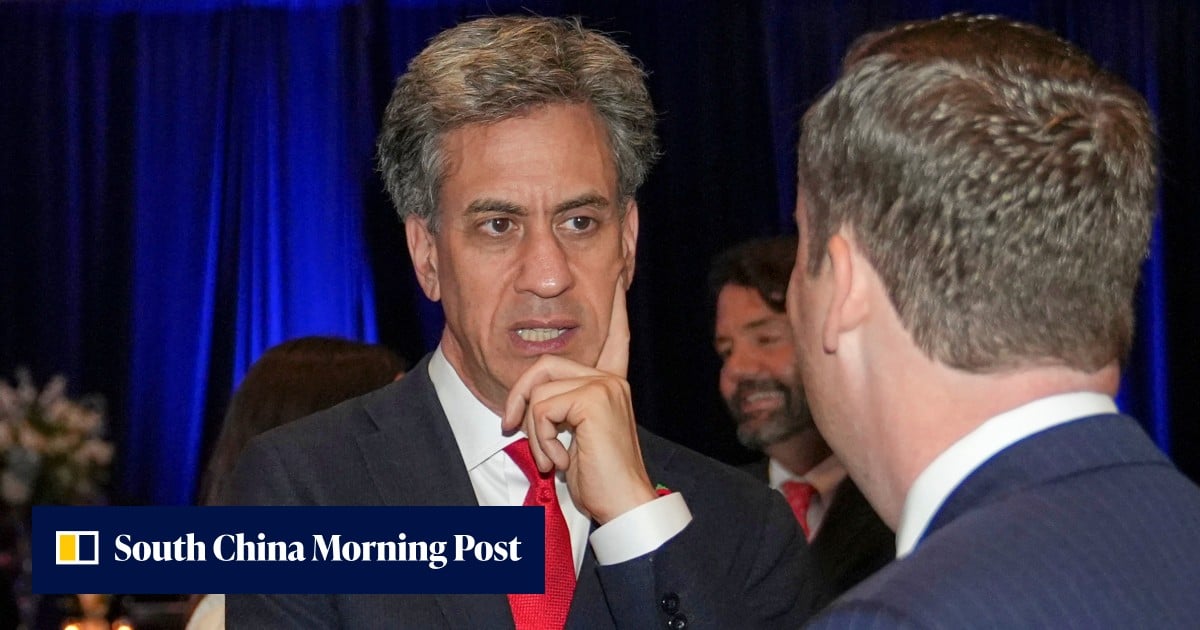
Photo via New York Post

Stand firm, King Charles — Britain owes no apologies for slavery

Read the original at New York Post ↗
Cite

Lowry, R. (2026, November 3). Stand firm, King Charles — Britain owes no apologies for slavery. New York Post. https://nypost.com/2026/11/03/opinion/stand-firm-king-charles-britain-owes-no-apologies-for-slavery/

Dated from the outlet's own feed. Check the original for its byline.

New York Post · collected 2026-11-03 · by Rich Lowry

Quick Summary

The article discusses whether the United Kingdom should apologize for its role in the transatlantic slave trade. Prime Minister Andy Burnham proposes that an apology is necessary and “patriotic,” while critics argue this stance reflects Western guilt and double standards. The piece highlights historical examples of slavery practiced by various cultures, including ancient Egyptians, Greeks, Romans, Byzantines, Vikings, and Islamic societies, to underscore the global nature of the institution and challenge Britain's sole responsibility for reparations or apologies related to slavery.
Written by AI on 2026-11-04, from this article's own text only (the story summary below draws on all the coverage).

AI analysis

Story summary

Prime Minister Andy Burnham of the United Kingdom is considering whether the UK should formally apologize for its participation in the transatlantic slave trade. This debate has been prompted by pressure from Caribbean countries within the British Commonwealth. However, conservative commentators argue that such an apology would be hypocritical given that slavery was widespread historically and that Britain played a significant role in abolishing it over two centuries ago. Rich Lowry of the New York Post suggests that focusing on Britain's historical involvement while ignoring other nations' roles, like the Arab slave trade which took more than a million slaves from East Africa in the 19th century, demonstrates double standards and excessive Western guilt.

Written for “British Slavery Apology Refused” on 2026-11-21, grounded in this article and the 0 other(s) covering the same event.

Compared with similar articles

This article reads leans strongly right and hedges 4% of its claims. Each row says how that neighbour differs.
BBC News
Hedges 1 of 11 claims Outlet record 65/100
“The articles discuss different aspects of the debate over whether the UK should apologize for its role in the transatlantic slave trade, rather than reporting on a single specific incident or statement.”
BBC News
Hedges 2 of 23 claims Outlet record 65/100
“The articles discuss different aspects of the UK's stance on apologizing for its role in the transatlantic slave trade, but describe distinct comments and positions from different officials at different times.”
The Guardian
Hedges 0 of 16 claims Outlet record 64/100
“The articles discuss different viewpoints on whether Britain should apologize for its role in the slave trade, with Article A focusing on Kemi Badenoch's stance and Article B criticizing Andy Burnham's position.”
Toronto Star
Hedges 1 of 24 claims Outlet record 64/100
“The articles discuss different aspects of the issue: Article A reports on Prime Minister Andy Burnham's announcement that his government will consider apologizing for Britain's role in the slave trade, while Article B critiques this potential apology and discusses the debate surrounding it.”
South China Morning Post
Hedges 0 of 2 claims Outlet record 62/100
“The articles discuss similar themes but focus on different aspects: Article A reports PM Burnham's stance on a potential apology for slavery, while Article B critiques the debate over whether Britain should apologize and mentions Burnham's position indirectly.”
The Hindu
Hedges 3 of 32 claims Outlet record 78/100
“While both articles discuss Prime Minister Andy Burnham's stance on apologizing for Britain’s role in slavery, they describe different aspects of this broader topic. Article A reports his initial statement and opinion piece in The Guardian, while Article B discusses the ongoing debate and reaction to his position.”
Al Jazeera
Leans strongly left further left than this Hedges 2 of 34 claims Outlet record 60/100
“The articles discuss different perspectives on whether Britain should apologize for its role in the transatlantic slave trade but do not describe a single specific incident occurring at a particular time and place.”
South China Morning Post
Hedges 1 of 7 claims Outlet record 62/100
“The articles discuss different aspects of the UK's potential apology regarding slavery, with Article A focusing on the debate and Prime Minister Andy Burnham's stance, while Article B reports on Foreign Secretary Ed Miliband's statements about a possible formal apology without financial compensation.”
The Guardian
Leans left further left than this Hedges 4 of 40 claims Outlet record 64/100
“The articles discuss related topics regarding apologies for slavery but describe different stages or aspects of the debate in Britain and reference a past event in the Netherlands.”
Evening Standard
Hedges 0 of 19 claims Outlet record 64/100
“While both articles discuss the possibility of Britain issuing an apology for slavery and mention Prime Minister Andy Burnham's stance, they do not describe the same specific incident or occurrence. Article A reports on Burnham expressing his views, while Article B discusses a debate around the issue without specifying if it is about a single event.”

Story

British Slavery Apology Refused
Politics · 1 article(s) covering the same event.
How this article was measured signals, leaning charts, publisher record, byline, topics and claims

Signals How these are calculated →

Claims extracted
23
sentences that state something as happening or true
Uncertain
4%
1 of 23 hedged ("reportedly", "may", "according to")
Leaning
Leans strongly right
of the writing, not the subject · beta estimate
Publisher signals
66/100
New York Post's corrections and hedging, across everything collected from it. Not a measure of accuracy.
Outlets on this story
1
Politics
Same framing elsewhere
1
articles that frame the event the way this one does
Analyzed 2026-11-04 · how these are computed

How this is being covered How these are calculated →

Article leaning vs. publisher reliability
Source leaning vs. consistency

Publisher

New York Post · 21764 article(s) · 42 correction(s) detected
Running correction rate · 42 correction(s)

Who wrote this

Rich Lowry
14 article(s) here · 1 carrying a prediction
Positing an equivalence between Russia and Ukraine regarding infrastructure attacks is preposterous; it brings to mind the old William F. Buckley line about the insanity of condemning both a man who pushes an old woman into the path of an oncoming bus, and a man who pushes her out of its way, for shoving old ladies around.
When the group with Pete Hegseth laughed and began to chatter after taking a photo, the voice of Spc. Thomas Iglesias rang out, “All visitors will maintain an atmosphere of silence and respect at all times!”
JD Vance may have many ambitions, but being the next Hubert Humphrey probably isn’t one of them.
Not any time soon, we can assume, since no one is asking it to apologize and presumably no one ever will.
President Donald Trump says the Iran war will end “soon,” a promise he’s been making most of this year.
One would seem plenty, but Alaska is going to the polls with two “Dan Sullivans” on the ballot — one the sitting Republican US senator in a nip-and-tuck battle to save his seat, and the other a random guy whose only discernible purpose in the race is to divert precious votes from the real Dan Sullivan.
Now, El-Sayed could say that none of this has anything to do with him, since his biological mother didn’t raise him, and that his mother made a mistake in working for the Brotherhood.
It started as demonstrations against underfunded schools and have morphed into a red-green campaign of mayhem ranging much more widely. Palestinian flags and the slogan “Free Palestine” are ubiquitous.
Trump’s standing will have much to do with whether such a thing happens.
Winston Churchill said that “wars are not won by evacuations” — and sometimes, he might have added, they are simply embarrassing.
Also by Rich Lowry
Nothing else under this byline is closely related to this article, so these are simply their most recent.
All 14 articles by Rich Lowry →

Topics

Britain Ethiopia Islam Muslim the United Kingdom

Subjects

Britain GPE · 3× British NORP · 2× Ethiopia GPE · 2× Islam ORG · 2× Andy Burnham PERSON · 1× Labour Party ORG · 1× Muslim NORP · 1× Western NORP · 1× the British Commonwealth GPE · 1× the United Kingdom GPE · 1×

Narrative

“But as Islam spread between the 8th and 15th centuries, and especially to black Africa, it extended and confirmed the commonplace use of slavery and slave trading.” As part of the so-called Arab slave trade, more than a million slaves were taken from East Africa in the 19th century, and the flow continued apace into the 20th century.
framing: assertive · carried by 1 article(s) · first seen 2026-11-04
Not any time soon, we can assume, since no one is asking it to apologize and presumably no one ever will.
2026-11-04 · New York Post
Stand firm, King Charles — Britain owes no apologies for slavery · assertive framing

Claims (23 extracted, 1 hedged)

When is the Muslim world going to apologize for its slave raids in Central and Eastern Europe that made off with millions of captives? asserted
that → go → captives
Not any time soon, we can assume, since no one is asking it to apologize and presumably no one ever will. asserted
one → assume → it
The same isn’t true in the United Kingdom, where there’s a hot debate over whether the country should apologize over its participation in the transatlantic slave trade — in what would be a stark expression of double standards and Western guilt. asserted
what → ’ → standards
Prime Minister Andy Burnham, whose contemporary Labour Party has a taste for self-abasement, wants to have “difficult conversations” over such an apology, and says that it’s “the patriotic thing to do.” asserted
it → have → apology
He is “offering a structured dialogue with those affected by the transatlantic slave trade,” never mind that Britain abolished the trade more than two centuries ago. asserted
Britain → offer → trade
It’s perverse for the UK — pressured by Caribbean countries within the British Commonwealth — to consider a formal apology, given that slavery was a universal phenomenon and Britain had an honored role in snuffing it out. asserted
Britain → ’ → it
The ancient Egyptians embraced slavery, and so did the Greeks and Romans. asserted
Greeks → embrace → slavery
After the fall of the Roman Empire in the West, the Byzantines, the Vikings and Central Asian societies all relied on slave labor. asserted
Byzantines → rely → labor
They weren’t alone; the institution spanned every type of society. asserted
institution → span → society
Historian Stewart Gordon notes that Ethiopia’s legal code in the mid-13th century “recognized slaves as central to the economy and defined the acquisition and holding of slaves as the natural order of things.” asserted
code → note → things
In the 16th century, he writes, Ethiopia “was a full slave society.” asserted
Ethiopia → write → century
The transatlantic slave trade couldn’t have operated without the participation of West African rulers, who took slavery for granted long before European slavers showed up and continued the practice after they left. asserted
they → operate → practice
Something that’s almost never mentioned in the debate over accountability for slavery is that North African slave traders enslaved enormous numbers of white Europeans between the 16th and 18th centuries. asserted
traders → mention → centuries
Also inconvenient to an anti-Western narrative is that, as James Walvin writes in his book “A Short History of Slavery”: “Islamic societies were characterized by the widespread and generally unchallenged use of slavery. asserted
characterized → write → slavery
“But as Islam spread between the 8th and 15th centuries, and especially to black Africa, it extended and confirmed the commonplace use of slavery and slave trading.” As part of the so-called Arab slave trade, more than a million slaves were taken from East Africa in the 19th century, and the flow continued apace into the 20th century. asserted
flow → spread → century
According to Gordon, “Perhaps the last large-scale movement of East African slaves to the Middle East was in the 1920s. uncertain
movement → accord → 1920s
Britain, beginning in earnest in the 17th century, became a central cog in the transatlantic slave trade, an industrial-scale enterprise of stomach-turning cruelty. asserted
Britain → begin → cruelty
Its ships transported millions of slaves, while the plantation economies of its Caribbean possessions depended on slave labor. asserted
economies → transport → labor
Then, in an extraordinary triumph of morality over unjust profit-making, William Wilberforce and his fellow abolitionists convinced British society to abolish the slave trade — and eventually slavery itself. asserted
Wilberforce → convince → trade
If the institution of slavery was very old, the influence of this Christian-driven attitude to human rights was new. asserted
influence → drive → rights
The British went further than simply turning their back on slavery: They used their navy to suppress the slave trade, and their diplomatic sway to push other countries to give up the trade as well. asserted
They → go → trade
At considerable cost to itself in terms of military effort and financial resources (it paid off Spain, for instance), the United Kingtom did much more than its share to make abolition the international norm — on top of its other outsized contributions to the creation of the modern world. asserted
abolition → pay → world
Rather than contemplating a groveling apology, the UK’s attitude should be this: “A simple ‘thank you’ will suffice.” asserted
attitude → contemplate → you

Give feedback · no sign-in needed

No sign-in needed for now. Your note is sent without a name, so it cannot be answered.

History Support