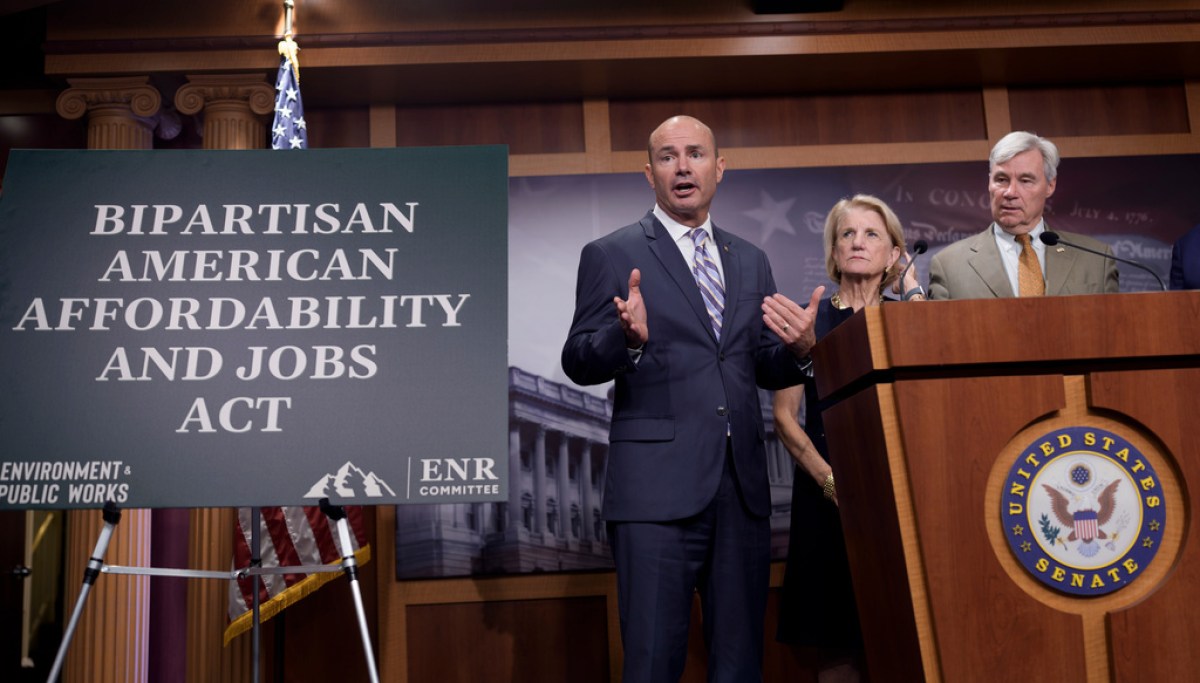
Photo via Washington Examiner

Incoming Democratic majorities will try to swing pendulum back on clean energy

Read the original at Washington Examiner ↗
Cite

Patteson, C. (2026, November 4). Incoming Democratic majorities will try to swing pendulum back on clean energy. Washington Examiner. https://www.washingtonexaminer.com/policy/energy-and-environment/4779438/incoming-democratic-majorities-swing-pendulum-clean-energy/

Dated from the outlet's own feed. Check the original for its byline.

Washington Examiner · collected 2026-11-04 · by Callie Patteson

Quick Summary

Democrats are expected to reverse recent Republican policies by reinstating funding for wind and solar power while re-regulating fossil fuel industries. Key priorities include passing legislation to streamline federal permitting processes, enabling easier construction of essential infrastructure like power lines and highways. A bipartisan bill called the Bipartisan American Affordability and Jobs Act aims to facilitate clean energy project development but faces resistance from some Democrats concerned about potential abuse by the Trump administration. Rep. Scott Peters supports quick passage, while others like Rep. Jared Huffman advocate for thoughtful reform that protects environmental laws and community interests.
Written by AI on 2026-11-04, from this article's own text only (the story summary below draws on all the coverage).

AI analysis

Story summary

With Democrats set to regain the majority in Congress starting next year, significant shifts in clean energy policy are expected. The incoming Democratic majorities aim to reverse the Republican agenda of cutting funding for wind and solar power, while also rolling back deregulation of fossil fuel industries. While both parties share interest in boosting nuclear power and geothermal energy, Democrats prioritize reforms that ease the construction and upgrading of transmission infrastructure, particularly for renewable projects. Democrats have been supportive of bipartisan legislation like the Bipartisan American Affordability and Jobs Act (BAAJ) to streamline federal permitting processes but remain cautious about potential biases in its implementation by the current administration.

Written for “Democratic Majories Push Clean Energy Policies” on 2026-11-21, grounded in this article and the 0 other(s) covering the same event.

Compared with similar articles

This article reads leans left and hedges 6% of its claims. Each row says how that neighbour differs.
Semafor
Leans right further right than this Hedges 1 of 17 claims Outlet record 64/100
“The articles discuss different perspectives on the political shift following Democrats retaking Congress but do not describe the same specific incident or occurrence.”
Mother Jones
Leans strongly left further left than this Hedges 2 of 54 claims Outlet record 60/100
“The articles discuss different aspects of political shifts but do not refer to the exact same specific event or outcome.”
Deutsche Welle
Leans left Hedges 8 of 42 claims Outlet record 95/100
“The articles discuss different aspects of political strategy regarding climate and energy policy over time, rather than a single specific event.”
The Dispatch
Centre further right than this Hedges 0 of 2 claims Outlet record 61/100
“The articles discuss different aspects of energy policy and politics, with Article A focusing on general debates about affordability and permitting reform on Election Day, while Article B focuses on the expected shift in clean energy policy due to Democrats retaking Congress.”
Just The News
Leans left Hedges 1 of 46 claims Outlet record 58/100
“The articles discuss future policy directions and shifts in priorities due to upcoming Democratic control, but do not describe a single specific immediate event occurring at the same time and place.”
TIME
Leans left Hedges 11 of 34 claims Outlet record 60/100
“The articles discuss different aspects of potential policy shifts under a Democratic majority but do not describe the same specific incident or occurrence.”
The Daily Caller
Hedges 8 of 64 claims Outlet record 92/100
“The articles discuss similar themes about energy policy shifts with Democratic majorities but do not describe the same specific incident at a particular time and place.”

Story

Democratic Majories Push Clean Energy Policies
Politics · 1 article(s) covering the same event.
How this article was measured signals, leaning charts, publisher record, byline, topics and claims

Signals How these are calculated →

Claims extracted
62
sentences that state something as happening or true
Uncertain
6%
4 of 62 hedged ("reportedly", "may", "according to")
Leaning
Leans left
of the writing, not the subject · beta estimate
Publisher signals
67/100
Washington Examiner's corrections and hedging, across everything collected from it. Not a measure of accuracy.
Outlets on this story
1
Politics
Same framing elsewhere
1
articles that frame the event the way this one does
Analyzed 2026-11-04 · how these are computed

How this is being covered How these are calculated →

Article leaning vs. publisher reliability
Source leaning vs. consistency

Publisher

Washington Examiner · 5251 article(s) · 11 correction(s) detected
Running correction rate · 11 correction(s)

Who wrote this

Callie Patteson
50 article(s) here · 1 carrying a prediction
✈️🍂🦃🚗 (Or maybe even bike if that’s your kind of thing?)
If passed in the House, the Bipartisan American Affordability and Jobs Act would be one of the most significant bills signed by President Donald Trump during his second term in office.
A bill that would make it easier to build renewable energy, power lines, highways, data centers, and power plants has cleared the Senate with sweeping bipartisan support, marking the closest Congress has been to reforming federal approvals for energy and infrastructure projects.
Several Republican senators have introduced amendments that would scale back on provisions expanding the federal government’s authority to approve of interstate power lines.
We may not have made it to Thanksgiving yet, but holiday markets are already popping up around D.C.
2026-11-13 · assertive framing · Daily on Energy: US-China rare earth truce extended
The public land sales were detailed in the Interior Department’s four-year strategic plan released this week, which omitted key details about how much the agency wishes to sell off, what areas could be targeted, or when the sales will take place.
Millions in New England are expected to be hit by a developing nor’easter later in the week, which could bring the first round of snow to the region this fall and winter season.
2026-11-11 · assertive framing · Daily on Energy: A tiny truck with a big catch
Twenty-five senators voted Tuesday evening against advancing a bipartisan bill that would make it easier and faster to build pipelines, power lines, power plants, and highways.
We’ll be watching next week how the flipped chambers may influence immediate issues still before members in the lame-duck session, such as permitting reform.
By mid-May, gas prices jumped to $4.49 per gallon, and Trump’s approval rating plummeted to -17.50.
Also by Callie Patteson
Nothing else under this byline is closely related to this article, so these are simply their most recent.
All 50 articles by Callie Patteson →

Topics

Congress Democratic Democrats Senate the Washington Examiner

Subjects

Democrats NORP · 9× Congress ORG · 4× Senate ORG · 3× Democratic NORP · 2× House ORG · 2× the Washington Examiner ORG · 2× Republican NORP · 1× Republicans NORP · 1× Scott Peters PERSON · 1× Trump PERSON · 1×

Narrative

The bill includes several key Democratic priorities for building out clean energy projects, including making it easier to construct and upgrade transmission infrastructure, forcing data center developers to pay for the energy and transmission infrastructure needed for their operations, and providing permitting certainty for all energy projects.
framing: assertive · carried by 1 article(s) · first seen 2026-11-04
Democrats are set to try to reverse the Republican agenda of the past two years, which was to cut funding for wind and solar power while deregulating fossil fuel industries.
2026-11-04 · Washington Examiner
Incoming Democratic majorities will try to swing pendulum back on clean energy · assertive framing

Claims (62 extracted, 4 hedged)

A significant shift in energy policy is in store with Democrats retaking the majority in the next Congress. asserted
Democrats → retake → Congress
Democrats are set to try to reverse the Republican agenda of the past two years, which was to cut funding for wind and solar power while deregulating fossil fuel industries. asserted
which → set → industries
Recommended Stories Although there is shared interest between the parties in boosting nuclear power and geothermal, as well as reforming permitting, the Democratic majorities will bring a new set of priorities to Congress overall. asserted
majorities → be → Congress
The No. 1 issue: permitting reform Democrats have been broadly supportive of passing legislation to streamline the federal permitting process, making it easier to build power lines, highways, and other essential infrastructure. asserted
it → pass → lines
Many within the party view it as essential to connecting wind and solar to the grid. asserted
Many → view → grid
But Democrats have been hesitant to back bipartisan legislation because they worry that the Trump administration would not fairly implement changes to the permitting system and would continue to block renewable energy projects. asserted
administration → back → projects
Two key Senate Democrats struck a deal with Republicans in late September to introduce the Bipartisan American Affordability and Jobs Act, or BAAJA. asserted
Democrats → strike → Act
The bill includes several key Democratic priorities for building out clean energy projects, including making it easier to construct and upgrade transmission infrastructure, forcing data center developers to pay for the energy and transmission infrastructure needed for their operations, and providing permitting certainty for all energy projects. asserted
it → include → projects
“I personally hope that we pass the Senate package in the lame duck,” Rep. Scott Peters (D-CA), who sits on the Energy and Commerce Committee and acts as the Climate Task Force chair of the New Democrat Coalition, told the Washington Examiner. asserted
who → hope → Examiner
Peters said he believes that the legislation would improve affordability across the United States, aid the development of clean energy, and increase grid reliability. asserted
legislation → say → reliability
“I think it will resolve a lot of the issues that have been dogging us for a long time around energy,” he said. asserted
he → think → energy
The bill is set to be put to its first vote in the Senate Nov. 9. asserted
bill → set → Senate
If it passes, the House would then consider it. asserted
House → pass → it
Not all House Democrats are in favor of moving on the bill immediately after the election and would like to pick up the issue in the next Congress, criticizing changes to environmental laws such as the Clean Water Act, Endangered Species Act, and National Environmental Policy Act. asserted
Democrats → move → Act
Rep. Jared Huffman (D-CA), the ranking member of the Natural Resources Committee, has repeatedly called for Democrats to wait on permitting negotiations. asserted
Democrats → call → negotiations
“It will be a priority,” Huffman told the Washington Examiner in October. asserted
Huffman → tell → October
“But it will be thoughtful and responsible permitting reform that includes the grid improvements and clean energy buildout, but also protects our natural environment in appropriate ways and doesn’t throw tribes and front-line communities under the bus.” asserted
that → include → bus
Many policy experts have said that permitting reform is crucial to the success of other energy measures. Xan Fishman, executive vice president for energy at the Bipartisan Policy Center, described permitting reform as the “great enabler.” asserted
Fishman → say → enabler
“Any other kind of good energy policy that you might want to pass — whether it’s pure energy focused or whether it’s, you know, looking at the environmental outcomes of energy — Any of those really do require … permitting to have happened first,” he said. uncertain
he → want → those
Revisiting clean energy and electric vehicle tax credits Another top priority for Democrats in the next Congress will be reintroducing federal tax credits for clean energy resources and electric vehicles that the GOP scrapped last year. asserted
GOP → revisit → that
Democrats implemented massive spending on clean energy with the Inflation Reduction Act in 2022, which was the most significant climate-related bill in U.S. history in terms of spending on clean energy. asserted
which → implement → energy
The IRA expanded and established a broad set of tax credits for renewable energy resources, energy efficiency technologies, and carbon capture and storage projects, as well as electric vehicles. asserted
IRA → expand → resources
Republicans cut many of these subsidies just three years later through the One Big Beautiful Bill Act. asserted
Republicans → cut → Act
The bill, signed into law last summer, ended incentives for wind and solar projects by the end of 2027. asserted
bill → sign → 2027
It also eliminated a $7,500 credit for consumers purchasing electric vehicles. asserted
It → eliminate → vehicles
Huffman told the Washington Examiner that he’d “love to see” those subsidies revisited, particularly those for electric vehicles. asserted
subsidies → tell → vehicles
But he said that passing any bill reintroducing those subsidies would be an uphill battle. asserted
passing → say → subsidies
“I’m interested in doing whatever I can, but I also know who’s in the White House for the next two years. asserted
who → ’m → years
…I’m pretty clear-eyed about that,” Huffman said. asserted
Huffman → ’m → that
Fishman is skeptical that reinstating the credits will gain much traction, given how politicized the subsidies had become. asserted
subsidies → reinstate → traction
“Obviously a tax credit has an affordability hook,” he said. asserted
he → have → hook
“So, I do think some will push for that, but I don’t know — I don’t know that it’ll find consensus.” asserted
it → think → consensus
Some Democrats, however, have indicated that there is more support for clean energy tax credits across the aisle than one might expect. uncertain
one → indicate → aisle
Rep. Mike Levin (D-CA) pointed out that last year, nearly two dozen Republicans signed a letter supporting keeping the subsidies in place, even though they ultimately voted in favor of cutting them. asserted
they → point → them
“I think there is bipartisan support for restoring the credits, particularly once Donald Trump’s power over the Republican Party diminishes,” he said, later adding that even if some Republicans in Congress won’t admit their support publicly, “they certainly talk about it privately.” asserted
they → think → it
Even before the midterm elections, Republicans were bracing for Democratic-led investigations into the Trump administration if the majority flipped in either chamber. asserted
majority → brace → chamber
In September, House Minority Leader Hakeem Jeffries (D-NY) said the caucus was preparing a sweeping oversight agenda, focusing on possible corruption within the administration, particularly as the fossil fuel industry has benefited heavily from Trump’s second presidency. asserted
industry → say → presidency
Huffman told the Washington Examiner that an “enormous amount of oversight and investigation work” has to be done under a Democratic majority, saying “there’s no avoiding it.” asserted
amount → tell → it
“Some of the most controversial corruption schemes have taken place within the jurisdiction of this committee,” he said, referring to the Natural Resources Committee. asserted
he → take → Committee
Huffman, in particular, has already begun investigating, requesting records from corporate sponsors of the Freedom 250 celebrations this year regarding donations, access to federal officials, and other benefits. asserted
Huffman → begin → officials
…and 22 more, not listed.

Give feedback · no sign-in needed

No sign-in needed for now. Your note is sent without a name, so it cannot be answered.

History Support