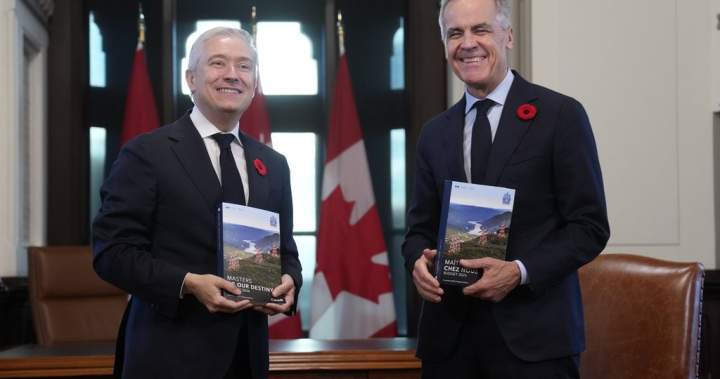
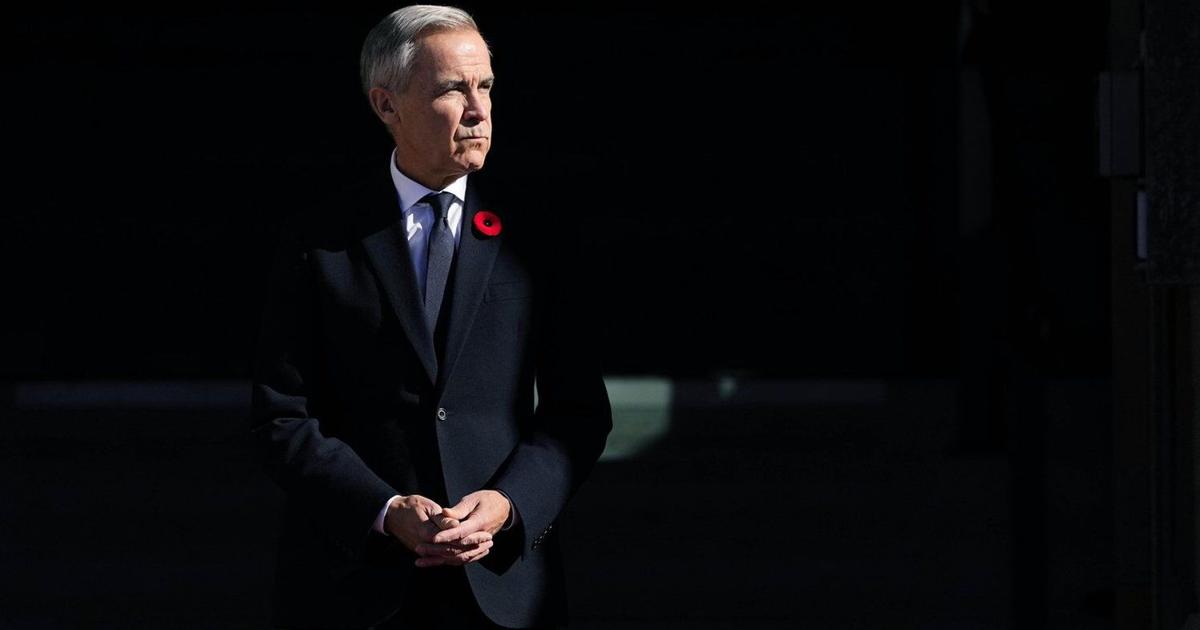
Photo via Global News

Carney’s ‘ambitious’ but ‘risky’ budget eyes investment in uncertain world

Read the original at Global News ↗
Cite

Boutilier, A. (2026, November 5). Carney’s ‘ambitious’ but ‘risky’ budget eyes investment in uncertain world. Global News. https://globalnews.ca/news/12138651/budget-2026-mark-carney/

Dated from the outlet's own feed. Check the original for its byline.

Global News · collected 2026-11-05 · by Alex Boutilier

Quick Summary

Prime Minister Mark Carney’s Liberal government presented its second budget with an ambitious plan to boost federal spending by $151 billion over five years, aiming to attract business investments and ease affordability issues for Canadians. The budget allocates funds from better-than-expected fiscal projections, despite the current global economic uncertainties and volatility. Finance Minister Francois-Philippe Champagne outlined three key pillars: attracting business investment through incentives like a productivity "mega deduction," addressing affordability challenges, and enhancing national sovereignty. Economists view this as both ambitious and risky, emphasizing that successful execution is crucial to avoid negative consequences for debt metrics and future economic stability.
Written by AI on 2026-11-06, from this article's own text only (the story summary below draws on all the coverage).
See how they differ ↓

AI analysis

Story summary

The Canadian government under Prime Minister Mark Carney officially unveiled its 2026 federal budget on November 5, 2026, focusing on a plan to change the nation's growth model and reduce economic reliance on the United States. Finance Minister Francois-Philippe Champagne stated that the budget prioritizes building domestic commerce, diversifying trade, and increasing Canadian sovereignty in response to shifting global trade dynamics and a U.S. trade war involving President Donald Trump. To achieve these goals, the government is utilizing a federal balance sheet bolstered by high energy prices and corporate profits to fund a long-term investment agenda, including financial guarantees for AI infrastructure and tax cuts for small businesses. Despite these measures, the budget has resulted in increased deficits and debt, with critics like former deputy finance minister Kevin Lynch warning that the government has spent its revenue windfall on new programs rather than reducing the deficit. Furthermore, the budget includes immigration targets that have faced criticism from Conservative Party leader Pierre Poilievre, who suggested the measures are part of a plan to increase the population to 100 million. While the government argues these investments will deliver future economic gains, some reports highlight that interest payments on existing debt are rising and that the federal borrowing rate remains a significant concern for taxpayers.

Written for “Canada's Budget 2026” on 2026-11-21, grounded in this article and the 55 other(s) covering the same event.

How they differ

9 outlets covered “Canada's Budget 2026”.

What each outlet says

One AI summary per outlet of its latest article on this story, written from that article alone and checked against it. Open the article for the outlet's own words.

Global NewsThis outlet5 Nov

Prime Minister Mark Carney’s Liberal government presented its second budget with an ambitious plan to boost federal spending by $151 billion over five years, aiming to attract business investments and ease affordability issues for Canadians. The budget allocates funds from better-than-expected fiscal projections, despite the current global economic uncertainties and volatility. Finance Minister Francois-Philippe…

Carney’s ‘ambitious’ but ‘risky’ budget eyes investment in uncertain world (this article)12 articles from Global News on this story
Toronto Star6 Nov

The federal budget for 2026 in Canada did not introduce any new measures to address student affordability issues or funding shortfalls in post-secondary education. Despite recognizing the importance of universities and colleges as key contributors to economic growth, the budget failed to provide additional support for students facing financial hardships or academic staff experiencing program cuts and job losses…

Federal budget 2026 silent on student affordability and public funding shortfall in post-secondary education →14 articles from Toronto Star on this story
CBC6 Nov

Prime Minister Mark Carney defended Canada's new immigration levels plan, which expects almost 660,000 new permanent residents in 2027, while Conservative Leader Pierre Poilievre criticized the numbers as unsustainable. The federal government plans to grant a combined total of more than one million people either permanent or temporary residency next year, with regular intakes set at 380,000 permanent and 370,000…

Carney says new immigration levels plan is 'sustainable' as it draws ire of Conservatives →11 articles from CBC on this story
The Globe and Mail9 Nov

Prime Minister Mark Carney’s federal budget proposes a $30-billion plan to end homelessness in Canada by 2036. The initiative includes funding for 25,000 supportive and transitional homes, rental assistance, and health facilities addressing social needs. Housing experts welcome the pledge but emphasize the need for additional details and provincial cooperation to ensure success.

Housing experts welcome Ottawa’s plan to eradicate homelessness, but call for more details, funding →7 articles from The Globe and Mail on this story
The Hub9 Nov

The Canadian federal government has announced that it has reduced its workforce to meet the target of 330,000 employees by March 2029, well ahead of schedule. This reduction includes significant cuts in major departments such as the Canada Revenue Agency and Immigration, Refugees and Citizenship Canada, with reductions ranging from 15% to almost 32%. However, despite these cuts, federal employment is still 29%…

Is Canada’s runaway big-government bureaucracy finally under control? →5 articles from The Hub on this story
Toronto Sun12 Nov

This editorial criticizes Prime Minister Mark Carney’s government for misclassifying hundreds of billions of dollars in borrowing to finance government programs as investments rather than liabilities, thus obscuring the true extent of federal debt. Parliamentary Budget Officer Annette Ryan warns that federal borrowing is growing at more than double the rate of deficits, reaching $732.9 billion over the next five…

EDITORIAL: Beware Carney’s borrowing bomb →4 articles from Toronto Sun on this story
Show 3 more outlets
The Straits Times5 Nov

Canadian Prime Minister Mark Carney’s government presented its second budget on November 5 aimed at reducing reliance on the United States. Finance Minister Francois-Philippe Champagne emphasized diversifying trade and boosting domestic commerce within Canada as key priorities. The budget includes funding for national projects such as infrastructure for energy production and critical mineral mining, while also…

Canada unveils budget to curb reliance on US →
South China Morning Post6 Nov

Canada has unveiled a new budget titled “Masters of our Destiny,” which emphasizes economic independence from the United States. The plan acknowledges the ongoing shift away from traditional reliance on the U.S., noting it will take time but is underway. Presented two days after President Trump’s midterm election losses, the budget outlines Canada's intention to reduce its dependence on the U.S. market despite…

Canada budget charts ‘economic independence’ in decisive shift from US →
The Blaze9 Nov

Prime Minister Mark Carney’s Liberal government announced plans to increase immigration to Canada, aiming to grant permanent residency to approximately 380,000 migrants and admit another 370,000 temporary residents each year from 2027 to 2029. This includes additional one-time measures that could boost the number of permanent residents in 2027 to about 660,000. Conservative Party leader Pierre Poilievre and other…

'This is insane': Mark Carney slammed for overloading Canada with immigrants →

Where they agree and split

Framing

How the first headlines put it

Attributed to a source2
Stated as fact1
The headlines (3)

Budget 2026 is about ‘us,’ not the U.S. trade war, finance minister says Global News · attributed to a source

Federal budget is about 'changing Canada's growth model,' finance minister says Toronto Star · attributed to a source

Canada's next budget to be unveiled this week amid U.S. trade war, economic uncertainty CBC · stated as fact

Words to watch (1)

'This is insane': Mark Carney slammed for overloading Canada with immigrants The Blaze

The full story: what happened, how it changed, and all 56 articles →

Compared with similar articles

This article reads leans left and hedges 0% of its claims. Each row says how that neighbour differs.
Global News
Leans left Hedges 1 of 11 claims Outlet record 63/100
CBC News
Hedges 2 of 30 claims Outlet record 72/100
The Globe and Mail
Hedges 0 of 2 claims Outlet record 51/100
CBC News
Leans left Hedges 3 of 38 claims Outlet record 72/100
The Globe and Mail
Leans strongly left further left than this Hedges 5 of 61 claims Outlet record 51/100
CBC News
Hedges 5 of 46 claims Outlet record 72/100
Toronto Star
Leans left Hedges 1 of 35 claims Outlet record 64/100
Toronto Star
Hedges 0 of 17 claims Outlet record 64/100
CBC News
Hedges 2 of 18 claims Outlet record 72/100
The Globe and Mail
Leans left Hedges 5 of 66 claims Outlet record 51/100

Story

Canada's Budget 2026
Economy/Business · 56 article(s) covering the same event. Compare every outlet's account →
How this article was measured signals, leaning charts, publisher record, byline, topics and claims

Signals How these are calculated →

Claims extracted
34
sentences that state something as happening or true
Uncertain
0%
0 of 34 hedged ("reportedly", "may", "according to")
Leaning
Leans left
of the writing, not the subject · beta estimate
Publisher signals
63/100
Global News's corrections and hedging, across everything collected from it. Not a measure of accuracy.
Outlets on this story
56
Economy/Business
Same framing elsewhere
1
articles that frame the event the way this one does
Analyzed 2026-11-06 · how these are computed

How this is being covered How these are calculated →

Article leaning vs. publisher reliability
Source leaning vs. consistency

Publisher

Global News · 3540 article(s) · 13 correction(s) detected
Running correction rate · 13 correction(s)

Who wrote this

Alex Boutilier
26 article(s) here · 1 carrying a prediction
It’s not a question of “if” but “how” Prime Minister Mark Carney will seek to deepen economic ties with China amidst a global reordering provoked by U.S. President Donald Trump, experts say.
Reuters reported that Huang’s exit has plunged the approximately $4 trillion company into uncertainty, and could disrupt the AI ecosystem that he helped foster by investing Nvidia’s profits back into the industry.
However, experts are skeptical that its voluntary nature and say without teeth, such agreements will not work.
The budget documents devoted a few short sentences to how the biggest cash injection in the agency’s history will be used, other than it will allow CSIS to better “engage” Canadians and protect against threats like terrorism, foreign interference and espionage.
“But if they don’t execute, then, it means that our debt metrics will have considerably deteriorated and it will be up to a workforce that is aging to support all of that into the future …
The budget notes that money will come from existing National Defence resources.
The Liberal government is set to table its 2026 budget Thursday amid continued economic uncertainty and the ongoing trade war with U.S. President Donald Trump’s administration.
Americans will head to the polls Tuesday to vote in consequential midterm elections that could hobble U.S. President Donald Trump’s administration for the next two years.
Finance Minister Francois-Philippe Champagne said Monday that this week’s federal budget will focus more on the government’s efforts to build up Canada’s economy and trade than the ongoing trade war with U.S. President Donald Trump.
A recent analysis by the Parliamentary Budget Office suggested reaching that target would require “core” defence spending to increase from $95.7 billion in 2030 to $163.7 billion in 2035-36.
Also by Alex Boutilier
Nothing else under this byline is closely related to this article, so these are simply their most recent.
All 26 articles by Alex Boutilier →

Topics

Canadian Canadians Finance Liberal the Canada Growth Incentive

Subjects

Canadian NORP · 3× Champagne PERSON · 2× Canadians NORP · 1× Carney PERSON · 1× Finance ORG · 1× Francois-Philippe Champagne PERSON · 1× Jimmy Jean PERSON · 1× Liberal NORP · 1× Mark Carney PERSON · 1× the Desjardins Group ORG · 1×

Narrative

The budget includes multiple consumer and affordability measures including changes to simplify the tax system for individuals and businesses, multiple new tax credits, raising the limit on consumer savings covered by CDIC insurance from $100,000 to $250,000, making the Canada Strong Pass permanent, making museum admission free for those under 25, allowing the intergenerational farm transfer to be used for nieces and nephews, and enhancing the Canada Groceries and Essentials Benefit, which would boost the benefit by $339 for a single person and up to $679 for a couple with two children.
framing: assertive · carried by 1 article(s) · first seen 2026-11-06
“But if they don’t execute, then, it means that our debt metrics will have considerably deteriorated and it will be up to a workforce that is aging to support all of that into the future …

Claims (34 extracted, 0 hedged)

The Liberal government is significantly boosting federal spending in an attempt to draw in business investment and address the affordability struggles of Canadians just days after Prime Minister Mark Carney said that the world is becoming “more dangerous and divided.” asserted
world → boost → Canadians
It’s a document experts say is both “ambitious” and “risky” amid significant global unknowns and volatility that has left consumers struggling with the soaring cost of just about everything. asserted
that → ’ → everything
Carney’s sophomore budget commits an additional $151 billion over five years in “supports” for Canadian households, businesses and other levels of government. asserted
budget → commit → government
That money is entirely taken from better-than-expected government fiscal projections, both higher than expected revenues and tightened government operational spending, which gave Finance Minister Francois-Philippe Champagne $158 billion to play with the planning horizon. asserted
which → take → horizon
The decision to use the windfall for spending gave the government room to take some big fiscal swings while keeping the deficits relatively stable at $62.3 billion in 2026-27 and declining over the five-year spending plan. “With solid revenue growth, and (a) shift towards capital investment and clear strategies, we are in a position to transform our economy towards stronger growth and productivity,” Champagne said in his budget speech Thursday. asserted
Champagne → use → speech
“Economic growth gives us the means. asserted
growth → give → means
Our plan is to turn that growth into greater opportunity, greater security, and a better life for all.” asserted
plan → turn → all
Champagne is selling the budget as built around three broad pillars: boosting business investment, addressing the affordability crunch, and defending Canadian sovereignty while celebrating shared heritage. asserted
Champagne → sell → heritage
To attract private sector investment, the government is strategy is centered on a productivity “mega deduction,” which allows businesses to immediately deduct the full cost of new investments, the Canada Growth Incentive to encourage entrepreneurs to reinvest capital gains into new businesses, and billions toward research and development. asserted
businesses → attract → research
Taken together, the government is calling these an “investment supercycle.” asserted
government → take → these
The hope is to both boost Canadian business investment while attracting $1 trillion in foreign direct investment over the coming years. asserted
hope → boost → years
Jimmy Jean, the chief economist with the Desjardins Group, characterized the budget as “risky” but said it’s clear that the government is leaning heavily into the push to drum up investment and grow the economy. “Really they’re going all in on this. asserted
they → characterize → this
So very ambitious,” said Jean. asserted
Jean → say → ?
“But if they don’t execute, then, it means that our debt metrics will have considerably deteriorated and it will be up to a workforce that is aging to support all of that into the future … asserted
that → execute → future
Taken together, the government is spending $67 billion on various initiatives aimed at enticing investment and strengthening the economy. asserted
government → take → economy
The budget comes just two days after the U.S. midterm elections that saw voters deliver a stark rebuke to the administration south of the border over the soaring cost of living caused by the war in Iran and the trade war, as well as growing global unrest in India, France, Italy, and multiple European countries over deteriorating public services and prospects for youth. asserted
voters → come → youth
The budget includes multiple consumer and affordability measures including changes to simplify the tax system for individuals and businesses, multiple new tax credits, raising the limit on consumer savings covered by CDIC insurance from $100,000 to $250,000, making the Canada Strong Pass permanent, making museum admission free for those under 25, allowing the intergenerational farm transfer to be used for nieces and nephews, and enhancing the Canada Groceries and Essentials Benefit, which would boost the benefit by $339 for a single person and up to $679 for a couple with two children. asserted
which → include → children
The government is also boosting the Nutrition North program by $610 million over five years to address astronomical food costs for northern Canadian communities, and making the federal caregiver credit fully refundable. asserted
credit → boost → communities
Still, the amount allocated on affordability measures is comparatively small, Jean says. asserted
Jean → allocate → measures
“It seems like, affordability is more treated from the lens of what they are provided for: for groceries or for rebates. asserted
they → seem → rebates
Certainly, they extend some of that, but they’re not going much further in terms of, addressing some of the still-acute cost of living issues many Canadians are dealing with,” Jean said. asserted
Jean → extend → issues
By far the biggest change in this year’s budget is that the government is providing hard figures on their plans to dramatically increase defence spending. asserted
government → provide → spending
After years of lagging behind, Canada hit the NATO target of spending two per cent of GDP on defence this year. asserted
Canada → lag → defence
Carney has committed to upping that to five per cent of GDP by 2035. asserted
Carney → commit → 2035
Based on government’s plan Thursday, core defence spending will increase from $75.1 billion in 2026-27 to $99.2 billion in 2030-31 — making defence, along with Old Age Security and debt service charges, among the most significant line items in the federal budget. asserted
defence → base → budget
While it’s mentioned throughout the document, trade tensions with the U.S. — the single largest political issue of Carney’s prime ministership so far —is not a central focus of the budget document. asserted
tensions → mention → document
In fact, the document opens by noting that the economic headwinds created by Donald Trump’s trade war have been largely offset by stronger-than-expected economic performance to start 2026. asserted
headwinds → open → 2026
But Kevin Page with the Institute for Fiscal Studies and Democracy said the government’s highlighting of its fiscal position does not take tell the full story. asserted
highlighting → say → story
While deficit numbers remain relatively stable over the budget’s planning horizon, Page noted, the federal government’s financial requirements — including loans and investments — is significantly higher. asserted
requirements → remain → loans
The cost of servicing the federal debt is likewise increasing over the budget’s planning horizon. asserted
cost → service → horizon
That’s going to reduce the federal government’s room to maneuver in future years, Page warned. asserted
Page → go → years
“We know finance ministers and cabinet ministers that are looking to fund new initiatives going forward, they’re going to have less and less fiscal room because the fastest (growing) spending component is interest on the public debt,” Page said in an interview. asserted
Page → know → interview
In his budget speech, Champagne noted that Canada has seen “what happens around the world when governments lose their fiscal room to manoeuvre.” “Choices become harder,” Champagne’s speech read. asserted
speech → note → room
Speaking to reporters Thursday afternoon, Champagne downplayed concerns over debt servicing costs — noting that things aren’t as bad as in the late 1980s, when the Canadian government was in a fiscal crisis that led to massive cuts to public spending in the early 1990s. asserted
that → speak → 1990s
Give feedback · no sign-in needed

No sign-in needed for now. Your note is sent without a name, so it cannot be answered.

History Support