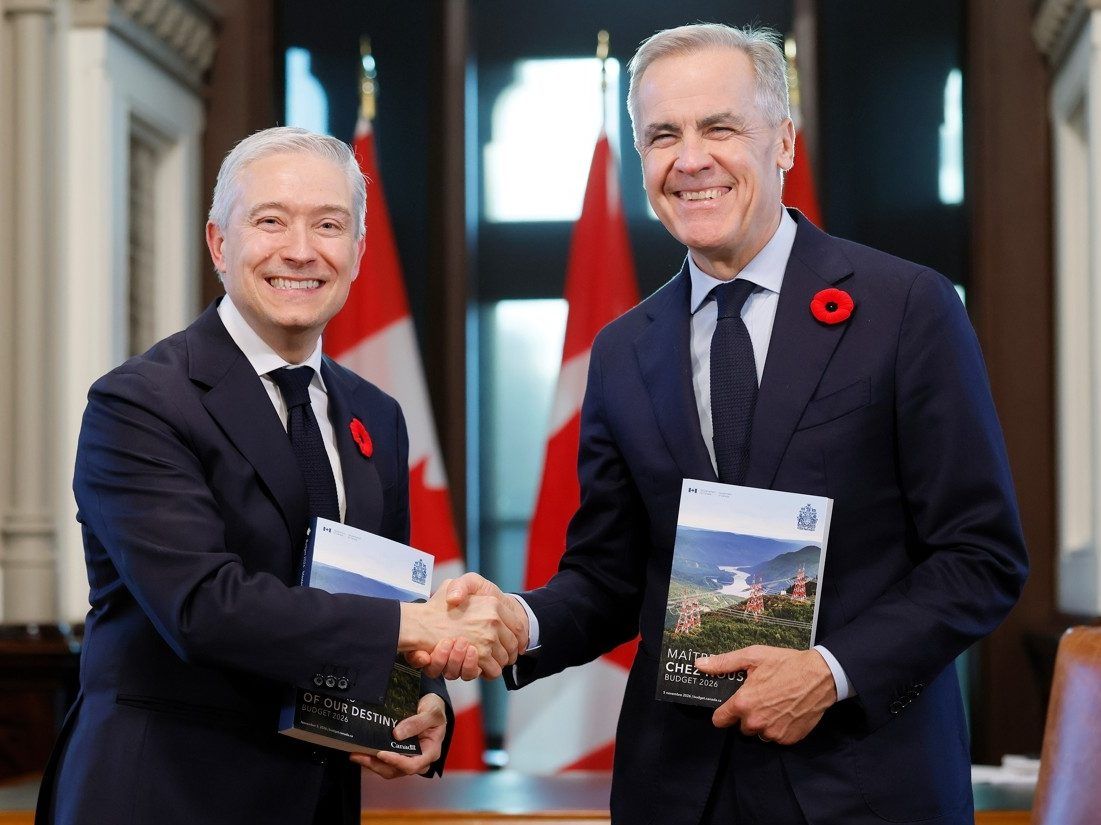
Photo via CBC News

Mark Carney's quiet revolution rests on investment and affordability

Read the original at CBC News ↗
Cite

Wherry, A. (2025, November 9). Mark Carney's quiet revolution rests on investment and affordability. CBC News. https://www.cbc.ca/news/politics/carney-champagne-budget-master-destiny-analysis-9.7411333?cmp=rss

Dated from the outlet's own feed. Check the original for its byline.

CBC News · collected 2026-11-06 · by Aaron Wherry

Quick Summary

Finance Minister François-Philippe Champagne presented Canada's second budget under Prime Minister Justin Trudeau, emphasizing investment and economic growth as part of what some are calling a "quiet revolution." The budget proposes a $36 billion productivity mega-deduction over five years to reduce business taxes on new investments, aiming for an "investment supercycle." Additionally, the government plans significant spending on clean electricity ($50 billion), forestry transformation ($2 billion), and critical minerals development ($1.7 billion). While these measures target long-term economic growth, the budget also addresses immediate affordability issues facing Canadians.
Written by AI on 2026-11-06, from this article's own text only (the story summary below draws on all the coverage).
See how they differ ↓

AI analysis

Story summary

The Canadian government under Prime Minister Mark Carney officially unveiled its 2026 federal budget on November 5, 2026, focusing on a plan to change the nation's growth model and reduce economic reliance on the United States. Finance Minister Francois-Philippe Champagne stated that the budget prioritizes building domestic commerce, diversifying trade, and increasing Canadian sovereignty in response to shifting global trade dynamics and a U.S. trade war involving President Donald Trump. To achieve these goals, the government is utilizing a federal balance sheet bolstered by high energy prices and corporate profits to fund a long-term investment agenda, including financial guarantees for AI infrastructure and tax cuts for small businesses. Despite these measures, the budget has resulted in increased deficits and debt, with critics like former deputy finance minister Kevin Lynch warning that the government has spent its revenue windfall on new programs rather than reducing the deficit. Furthermore, the budget includes immigration targets that have faced criticism from Conservative Party leader Pierre Poilievre, who suggested the measures are part of a plan to increase the population to 100 million. While the government argues these investments will deliver future economic gains, some reports highlight that interest payments on existing debt are rising and that the federal borrowing rate remains a significant concern for taxpayers.

Written for “Canada's Budget 2026” on 2026-11-21, grounded in this article and the 55 other(s) covering the same event.

How they differ

9 outlets covered “Canada's Budget 2026”.

What each outlet says

One AI summary per outlet of its latest article on this story, written from that article alone and checked against it. Open the article for the outlet's own words.

CBCThis outlet6 Nov

Finance Minister François-Philippe Champagne presented Canada's second budget under Prime Minister Justin Trudeau, emphasizing investment and economic growth as part of what some are calling a "quiet revolution." The budget proposes a $36 billion productivity mega-deduction over five years to reduce business taxes on new investments, aiming for an "investment supercycle." Additionally, the government plans…

Mark Carney's quiet revolution rests on investment and affordability (this article)11 articles from CBC on this story
Toronto Star6 Nov

The federal budget for 2026 in Canada did not introduce any new measures to address student affordability issues or funding shortfalls in post-secondary education. Despite recognizing the importance of universities and colleges as key contributors to economic growth, the budget failed to provide additional support for students facing financial hardships or academic staff experiencing program cuts and job losses…

Federal budget 2026 silent on student affordability and public funding shortfall in post-secondary education →14 articles from Toronto Star on this story
Global News6 Nov

Budget 2026 proposes several tax changes aimed at reducing the administrative burden on Canadians. Key among these is changing the tax filing deadline from April 30 to May 15 for all taxpayers and self-employed individuals, eliminating the previous June 15 deadline for self-employed workers. This change aims to simplify tax filings and could save Canadians $230 million in interest and penalty payments over five…

These are all the key tax changes and credits impacting you from the budget →12 articles from Global News on this story
The Globe and Mail9 Nov

Prime Minister Mark Carney’s federal budget proposes a $30-billion plan to end homelessness in Canada by 2036. The initiative includes funding for 25,000 supportive and transitional homes, rental assistance, and health facilities addressing social needs. Housing experts welcome the pledge but emphasize the need for additional details and provincial cooperation to ensure success.

Housing experts welcome Ottawa’s plan to eradicate homelessness, but call for more details, funding →7 articles from The Globe and Mail on this story
The Hub9 Nov

The Canadian federal government has announced that it has reduced its workforce to meet the target of 330,000 employees by March 2029, well ahead of schedule. This reduction includes significant cuts in major departments such as the Canada Revenue Agency and Immigration, Refugees and Citizenship Canada, with reductions ranging from 15% to almost 32%. However, despite these cuts, federal employment is still 29%…

Is Canada’s runaway big-government bureaucracy finally under control? →5 articles from The Hub on this story
Toronto Sun12 Nov

This editorial criticizes Prime Minister Mark Carney’s government for misclassifying hundreds of billions of dollars in borrowing to finance government programs as investments rather than liabilities, thus obscuring the true extent of federal debt. Parliamentary Budget Officer Annette Ryan warns that federal borrowing is growing at more than double the rate of deficits, reaching $732.9 billion over the next five…

EDITORIAL: Beware Carney’s borrowing bomb →4 articles from Toronto Sun on this story
Show 3 more outlets
The Straits Times5 Nov

Canadian Prime Minister Mark Carney’s government presented its second budget on November 5 aimed at reducing reliance on the United States. Finance Minister Francois-Philippe Champagne emphasized diversifying trade and boosting domestic commerce within Canada as key priorities. The budget includes funding for national projects such as infrastructure for energy production and critical mineral mining, while also…

Canada unveils budget to curb reliance on US →
South China Morning Post6 Nov

Canada has unveiled a new budget titled “Masters of our Destiny,” which emphasizes economic independence from the United States. The plan acknowledges the ongoing shift away from traditional reliance on the U.S., noting it will take time but is underway. Presented two days after President Trump’s midterm election losses, the budget outlines Canada's intention to reduce its dependence on the U.S. market despite…

Canada budget charts ‘economic independence’ in decisive shift from US →
The Blaze9 Nov

Prime Minister Mark Carney’s Liberal government announced plans to increase immigration to Canada, aiming to grant permanent residency to approximately 380,000 migrants and admit another 370,000 temporary residents each year from 2027 to 2029. This includes additional one-time measures that could boost the number of permanent residents in 2027 to about 660,000. Conservative Party leader Pierre Poilievre and other…

'This is insane': Mark Carney slammed for overloading Canada with immigrants →

Where they agree and split

Framing

How the first headlines put it

Attributed to a source2
Stated as fact1
The headlines (3)

Budget 2026 is about ‘us,’ not the U.S. trade war, finance minister says Global News · attributed to a source

Federal budget is about 'changing Canada's growth model,' finance minister says Toronto Star · attributed to a source

Canada's next budget to be unveiled this week amid U.S. trade war, economic uncertainty CBC · stated as fact

Words to watch (1)

'This is insane': Mark Carney slammed for overloading Canada with immigrants The Blaze

The full story: what happened, how it changed, and all 56 articles →

Compared with similar articles

This article reads unscored and hedges 16% of its claims. Each row says how that neighbour differs.
Toronto Sun
Hedges 0 of 27 claims Outlet record 96/100
Toronto Star
Leans right Hedges 0 of 2 claims Outlet record 64/100
“Article A reports on a cabinet meeting ahead of the budget unveiling, while Article B discusses the content and implications of Carney's second budget presented after the meeting.”
Toronto Star
Hedges 1 of 86 claims Outlet record 64/100
“The articles discuss related topics but do not describe the same specific incident or occurrence.”

Story

Canada's Budget 2026
Economy/Business · 56 article(s) covering the same event. Compare every outlet's account →
How this article was measured signals, leaning charts, publisher record, byline, topics and claims

Signals How these are calculated →

Claims extracted
51
sentences that state something as happening or true
Uncertain
16%
8 of 51 hedged ("reportedly", "may", "according to")
Leaning
withheld
no quote in the article backed the model's score
Publisher signals
72/100
CBC News's corrections and hedging, across everything collected from it. Not a measure of accuracy.
Outlets on this story
56
Economy/Business
Same framing elsewhere
1
articles that frame the event the way this one does
Analyzed 2026-11-06 · how these are computed

How this is being covered How these are calculated →

Article leaning vs. publisher reliability
Source leaning vs. consistency

Publisher

CBC News · 2417 article(s) · 6 correction(s) detected
Running correction rate · 6 correction(s)

Who wrote this

Aaron Wherry
7 article(s) here · 1 carrying a prediction
'Absolutely' possible: Vancouver, Victoria mayors back Ottawa's bid Montreal mayor endorses PM's plan to end homelessness "
Champagne's suggestion earlier this week that this week's budget was about "changing Canada's growth model" is perhaps as close as the Carney government will come to declaring a rousing overthrow of the old order.
And on at least one specific area of policy Carney suggested he would do things differently than Justin Trudeau.
Will the Alberta referendum feed a more polarized immigration debate?
Mark Carney faces the return of national unity politics The price of Canadian federalism might be recurring vigilance
Near the end of his remarks, Carney told his caucus that this would be "a crucial session of the House of Commons.
However close they once were to a deal, it could be awhile before they get back there U.S. Trade Representative Jamieson Greer might not like to think of it as a trade "war," but whatever you call it — a difference of opinion? an incongruity? the unpleasantness? — it's now been going on for more than 19 months.
Also by Aaron Wherry
Nothing else under this byline is closely related to this article, so these are simply their most recent.
All 7 articles by Aaron Wherry →

Topics

America Canada Finance Liberal Quebec

Subjects

Carney PERSON · 8× Canada GPE · 4× America GPE · 1× Donald Trump's PERSON · 1× Finance ORG · 1× Jean Lesage's PERSON · 1× Liberal NORP · 1× Mark Carney PERSON · 1× Mark Carney's PERSON · 1× Quebec GPE · 1×

Narrative

Fretting about the fiscal framework Due to higher oil prices, the federal government managed to record a lower-than-projected deficit for the last fiscal year and it has also managed to avoid projecting higher deficits for the next four years than it had in the spring.
framing: assertive · carried by 1 article(s) · first seen 2026-11-06
Champagne's suggestion earlier this week that this week's budget was about "changing Canada's growth model" is perhaps as close as the Carney government will come to declaring a rousing overthrow of the old order.
2026-11-06 · CBC News
Mark Carney's quiet revolution rests on investment and affordability · assertive framing

Claims (51 extracted, 8 hedged)

Mark Carney's quiet revolution rests on investment and affordability asserted
revolution → rest → investment
Can the Liberal government master its economic strategy? asserted
government → master → strategy
"Maitre chez nous" — "master in our own house" — was a rallying cry of Jean Lesage's Quiet Revolution, a period of rapid modernization and reform in Quebec in the 1960s. asserted
nous → rally → 1960s
Mark Carney first tried it out a year and a half ago in the shadow of Donald Trump's America and a newly anglicized version — "masters of our destiny" — adorns the Carney government's second budget. asserted
version → try → budget
"The moment in front of us is serious," Finance Minister François Philippe-Champagne said in presenting the budget on Thursday. asserted
Champagne → say → Thursday
"The moment demands an ambitious plan to be masters of our destiny; to be maîtres chez nous." asserted
moment → demand → destiny
Carney has never claimed to be a revolutionary. asserted
Carney → claim → ?
Champagne's suggestion earlier this week that this week's budget was about "changing Canada's growth model" is perhaps as close as the Carney government will come to declaring a rousing overthrow of the old order. asserted
government → change → order
But perhaps the Carney government's second budget can be said to be another step in the prime minister's own version of a quiet revolution. asserted
budget → say → revolution
7 takeaways from the Carney government's 2nd budget Canada's new budget proposes $5B for culture. asserted
budget → propose → culture
Here's where it would go Budget offers $50B jolt to help Canada double its electricity grid The primary front in the revolution remains that "growth model." asserted
front → go → revolution
The single largest line item in this budget is the "productivity mega-deduction," a previously announced measure that cuts the effective tax rate on new business investment. asserted
that → announce → investment
Over the next five years it is expected to cost the federal treasury approximately $36 billion, a quarter of all new spending in the budget. asserted
it → expect → budget
Paired with a new capital-gains exemption for entrepreneurs, the government hopes the "mega-deduction" will kickstart an "investment supercycle." asserted
deduction → pair → supercycle
Nearly $9 billion is set aside for boosting the deployment of clean electricity — the backbone of Carney's climate agenda — and there is a commitment to work with provinces to provide further financing going forward. asserted
billion → set → financing
Over $2 billion is set aside for transforming the forestry sector, and $1.7 billion for the development of critical minerals. asserted
billion → set → minerals
The government will fully fund and construct the Mackenzie Valley Highway project in the Northwest Territories and support two hydro projects in the Yukon. asserted
government → fund → Yukon
It is moving forward with plans to privatize some of the operations of Canada's biggest airports and it will begin inviting Canadians to invest in a new sovereign wealth fund. asserted
it → move → fund
This is the continuation of an agenda that champions the ideas of investment and building things — a tonal and now fiscal shift away from the Trudeau era. asserted
that → champion → era
However much this might amount to a revolution, it is also a long-term plan that may only start to be felt in the medium term. uncertain
that → amount → term
In the meantime, the short term cries out for attention. asserted
term → cry → attention
Wrestling with affordability To the affordability concerns that may define this moment as much as the geopolitical upheaval, the Carney government's latest response includes enhancing both the groceries and essentials benefit (previously known as the GST benefit) and the workers benefit (an income-based tax credit), two policy changes that will particularly benefit low-income households. uncertain
that → wrestle → households
Those two policies will cost $6.7 billion. asserted
policies → cost → billion
A previously announced suspension of the federal gas tax is projected to cost another $2.9 billion. asserted
suspension → announce → billion
The Carney government is setting a goal of eliminating homelessness over the next decade and is putting $11.2 billion over the next five years toward that goal. asserted
government → set → goal
New funds are also being put toward affordable housing and using federal land to build more homes — a lack of new housing construction remains one of the government's most acute vulnerabilities. asserted
lack → put → vulnerabilities
Though it might make fewer headlines, the budget also includes $26 billion over five years for housing, infrastructure and social supports in Indigenous communities. uncertain
budget → make → communities
Looming over all such new expenditures are the ever-lingering questions about the sustainability of the federal government's balance sheet. asserted
questions → loom → sheet
Fretting about the fiscal framework Due to higher oil prices, the federal government managed to record a lower-than-projected deficit for the last fiscal year and it has also managed to avoid projecting higher deficits for the next four years than it had in the spring. asserted
it → fret → spring
The debt-to-GDP ratio — the size of the federal debt when measured against the size of the Canadian economy — is now projected to settle in around 40 per cent, three points lower than what the Carney government predicted a year ago. asserted
government → measure → what
In that sense, it might vaguely claim to have held its widely drawn line on the deficit. uncertain
it → claim → deficit
But the federal government still shows a deficit of $53.4 billion in 2029. asserted
government → show → 2029
And the cost of servicing the federal debt is now showing the sorts of big numbers — $78.4 billion in 2029 — that tend to attract attention. asserted
that → service → attention
"This budget would be better titled, 'masters of increasing debt and interest payments,'" Michael Chong, the Conservative finance critic, charged after Champagne had concluded delivering the budget. asserted
Champagne → title → budget
"The budget fails to establish a credible fiscal anchor to reduce the debt and balance the budget." asserted
budget → fail → budget
The Carney government argues it has reduced the cost of government operations such that the borrowing it is doing will be put toward "capital" spending — building the sorts of things that should grow the economy. asserted
that → argue → economy
(The parliamentary budget officer has quibbled with the government's methodology.) asserted
officer → quibble → methodology
The cost of servicing the debt also doesn't look like a crisis when measured against the economy. asserted
cost → service → economy
And it remains much lower than it was when Canada experienced a real fiscal crisis in the mid-1990s (when it peaked at 6.5 per cent). asserted
it → remain → cent
In the long term, the federal government might face real fiscal questions, particularly as defence spending is projected to increase. uncertain
spending → face → questions
…and 11 more, not listed.
Give feedback · no sign-in needed

No sign-in needed for now. Your note is sent without a name, so it cannot be answered.

History Support