Photo via The Hub

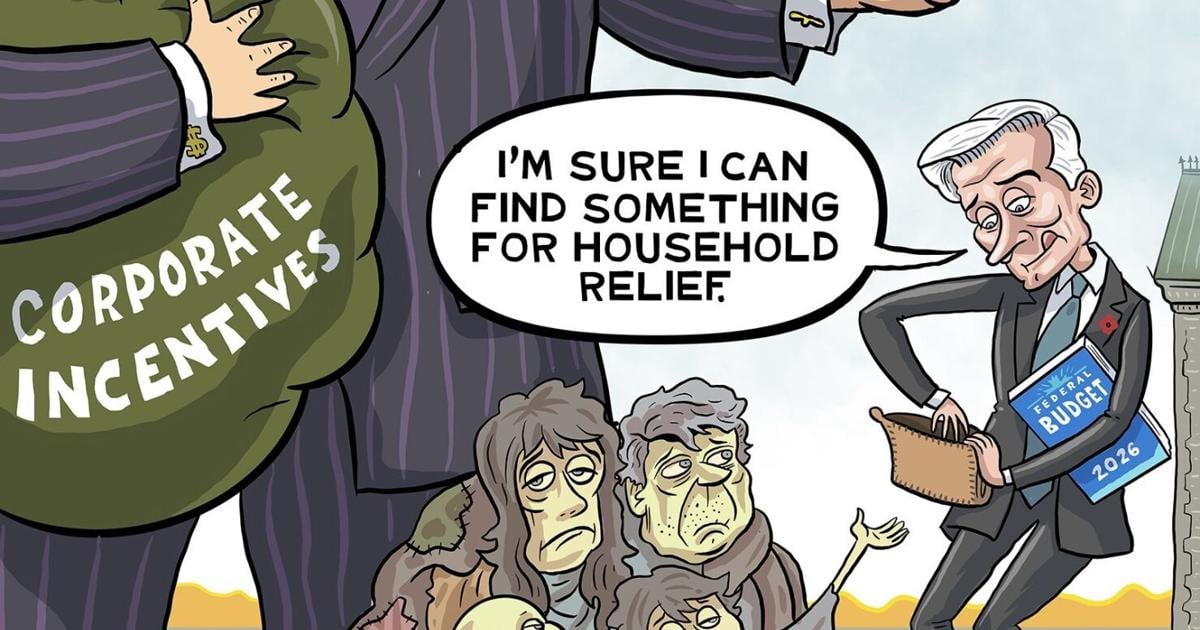
Carney’s 2026 budget shows massive government spending on par with Trudeau years

Read the original at The Hub ↗
Cite

Gordon, G. (2026, November 7). Carney’s 2026 budget shows massive government spending on par with Trudeau years. The Hub. https://thehub.ca/2026/11/07/carneys-2026-budget-shows-massive-government-spending-on-par-with-trudeau-years/

Dated from the outlet's own feed. Check the original for its byline.

The Hub · collected 2026-11-08 · by Graeme Gordon commentary

Quick Summary

Prime Minister Mark Carney's 2026 budget revealed an 8.9% increase in program spending to $542.7 billion for the fiscal year 2026-27, up from $498.5 billion the previous year. Direct program expenses rose by 10.7%, with departmental operating and other spending increasing by $19 billion or 14.5%. The budget also projects a significant rise in public debt charges to $85.5 billion by 2030–31, marking a 60% increase from the previous year's $53.5 billion. This report critiques Carney’s promise of austerity, highlighting that this year's spending is far greater than initially projected and comparable to or exceeding the levels seen during the Trudeau administration.
Written by AI on 2026-11-08, from this article's own text only (the story summary below draws on all the coverage).
See how they differ ↓

AI analysis

Story summary

The Canadian government under Prime Minister Mark Carney officially unveiled its 2026 federal budget on November 5, 2026, focusing on a plan to change the nation's growth model and reduce economic reliance on the United States. Finance Minister Francois-Philippe Champagne stated that the budget prioritizes building domestic commerce, diversifying trade, and increasing Canadian sovereignty in response to shifting global trade dynamics and a U.S. trade war involving President Donald Trump. To achieve these goals, the government is utilizing a federal balance sheet bolstered by high energy prices and corporate profits to fund a long-term investment agenda, including financial guarantees for AI infrastructure and tax cuts for small businesses. Despite these measures, the budget has resulted in increased deficits and debt, with critics like former deputy finance minister Kevin Lynch warning that the government has spent its revenue windfall on new programs rather than reducing the deficit. Furthermore, the budget includes immigration targets that have faced criticism from Conservative Party leader Pierre Poilievre, who suggested the measures are part of a plan to increase the population to 100 million. While the government argues these investments will deliver future economic gains, some reports highlight that interest payments on existing debt are rising and that the federal borrowing rate remains a significant concern for taxpayers.

Written for “Canada's Budget 2026” on 2026-11-21, grounded in this article and the 55 other(s) covering the same event.

How they differ

9 outlets covered “Canada's Budget 2026”.

What each outlet says

One AI summary per outlet of its latest article on this story, written from that article alone and checked against it. Open the article for the outlet's own words.

The HubThis outlet8 Nov

Prime Minister Mark Carney's 2026 budget revealed an 8.9% increase in program spending to $542.7 billion for the fiscal year 2026-27, up from $498.5 billion the previous year. Direct program expenses rose by 10.7%, with departmental operating and other spending increasing by $19 billion or 14.5%. The budget also projects a significant rise in public debt charges to $85.5 billion by 2030–31, marking a 60% increase…

Carney’s 2026 budget shows massive government spending on par with Trudeau years (this article)5 articles from The Hub on this story
Toronto Star6 Nov

The federal budget for 2026 in Canada did not introduce any new measures to address student affordability issues or funding shortfalls in post-secondary education. Despite recognizing the importance of universities and colleges as key contributors to economic growth, the budget failed to provide additional support for students facing financial hardships or academic staff experiencing program cuts and job losses…

Federal budget 2026 silent on student affordability and public funding shortfall in post-secondary education →14 articles from Toronto Star on this story
Global News6 Nov

Budget 2026 proposes several tax changes aimed at reducing the administrative burden on Canadians. Key among these is changing the tax filing deadline from April 30 to May 15 for all taxpayers and self-employed individuals, eliminating the previous June 15 deadline for self-employed workers. This change aims to simplify tax filings and could save Canadians $230 million in interest and penalty payments over five…

These are all the key tax changes and credits impacting you from the budget →12 articles from Global News on this story
CBC6 Nov

Prime Minister Mark Carney defended Canada's new immigration levels plan, which expects almost 660,000 new permanent residents in 2027, while Conservative Leader Pierre Poilievre criticized the numbers as unsustainable. The federal government plans to grant a combined total of more than one million people either permanent or temporary residency next year, with regular intakes set at 380,000 permanent and 370,000…

Carney says new immigration levels plan is 'sustainable' as it draws ire of Conservatives →11 articles from CBC on this story
The Globe and Mail9 Nov

Prime Minister Mark Carney’s federal budget proposes a $30-billion plan to end homelessness in Canada by 2036. The initiative includes funding for 25,000 supportive and transitional homes, rental assistance, and health facilities addressing social needs. Housing experts welcome the pledge but emphasize the need for additional details and provincial cooperation to ensure success.

Housing experts welcome Ottawa’s plan to eradicate homelessness, but call for more details, funding →7 articles from The Globe and Mail on this story
Toronto Sun12 Nov

This editorial criticizes Prime Minister Mark Carney’s government for misclassifying hundreds of billions of dollars in borrowing to finance government programs as investments rather than liabilities, thus obscuring the true extent of federal debt. Parliamentary Budget Officer Annette Ryan warns that federal borrowing is growing at more than double the rate of deficits, reaching $732.9 billion over the next five…

EDITORIAL: Beware Carney’s borrowing bomb →4 articles from Toronto Sun on this story
Show 3 more outlets
The Straits Times5 Nov

Canadian Prime Minister Mark Carney’s government presented its second budget on November 5 aimed at reducing reliance on the United States. Finance Minister Francois-Philippe Champagne emphasized diversifying trade and boosting domestic commerce within Canada as key priorities. The budget includes funding for national projects such as infrastructure for energy production and critical mineral mining, while also…

Canada unveils budget to curb reliance on US →
South China Morning Post6 Nov

Canada has unveiled a new budget titled “Masters of our Destiny,” which emphasizes economic independence from the United States. The plan acknowledges the ongoing shift away from traditional reliance on the U.S., noting it will take time but is underway. Presented two days after President Trump’s midterm election losses, the budget outlines Canada's intention to reduce its dependence on the U.S. market despite…

Canada budget charts ‘economic independence’ in decisive shift from US →
The Blaze9 Nov

Prime Minister Mark Carney’s Liberal government announced plans to increase immigration to Canada, aiming to grant permanent residency to approximately 380,000 migrants and admit another 370,000 temporary residents each year from 2027 to 2029. This includes additional one-time measures that could boost the number of permanent residents in 2027 to about 660,000. Conservative Party leader Pierre Poilievre and other…

'This is insane': Mark Carney slammed for overloading Canada with immigrants →

Where they agree and split

Framing

How the first headlines put it

Attributed to a source2
Stated as fact1
The headlines (3)

Budget 2026 is about ‘us,’ not the U.S. trade war, finance minister says Global News · attributed to a source

Federal budget is about 'changing Canada's growth model,' finance minister says Toronto Star · attributed to a source

Canada's next budget to be unveiled this week amid U.S. trade war, economic uncertainty CBC · stated as fact

Words to watch (1)

'This is insane': Mark Carney slammed for overloading Canada with immigrants The Blaze

The full story: what happened, how it changed, and all 56 articles →

Compared with similar articles

This article reads unscored and hedges 8% of its claims. Each row says how that neighbour differs.
The Globe and Mail
Hedges 0 of 2 claims Outlet record 51/100
Global News
Hedges 2 of 24 claims Outlet record 63/100
“The articles discuss different budget proposals at distinct governmental levels (city of Edmonton vs federal government) for separate time periods.”
Global News
Hedges 2 of 27 claims Outlet record 63/100
“The articles discuss different governmental financial decisions at separate times and contexts.”
CBC News
Hedges 4 of 21 claims Outlet record 72/100
“The articles discuss different aspects of the federal budget: one focuses on the Assembly of First Nations' priorities for funding services and infrastructure, while the other analyzes the overall spending increase in Carney's budget.”
The Straits Times
Leans left Hedges 0 of 18 claims Outlet record 64/100
CBC News
Hedges 5 of 46 claims Outlet record 72/100
Toronto Star
Leans left Hedges 1 of 35 claims Outlet record 64/100
Global News
Hedges 0 of 7 claims Outlet record 63/100
Toronto Star
Leans left Hedges 22 of 369 claims Outlet record 64/100

Story

Canada's Budget 2026
Economy/Business · 56 article(s) covering the same event. Compare every outlet's account →
How this article was measured signals, leaning charts, publisher record, byline, topics and claims

Signals How these are calculated →

Claims extracted
73
sentences that state something as happening or true
Uncertain
8%
6 of 73 hedged ("reportedly", "may", "according to")
Leaning
withheld
no quote in the article backed the model's score
Publisher signals
not measured
these signals count newsroom corrections; Commentary has none to count
Outlets on this story
56
Economy/Business
Same framing elsewhere
1
articles that frame the event the way this one does
Analyzed 2026-11-08 · how these are computed

How this is being covered How these are calculated →

Article leaning vs. publisher reliability
Source leaning vs. consistency

Publisher

The Hub · 88 article(s) · 0 correction(s) detected
No corrections detected for this publisher. That may mean careful reporting, or simply that nothing has been checked.

Who wrote this

Graeme Gordon
4 article(s) here · 1 carrying a prediction
“So the cycle explains the timing, but there’s a structural layer that may not unwind on its own.”
“In the United States, this administration, from the top down, has said antisemitism is unacceptable, and we will prosecute it to the fullest extent of the law.
In 2027 alone, the roughly 282,000 conversions of temporary immigrants to permanent residents would add 74 percent on top of the 380,000 levels plan, none of it counted in the official number.
Prime Minister Mark Carney promised a government that would “spend less to invest more.”
Also by Graeme Gordon
Nothing else under this byline is closely related to this article, so these are simply their most recent.

Topics

Budget 2026 Canadians Crown Finance Canada Ottawa

Subjects

Ottawa GPE · 4× PBO ORG · 4× Canadians NORP · 2× Speer PERSON · 2× Carney PERSON · 1× Crown ORG · 1× Finance Canada ORG · 1× Mark Carney PERSON · 1× Sean Speer PERSON · 1× the Canada Health Transfer ORG · 1×

Narrative

As economist Charles Lammam wrote in The Hub, the government now expects $158 billion more over five years than it did in the spring, and spends $152 billion of it on new measures—96 cents of every extra dollar, and that’s only if that added revenue indeed comes in.
framing: assertive · carried by 1 article(s) · first seen 2026-11-08
Prime Minister Mark Carney promised a government that would “spend less to invest more.”

Claims (73 extracted, 6 hedged)

Prime Minister Mark Carney promised a government that would “spend less to invest more.” asserted
that → promise → more
Budget 2026, tabled Thursday, does neither. asserted
Budget → table → neither
Program spending is set to rise $44.2 billion this fiscal year, from $498.5 billion in 2025-26 to $542.7 billion in 2026-27—an 8.9 percent jump. asserted
spending → set → 2026
It’s what Finance Canada calls direct program expenses: departmental operations, Crown corporations, defence and the grants Ottawa hands out itself. asserted
Ottawa → ’ → what
That category climbs 10.7 percent, to $272.4 billion, with departmental operating and other spending alone up $19 billion, or 14.5 percent. asserted
category → climb → operating
The bill for all of it is always coming due. asserted
bill → come → it
Public debt charges rise from $53.5 billion last year to $85.5 billion by 2030–31, a 60 percent increase. asserted
charges → rise → 2030–31
Starting this year, Ottawa will spend more servicing its debt than it sends the provinces through the Canada Health Transfer, and by 2030–31 the gap reaches nearly $18 billion. asserted
gap → start → billion
Whatever this budget is, it cannot be credibly called austerity. What a difference a year makes The clearest test of the federal government’s restraint is to compare this budget with Carney’s first one. asserted
test → call → one
A year ago, Budget 2025’s fiscal plan projected program spending of $528.4 billion for 2026-27—growth of just 0.6 percent. asserted
plan → project → percent
Budget 2026 now puts that figure at $542.7 billion, $14.3 billion higher. asserted
Budget → put → billion
The gap widens in every year that follows in the latest budget compared to the previous year. asserted
that → widen → year
Next fiscal year, it jumps to $21.4 billion more in 2027–28, then $18.6 billion more in 2028–29, and $18 billion more in 2029–30. asserted
it → jump → 2029–30
Across the four years both plans cover, Ottawa now expects to spend $72.3 billion more on programs than it told Canadians a year ago. asserted
it → cover → Canadians
That’s after the government trimmed its own forecast. asserted
government → ’ → forecast
Budget 2026 lowers projected direct program spending by about $12.4 billion a year, an “aggregate forecasting adjustment” that the document says is “not attributed to particular departments, programs, or policy decisions.” asserted
document → lower → departments
In other words, it assumes money will go unspent, not that anything will necessarily be cut. asserted
anything → assume → words
Look past the red ink Sean Speer, The Hub‘s co-founder and editor-at-large, argued in a special budget-night Hub podcast conversation that the year-over-year jump is “frankly higher than we saw from the Trudeau government,” excluding the pandemic. asserted
we → look → pandemic
But Speer cautioned against fixating only on the deficit. asserted
Speer → caution → deficit
Deficits and debt, he pointed out, are “a function of the demands on government itself [relative to] what Canadians are collectively prepared to pay.” asserted
Canadians → point → government
“The more important question is, what is this 9 percent growth in spending buying us?” Speer said. asserted
Speer → buy → us
“What are we getting for an incremental $44 billion?” asserted
we → get → billion
The watchdog’s warnings Parliamentary Budget Officer Annette Ryan’s office has been flagging this pattern for months. asserted
office → flag → months
In its October economic and fiscal outlook, released two weeks before the budget, the PBO found that fiscal room had improved by $37.4 billion since June. asserted
room → release → June
New spending measures, it estimated, would cost $52.6 billion over five years, “more than offsetting the revenue improvement,” and concluded the fiscal anchors “have imposed limited fiscal discipline on government spending and borrowing.” asserted
anchors → estimate → spending
The PBO has also questioned whether Ottawa’s own numbers hold up. asserted
numbers → question → ?
Its assessment of departmental spending in the spring economic update warned that missing planning detail and “front-loaded” spending profiles raised questions about whether departments could actually deliver at the pace proposed. uncertain
departments → warn → pace
It also noted the update gave no figures on savings or job reductions from the Comprehensive Expenditure Review for 2026–27. asserted
update → note → 2026–27
The forecasts also shift quickly. asserted
forecasts → shift → ?
The PBO’s review of the Main Estimates noted that weeks after those estimates were tabled, the spring update raised the 2026–27 forecast for elderly benefits by $6.2 billion, or 7.5 percent. asserted
update → note → billion
The $26.7 billion underspend in 2025–26 suggests the PBO’s capacity warning was well founded. uncertain
warning → suggest → 2025–26
Deficits stuck, debt and interest both climbing asserted
interest → climb → ?
Despite the extra spending, the headline deficit looks familiar. asserted
deficit → look → spending
Budget 2026 projects a $62.3 billion shortfall this year, edging down to $52.9 billion by 2030–31. asserted
Budget → project → 2030–31
The deficit also understates how much Ottawa will borrow. asserted
Ottawa → understate → much
The PBO projects federal borrowing will rise $732.9 billion over five years, more than double the $333.3 billion in cumulative deficits, as Ottawa lends to Crown corporations and finances capital and defence purchases that sit off the bottom line. asserted
that → project → line
“We are seeing a pretty significant kind of off-the-books increase in the national debt,” Speer said, pointing to the Canada Strong Fund, Build Canada Homes, and numerous other arm’s-length vehicles. asserted
Speer → see → Fund
Net debt rises from $1.45 trillion last year to $1.92 trillion by 2030–31. asserted
debt → rise → 2030–31
Public debt charges climb from $53.5 billion to $85.5 billion over the same period, eating almost 14 cents of every revenue dollar, up from about 10 cents. asserted
charges → climb → cents
That’s $2.3 billion more in 2029–30 than Budget 2025 projected, and above the PBO’s own estimate of roughly $83 billion for 2030–31. asserted
Budget → ’ → 2030–31
…and 33 more, not listed.
Give feedback · no sign-in needed

No sign-in needed for now. Your note is sent without a name, so it cannot be answered.

History Support