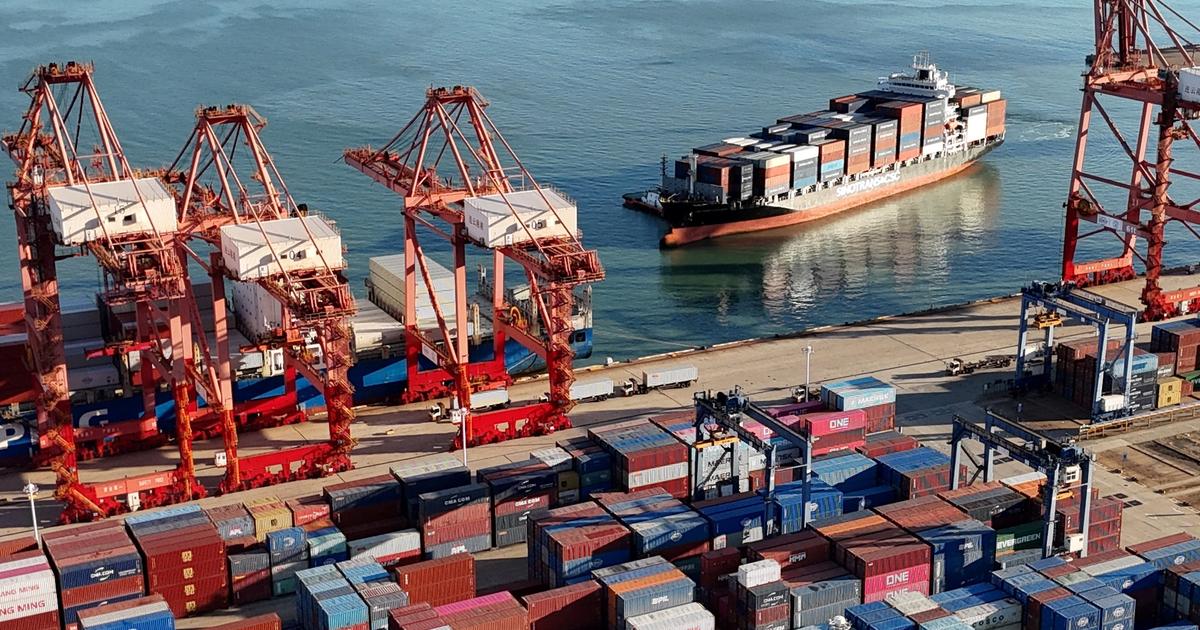
Photo via Al Jazeera

Why China’s $1 trillion trade surplus isn’t all good news for its economy

Read the original at Al Jazeera ↗
Cite

Power, J. (2026, November 11). Why China’s $1 trillion trade surplus isn’t all good news for its economy. Al Jazeera. https://www.aljazeera.com/economy/2026/11/11/why-chinas-1-trillion-trade-surplus-isnt-all-good-news-for-its-economy?traffic_source=rss

Dated from the outlet's own feed. Check the original for its byline.

Al Jazeera · collected 2026-11-11 · by John Power

Quick Summary

China reported a $1.04 trillion trade surplus in the first ten months of the year, driven largely by exports, particularly semiconductors and data processing machines. However, this article highlights structural issues such as weak domestic demand and high household savings rates due to an underdeveloped social safety net, which may hinder China's economic growth aspirations. The author argues that while trade has been crucial for China’s economy, the current export-dependent model is unsustainable given increasing international criticism and protectionist measures from other countries.
Written by AI on 2026-11-11, from this article's own text only (the story summary below draws on all the coverage).
See how they differ ↓

AI analysis

Story summary

As of November 10, 2026, China's trade surplus surpassed $1 trillion in the first ten months of the year, according to data from the General Administration of Customs. Exports surged by 35.2% year-over-year to reach $412.3 billion, while imports expanded by 41.6% to $307.1 billion. This milestone was driven largely by a global surge in demand for artificial intelligence-related products like computer chips and data center servers. Despite this export boom, domestic economic activity remains sluggish due to ongoing issues in the property sector. The figures come as President Xi Jinping prepares to meet with U.S. President Donald Trump at the upcoming Asia-Pacific Economic Cooperation (APEC) summit, where trade tensions are expected to be a major topic of discussion.

Written for “China's Trade Surplus Exceeds $1T” on 2026-11-21, grounded in this article and the 3 other(s) covering the same event.

How they differ

4 outlets covered “China's Trade Surplus Exceeds $1T”.

What each outlet says

One AI summary per outlet of its latest article on this story, written from that article alone and checked against it. Open the article for the outlet's own words.

Al JazeeraThis outlet11 Nov

China reported a $1.04 trillion trade surplus in the first ten months of the year, driven largely by exports, particularly semiconductors and data processing machines. However, this article highlights structural issues such as weak domestic demand and high household savings rates due to an underdeveloped social safety net, which may hinder China's economic growth aspirations. The author argues that while trade has…

Why China’s $1 trillion trade surplus isn’t all good news for its economy (this article)
The Hindu10 Nov

China reported a trade surplus surpassing $1 trillion by October 2026, with exports reaching $412.3 billion and imports at $307.1 billion, marking a year-on-year increase of 35.2% for exports and 41.6% for imports. The surge is largely attributed to global demand for AI-related products such as computer chips and data center servers. This economic boom contrasts with domestic challenges in the property sector and…

China says 2026 trade surplus surpassed $1 trillion in October →
Semafor10 Nov

China's trade surplus surpassed $1 trillion for the first ten months of the year due to record growth in exports despite increased international trade barriers. Domestic consumption has stagnated, pushing Chinese manufacturers to focus on foreign markets, which has led to tensions with other countries over domestic industry impacts. Additionally, high fuel prices have boosted demand for China's electric vehicle and…

China’s trade surplus soars past $1T →
ABC News (AU)11 Nov

China's trade surplus surpassed $US1 trillion for the first ten months of the year, with exports jumping 35.2% to $412.3 billion and imports growing 41.6% to $307.1 billion in October alone. This marks an earlier achievement than last year’s record-breaking surplus of $US1.2 trillion. The article highlights that Chinese exports to the US grew by more than 32%, contributing to tensions between China and its trading…

China's trade surplus surpasses $US1 trillion for second straight year →

Compared with similar articles

This article reads leans strongly left and hedges 8% of its claims. Each row says how that neighbour differs.
ABC News (AU)
Hedges 5 of 24 claims Outlet record 67/100
The Hindu
Hedges 3 of 19 claims Outlet record 78/100
“While both articles discuss China's trade surplus, Article A focuses on the October figures and details about exports, while Article B discusses broader economic implications of the entire year's data up to October.”
Semafor
Leans right further right than this Hedges 0 of 5 claims Outlet record 64/100
“While both articles discuss China's trade surplus exceeding $1 trillion in the first ten months of the year, Article A focuses on the structural weaknesses and long-term implications for China’s economy, whereas Article B emphasizes the factors contributing to this record-breaking surplus.”

Story

China's Trade Surplus Exceeds $1T
Economy/Business · 4 article(s) covering the same event. See how they differ ↑
How this article was measured signals, leaning charts, publisher record, byline, topics and claims

Signals How these are calculated →

Claims extracted
36
sentences that state something as happening or true
Uncertain
8%
3 of 36 hedged ("reportedly", "may", "according to")
Leaning
Leans strongly left
of the writing, not the subject · beta estimate
Publisher signals
60/100
Al Jazeera's corrections and hedging, across everything collected from it. Not a measure of accuracy.
Outlets on this story
4
Economy/Business
Same framing elsewhere
1
articles that frame the event the way this one does
Analyzed 2026-11-11 · how these are computed

How this is being covered How these are calculated →

Article leaning vs. publisher reliability
Source leaning vs. consistency

Publisher

Al Jazeera · 6200 article(s) · 4 correction(s) detected
Running correction rate · 4 correction(s)

Who wrote this

John Power
50 article(s) here · 1 carrying a prediction
The emergence of the memo acknowledging the negative fallout of the blockade comes as a definitive end to the Iran war remains elusive after months of on-again, off-again negotiations between Washington and Tehran. US President Donald Trump last week dismissed the need for a peace deal with Iran, days after suggesting that the conflict could end “fairly soon” and that renewed US strikes were “highly unlikely”. “Those days have long since passed,” Trump wrote on Truth Social on Thursday.
Global AI-related investment is projected to reach $2.7 trillion in 2026 and $3.6 trillion in 2027, according to technology insights company Gartner.
Instead, the two leaders are expected to focus on stabilising ties between Washington and Beijing a time when their differences are in full view amid claims that chip giant Nvidia’s former CEO was targeted in a Chinese espionage operation.
“Earnings were very strong, and were just what the market needed to shake off some AI-related jitters experienced over the last couple of weeks,” Will Rhind, chief executive officer at GraniteShares Advisors, told Al Jazeera.
Kuala Lumpur, Malaysia – Southeast Asian leaders are preparing to hold their flagship annual summit as US President Donald Trump embarks on an Asia Pacific trip that will focus attention on his upending of trade and traditional alliances.
The plunge comes after the New York Times, the Financial Times and the Wall Street Journal reported that Nvidia’s board of directors would discuss Huang’s position amid controversy over his personal life.
Earlier this month, the European Union announced it would cap imports of Chinese hybrid electric vehicles at 350,000 units annually as part of its efforts to counter China’s “overcapacity”.
Whereas hawkish voices argued that Beijing should not have access to cutting-edge US technology on national security grounds, Huang and like-minded executives argued that China already had the computing power to make strides in AI and that wider uptake of US technology would help maintain its dominance in the field.
“I think he will be in good shape.”
Key indexes in Japan, South Korea, Taiwan and Hong Kong made substantial gains on Monday, following a rebound on Wall Street on Friday. Recommended Stories list of 4 items- list 1 of 4Mexican mayor found alive after hours-long abduction - list 2 of 4Nvidia CEO’s affair sparks Chinese espionage probe - list 3 of 4Jeffries backs Hegseth impeachment as Democrats vow probes of Trump allies - list 4 of 4India’s night lights up for Diwali In Tokyo, the benchmark Nikkei 225 was up 3.45 percent as of 04:00 GMT. In Taipei, the Taiex was 5.72 percent higher, while the Kospi in Seoul was up 1.68 percent. Hong Kong’s Hang Seng Index was up 0.19 percent. Futures for Wall Street’s benchmark S&P 500 index and the tech-heavy Nasdaq 100 were up 0.60 percent and 0.59 percent, respectively. They had dipped earlier following US-based chip giant Nvidia’s announcement that it would investigate its CEO over a romantic relationship he conducted with a woman accused of being a Chinese spy.
2026-11-09 · assertive framing · Asian stock markets climb after earlier tech rout
Also by John Power
Nothing else under this byline is closely related to this article, so these are simply their most recent.
All 50 articles by John Power →

Topics

China Chinese Iran Israeli Nablus

Subjects

China GPE · 11× Chinese NORP · 5× Al Jazeera ORG · 2× PRC GPE · 2× 4Spain GPE · 1× Iran GPE · 1× Israeli NORP · 1× Nablus GPE · 1× OECD ORG · 1× Thunberg PERSON · 1×

Narrative

Recommended Stories list of 4 items- list 1 of 4Massive fire as Israeli settlers burn down business near Nablus - list 2 of 4Fire contained on platform in Iran’s South Pars gas field - list 3 of 4‘Everything and everyone we love is at stake’: Thunberg slams COP31 talks - list 4 of 4Spain holds state funeral for 69 victims of deadly train crash While its status as the world’s factory helped it achieve a dramatic rise in living standards beginning in the late 1970s, China’s export-led economic model is facing diminishing returns.
framing: assertive · carried by 1 article(s) · first seen 2026-11-11
Earlier this month, the European Union announced it would cap imports of Chinese hybrid electric vehicles at 350,000 units annually as part of its efforts to counter China’s “overcapacity”.

Claims (36 extracted, 3 hedged)

It is also a sign of structural weaknesses that, left unchecked, threaten to derail China’s bid to join the ranks of the wealthiest nations. asserted
that → leave → nations
Recommended Stories list of 4 items- list 1 of 4Massive fire as Israeli settlers burn down business near Nablus - list 2 of 4Fire contained on platform in Iran’s South Pars gas field - list 3 of 4‘Everything and everyone we love is at stake’: Thunberg slams COP31 talks - list 4 of 4Spain holds state funeral for 69 victims of deadly train crash While its status as the world’s factory helped it achieve a dramatic rise in living standards beginning in the late 1970s, China’s export-led economic model is facing diminishing returns. asserted
model → burn → returns
Even as the AI boom drives its exports to record highs, the world’s second-largest economy suffers from chronically weak domestic demand. asserted
economy → drive → demand
Chinese consumers save far more than their peers elsewhere, with households typically putting away one-third or more of earnings. asserted
households → save → earnings
The dynamic can be partly explained by China’s relatively weak social safety net, as well as cultural attitudes, an undervalued currency and a flailing real estate market. asserted
dynamic → explain → net
China spends far less on social protection than most advanced economies. asserted
China → spend → economies
Government spending on healthcare, pensions and welfare payments accounts for only about 10 percent of the country’s gross domestic product (GDP), far below the OECD average of about 23 percent. asserted
spending → account → percent
With more money stowed away for a rainy day, Chinese households also spend less. asserted
households → stow → less
Chinese household consumption sits at about 39 percent of GDP, versus 68 percent of GDP in the United States, according to the Hinrich Foundation, a Singapore-based philanthropic organisation that promotes trade. “An export-dependent model essentially means Chinese households are subsidising global consumers,” Alicia García Herrero, a senior fellow at Bruegel, a Brussels-based think tank, told Al Jazeera. uncertain
Herrero → sit → Jazeera
“High precautionary savings – driven by falling property wealth and thin social safety nets – leave families with weaker wage growth, deflationary pressures at home, and a smaller share of the country’s economic gains,” García Herrero said. asserted
Herrero → drive → gains
For China, trade has been critical in mitigating areas of weakness in the economy. asserted
trade → mitigate → economy
Exports surged 35.2 percent in October on a yearly basis, according to official figures released on Tuesday, buoyed by red-hot demand for semiconductors and automatic data processing machines. uncertain
Exports → surge → semiconductors
The latest trade figures put China on track to exceed its record full-year surplus of $1.2 trillion in 2025. asserted
figures → put → 2025
But the reliance on trade has also left its economy vulnerable to growing discontent overseas. asserted
reliance → leave → discontent
Critics say China’s state-subsidised export model abuses the norms of fair trade. asserted
model → say → trade
Earlier this month, the European Union announced it would cap imports of Chinese hybrid electric vehicles at 350,000 units annually as part of its efforts to counter China’s “overcapacity”. asserted
it → announce → overcapacity
The growing reliance on exports to maintain growth is “unlikely to be sustainable”, said Carsten Holz, a professor of economics at the Hong Kong University of Science and Technology. asserted
Holz → grow → Science
“The world is too small to absorb all of the PRC’s excess manufacturing capacity and eventually, other countries will put up barriers similar to those the PRC has used in the past and is still using across some sectors of its economy,” Holz told Al Jazeera, using the acronym of China’s official name, the People’s Republic of China. asserted
Holz → absorb → China
“The property boom has run its course. asserted
boom → run → course
The export boom, too, will run its course,” he said. asserted
he → run → course
The limits of China’s economic model have become increasingly visible over the past decade. asserted
limits → become → decade
In March, Beijing announced an economic growth target of 4.5-5 percent, its lowest since 1991. asserted
Beijing → announce → 1991
While such growth would be the envy of most advanced economies, it represents a marked slowdown from the double-digit increases that were common during the 1990s and 2000s. asserted
that → represent → 1990s
Despite decades of rapid growth after reforms undertaken in the 1970s and 1980s, the Chinese economy still has considerable ground to cover to catch up with its developed counterparts. asserted
economy → undertake → counterparts
President Xi Jinping has expressed his ambition to double the size of the economy by 2035, a goal that some economists believe will be difficult to reach at expected growth rates in the coming years. asserted
economists → express → years
“As a large country, China will eventually need better consumption to support its long-term growth,” said Gary Ng, a senior economist for the Asia Pacific at Natixis Corporate & Investment Banking in Hong Kong. asserted
Ng → need → Kong
“It is not a small economy that can rely on one or two sectors,” Ng told Al Jazeera. asserted
Ng → rely → Jazeera
Policymakers have acknowledged the need to boost domestic demand. asserted
Policymakers → acknowledge → demand
In July, Beijing announced its first five-year plan aimed specifically at boosting consumption, targeting 60 trillion yuan ($9 trillion) in sales of consumer goods by 2030, up from a record 50.12 trillion yuan ($7.5 trillion) last year. asserted
Beijing → announce → yuan
So far, such efforts have produced meagre results. asserted
efforts → produce → results
Retail sales have been close to stagnant in 2026, growing just 1.1 percent year-on-year in September, up from 0.6 percent growth in August. asserted
sales → grow → August
“More policy support is expected, but I think for now, the focus may be more oriented toward developing tech self-reliance and industrial upgrading,” said Lynn Song, chief economist for Greater China at ING. uncertain
Song → expect → ING
“Longer term, China’s consumption will naturally play a larger role in economic growth as more households enter the middle class – this process takes some time,” Song said, adding that most observers would agree that “quality of life and consumption has improved over the years”. asserted
quality → play → years
While China’s growing trade surplus reflects its competitiveness in tech, it also points to a “stark two-speed economy”, said Bruegel’s García Herrero. asserted
Herrero → grow → economy
“Publicly, Beijing insists it wants more balanced trade, yet its industrial policies continue to channel capital into manufacturing and self-reliance rather than household demand,” she said. asserted
she → insist → demand
“Without meaningful structural reforms to boost household income and social welfare, this reliance on exports is unsustainable – especially as trading partners like the US and EU push back with tariffs and trade curbs.” asserted
partners → boost → tariffs
Give feedback · no sign-in needed

No sign-in needed for now. Your note is sent without a name, so it cannot be answered.

History Support