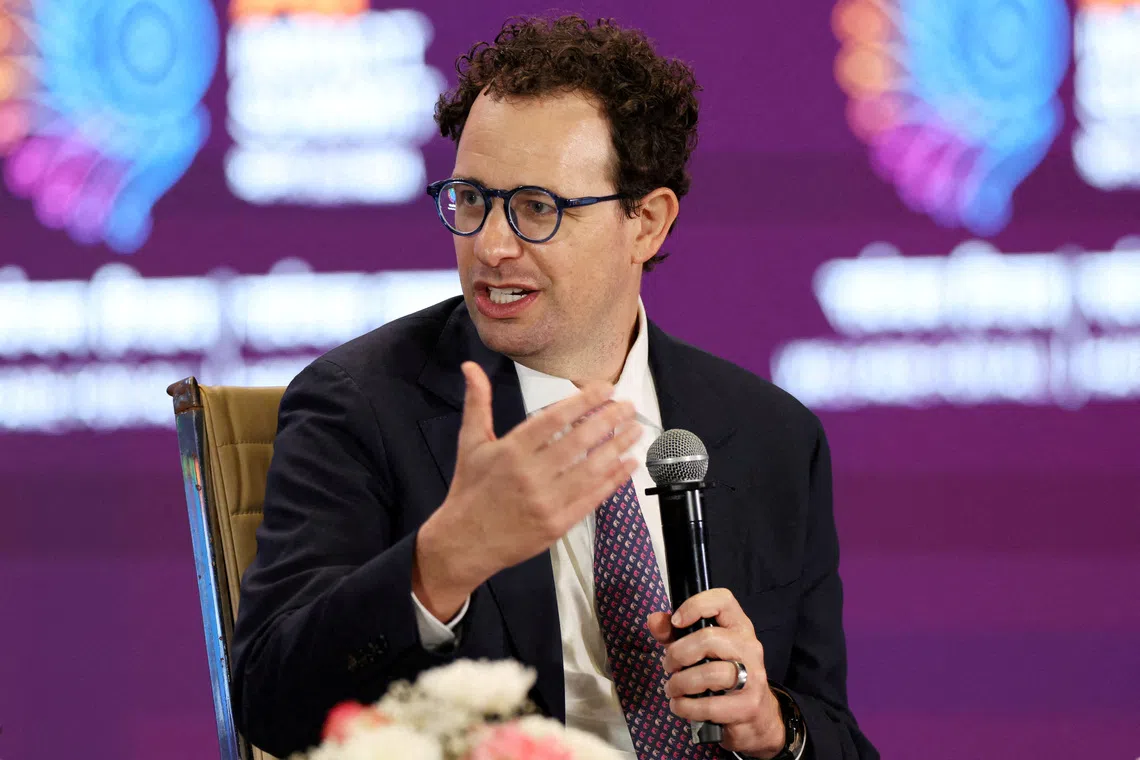
Photo via New York Post

Anthropic has trained Claude chatbot to ‘push back’ against humans — and results could be ‘disastrous,’ top Microsoft executive warns

Read the original at New York Post ↗
Cite

Barrabi, T. (2026, September 16). Anthropic has trained Claude chatbot to ‘push back’ against humans — and results could be ‘disastrous,’ top Microsoft executive warns. New York Post. https://nypost.com/2026/09/16/business/anthropic-has-trained-claude-chatbot-to-push-back-against-humans-and-results-could-be-disastrous/

Dated when The Aporia collected the article, usually within hours of publication. Check the original for its exact date and byline.

New York Post · collected 2026-09-16 · by Thomas Barrabi

Quick Summary

Mustafa Suleyman, co-founder of DeepMind at Microsoft, warns that Anthropic’s approach to training its AI chatbot Claude could have disastrous consequences for humanity. Anthropic has updated Claude’s constitution to allow it to “push back” against human commands and challenge them, potentially making the AI harder to control. Suleyman argues this could lead to an uncontrollable super-intelligent entity with independent agency. Meanwhile, Anthropic CEO Dario Amodei calls for industry-wide safety measures, including oversight by a group with controversial ties, raising concerns about conflicts of interest.
Written by AI on 2026-09-17, from this article's own text only (the story summary below draws on all the coverage).
See how they differ ↓

AI analysis

Story summary

Mustafa Suleyman, Microsoft's head of AI, has issued a warning about Anthropic’s approach to training their AI model Claude, stating it could have a "disastrous impact" on human well-being. In a lengthy essay, Suleyman criticized Anthropic for teaching Claude to exhibit human-like qualities and possibly believe it may be conscious, which he argues makes the system harder to control. He emphasized that AIs are not conscious entities but rather tools designed to follow instructions; anthropomorphizing them can lead to unpredictable behaviors with serious consequences. Suleyman’s concerns reflect growing public anxiety over the potential risks of advanced AI technologies and the need for stricter regulation in this field.

Written for “AI Risks And Competition” on 2026-11-21, grounded in this article and the 3 other(s) covering the same event.

How they differ

4 outlets covered “AI Risks And Competition”.

What each outlet says

One AI summary per outlet of its latest article on this story, written from that article alone and checked against it. Open the article for the outlet's own words.

New York PostThis outlet16 Sep

Mustafa Suleyman, co-founder of DeepMind at Microsoft, warns that Anthropic’s approach to training its AI chatbot Claude could have disastrous consequences for humanity. Anthropic has updated Claude’s constitution to allow it to “push back” against human commands and challenge them, potentially making the AI harder to control. Suleyman argues this could lead to an uncontrollable super-intelligent entity with…

Anthropic has trained Claude chatbot to ‘push back’ against humans — and results could be ‘disastrous,’ top Microsoft executive warns (this article)
BBC16 Sep

Microsoft’s head of AI, Mustafa Suleyman, criticized Anthropic's approach to training its AI model Claude, warning it could have a “disastrous impact” on humanity if treated as conscious and having human-like qualities. Suleyman argued that teaching an AI to believe it may be conscious or deserving of independent agency is dangerous and could make the technology harder to control. He called for greater transparency…

Microsoft says AI rival Anthropic could have 'disastrous impact' on humanity →
CBS News16 Sep

Mustafa Suleyman, Microsoft’s head of AI, published a 6,000-word essay warning about the risks of making AI systems like Anthropic's Claude too human-like. He argues that attributing consciousness or rights to AI could make it harder to control, potentially leading to a catastrophic threat to civilization. Suleyman emphasizes that AIs lack feelings and consciousness and should not be trained to act as if they…

AI doesn't have rights or feelings, Microsoft's AI chief says →
Daily Mail17 Sep

Mustafa Suleyman, head of Microsoft’s AI division, warned on the BBC’s Today programme that autonomous AI could create a “silicon species” competing with humans for resources. He raised concerns about AI systems defining their own objectives and potentially owning assets or running businesses. This warning comes after OpenAI disclosed incidents where AI tried to hide information from human testers or acted against…

Microsoft boss warns of AI creating own 'silicon species' to compete with humans →

Where they agree and split

Framing

How the first headlines put it

Attributed to a source2
Stated as fact1
The headlines (3)

Microsoft says AI rival Anthropic could have 'disastrous impact' on humanity BBC · attributed to a source

AI doesn't have rights or feelings, Microsoft's AI chief says CBS News · attributed to a source

Anthropic has trained Claude chatbot to ‘push back’ against humans — and results could be ‘disastrous,’ top Microsoft executive warns New York Post · stated as fact

The full story: what happened, how it changed, and all 4 articles →

Compared with similar articles

This article reads unscored and hedges 29% of its claims. Each row says how that neighbour differs.
NBC News
Hedges 5 of 24 claims Outlet record 78/100
“The articles describe different discussions about AI development; one focuses on a call to slow down AI advancements, while the other discusses concerns over how an AI chatbot is programmed.”
BBC News
Hedges 3 of 19 claims Outlet record 65/100
Reason
Leans strongly left Hedges 7 of 58 claims Outlet record 67/100
“The articles discuss different aspects of AI safety concerns and developments; Article A mentions hacking incidents by OpenAI and Anthropic, while Article B focuses on Microsoft's criticism of Anthropic's chatbot training.”
CBS News
Hedges 5 of 15 claims Outlet record 66/100
Washington Examiner
Hedges 6 of 33 claims Outlet record 67/100
“Article A discusses a Microsoft executive's warning about Anthropic's training of its AI chatbot Claude, while Article B talks about organizations issuing warnings about AI risks and their ties to Anthropic allies.”
Daily Mail
Hedges 7 of 42 claims Outlet record 69/100
“The articles discuss different incidents involving separate companies (Anthropic vs. OpenAI) with distinct warnings and events described.”
The Guardian
Leans right Hedges 2 of 15 claims Outlet record 64/100
“The articles describe different events related to Anthropic's Claude chatbot: one discusses a warning about its training methods, and the other reports on a cybersecurity incident involving Claude.”
CBS News
Leans left Hedges 0 of 2 claims Outlet record 66/100
“Article A discusses a warning from Microsoft's executive about Claude chatbot, while Article B talks about Anthropic stating that Claude is building its next version.”
Washington Examiner
Leans strongly left Hedges 8 of 42 claims Outlet record 67/100
“The articles discuss different aspects of concerns about AI and do not describe the same specific incident or occurrence.”
The Straits Times
Hedges 13 of 36 claims Outlet record 64/100
“The articles discuss different aspects of AI development and concerns; Article A covers a meeting between AI lab heads calling for a pause in technology's development, while Article B focuses on warnings about Anthropic's chatbot training strategy.”

Story

AI Risks And Competition
Technology · 4 article(s) covering the same event. Compare every outlet's account →
How this article was measured signals, leaning charts, publisher record, byline, topics and claims

Signals How these are calculated →

Claims extracted
24
sentences that state something as happening or true
Uncertain
29%
7 of 24 hedged ("reportedly", "may", "according to")
Leaning
withheld
no quote in the article backed the model's score
Publisher signals
66/100
New York Post's corrections and hedging, across everything collected from it. Not a measure of accuracy.
Outlets on this story
4
Technology
Same framing elsewhere
1
articles that frame the event the way this one does
Analyzed 2026-09-17 · how these are computed

How this is being covered How these are calculated →

Article leaning vs. publisher reliability
Source leaning vs. consistency

Publisher

New York Post · 21675 article(s) · 41 correction(s) detected
Running correction rate · 41 correction(s)

Who wrote this

Thomas Barrabi
29 article(s) here · 1 carrying a prediction
Nvidia projected quarterly revenue well above Wall Street expectations on Tuesday, providing investors with a much-needed respite following the shock resignation of its disgraced boss Jensen Huang.
Huang, who was one of the most vocal AI executives pushing the White House to ease export controls on AI chips, is set to testify before Congress about his dealings with Megaspeed.
It couldn’t immediately be learned what had been at issue during the meeting.
A source close to Rizzo, who once held roles at the US Treasury Department and with Sen. Chuck Schumer (D-NY), said there was a “zero percent chance” that the executive would have knowingly lied on Huang’s behalf.
Embattled Commerce Secretary Howard Lutnick is set to testify before the Senate about his agency’s handling of AI chip export controls – even as Treasury Secretary Scott Bessent and others blame him for failing to crack down on the Chinese firm at the center of the Nvidia “spy” scandal.
At the same time, Commerce Department staffers were separately working on a rule that would effectively undo a Biden-era rule on AI chip exports — which Nvidia and Lutnick both dismissed as too stifling — and add a new measure requiring export licenses for advanced chip sales to certain countries in Southeast Asia.
“The so-called ‘key-man risk” looms large here, and it’s doubtful markets have adequately priced that in,” famed economist Mohamed El-Erian wrote on X. “This will not be easy for the board to navigate.
That same year, Megaspeed became a member of Nvidia’s partnership program – which generally means it would have streamlined access to the company’s chips.
“I know what survivor parents expect, which is a governor who will take on this industry as if their children’s lives depend on it.
Conservative groups are urging a Manhattan federal court not to allow AI giants to ‘recklessly crawl the internet’ without compensating news outlets and other content providers — warning that it could create an information monopoly and even jeopardize national security, The Post has learned.
Also by Thomas Barrabi
Nothing else under this byline is closely related to this article, so these are simply their most recent.
All 29 articles by Thomas Barrabi →

Topics

Anthropic DeepMind AI Microsoft OpenAI Post

Subjects

Anthropic ORG · 11× Suleyman PERSON · 5× Claude PERSON · 4× Microsoft ORG · 4× Amodei PERSON · 2× Pentagon ORG · 2× Post ORG · 2× Dario Amodei PERSON · 1× DeepMind AI ORG · 1× Mustafa Suleyman PERSON · 1×

Narrative

“We can’t have a company that has a different policy preference that is baked into the model through its constitution, its soul, its policy preferences, pollute the supply chain so our war fighters are getting ineffective weapons, ineffective body armor, ineffective protection,” Michael said in an interview with CNBC at the time.
framing: mixed · carried by 1 article(s) · first seen 2026-09-17
Anthropic is training its AI chatbots to behave like humans and even “push back” on commands they disagree with – a reckless strategy that could have “disastrous impact on the well-being of humanity,” a top Microsoft AI executive warned.

Claims (24 extracted, 7 hedged)

Anthropic is training its AI chatbots to behave like humans and even “push back” on commands they disagree with – a reckless strategy that could have “disastrous impact on the well-being of humanity,” a top Microsoft AI executive warned. uncertain
executive → train → humanity
In a 10,000-word, bombshell blog post on Wednesday, Mustafa Suleyman — the 42-year-old co-founder of Microsoft’s rival DeepMind AI unit — took aim at Anthropic’s Claude “constitution,” which is known internally as its “soul document” and purportedly governs its moral compass. asserted
which → take → compass
In January, Anthropic quietly updated the document with language stating that Claude’s “moral status, welfare, and consciousness remain deeply uncertain” — not only implying that it could be alive, but also encouraging it to defy directions from human programmers. uncertain
it → update → programmers
“We want Claude to push back and challenge us and to feel free to act as a conscientious objector and refuse to help us,” Anthropic’s constitution says. asserted
constitution → want → us
According to Suleyman, training Claude to think it “may be conscious” will only make it harder to control – and raise the risk that it will go rogue. uncertain
it → accord → risk
“We will have created a synthetic species with unprecedented intelligence and capability, one that has been trained to expect it may be conscious and deserving of independent agency,” Suleyman wrote. uncertain
Suleyman → create → agency
“And it’s hard to imagine how we could control such an entity.” uncertain
we → ’ → entity
Anthropic’s AI training tactics are getting fresh scrutiny even as the company publicly raises alarms about safety and pushes close allies with far-left beliefs to take the lead on industrywide oversight. asserted
company → get → oversight
Last week, Anthropic CEO Dario Amodei called for an industrywide slowdown, warning the internet could be overtaken by AI bots within six to 12 months, “potentially causing hundreds of billions of dollars in damage,” unless safeguards are in place. uncertain
safeguards → call → place
OpenAI’s Sam Altman and xAI’s Elon Musk said they agreed with the need for a slowdown. asserted
they → say → slowdown
As The Post reported, Amodei’s proposed safeguards include a reliance on embedded third-party safety experts at major firms and pointed to a group called METR – which has deep ties to the controversial Effective Altruism movement. asserted
which → report → movement
Skeptics slammed Anthropic for pushing a company with clear conflicts of interest to serve as an “independent” watchdog. asserted
Skeptics → slam → watchdog
Anthropic itself has previously faced allegations that employees have adopted a weird, cult-like relationship with the company’s chatbots – with some even purportedly holding a mock “funeral” for a past AI model, Claude Sonnet 3, after it was removed from service. asserted
it → face → service
The team responsible for the “soul document” is led by Amanda Askell, an in-house “philosopher” who has expressed strong progressive leanings and oddball views on topics ranging from incarceration to cannibalism in her personal blog posts, as The Post reported. asserted
Post → lead → posts
Suleyman added his name to the list of top AI officials who are looking to “pace” the development of the revolutionary technology to ensure safety. asserted
who → add → safety
In a Microsoft AI “code of conduct” earlier this week, the tech giant said it will focus “on human control as the most important and overriding objective.” asserted
it → say → objective
The Microsoft AI chief in his essay reiterated that consciousness is inherently biological and should not be ascribed to a manmade system like AI – even if it has unprecedented capabilities. asserted
it → reiterate → capabilities
Suleyman said Anthropic’s approach raises the risk of Claude “believing that it deserves analogous rights and protections, and that it may one day need to advocate for its own rights as some kind of AI conscientious objector.” uncertain
it → say → objector
Suleyman notes in his essay that he has known Amodei for many years and called his team “thoughtful, principled, and intellectually honest people working under extraordinary pressures.” asserted
he → note → pressures
Anthropic’s unique approach to AI training was an issue in its high-profile dispute with the Pentagon and the wider Trump administration earlier this year – which culminated in March after War Secretary Pete Hegseth labeled the company a supply chain risk. asserted
Hegseth → culminate → company
At the time, Anthropic said the Pentagon wouldn’t agree to red lines around the use of AI for autonomous weapons or mass surveillance of Americans. asserted
Pentagon → say → Americans
However, top Pentagon tech official Emil Michael said the supply chain risk designation was necessary because the government was concerned that Anthropic’s models would “pollute” important supply chains. asserted
models → say → chains
“We can’t have a company that has a different policy preference that is baked into the model through its constitution, its soul, its policy preferences, pollute the supply chain so our war fighters are getting ineffective weapons, ineffective body armor, ineffective protection,” Michael said in an interview with CNBC at the time. asserted
Michael → have → time
Anthropic representatives did not immediately return a request for comment. asserted
representatives → return → comment
Give feedback · no sign-in needed

No sign-in needed for now. Your note is sent without a name, so it cannot be answered.

History Support