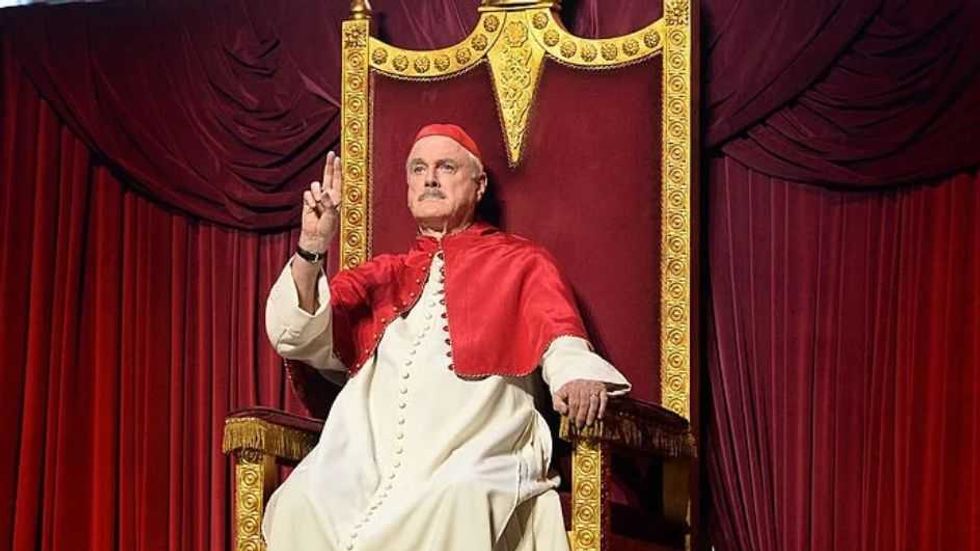
Half a century after 'Life of Brian' scandalized Christian Britain, the Monty Python legend faces a new religious backlash.
asserted
legend → scandalize → backlash
For generations of American comedy fans, John Cleese has embodied a certain idea of Britain.
asserted
Cleese → embody → Britain
His long face, angular features, and stiff, vaguely aristocratic bearing suggested the quintessential Englishman: formal, reserved, faintly pompous, easily befuddled, and perpetually irritated by the stupidity of everyone around him.
uncertain
face → suggest → him
He rode that comic persona to international fame, first as a member of Monty Python, whose surreal sketches became a cult phenomenon on American public television in the 1970s, then in the troupe's hit films "Monty Python and the Holy Grail" and "Life of Brian."
asserted
sketches → ride → Brian
In 1988, he found mainstream Hollywood success with "A Fish Called Wanda," playing a stuffy English barrister opposite Jamie Lee Curtis and Kevin Kline.
asserted
he → find → Curtis
In 2019, Cleese took to Twitter to declare that London was "no longer an English city," repeating an observation he had first made in 2011.
asserted
he → take → 2011
Now, at 87, Cleese has become a symbol of a very different Britain — one in which the absurdities he spent his career ridiculing have acquired new forms and where his criticism of Islam has prompted someone to report him to the government's counter-extremism program, Prevent.
asserted
criticism → become → program
For decades, Cleese made a living mocking the conventions of a Britain that was insular, socially conservative, and fiercely protective of its traditions.
asserted
that → make → traditions
Its stuffy manners, rigid hierarchies, and reverence for authority provided endless material for Monty Python.
asserted
manners → provide → Python
In their first original feature film, "Monty Python and the Holy Grail," the Pythons sent up Arthurian legend, medieval superstition, and religious ritual.
asserted
Pythons → send → legend
But when they turned their attention more directly to Christianity in "Life of Brian," they discovered something surprising: Jesus wasn't particularly funny.
asserted
Jesus → turn → something
They had initially considered making a comedy about Christ himself, but the more they read about him, the less material they found.
asserted
they → consider → material
As fellow Python Michael Palin explained in 1979, there was very little in Jesus' life worth ridiculing.
asserted
Palin → explain → life
Instead, they invented Brian, an ordinary fellow living in Roman-occupied Judea who is mistaken for the Messiah.
asserted
who → invent → Messiah
The film satirized human gullibility, religious zealotry, and political factionalism.
asserted
film → satirize → gullibility
As Reg, the revolutionary leader, Cleese memorably spoofed left-wing factionalism.
asserted
Cleese → spoof → factionalism
Asked if he belonged to the Judean People's Front, he replied: "F**k off! … Judean People's Front.
asserted
he → ask → Front
Christian critics failed to see the distinction.
asserted
critics → fail → distinction
In a notorious 1979 BBC debate, Cleese and Palin defended the film against Malcolm Muggeridge and Mervyn Stockwood, the Bishop of Southwark, who accused them of mocking Christ.
asserted
who → defend → Christ
The Pythons insisted they were making fun of people who misunderstood religious teaching.
asserted
who → insist → teaching
The controversy proved enormously profitable.
asserted
controversy → prove → ?
The film was banned in Ireland and Norway, while some British councils prohibited screenings.
asserted
councils → ban → screenings
But protests only increased public interest.
asserted
protests → increase → interest
"Life of Brian" became Britain's fourth-highest-grossing film of 1979, and Cleese later joked that the protesters had made him rich.
asserted
him → become → 1979
Nearly half a century later, the stakes appear considerably higher.
asserted
stakes → appear → ?
What was once a cultural controversy, fought out in cinemas, newspapers, and television studios, now threatens to become a matter for the state.
asserted
was → fight → state
The guardians of public morality have changed, and so have the means at their disposal.
asserted
means → change → disposal
To his critics, Cleese's increasingly outspoken views are simply the predictable grumblings of an old man drifting toward conservatism.
asserted
views → drift → conservatism
In a 2019 Independent column, Caspar Salmon lamented that the comedian who once delighted in mocking English pomposity and small-mindedness had become reactionary himself.
asserted
who → lament → pomposity
Comedy thrives on undermining the status quo, Salmon argued, but successful comedians can eventually become part of it.
asserted
comedians → thrive → it
It's a familiar accusation, but it overlooks something rather important: The status quo itself has changed beyond recognition.
asserted
quo → overlook → recognition
Christianity remains fair game for British comedy, to say the least.
asserted
Christianity → remain → least
The second season of the acclaimed BBC series "Fleabag" featured its sexually adventurous heroine falling for — and eventually seducing — a Catholic priest.
asserted
heroine → feature → priest
But when the subject turns to Islam, the boundaries of acceptable ridicule become considerably more contentious.
asserted
boundaries → turn → ridicule
These changing sensitivities have accompanied a staggering demographic transformation.
asserted
sensitivities → change → transformation
In 2001, White British residents accounted for 59.8% of London's population.
asserted
residents → account → population
By the 2021 census, that figure had fallen to 36.8%.
asserted
figure → fall → %
Over the same period, the capital's Muslim population more than doubled, from approximately 607,000 in 2001 to 1.32 million in 2021, rising from 8.5% to 15% of Londoners.
asserted
population → double → Londoners
Cleese has been marking the changes for years.
asserted
Cleese → mark → years
In 2019, he took to Twitter to declare that London was "no longer an English city," repeating an observation he had first made in 2011.
asserted
he → take → 2011
…and 45 more, not listed.
 The Aporia