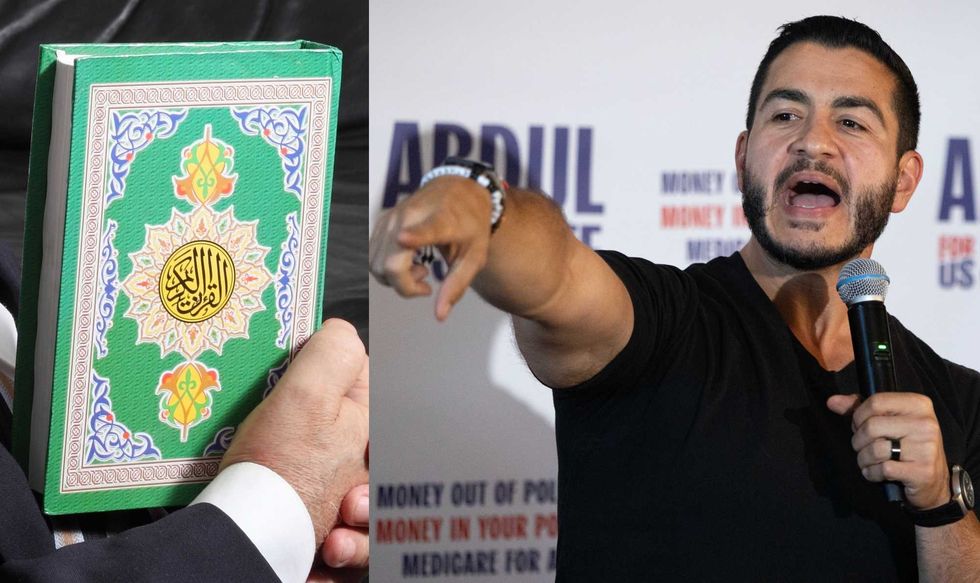
A Muslim senator will soon lay his hand on Thomas Jefferson’s Quran, and America will applaud a book it has never read.
asserted
it → lay → book
Abdul El-Sayed is invoking the third president’s copy as a symbol of American openness.
asserted
Sayed → invoke → openness
The gesture is not even new, since Keith Ellison did the same in 2007.
asserted
Ellison → do → 2007
It’s clever because it trades on what Westerners think they know about Jefferson and, more importantly, what they don’t know about the Quran.
asserted
they → ’ → Quran
Most Americans have never opened it.
asserted
Americans → open → it
They know the headline version, that Islam is a religion of peace and the Quran a cousin of the Psalms, and they were taught that to doubt this is bigotry or islamophobia.
asserted
doubt → know → this
That ignorance is the soil in which Islamic claims grow best.
uncertain
claims → grow → which
A text people refuse to read can be made to mean anything, and every claim made in its name goes unchallenged.
uncertain
claim → refuse → name
So, what does the Quran say about Jews and Christians, and how should they be treated as non-Muslims?
asserted
they → say → Muslims
The Quran does acknowledge that Jews and Christians received scripture, but only to tell them that they are misguided and have corrupted it.
asserted
they → acknowledge → it
It instructs Muslims not to take Jews and Christians as allies and explicitly denies the heart of the Christian faith, insisting that Jesus was neither killed nor crucified.
asserted
Jesus → instruct → faith
It then mocks the claim that Jesus is the Son of God and invokes God’s curse on those who say it.
uncertain
who → mock → it
While Muslims insist they love Jesus, they have a completely different “Jesus” from the one found in the Bible.
asserted
they → insist → Bible
Then comes the law (think, Sharia) that follows from that Quran.
asserted
that → come → Quran
Islam’s scripture commands Muslims to fight Jews and Christians until they pay the jizya “while humiliated.”
asserted
they → command → jizya
No Muslim would take these verses as symbolic or metaphorical, since Islamic history is full of atrocities committed in application of this verse.
asserted
history → take → verse
For centuries, Christians and Jews under Muslim rule paid a jizya tax that was meant to remind them of their inferior place.
asserted
that → pay → place
If Jews and Christians are considered by Muslims to be unbelievers or infidels, then their destiny is blunt: “When you meet those who disbelieve in battle, strike their necks until you have inflicted slaughter upon them, then secure the bonds of the captives.
asserted
you → consider → captives
This is the Quran the senator-elect wants to swear on.
asserted
elect → want → ?
Either Abdul doesn’t know this history, or he is counting on the audience not to.
asserted
he → know → audience
I don’t know which is worse.
asserted
which → know → ?
Consider what Jefferson actually did with his Quran.
asserted
Jefferson → consider → Quran
In 1765, a 22-year-old law student bought George Sale’s English translation.
asserted
student → buy → translation
He did not buy it out of devotion.
asserted
He → buy → devotion
He was a lawyer studying the legal systems of the world, as part of a comparative education in the world’s religions and laws.
asserted
He → study → religions
The book sat on his shelf for decades before it mattered.
asserted
it → sit → decades
It mattered in 1786, when Jefferson and John Adams met in London with the Muslim ambassador of Tripoli, Sidi Haji Abdrahaman Adja, to ask why his corsairs were seizing American ships and enslaving their crews.
asserted
corsairs → matter → crews
The Muslim answered that the Quran gave Muslims the right and duty to make war on nations that had not acknowledged Muhammad and to enslave the prisoners they captured.
asserted
they → answer → prisoners
Jefferson learned what Islam’s scripture teaches, and upon becoming president, he did not pay jizya tribute to the Muslims or accommodate them.
asserted
he → learn → them
He sent the Navy.
asserted
He → send → Navy
More revealingly, Jefferson never praised Islam as a religion, although, in his Virginia Statute for Religious Freedom, he insisted that civil rights should not depend on religion and wanted the “Mahometan” (Muslims) included among those protected.
asserted
Mahometan → praise → those
Let this sink in: a US president wanted Muslims protected, while Islam’s so-called scripture insists on targeting Christians because of their religion until they are humiliated and subdued.
asserted
they → let → religion
Jefferson saw a political and military doctrine that justified aggression against outsiders on religious grounds, and he answered it with force.
asserted
he → see → force
That is a far cry from the sentimental symbol El-Sayed wants us to see.
asserted
us → want → symbol
The copy Jefferson owned is an English translation, made by an Englishman.
asserted
Jefferson → own → Englishman
The Quran is the Arabic text, and any other language gives only an interpretation.
asserted
language → give → interpretation
By the strict standard of his own tradition, the senator-elect will be swearing on a book that is not, for Muslims, the real book.
asserted
that → swear → Muslims
Either he knows this and intends the gesture as a political prop, or he doesn’t and has chosen a symbol he doesn’t understand.
asserted
he → know → symbol
None of this seems to trouble the progressive left, which has found its new allies.
asserted
which → seem → allies
On campuses, in coalitions, and in the press, Islamist causes now march alongside progressive ones, and each side finds the other useful.
asserted
other → march → ones
…and 10 more, not listed.
 The Aporia