- Published
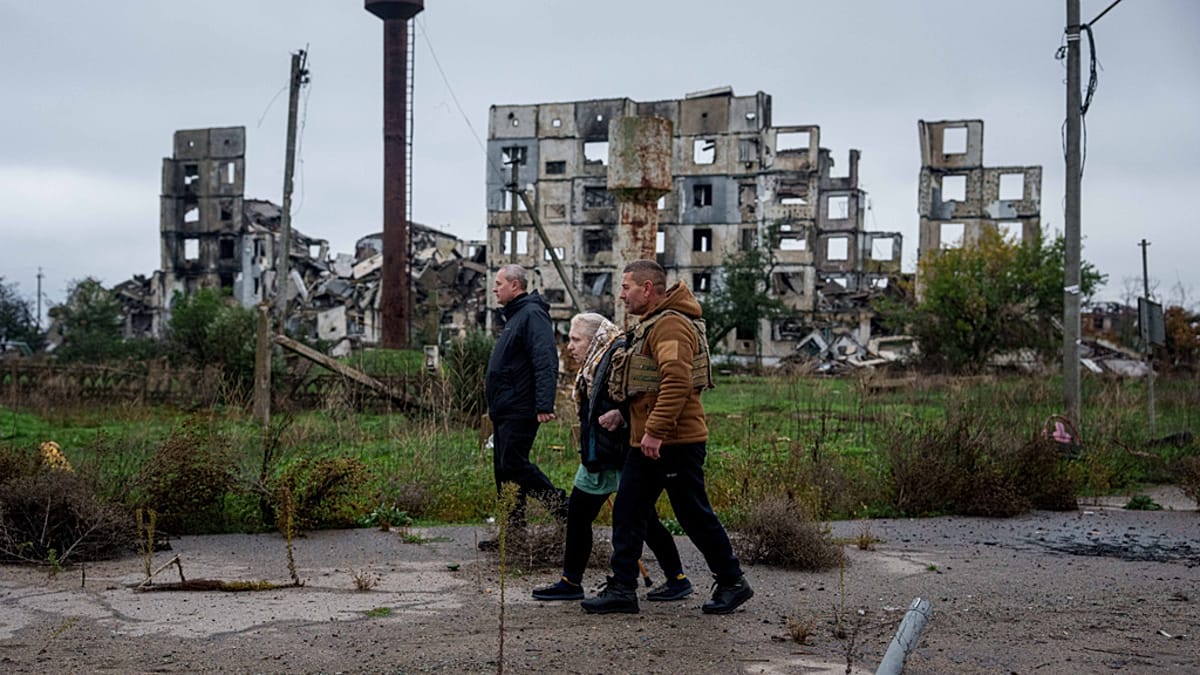
Ukrainian officials have accused Russia of targeting rescue and recovery operations two weeks after a deadly "double-tap" strike at a village close to the front line killed at least 72 people.
asserted
strike → publish → people
Ukraine says Russia carried out two attacks in succession on a humanitarian aid centre in the village of Komyshuvakha on 2 November - including the use of what it said was a 3,000kg (6,600lb) aerial bomb on a shelter where residents had fled for safety.
asserted
residents → say → safety
Verified images posted in the days after the attack show damage to emergency vehicles and excavation equipment at the site.
asserted
images → verify → site
The State Emergency Service of Ukraine (DSNS) told BBC Verify there have been multiple Russian strikes during the rescue.
asserted
Service → tell → rescue
The DSNS said three police officers, four workers and two rescue dogs were injured while five vehicles were damaged.
asserted
vehicles → say → ?
"Due to the threat of repeated shelling, emergency workers are constantly forced to periodically suspend work and retreat to a safe place," it added.
asserted
it → repeat → place
The DSNS said the death toll had risen to at least 72 people making it one of the deadliest single incidents since Russia launched its full-scale invasion of Ukraine in February 2022.
asserted
Russia → say → February
Oleksiy, an intelligence officer investigating the incident for Ukraine's SBU security service, who asked to be identified only by his first name, said rescue vehicles were "clearly marked" and accused Russia of "deliberately destroying humanitarian equipment".
asserted
vehicles → investigate → equipment
He added the village's infrastructure and the people still living in Komyshuvakha are also being systematically targeted by drones and bombs.
asserted
infrastructure → add → drones
Oleksiy accused Russian forces of "outright terror against civilians, against peaceful residents" to make life on the front line impossible.
asserted
life → accuse → line
BBC Verify has confirmed videos being shared by Ukrainian police that show rescue workers at the scene shouting "drone, drone" and running for cover on the day after the 2 November attack.
asserted
workers → confirm → attack
A group can also be seen treating a victim.
asserted
group → see → victim
Bodies are still to be recovered from the rubble, Oleksiy said.
asserted
Oleksiy → recover → rubble
"The enemy knows perfectly well that what is being carried out there is essentially a humanitarian operation to search for the dead."
asserted
carried → know → dead
BBC Verify has asked the Russian Ministry of Defence for comment specifically about the Komyshuvakha attacks but has not received a response.
asserted
Verify → ask → response
A general statement released on 2 November by the Russian MoD said it had targeted energy and transport infrastructure used by the Ukrainian military across the country.
asserted
it → release → country
While there are no military or industrial facilities in Komyshuvakha it is close to a key route used for Ukrainian troop movements, supplies and evacuations.
asserted
it → be → movements
The village was previously reported to have been struck by the Russians on 28 October.
asserted
village → report → October
Fears of second strike heard on police radios
Local people headed to the shelter area on 2 November after being told by a local Telegram group that aid would be distributed between 10:00 and 12:00 local time (08:00-10:00 GMT).
asserted
aid → hear → time
Ukrainian authorities said an initial strike, at 09:45 local time, hit buildings above ground killing one woman.
asserted
strike → say → woman
Bodycam footage, released by Ukrainian police in edited segments and analysed by BBC Verify, shows people trying to free a casualty from the rubble before declaring she had died.
asserted
she → release → rubble
Throughout the footage, warnings of an impending second strike can be heard on police radios with increasing urgency until people are instructed to run to the underground shelter.
asserted
people → hear → shelter
The same footage, which was taken around an hour after the first attack, goes on to show people in a shelter.
asserted
which → take → shelter
As they wait in silence a large explosion can be heard and the video goes dark.
asserted
video → wait → silence
Aftermath video filmed later shows bodies being recovered from a large crater immediately above the shelter.
asserted
bodies → film → shelter
Twisted iron and rubble from the structure below can be seen beneath the surface.
asserted
iron → see → surface
Funerals have been held almost daily for the victims of the attack, including locals working to administer aid distribution, those seeking to collect it and soldiers who officials say arrived to assist with rescue efforts.
asserted
officials → hold → efforts
Trevor Ball, bomb disposal expert at intelligence firm at Armament Research Services, said a crater seen in the footage was consistent with the damage and depth left by a FAB-3000, a 3,000kg Russian bomb which can destroy underground structures.
asserted
which → say → structures
His comments were echoed by Chris Proops, an ex-UK National Crime Agency investigator, who said the scale of the damage at the scene matched the size of the FAB-3000.
asserted
scale → echo → FAB-3000
Ball and Proops both confirmed verified photos of munition fragments obtained by BBC Verify from Ukrainian authorities show part of a guidance kit that is compatible with the FAB-3000, which increases the weapon's accuracy and allows it to be fired from a greater distance from the target.
asserted
it → confirm → target
International law experts told BBC Verify that Russia had committed a war crime if it knowingly attacked rescue workers.
asserted
it → tell → workers
Ben Saul, professor of international law at the University of Sydney, said this "appears to be either a deliberate attack on civilians or civilian objects - a war crime - or an indiscriminate attack - also a war crime".
asserted
this → say → civilians
Prof Samuel Moyn of Yale University said "directly targeting rescuers or their equipment is a gross violation of international humanitarian law".
asserted
targeting → say → law
Precautions have to be taken to ensure that strikes target combatants rather than others, he added.
asserted
he → have → others
 The Aporia