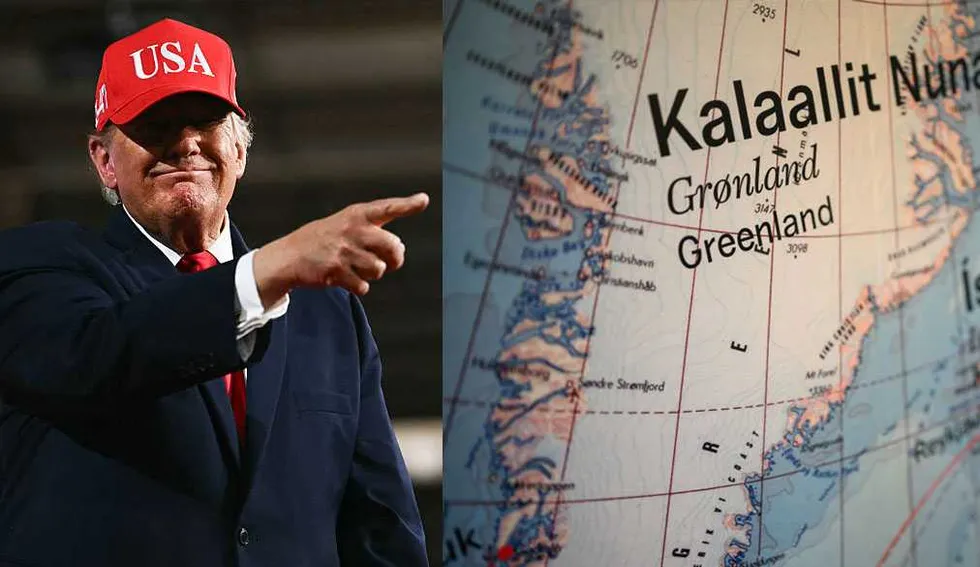
Photo via TIME

The Greenland Test: What Follows When America Coerces Its Allies

Read the original at TIME ↗
Cite

Drennan, J., & Tabatabai, A. (2026, November 17). The Greenland Test: What Follows When America Coerces Its Allies. TIME. https://time.com/article/2026/11/17/greenland-trump-nato-america-britain-france-allies/

Dated from the outlet's own feed. Check the original for its byline.

TIME · collected 2026-11-17 · by John Drennan, Ariane Tabatabai analysis

Quick Summary

President Trump used pressure on Denmark and Greenland to secure an agreement in September that enhances U.S. military presence on Greenland. The deal aims to address security concerns and restrict adversaries' military presence and investments there. Denmark’s ambassador to the U.N. described the agreement as beneficial for all parties and for international peace and security. Some observers see the deal as advancing U.S. national security interests despite the coercive methods used to achieve it. The article draws parallels to historical instances of U.S. coercion of allies, suggesting potential long-term consequences for the alliance.
Written by AI on 2026-11-17, from this article's own text only (the story summary below draws on all the coverage).
See how they differ ↓

AI analysis

Story summary

President Donald Trump secured a significant diplomatic victory when the Danish parliament unanimously approved a security agreement with Greenland, allowing the U.S. to expand its military presence on the island. The agreement, signed in September, grants the U.S. permanent control over security and other needs on Greenland, while also preventing adversaries like Russia and China from establishing military presence or making sensitive investments there. Danish lawmakers voted 109-0 in favor of the deal, which includes permission to establish a "Golden Dome" missile defense system and expand existing military installations. Greenland's parliament had already ratified the agreement in November. The move aims to address the growing threat from Russia and China in the Arctic and to modernize the U.S.-Danish partnership, though its full impact on U.S. national security remains to be seen.

Written for “Denmark Seals Greenland Deal With Trump” on 2026-11-21, grounded in this article and the 3 other(s) covering the same event.

How they differ

4 outlets covered “Denmark Seals Greenland Deal With Trump”.

What each outlet says

One AI summary per outlet of its latest article on this story, written from that article alone and checked against it. Open the article for the outlet's own words.

TimeThis outlet17 Nov

President Trump used pressure on Denmark and Greenland to secure an agreement in September that enhances U.S. military presence on Greenland. The deal aims to address security concerns and restrict adversaries' military presence and investments there. Denmark’s ambassador to the U.N. described the agreement as beneficial for all parties and for international peace and security. Some observers see the deal as…

The Greenland Test: What Follows When America Coerces Its Allies (this article)
Daily Caller19 Nov

Denmark’s parliament unanimously approved a military agreement on Thursday that permits the United States to expand its military presence in Greenland, including the potential establishment of two new bases. The deal, initially approved by Greenland’s parliament on November 3, grants the U.S. expanded access and the opportunity to deploy missile defense systems, reflecting strategic concerns over monitoring missile…

Looks Like America’s Getting More Military Bases In Greenland →
The Blaze19 Nov

Denmark has approved a trilateral security deal with the United States and Greenland, allowing for significant expansion of U.S. military presence in Greenland. This agreement, signed on September 22, permits the U.S. to modernize Pituffik Space Base, establish additional defense areas, and restrict non-NATO countries from having a military presence on the island. President Trump, who previously expressed interest…

Art of the deal: Denmark makes Trump's Greenland victory official →
The Independent19 Nov

Danish lawmakers unanimously approved a security agreement with the U.S. regarding Greenland, aiming to ease tensions following President Trump's threats to take control of the territory. The agreement, signed in September, expands the U.S. military's role in Greenland, including the potential establishment of a missile defense system, while reaffirming Danish sovereignty and Greenland's self-determination rights…

Denmark’s government just unanimously sealed a Greenland deal with Trump →

Compared with similar articles

This article reads leans right and hedges 10% of its claims. Each row says how that neighbour differs.
The Independent
Leans right Hedges 1 of 16 claims Outlet record 59/100
Blaze Media
Leans right Hedges 1 of 22 claims Outlet record 94/100
The Daily Caller
Leans right Hedges 21 of 33 claims Outlet record 92/100
“Article A describes the Danish parliament's unanimous approval of the agreement, while Article B discusses the initial negotiation and signing of the agreement, which occurred earlier in time.”

Story

Denmark Seals Greenland Deal With Trump
Politics · 4 article(s) covering the same event. See how they differ ↑
How this article was measured signals, leaning charts, publisher record, byline, topics and claims

Signals How these are calculated →

Claims extracted
102
sentences that state something as happening or true
Uncertain
10%
10 of 102 hedged ("reportedly", "may", "according to")
Leaning
Leans right
of the writing, not the subject · beta estimate
Publisher signals
60/100
TIME's corrections and hedging, across everything collected from it. Not a measure of accuracy.
Outlets on this story
4
Politics
Same framing elsewhere
1
articles that frame the event the way this one does
Analyzed 2026-11-17 · how these are computed

How this is being covered How these are calculated →

Article leaning vs. publisher reliability
Source leaning vs. consistency

Publisher

TIME · 1081 article(s) · 2 correction(s) detected
Running correction rate · 2 correction(s)

Who wrote this

John Drennan
6 article(s) here · 1 carrying a prediction
The historical parallels are imperfect, but earlier episodes of U.S. coercion against allies offer clues to what might follow.
The Government has signalled a significant crackdown on illegal immigration this year, promising to reduce the number of IPAS centres and ratchet up the number of chartered deportation flights. Writing in today’s Irish Mail on Sunday, Migration Minister Colm Brophy said he and Justice Minister Jim O’Callaghan will ‘reduce rather than increase the number of IPAS centres this year’.
The controversial hiring of three special advisers to the Ceann Comhairle, the Leas-Cheann Comhairle and the Seanad Cathaoirleach will be examined by a review into Oireachtas spending.
It comes as Public Expenditure Minister Jack Chambers and Health Minister Jennifer Carroll MacNeill ‘closed off’ the Department of Health 2027 Budget to their satisfaction last night. However, the solution is unlikely to be satisfactory to either the Opposition or many in the Coalition due to the €1billion ‘supplementary budget’ that will be needed to cover this year’s overruns at the Department of Health.
I am a man of strong faith and try my best to be a person of character and principle, therefore I feel it would be wrong to participate in the upcoming fixtures against Israel.
Ms Murphy said: ‘If someone has a gender recognition certificate and we have not received their details from the Department of Social Protection yet, they will not automatically be invited for screening. ‘
Also by John Drennan
Nothing else under this byline is closely related to this article, so these are simply their most recent.
All 6 articles by John Drennan →
Ariane Tabatabai
1 article(s) here · 1 carrying a prediction
The historical parallels are imperfect, but earlier episodes of U.S. coercion against allies offer clues to what might follow.
The only article under this byline in the corpus.

Topics

American Greenland NATO U.S. Washington

Subjects

U.S. GPE · 10× American NORP · 6× Trump PERSON · 6× Washington GPE · 5× Greenland GPE · 4× America GPE · 3× Denmark GPE · 2× Egypt GPE · 2× NATO ORG · 2× Donald Trump PERSON · 1×

Narrative

In a speech at the United Nations, Trump described the deal as offering the U.S. “permanent control over security and all other needs on that territory,” and forbidding American adversaries from establishing a “military presence” or making “sensitive investments” there.
framing: assertive · carried by 1 article(s) · first seen 2026-11-17
The historical parallels are imperfect, but earlier episodes of U.S. coercion against allies offer clues to what might follow.

Claims (102 extracted, 10 hedged)

President Donald Trump began his second term in office by weaponizing European worries about being abandoned by the United States, attacking NATO, and threatening to annex or buy Greenland, the semi-autonomous territory of the Kingdom of Denmark. asserted
Trump → begin → Denmark
On Sept. 22, Trump got much of what he wanted, short of sovereignty. asserted
he → get → sovereignty
He signed an agreement with Denmark and Greenland on the future of U.S. presence on the island. asserted
He → sign → island
In a speech at the United Nations, Trump described the deal as offering the U.S. “permanent control over security and all other needs on that territory,” and forbidding American adversaries from establishing a “military presence” or making “sensitive investments” there. asserted
Trump → describe → investments
The deal aims to address the limitations of the 1951 agreement that governed the U.S. security relationship with Greenland and counter the growing threat posed by Russian and Chinese activity in the Arctic. asserted
that → aim → Arctic
The new agreement increases American presence on the island through the expansion of two military installations. asserted
agreement → increase → installations
Whether it adequately addresses U.S. national security concerns remains to be seen. asserted
addresses → address → concerns
But it does resolve one of the disputes that have strained relations within NATO since President Trump’s return to office. asserted
that → resolve → office
And it reflects America’s short-term approach to coercing allies in the Trump Era. asserted
it → reflect → Era
For now, the acute phase of the Greenland crisis appears to be over. asserted
phase → appear → crisis
Denmark’s ambassador to the U.N. described the deal as “good” for all parties, as well as for “international peace and security.” asserted
ambassador → describe → peace
Some observers, irrespective of their views on the methods used to secure the agreement, have emphasized that the deal does advance U.S. national security interests. asserted
deal → use → interests
As Americans voted in midterm elections that gave Democrats control of both houses of Congress, Greenland’s legislature approved the September agreement. asserted
legislature → vote → agreement
Trump hailed the Greenland deal as Europe giving the U.S. the “greatest gift we were ever given.” asserted
we → hail → gift
Seventy years earlier, another American election coincided with a crisis between Washington and two of its closest allies, Britain and France, over their invasion of Egypt and seizure of the Suez Canal. asserted
election → coincide → Canal
Washington coerced its allies to withdraw their forces. asserted
Washington → coerce → forces
Judged by its immediate aims, the coercion succeeded. asserted
coercion → judge → aims
But the longer-term costs of American coercion of allies offer a warning. asserted
costs → offer → warning
Even if the Greenland crisis remains resolved, a big if, the consequences of Washington’s coercion, like those of its intervention in the Suez crisis, are likely to reverberate throughout the alliance for years to come. asserted
consequences → remain → years
The historical parallels are imperfect, but earlier episodes of U.S. coercion against allies offer clues to what might follow. uncertain
what → offer → clues
The U.S. has occasionally used coercion to resolve disagreements with allies. asserted
U.S. → use → allies
When it has, Washington has typically made its demands and their limits clear: it specified the policy outcome it sought, confined its pressure to the issue at hand, and promised a return to normal relations once the allies complied. asserted
allies → make → relations
In short, Washington offered a path back. asserted
Washington → offer → path
The American nuclear non-proliferation policy illustrates this approach. asserted
policy → illustrate → approach
In the 1970s, the U.S. used threats of abandonment, among other forms of pressure, to prevent South Korea from developing a nuclear weapons program. asserted
U.S. → use → program
The Trump Administration’s coercion has typically lacked those limits. asserted
coercion → lack → limits
Its pressure spills across policy areas, from trade relationships to state sovereignty. asserted
pressure → spill → sovereignty
What's more, it often lacks a clear, stated objective and offers no obvious path back. asserted
it → lack → path
The administration has yet to articulate a positive vision for America’s alliances. asserted
administration → have → alliances
In these ways, coercion under Trump differs in kind from that wielded by his predecessors. asserted
coercion → differ → predecessors
The resulting damage to America’s alliances is likely to endure long after the immediate disputes are settled. asserted
disputes → result → alliances
Ghosts of the past Even cases of conditional American coercion show how alliance cohesion can shift in ways the U.S. did not anticipate. asserted
U.S. → show → ways
In July 1956, President Gamal Abdel Nasser of Egypt proclaimed, “The Suez Canal belongs to us! And it will be run by Egyptians! asserted
it → proclaim → Egyptians
Nasser nationalized the Suez Canal Company, the international enterprise that had operated the canal since 1869. asserted
that → nationalize → 1869
In the fall of 1956, as President Dwight Eisenhower campaigned for a second term, Britain partnered with France and Israel, invaded Egypt, and seized the northern end of the Suez Canal, a lucrative and vital waterway for international trade. asserted
Britain → campaign → trade
The invasion of Egypt by American allies came at the height of the Cold War. asserted
invasion → come → War
The Eisenhower Administration worried about Soviet intervention in the Mediterranean should the conflict become prolonged, and Eisenhower wrote in his memoirs about the potential damage to the “interests of the entire Free World.” asserted
Eisenhower → worry → World
President Eisenhower launched a coercive campaign against Britain and France with the aims of establishing a ceasefire and then the withdrawal from Egypt. asserted
Eisenhower → launch → Egypt
In the aftermath of World War II, Britain was heavily indebted, and the pound’s role as an international reserve currency made it vulnerable to a run. asserted
it → make → run
The British pound came under pressure. asserted
pound → come → pressure
…and 62 more, not listed.
Give feedback · no sign-in needed

No sign-in needed for now. Your note is sent without a name, so it cannot be answered.

History Support