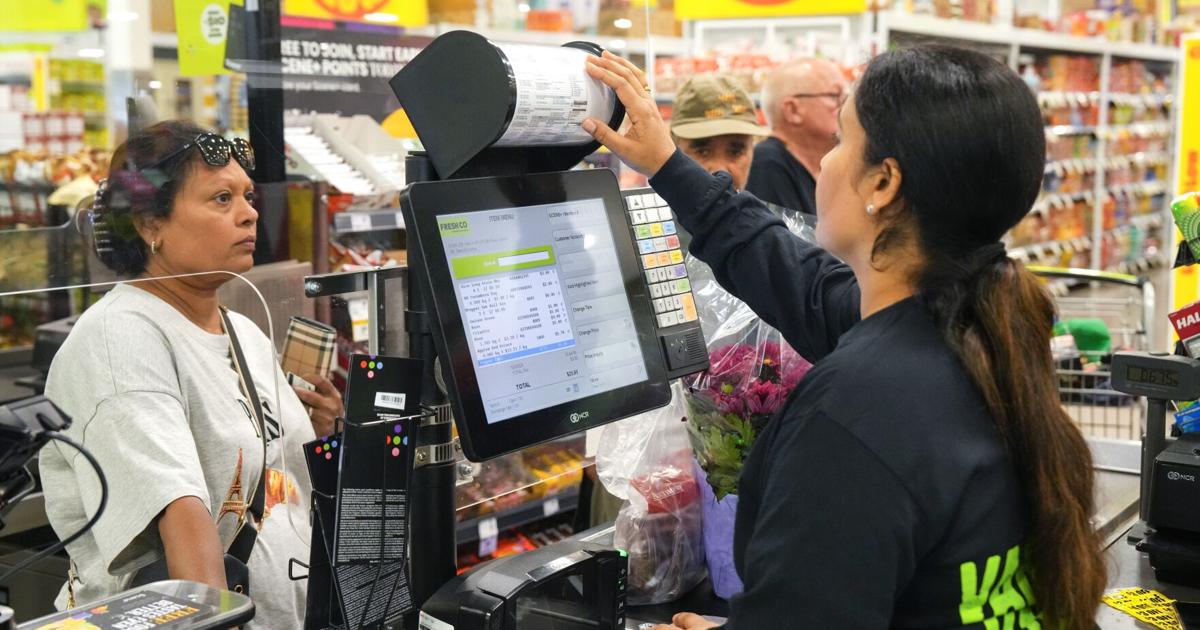
Photo via Toronto Star

How will we pay for groceries when we are all out of work?

Read the original at Toronto Star ↗
Cite

Farooq, M. (2026, November 17). How will we pay for groceries when we are all out of work? Toronto Star. https://www.thestar.com/opinion/contributors/how-will-we-pay-for-groceries-when-we-are-all-out-of-work/article_135a5171-8dac-4522-98b9-7da6a102095b.html

Dated from the outlet's own feed. Check the original for its byline.

Toronto Star · collected 2026-11-17 · by Mustafa Farooq

Quick Summary

This article, written from a progressive perspective, discusses the urgent need to address the potential economic displacement caused by the rapid growth of the AI industry in Canada. It highlights that while 81% of Canadian businesses have yet to adopt AI, many major AI companies are already seeing significant revenue growth, with Anthropic reporting $16.96 billion in Q3 2026 and OpenAI $6.7 billion in Q2 2026. The author questions why there is not more urgency in discussing how to tax AI companies and support workers who might lose their jobs due to AI, especially since Canada’s current AI strategy focuses more on growth than regulation.
Written by AI on 2026-11-17, from this article's own text only (the story summary below draws on all the coverage).

AI analysis

Story summary

As the AI industry rapidly grows in Canada, with 46% of Canadian CEOs considering replacing workers with AI, discussions about supporting displaced workers are increasingly urgent. Despite 81% of Canadian companies not yet adopting AI, AI firms like Anthropic and OpenAI are experiencing explosive revenue growth, with Anthropic reporting $16.96 billion in Q3 2026 and OpenAI recording $6.7 billion in Q2 2026. This raises questions about how to financially support workers who may lose their jobs to AI, a concern echoed in other jurisdictions such as the European Union, the United Kingdom, Japan, Singapore, and several U.S. states.

Written for “Economic Concerns Over Job Losses” on 2026-11-21, grounded in this article and the 0 other(s) covering the same event.

Compared with similar articles

This article reads leans strongly left and hedges 12% of its claims. Each row says how that neighbour differs.
Toronto Star
Hedges 0 of 3 claims Outlet record 64/100
“Article A discusses the need for Canadians to urgently address the potential impact of AI on the labor market, while Article B reports on a specific meeting convened by the Council for Inclusive Capitalism to discuss AI and the workforce.”

Story

Economic Concerns Over Job Losses
Economy/Business · 1 article(s) covering the same event.
How this article was measured signals, leaning charts, publisher record, byline, topics and claims

Signals How these are calculated →

Claims extracted
26
sentences that state something as happening or true
Uncertain
12%
3 of 26 hedged ("reportedly", "may", "according to")
Leaning
Leans strongly left
of the writing, not the subject · beta estimate
Publisher signals
64/100
Toronto Star's corrections and hedging, across everything collected from it. Not a measure of accuracy.
Outlets on this story
1
Economy/Business
Same framing elsewhere
1
articles that frame the event the way this one does
Analyzed 2026-11-17 · how these are computed

How this is being covered How these are calculated →

Article leaning vs. publisher reliability
Source leaning vs. consistency

Publisher

Toronto Star · 16399 article(s) · 31 correction(s) detected
Running correction rate · 31 correction(s)
2026-11-17
Correction
2026-10-26
Correction
2026-10-24
Correction
2026-10-07
Correction
2026-09-24
Correction

Who wrote this

Mustafa Farooq
1 article(s) here · 1 carrying a prediction
With the rapid growth of the AI industry and in light of a recent study that found 46 per cent of Canadian CEOs are considering replacing workers with AI to meet growth goals, why are we not openly discussing what supports will be available for workers who are displaced?
The only article under this byline in the corpus.

Topics

Anthropic Canada Canadian Canadians OpenAI

Subjects

Canada GPE · 11× Anthropic ORG · 3× OpenAI ORG · 3× Canadian NORP · 1× Canadians NORP · 1× Evan Solomon PERSON · 1× Mark Carney PERSON · 1× National Artificial Intelligence Strategy ORG · 1× Statistics Canada ORG · 1× Trump PERSON · 1×

Narrative

This matters because many other jurisdictions, including the European Union, the United Kingdom, Japan, Singapore, and several U.S. states, are starting to grapple with the same question: What do we do when huge populations of the workforce, both young and old, are displaced by AI and face limited prospects for reintegration into the economy?
framing: assertive · carried by 1 article(s) · first seen 2026-11-17
With the rapid growth of the AI industry and in light of a recent study that found 46 per cent of Canadian CEOs are considering replacing workers with AI to meet growth goals, why are we not openly discussing what supports will be available for workers who are displaced?
2026-11-17 · Toronto Star
How will we pay for groceries when we are all out of work? · assertive framing

Claims (26 extracted, 3 hedged)

AI is poised to fundamentally change the labour market, so why aren’t Canadians talking more urgently about taxing AI companies? asserted
Canadians → poise → companies
As someone who helps progressive organizations and non-profits advocate for social change, I find that increasingly difficult to ignore. asserted
that → help → change
With the rapid growth of the AI industry and in light of a recent study that found 46 per cent of Canadian CEOs are considering replacing workers with AI to meet growth goals, why are we not openly discussing what supports will be available for workers who are displaced? asserted
who → find → workers
While studies show that the vast majority of companies in Canada — 81 per cent according to Statistics Canada — are not yet adapting AI into their businesses, revenues at AI companies such as Anthropic and OpenAI are swelling. uncertain
revenues → show → Anthropic
Anthropic’s most recent quarterly revenue hit $16.96 billion in Q3 2026 and OpenAI revenue reached $6.7 billion in Q2 2026 — figures that signal the AI industry’s explosive commercial momentum. asserted
that → hit → momentum
AI is here to stay. asserted
AI → stay → ?
We need to start this conversation. asserted
We → need → conversation
In many respects Prime Minister Mark Carney has met the mark when it comes to confronting the existential threats posed by the Trump administration, but we have lagged when it comes to AI regulation in Canada. asserted
it → meet → Canada
No doubt that Evan Solomon, Canada’s minister on AI, is working towards something robust, as evidenced by the spring unveiling of Canada’s National Artificial Intelligence Strategy. asserted
Solomon → work → Strategy
However, of the six pillars of Canada’s National AI Strategy, five have to do with growing Canada’s AI capacity. asserted
five → have → capacity
Only one pillar has to do with regulation. asserted
pillar → have → regulation
Canada’s one attempt at AI legislation — former prime minister Justin Trudeau’s Bill C-27 — appears to have vanished with no sign of resurrection (perhaps a good thing given the many drafting problems of C-27) under the Carney government, which is much more focused on growing Canada’s faltering AI ecosystem than on regulating it. asserted
which → appear → it
While Canada’s new online harms bill, Bill C-34, does put forward some new guidelines to chatbot technology by laying out new duties, these largely are quite narrow and have to do with protecting children online. asserted
these → put → children
This matters because many other jurisdictions, including the European Union, the United Kingdom, Japan, Singapore, and several U.S. states, are starting to grapple with the same question: What do we do when huge populations of the workforce, both young and old, are displaced by AI and face limited prospects for reintegration into the economy? asserted
populations → matter → economy
How will we pay for our groceries if we are all out of work? asserted
we → pay → work
While creating a social safety net is of course an inelegant solution to what could be a massive societal disrupter, this is something that progressives, both political and institutional, need to start to think about. uncertain
progressives → create → that
How do unions function if there are dramatically fewer workers on the line because they have all been replaced by automated agents? asserted
they → function → agents
Since income tax is the basis of our entire tax system, what happens when that tax base dramatically shrinks as the Anthropics and Open AIs of the world shift income-earners out of the economy? asserted
Anthropics → happen → economy
While Canada’s Digital Services Tax experiment ended in ignominy, the debate over how to tax AI is growing globally. asserted
debate → end → AI
The Organization for Economic Co-operation and Development (OECD), whose 38 member countries include Canada, has put forward proposals for a Digital Services Tax on AI companies. asserted
countries → include → companies
However, critics argue that AI integrations may become so common place that a DST would be impossible to impose. uncertain
DST → argue → ?
Other proposals include South Korean legislators’ idea for an “excess profits tax” on massive AI company profits. asserted
proposals → include → profits
OpenAI itself has proposed the concept of a robot tax — a new tax regime applied specifically to companies that replace human workers with automated systems. asserted
that → propose → systems
Any proposal must of course be put forward in a responsible manner, given the current trade tensions with the United States. asserted
proposal → put → States
But that is no reason to delay a serious study at a parliamentary committee at the House of Commons on looking at AI and tax. asserted
that → delay → AI
At the same time, it is critical that unions, progressives, think tanks, and others develop a made-in-Canada solution for what the future of taxing AI companies should look like. asserted
future → develop → companies

Give feedback · no sign-in needed

No sign-in needed for now. Your note is sent without a name, so it cannot be answered.

History Support