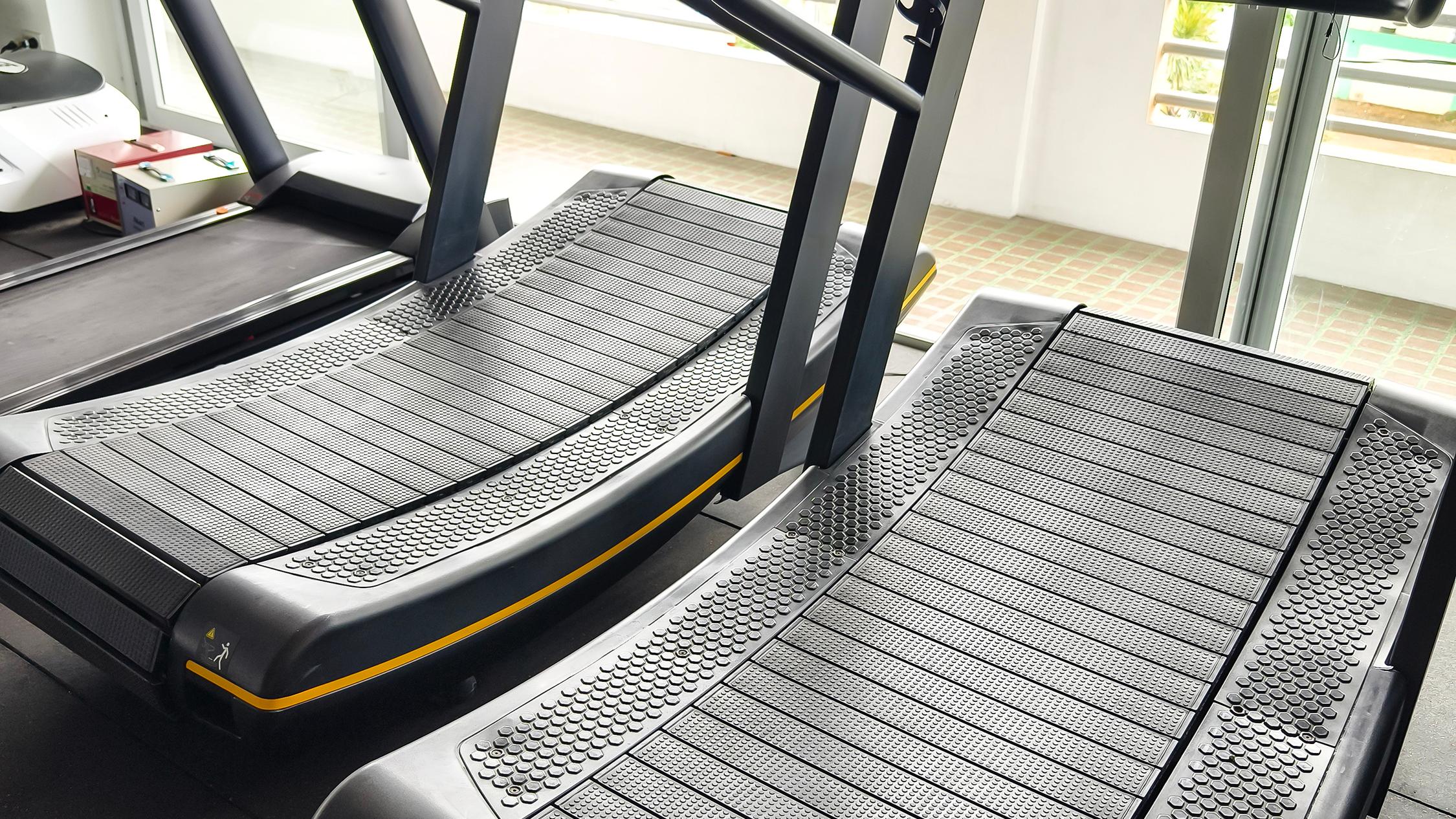
You’re at the gym facing a line of treadmills.
asserted
You → ’re → treadmills
But there are also a few odd looking machines that arch up in the front and the back, with no buttons on the console and no plug for an outlet.
asserted
that → be → outlet
These machines are designed with a curved surface so that as you land from each stride, the force of your foot moving downward revolves the belt around the deck.
asserted
force → design → deck
Each step you take powers the treadmill.
asserted
you → take → treadmill
(There are also some flat manual treadmills, though they’re far less common and generally used only for walking.)
asserted
they → be → walking
In CrossFit gyms and Reddit threads alike, you’ll come across plenty of runners who say manual treadmills are better for you.
asserted
treadmills → come → you
“A lot of people think that the motorized treadmill is doing all the work, and because of that, they have to use a non-motorized treadmill to really get the benefits of running,” says Richard Willy, an associate professor in the school of health and rehabilitation sciences at The Ohio State University.
asserted
Willy → think → University
Experts say that’s largely a misconception—yet there are other good reasons to hop on a manual treadmill.
asserted
that → say → treadmill
How manual treadmills work your body differently
The most common argument for manual treadmills is that they help you run with a more natural gait, closer to how you’d run on a road or a track.
asserted
you → work → road
But a 2023 study in the Journal of Sports Sciences found that traditional treadmills actually do a better job of replicating outdoor running than manual ones do.
asserted
ones → find → running
“There's very little difference between running on a motorized treadmill and running overground,” Willy says.
asserted
Willy → be → treadmill
The curve of a manual treadmill changes the joint movements in the lower body, explains Mohammad Saad, a physical therapist with Hospital for Special Surgery in New York City.
asserted
Saad → change → City
The thighs lift higher, putting the hips in a more flexed position, while the ankles go through a bigger range of motion, and the knees stay in a more flexed position the entire time.
asserted
knees → lift → position
With this gait, the mechanical load shifts away from the knee joints and more onto the hips and ankles.
asserted
load → shift → hips
And because runners have to use the force of their stride to accelerate the belt, they tend to use their propulsive muscles—the calves, hamstrings, and glutes—more, according to Willy.
uncertain
they → have → Willy
He says this can make manual treadmills helpful for people with knee pain, but dicey for those with glute, hamstring, calf, or Achilles problems.
asserted
treadmills → say → problems
Meanwhile, research also shows that runners also tend to run with a shorter stride and higher cadence (meaning more steps per minute) on a manual treadmill.
asserted
runners → show → treadmill
These two patterns are generally linked to more efficient running, though it hasn’t yet been studied if this gait style translates when a runner steps off the treadmill and heads out the door.
asserted
runner → link → door
Biomechanics aside, there’s also the effort level to consider: A manual treadmill makes for a brutal workout.
asserted
treadmill → ’ → workout
Multiple studies have found it takes significantly more energy to run on these machines compared to motorized treadmills.
asserted
it → find → treadmills
“The metabolic cost can be anywhere from 16-38% more,” Saad says.
asserted
Saad → say → ?
Runners use up more oxygen and calories, their heart rate spikes higher, they breathe heavier, and the same pace feels harder.
asserted
pace → use → oxygen
This is partially because of the extra energy it takes to move the belt, and partly because that curved surface means you’re basically running uphill nonstop.
asserted
you → take → belt
“It's the equivalent of running on about a five-degree incline the whole time,” says James Smoliga, a professor in the department of rehabilitation sciences at Tufts University who led a 2015 study comparing the intensities on manual and motorized treadmills.
asserted
who → run → treadmills
Although there’s been far less research on walking on a non-motorized treadmill, the trends are similar: Smoliga’s study found that even for healthy, athletic adults, walking on the curved, manual treadmill used up so much energy it qualified as a “vigorous” workout by American College of Sports Medicine standards.
asserted
it → walk → standards
(That can be good or bad, depending on your goals.)
asserted
That → depend → goals
So why do many runners think manual treadmills feel more natural?
asserted
treadmills → think → ?
That likely has more to do with the mental challenge of running than any physical effects.
asserted
That → have → effects
On a traditional treadmill, you key in the pace you want, then just have to keep up.
asserted
you → key → pace
But on a manual treadmill, your body sets the pace with each stride, so you have to keep focused and continually check in to stay on target—just like you would outside.
asserted
you → set → target
Practicing this can help runners prepare for the cognitive effort it takes to maintain a certain speed on race day.
asserted
it → practice → day
“You can do your entire workout based on your own feeling of intensity, which is a valuable part of training,” Smoliga says.
asserted
Smoliga → do → training
The best way to use a manual treadmill
It’s not unheard of for runners to do the bulk of their workouts on motorized treadmills.
asserted
runners → use → treadmills
Recently, professional runner Vincent Mauri placed 10th in the Chicago Marathon after doing about 70% of his training on standard treadmills at his local Planet Fitness.
asserted
Mauri → place → Fitness
“You just don't hear about people doing that on a non-motorized treadmill, and that's because the metabolic cost is too high,” Willy says.
asserted
Willy → hear → treadmill
Manual treadmills are best used as specialized tools for short, hard efforts like sprints or fast intervals.
asserted
treadmills → use → sprints
Saad, for instance, says he typically only hops on a manual treadmill for one to four minutes at a time in his own training.
asserted
he → say → training
“If you're looking to have a very intense workout in a very short period of time, a curved, non-motorized treadmill is the way to go,” Willy says.
asserted
Willy → look → time
While it’s technically possible to do a long endurance run on a manual treadmill, just know that doing, say, a 10-miler on this machine will tax your body far more than running 10 miles on the road or a motorized treadmill.
asserted
doing → ’ → road
You’ll essentially be running 10 miles uphill the entire time while also pushing against the resistance of the belt.
asserted
You → run → belt
…and 8 more, not listed.
 The Aporia