Photo via Al Jazeera

Ghalibaf’s maths missile at Trump decoded: Is Iran fixing US interest rates?

Read the original at Al Jazeera ↗
Cite

Siddiqui, U. (2026, September 17). Ghalibaf’s maths missile at Trump decoded: Is Iran fixing US interest rates? Al Jazeera. https://www.aljazeera.com/news/2026/9/17/ghalibafs-maths-missile-at-trump-decoded-is-iran-fixing-us-interest-rates?traffic_source=rss

Dated when The Aporia collected the article, usually within hours of publication. Check the original for its exact date and byline.

Al Jazeera · collected 2026-09-17 · by Usaid Siddiqui

Quick Summary

Iranian Parliament Speaker Mohammad Bagher Ghalibaf posted an equation used by central banks to determine interest rates on X, alongside wartime rhetoric implying Iran's influence over US economic decisions. He suggested that Tehran could manipulate U.S. interest rates and control the Strait of Hormuz strategically. This comes amid ongoing tensions between Iran and the United States since February 28 when a war allegedly initiated by the US and Israel against Iran began. Economists use the Taylor equation to estimate central bank interest rates based on inflation and economic output, but Ghalibaf's post is more an act of propaganda than practical economics.
Written by AI on 2026-09-17, from this article's own text only (the story summary below draws on all the coverage).
See how they differ ↓

AI analysis

Story summary

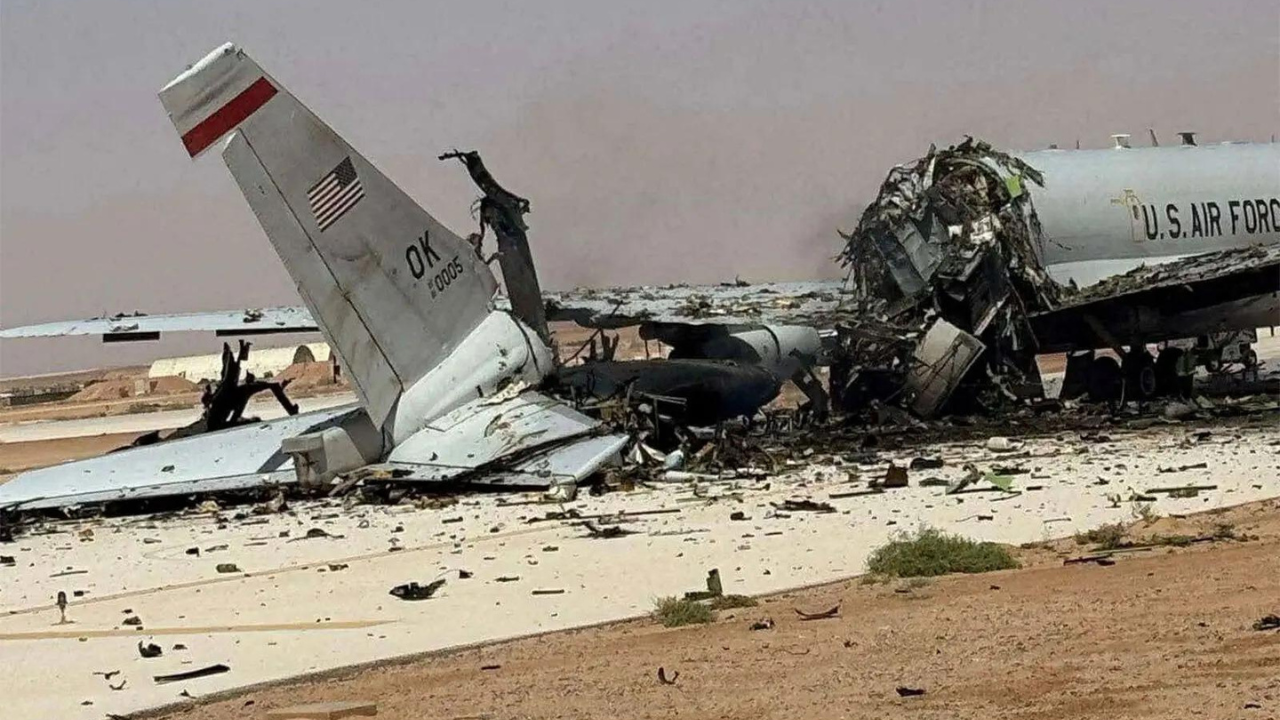
CBS News has obtained leaked photos from anonymous U.S. military personnel stationed in Saudi Arabia and Kuwait, showing extensive damage at U.S. bases following Iranian missile and drone strikes. The images depict destroyed aircraft, collapsed buildings, and burned-out vehicles. One photo captures a $270 million Boeing E-3 Sentry spy plane severely damaged at Prince Sultan Air Force Base in Saudi Arabia, with its tail section ripped off. These photos highlight significant destruction across multiple U.S. positions, raising concerns about the impact of President Trump's war on Iran, which began seven months prior and shows no signs of ending. The Pentagon’s inspector general reported that hundreds of buildings and structures at U.S. bases in eight countries, including Kuwait, Bahrain, Saudi Arabia, Iraq, and Jordan, were damaged or destroyed by Iranian strikes.

Written for “Iran Attacks Damage US Bases” on 2026-11-20, grounded in this article and the 29 other(s) covering the same event.

How they differ

17 outlets covered “Iran Attacks Damage US Bases”.

What each outlet says

One AI summary per outlet of its latest article on this story, written from that article alone and checked against it. Open the article for the outlet's own words.

Al JazeeraThis outlet17 Sep

Iranian Parliament Speaker Mohammad Bagher Ghalibaf posted an equation used by central banks to determine interest rates on X, alongside wartime rhetoric implying Iran's influence over US economic decisions. He suggested that Tehran could manipulate U.S. interest rates and control the Strait of Hormuz strategically. This comes amid ongoing tensions between Iran and the United States since February 28 when a war…

Ghalibaf’s maths missile at Trump decoded: Is Iran fixing US interest rates? (this article)3 articles from Al Jazeera on this story
The Independent16 Sep

Anonymous active-duty U.S. service members have leaked photos to CBS News showing damage to American facilities in Saudi Arabia and Kuwait due to missile and drone attacks by Iran during the ongoing conflict that started seven months prior. The images depict significant destruction, including a severely damaged Boeing aircraft at Prince Sultan Air Force Base in Saudi Arabia and gutted buildings at Camp Buehring and…

Active-duty military members leak images of damage to US planes and bases during Iran war →3 articles from The Independent on this story
BBC16 Sep

CBS obtained leaked photos from an unnamed US military source showing significant damage to several American bases in the Middle East due to Iranian strikes. The images depict a severed radar jet, destroyed trailers, and severely damaged buildings. The BBC's State Department correspondent discusses the implications of these undisclosed damages with viewers.

Watch: Leaked photos reveal extensive damage at US bases in Gulf →3 articles from BBC on this story
South China Morning Post19 Sep

The Pentagon reported to Congress that the ongoing conflict with Iran has incurred a total cost of $43.6 billion as of recent, including $11.2 billion for operational expenses and an additional $32.4 billion for replacing lost or damaged equipment. This figure does not account for potential damages to US military infrastructure in eight Middle Eastern countries. The increasing costs are cited by polls as a factor in…

How much has Iran war cost US? Pentagon estimates US$43.6 billion so far →2 articles from South China Morning Post on this story
Daily Mail17 Sep

Leaked photographs from American service members show significant damage to U.S. military bases in Saudi Arabia and Kuwait following Iranian missile and drone attacks. The photos depict destroyed aircraft, buildings, and vehicles at Prince Sultan Air Force Base and Camp Buehring in Kuwait. One striking image shows a Boeing E-3 Sentry surveillance aircraft with its tail severed and fuselage charred from what appears…

Leaked photos appear to show catastrophic damage to US military bases: 'This hasn't been communicated' →2 articles from Daily Mail on this story
Show 11 more outlets
New York Post16 Sep

CBS News reports on extensive damage to U.S. military bases in Saudi Arabia and Kuwait from Iranian airstrikes, showing destroyed aircraft, buildings, and vehicles. The article highlights a $270 million E-3 Sentry spy plane among the damaged assets. Service members who provided images to CBS contradicted claims by Defense Secretary Pete Hegseth that only minor damage occurred, stating they are witnessing major…

Widespread damage on US bases from Iranian airstrikes revealed, including to $270 million spy plane →2 articles from New York Post on this story
Times of India19 Sep

The Pentagon has informed Congress that the cost of America’s ongoing conflict with Iran is $45.1 billion, surpassing previous estimates by the Congressional Budget Office. Additionally, six US officials told The Washington Post that at least 22 service members have died since the war began, more than the 18 deaths reported publicly by the Pentagon. The article highlights uncertainties around the exact number of…

Iran war costs US $45.1 billion; fatalities possibly higher than 18 reported by Pentagon →2 articles from Times of India on this story
NBC News14 Sep

The Pentagon's inspector general released a report on Monday stating that the ongoing conflict with Iran has caused a shortage of U.S. munitions and supply chain bottlenecks. The report covers the period from February 28 to June 30, estimating costs at about $33.4 billion, including $22.3 billion for expended munitions. President Trump countered these findings by asserting that the U.S. is producing more weapons…

Pentagon inspector general says Iran war has led to a shortfall of U.S. munitions →
Euronews15 Sep

The US Defense Department's inspector general reported a shortage of ammunition and advanced weapons due to the conflict with Iran, costing an estimated $22.3 billion in munitions alone from February to June. The report revealed significant military equipment losses including four F-15 fighter jets, one damaged F-35, seven KC-135 tanker aircraft, and up to 30 MQ-9 Reaper drones, with repairs to base infrastructure…

US military says it is facing a shortfall in ammunition as a result of Iran war →
Dawn15 Sep

The Pentagon has released a report confirming that the US-Israeli war on Iran led to significant shortages in American munitions stocks and highlighted industrial bottlenecks for resupply. The four-month conflict from February 28 to June 30 involved over 50,000 US service members who flew thousands of combat missions at a cost of $33.4 billion, with $22.3 billion spent on munitions alone. The report underscores the…

War on Iran resulted in munitions shortfall for US, confirms Pentagon report →
The Hindu15 Sep

The U.S. Department of Defence's inspector general reported on September 14, 2026, to Congress that the ongoing war in Iran has caused a significant munitions shortfall costing $33.4 billion between February and June 2026, with $22.3 billion spent specifically on expended munitions. This report highlights industrial bottlenecks for resupplying ammunition and lists substantial military losses including damaged…

U.S. military says Iran war has led to munitions shortfall →
The Straits Times15 Sep

The US military reports a significant shortage of ammunition due to ongoing operations against Iran, as detailed in a recent mandatory report to Congress. Between February 28 and June 30, the operation cost $33.4 billion, with $22.3 billion spent on munitions alone, leading to strategic inventory shortfalls. The Pentagon is working to streamline procurement processes but acknowledges that expanding production…

US military says Iran war has led to munitions shortfall →
CBC15 Sep

A Pentagon inspector general report details damage caused by Iranian strikes during Operation Epic Fury from April to June 30, costing an estimated $33.4 billion. The report reveals damaged U.S. military bases and diplomatic buildings across several Middle Eastern countries, including the naval base in Bahrain which was targeted with drones and missiles. The conflict has also exposed shortages of advanced weapons…

Several U.S. military bases, diplomatic buildings have been damaged in Iran war: inspector general report →
The Bulwark16 Sep

Ben Parker and Lt. Gen. Mark Hertling discuss on The Bulwark’s live video how Iran is causing significant damage to U.S. military operations in the Middle East, including attacks on bases and interference with oil supplies. They also estimate economic consequences could amount to $38 billion. The conversation covers broader conflicts involving the Houthis and their impact on American forces. Subscribers get full…

Command Post: Iran Is Doing More Damage to the U.S. Military Than We Knew →
Reason16 Sep

Pentagon auditors report that the cost of the conflict with Iran, labeled as “Operation Epic Fury,” has reached $33.4 billion since February 28 through June 29, including $22.3 billion for munitions alone. However, this figure does not account for infrastructure repairs or ongoing impacts on fuel prices and supply chains, which have contributed to broader economic challenges like inflation and increased interest…

Pentagon Auditors Say the Iran War Has Cost $33 Billion. The Real Price Tag Is Far Higher. →
Toronto Star18 Sep

The U.S. military's cost for the ongoing Iran war has increased to $43.6 billion as of September 3, according to an estimate provided by U.S. Central Command to lawmakers this week. The report indicates that costs have escalated from $38 billion through August 1 and are expected to rise further at a rate of about $3 billion per month based on the conflict's intensity.

Iran war’s cost grows to $43.6 billion in new US military estimate →

Where they agree and split

Agreed

AI · cited, from two or more outlets

  • The Pentagon's inspector general reported a shortfall of U.S. munitions and supply chain bottlenecks due to the war with Iran.23
  • US bases across the Middle East have come under repeated attack by Iran, raising questions about their sustainability.13
Quoted from the coverage (3)

Two weeks ago, Trump posted that the U.S. had “virtually unlimited” amounts of ammunition and lashed out at reports of munitions shortfalls.

7 outlets

The report added that the defence department is now working to "streamline procurement processes and production lead times" to address the shortages and "respond rapidly to a contingency".

5 outlets

Among the losses have been four F-15e fighter jets, a highly advanced F-35 Joint Strike Fighter and 30 MQ-9 drones destroyed in "various circumstances".

4 outlets

Disputed

Picked by our model, which is sometimes wrong

  • President Trump denied reports of munitions shortages while the Pentagon's inspector general confirmed such shortfalls in a report.24

Framing

How the first headlines put it

  • Al Jazeera's headline emphasizes Iran's damage to U.S. bases in Bahrain and Jordan, while NBC News focuses on munitions shortfalls reported by the Pentagon inspector general.12
  • Dawn highlights the confirmation of munitions shortfall for US from a Pentagon report, whereas CBS News presents new photos showing widespread damage at U.S. positions caused by Iranian attacks.35
Words to watch (1)

Iran-US war latest: US military facing weapons shortages after dozens of aircraft destroyed as cost of war hits $33bn The Independent

The full story: what happened, how it changed, and all 30 articles →

Compared with similar articles

This article reads leans left and hedges 16% of its claims. Each row says how that neighbour differs.
Al Jazeera
Leans left Hedges 0 of 46 claims Outlet record 60/100
Al Jazeera
Leans left Hedges 8 of 54 claims Outlet record 60/100
“Both articles discuss aspects of the ongoing conflict between Iran and the US, but they cover different elements: Article A focuses on the financial cost and economic impact, while Article B discusses military actions and a specific tactic involving mathematics.”
Times of India
Leans left Hedges 2 of 25 claims Outlet record 59/100
“While both articles discuss financial and military costs related to a war involving Iran and the US, they do not describe the exact same incident or occurrence.”

Story

Iran Attacks Damage US Bases
World · 30 article(s) covering the same event. Compare every outlet's account →
How this article was measured signals, leaning charts, publisher record, byline, topics and claims

Signals How these are calculated →

Claims extracted
37
sentences that state something as happening or true
Uncertain
16%
6 of 37 hedged ("reportedly", "may", "according to")
Leaning
Leans left
of the writing, not the subject · beta estimate
Publisher signals
60/100
Al Jazeera's corrections and hedging, across everything collected from it. Not a measure of accuracy.
Outlets on this story
30
World
Same framing elsewhere
1
articles that frame the event the way this one does
Analyzed 2026-09-17 · how these are computed

How this is being covered How these are calculated →

Article leaning vs. publisher reliability
Source leaning vs. consistency

Publisher

Al Jazeera · 6131 article(s) · 4 correction(s) detected
Running correction rate · 4 correction(s)

Who wrote this

Usaid Siddiqui
14 article(s) here · 1 carrying a prediction
But on Wednesday, almost exactly a year after those comments, Modi will host Prince William and his wife, Catherine, the Princess of Wales, in New Delhi, after they also visited Mumbai — playing street cricket alongside Indian legend Sachin Tendulkar to kick off a three-day visit to India.
So what do we know about the affair, and how will this impact US-China relations and the race for AI dominance?
Iran essentially closed the strait after the US-Israeli attacks began, warning that ships trying to sail through the waterway without authorisation could be targeted.
So a great divide could really mean an opportunity divide, and really could deepen the socioeconomic divide,” he said.
“Trade will prosper, and long-term investment will create its potential only with a safe and stable environment.”
Iranian strikes on Qatar’s Ras Laffan industrial complex in March damaged facilities, with repairs expected to take several years. “We were surprised,” Al Thani said when asked about the attack, adding that there had since been “a lot of discussion with Iran”.
“On the other hand, AI gives individuals access to types and quantities of information they didn’t have previously that may facilitate the commission of mass casualty events, a concern it’s not easy to dismiss.”
Varga said current flows could be maintained as long as those methods and routes remain secure.
Gulf countries, she suggested, may be paying Iran to allow their oil through – potentially handing Tehran a significant portion of the value of the cargo.
Sami Abu Shehadeh, the leader of the Balad party, withdrew his candidacy after the Supreme Court warned he could be disqualified from the race.
Also by Usaid Siddiqui
Nothing else under this byline is closely related to this article, so these are simply their most recent.
All 14 articles by Usaid Siddiqui →

Topics

Al Jazeera Iran Tehran Washington the United States’

Subjects

Iran GPE · 11× Ghalibaf PERSON · 4× Fed ORG · 3× Taylor PERSON · 3× Tehran GPE · 3× the US Federal Reserve ORG · 3× Al Jazeera ORG · 2× Trump PERSON · 2× Washington GPE · 2× the United States’ GPE · 1×

Narrative

Early in the war, which was launched by the US and Israel against Iran on February 28, Ghalibaf frequently used financial arguments to mock how the conflict was being conducted by the administration of US President Donald Trump, to point to Iran’s ability to hurt Washington economically unless it changed its approach.
framing: assertive · carried by 1 article(s) · first seen 2026-09-17
“Let’s see if a hike could open SOH or produce a single barrel,” he wrote, referring to interest rate hikes and the Strait of Hormuz, a crucial waterway Iran has effectively blocked for global shipping.

Claims (37 extracted, 6 hedged)

Iran’s missiles and drones have downed dozens of US aircraft, damaged or destroyed hundreds of the United States’ buildings at its bases in the Middle East, and drained its inventories of military equipment worth billions of dollars, the Pentagon conceded earlier this week. asserted
Pentagon → down → dollars
On Wednesday, Tehran unleashed another unlikely weapon in its war against the US: a maths equation. asserted
Tehran → unleash → US
Recommended Stories list of 4 items- list 1 of 4‘They called us’: Has Trump abandoned Bab al-Mandeb to the Houthis? asserted
Trump → call → Houthis
- list 2 of 4US CENTCOM tells Al Jazeera Hormuz blockade ‘highly effective’ - list 3 of 4Trump claims direct talks with Iran: Is diplomacy picking up again? - list 4 of 4Why is inflation rising again around the world? Iranian Parliament Speaker Mohammad Bagher Ghalibaf, who has also been a lead negotiator during talks between Tehran and Washington at different stages during the past six months, typed out a version of the Taylor equation, a formula used by central banks to determine interest rates, in a post on X loaded with a wartime message. uncertain
who → tell → message
“Let’s see if a hike could open SOH or produce a single barrel,” he wrote, referring to interest rate hikes and the Strait of Hormuz, a crucial waterway Iran has effectively blocked for global shipping. uncertain
Iran → see → shipping
“You can’t 25bp [basis points] a chokepoint,” he added, seemingly again referring to the strait. asserted
he → add → strait
“It’s SOH risk premium, and We set it.” asserted
We → ’ → it
Hours after Ghalibaf’s post, the US Federal Reserve did raise the benchmark interest rate by 25 basis points. asserted
Reserve → raise → points
Early in the war, which was launched by the US and Israel against Iran on February 28, Ghalibaf frequently used financial arguments to mock how the conflict was being conducted by the administration of US President Donald Trump, to point to Iran’s ability to hurt Washington economically unless it changed its approach. asserted
it → launch → approach
Now he’s turned to maths. asserted
he → turn → maths
“This is a spectacular bit of agitprop from Iran, a country which, if nothing else in 2026, has demonstrated an impressive ability to needle its US opponent,” Chris Beauchamp, chief market analyst at IG Group, told Al Jazeera. asserted
Beauchamp → demonstrate → Jazeera
But what exactly is Ghalibaf trying to say? What is the Taylor equation, has the Iran war influenced the US interest rate, and does Tehran “set it”, as the parliament speaker has suggested? uncertain
speaker → try → it
What is the Taylor equation that Ghalibaf cited? asserted
Ghalibaf → cite → that
The rule is a formula economists use to estimate where a central bank should set interest rates based on inflation and the strength of the economy. asserted
bank → use → economy
Developed by economist John Taylor in the early 1990s, the rule links the US federal funds rate to inflation and the “output gap” – the difference between actual economic output and its potential. asserted
rule → develop → output
In its simplest form, the formula is: Interest rate = inflation + 0.5(output gap) + 0.5(inflation − 2%) + 2%. This means the recommended interest rate rises when inflation moves above the 2 percent target or when economic output exceeds its potential. asserted
output → mean → potential
It falls when inflation weakens or the economy operates below potential. asserted
economy → fall → potential
However, the equation is a benchmark, not a set rule that is strictly followed. asserted
that → set → ?
Policymakers at the US Federal Reserve weigh other economic factors when setting interest rates. asserted
Policymakers → weigh → rates
Trump’s tariffs, the energy shock following the US-Israeli war with Iran, and heavy investment associated with the artificial intelligence boom, taken together, have kept inflationary pressures strong, experts say. asserted
experts → follow → pressures
On Wednesday, when the US Federal Reserve raised interest rates by 25bp, it was the first increase in three years. asserted
it → raise → years
Fed Chairman Kevin Warsh, in his speech following the rate hike, said renewed fighting between the US and Iran, which has pushed up petrol prices, helped convince Fed officials to support higher rates. asserted
which → follow → rates
“There’s no hiding from hot spots around the world,” Warsh said. asserted
Warsh → hide → world
IG Group’s Beauchamp said, “The Iran war, indirectly, is a huge driver of last night’s hike, though no one wants to admit it.” asserted
one → say → it
“The energy spike has combined with the rise in yields to drive the Fed into a corner with no way out,” he said. asserted
he → combine → way
Susannah Streeter, chief investment strategist at the Wealth Club, said there is “no denying” that Iran’s retaliatory action against the US and its allies across the Gulf region has “intensified concerns about energy supplies and led to hotter inflation forecasts”. asserted
action → say → forecasts
“The ongoing geopolitical turmoil and elevated crude prices certainly were key issues behind the Fed’s decision to hike rates,” she said. asserted
she → hike → rates
Is Iran ‘setting’ the US interest rate? asserted
Iran → set → rate
Wealth Club’s Streeter cautioned that while the war in the Middle East and rising oil prices were certainly an element in the Fed’s decision, they weren’t the “only factors at play”. asserted
they → caution → play
“The spending might of AI hyperscalers has also pulsed through the veins of the economy, with strong capital investment and resilient domestic demand adding to inflationary pressures, so policymakers will have been looking at the whole picture,” she noted. uncertain
she → pulse → picture
“So, while Tehran has arguably had an influence on some of the forces feeding into US monetary policy, particularly through the impact of the conflict on oil supplies and prices, it is not ‘setting’ US interest rates.” asserted
it → have → rates
Streeter said the US Federal Reserve was responding to a much broader set of economic conditions. asserted
Reserve → say → conditions
“Iran’s actions have affected the inflation outlook, but the decision on where to set interest rates ultimately rests with the Federal Reserve, and there are plenty of other data points policymakers use,” she noted. asserted
she → affect → points
What’s behind Ghalibaf’s maths mocking? asserted
What → ’ → mocking
In March, Iran’s parliamentary speaker had repeatedly used social media to comment on markets and energy prices, including mocking efforts by the Trump administration to influence oil futures and arguing that financial manoeuvring could not create “actual fuel” at petrol stations. uncertain
manoeuvring → use → stations
Last month, Ghalibaf posted a graphic bearing the phrase “Make America Hungry Again” – a play on Trump’s slogan “Make America Great Again” – together with statistics on food insecurity and hunger in the US. asserted
America → post → US
“You can’t cover up defeats with false claims,” he said. uncertain
he → cover → claims
Give feedback · no sign-in needed

No sign-in needed for now. Your note is sent without a name, so it cannot be answered.

History Support