In the large lobby of a three story building in Wuhan, China, a child-size yellow robot greets visitors with a dance.
asserted
robot → greet → dance
It sways along to traditional Chinese music while robots twice the size stand on either side of the stage, beating loud drums to the rhythm.
asserted
robots → sway → rhythm
The little robot then moves on to another dance, bopping along to a pop tune that makes people smile and laugh.
asserted
people → move → tune
The small
makes it look almost lifelike.
asserted
it → make → ?
Then it stops, and the crowd is ushered on to see the real wonders inside the Hubei Humanoid Robotics Innovation Center.
asserted
crowd → stop → Center
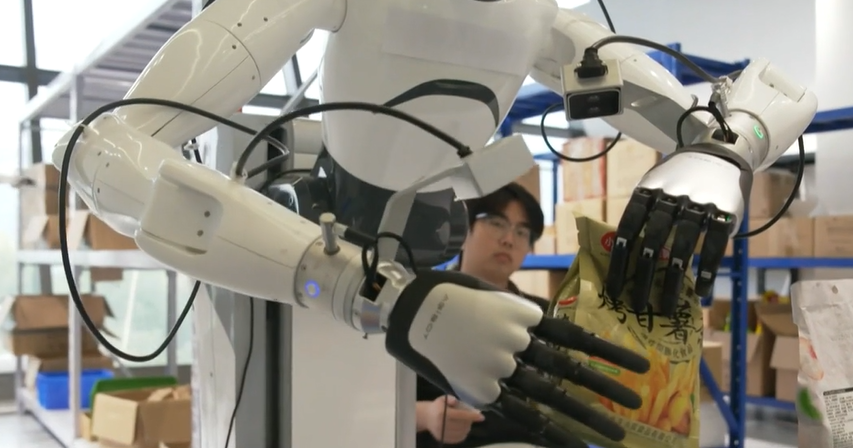
On the top floor, more than 100 computer science and engineering graduates toil at individual work stations wearing gloves and outfits equipped with motion and tactile sensors, while cameras record their every movement.
asserted
cameras → toil → movement
One pours water into a jug; another places cutlery and chopsticks into a container.
asserted
another → pour → container
The graduate at the next table unscrews a flashlight and removes the battery, then replaces it.
asserted
graduate → unscrew → it
All the movements are done slowly, meticulously and repeated over and over again, with the actions recorded as valuable data from the cameras and sensors that can be used to train the company's humanoid robots.
asserted
that → do → robots
"It was fun at first," said 22-year-old intern Mei.
asserted
Mei → say → ?
"It gets a little boring in the middle.
asserted
It → get → middle
But it's such a proud moment when we get the model trained."
Mei is one of nearly 1 million engineering graduates China's universities are estimated to be churning out every year.
asserted
universities → get → graduates
The U.S., by comparison, sends about 140,000 young engineers into the job market annually.
asserted
U.S. → send → market
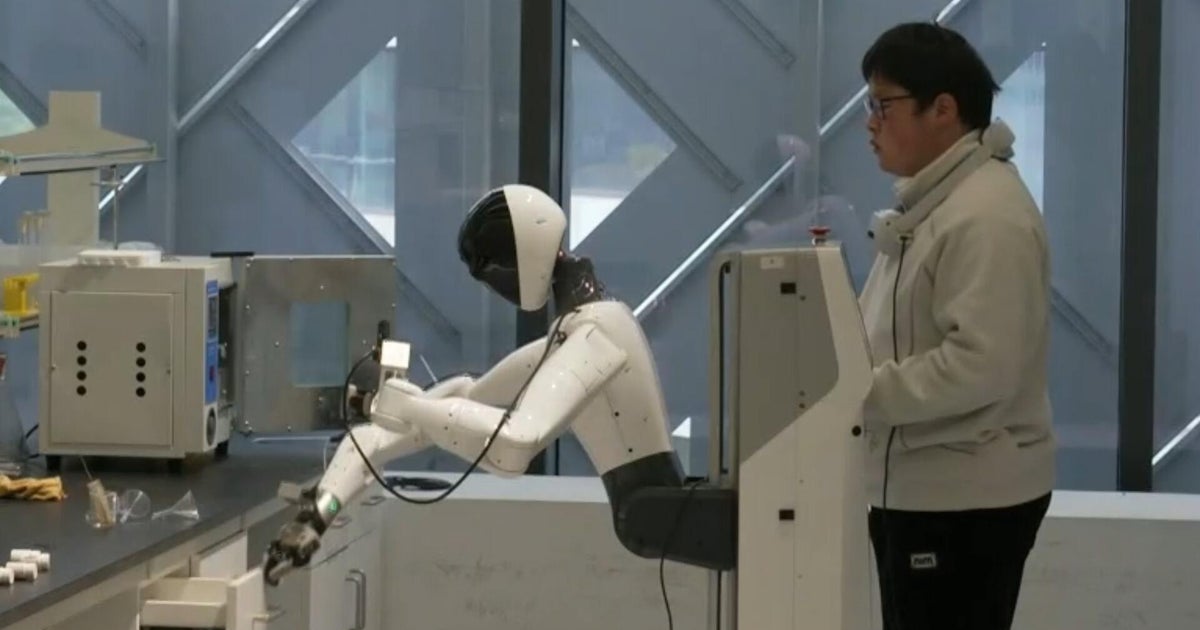
Another graduate sits with a remote control in his hand and a humanoid robot next to him.
asserted
graduate → sit → him
As he moves his hand, the robot mimics his motions.
asserted
robot → move → motions
"Right now I'm capturing the motion of pouring water into a cup.
asserted
I → capture → cup
We're training this action and gathering data for the model.
asserted
We → train → model
It's controlled by this hand controller.
asserted
It → control → controller
It moves exactly how the hand moves," he explains.
asserted
he → move → ?
"We need to run this hundreds or thousands of times.
asserted
We → need → times
We have only completed 500 iterations so far."
asserted
We → complete → iterations
At the G20 summit in September, Elon Musk made a bold statement, declaring that within 10 years, "there will be well over a billion humanoid robots, and productivity of a robot will be five-times that of a human."
asserted
productivity → make → human
The world's richest man may believe robots will replace human productivity within a decade, but many in China take a different view.
uncertain
many → believe → view
"Our main goal is for these robots to serve humans in household and industrial settings," Prof. Jiyin Cao, who runs the Hubei robotics center, told CBS News, clearly oozing pride over the work they are doing.
asserted
they → serve → work
"We train them to carry out tasks for industrial applications.
asserted
We → train → applications
This is why we train these robots — to help them integrate better into human life."
asserted
them → train → life
China is under enormous pressure to make that happen.
asserted
that → make → pressure
The country has an aging, shrinking population.
asserted
country → have → population
It's one of the fastest demographic shifts playing out anywhere in the world, and it is lending urgency to efforts to get humanoid robots into labor-intensive sectors such as manufacturing, logistics, retail and healthcare.
asserted
it → play → manufacturing
"I believe future robots will be deployed across all industries.
asserted
robots → believe → industries
They will work in factory workshops, homes, nuclear energy sites, provide elderly care services, and serve as our personal assistants," Cao told CBS News.
asserted
Cao → work → News
"They can help us with all these things."
asserted
They → help → things
Training the humanoids, however, takes an enormous amount of time, especially for more complex tasks.
asserted
Training → train → tasks
Cao laughed off any suggestion that most people could have humanoid helpers in their homes anytime soon.
uncertain
people → laugh → homes
"It still requires extensive training and learning," he said.
asserted
he → require → training
Early robots mostly perform actions in simple, fixed, structured settings.
asserted
robots → perform → settings
But every household is unique, making home environments highly complex.
asserted
environments → make → ?
But it could also take 10 years.
uncertain
it → take → years
The timescale may be up for debate, but
and on a monumental scale to bring robots into the mainstream consumer world — and to ensure it is Chinese companies developing and making them.
uncertain
it → bring → them
"China has the world's strongest industrial manufacturing system and a full supply chain for upstream and downstream robotics products," Cao said.
asserted
Cao → have → products
 The Aporia