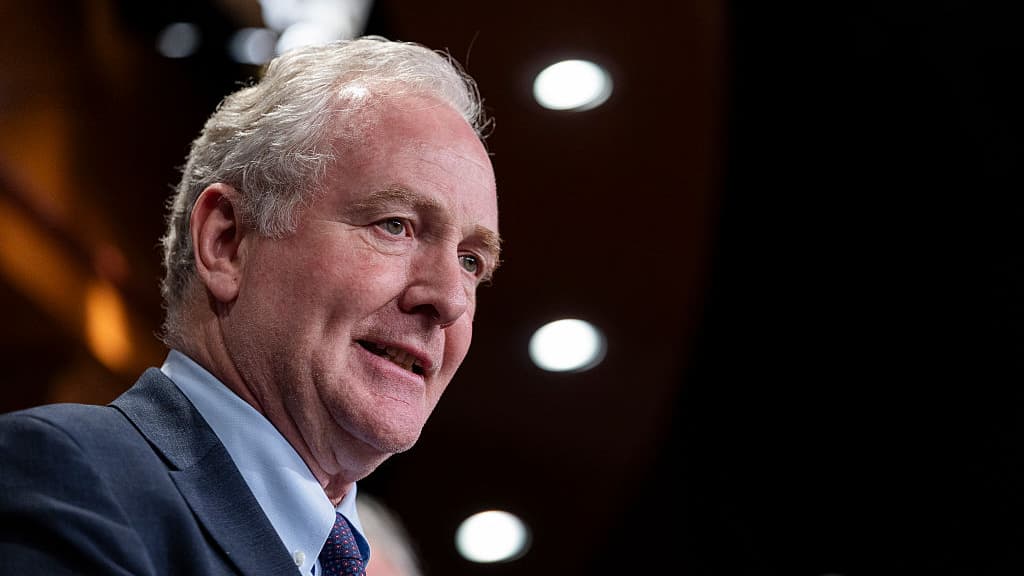
Senator Chris Van Hollen of Maryland is making the regulation of artificial intelligence a central part of his campaign to lead Senate Democrats, arguing that Congress must move more aggressively to confront the technology's growing risks and that the party needs a leader willing to challenge the powerful companies seeking to shape the rules.
asserted
party → make → rules
At a news conference Thursday, Van Hollen laid out a vision for a more assertive Senate that would impose mandatory safeguards on AI companies, hold them liable for harm caused by their products, and overhaul congressional procedures to prevent legislation opposed by powerful corporate interests from languishing indefinitely.
asserted
them → lay → interests
“The Senate moves like a glacier compared to the rushing stream that's coming at us in terms of the risks of AI,” Van Hollen said, arguing that the chamber's existing rules were ill-equipped to address the technology's rapid development.
asserted
rules → move → development
“We need a Senate that's equal to the AI age.”
asserted
that → need → age
The remarks offered one of the clearest policy distinctions yet in Van Hollen's insurgent challenge to Senator Chuck Schumer of New York, the current Democratic leader, who is seeking another term leading the caucus after helping engineer the party's sweeping victories in this month's midterm elections.
asserted
who → offer → elections
It also underscored how artificial intelligence is becoming a significant political issue as Democrats prepare to take control of the Senate in January.
asserted
Democrats → underscore → January
Concerns about AI's potential to displace workers, threaten cybersecurity, and drive up electricity costs due to the proliferation of energy-intensive data centers was a central topic on the campaign trail this year, Van Hollen said, adding urgency to questions about how a Democratic-led Congress should regulate an industry whose influence has grown considerably.
asserted
influence → displace → industry
For Democrats choosing their next leader, the issue presents a test of how the party intends to translate its electoral success into legislation, and whether its leaders are prepared to confront some of the country's most influential corporations.
asserted
leaders → choose → corporations
Van Hollen, 67, has sought to cast his candidacy as a response to voters demanding fundamental change, arguing that Democrats cannot return to the governing practices that preceded their election victories.
asserted
that → seek → victories
Schumer, 75, who has led Senate Democrats for a decade, has countered that his record of recruiting candidates, raising money, and building a majority demonstrates why he should remain in charge.
asserted
he → lead → charge
The contest, the first competitive race for Senate Democratic leader in more than three decades, will be decided in a secret ballot on Dec. 1.
asserted
contest → decide → Dec.
With 56 current and incoming senators eligible to participate, either candidate would need at least 29 votes to win if everyone votes.
asserted
everyone → participate → votes
Schumer has said that he has secured enough commitments to win.
asserted
he → say → commitments
So far, he has the public backing of 15 senators and senators-elect, including Angela Alsobrooks of Maryland, Tammy Baldwin of Wisconsin, Richard Blumenthal of Connecticut, Catherine Cortez Masto of Nevada, John Fetterman of Pennsylvania, Ruben Gallego of Arizona, Kirsten Gillibrand of New York, Mazie Hirono of Hawaii, Mark Kelly of Arizona, Angus King of Maine, Jack Reed of Rhode Island, Jacky Rosen of Nevada, Brian Schatz of Hawaii, Sheldon Whitehouse of Rhode Island, and Sherrod Brown of Ohio.
asserted
he → have → Ohio
His supporters credit him with helping Democrats win a Senate majority that is expected to reach 56 seats next year.
asserted
that → credit → seats
Van Hollen has said that approximately 15 colleagues support him, although most have not publicly declared their intentions.
asserted
most → say → intentions
His announced backers include Senators Bernie Sanders of Vermont and Jeff Merkley of Oregon and Senators-elect Abdul El-Sayed of Michigan and Peggy Flanagan of Minnesota.
asserted
backers → announce → Minnesota
Several other Democrats, including Senators Elissa Slotkin of Michigan and newly elected senators who campaigned on changing the party's leadership, have said they will not support Schumer without committing to backing his challenger.
asserted
they → include → challenger
An additional 30 Democrats have not said whom they plan to support.
asserted
they → say → whom
The debate over AI has given Van Hollen a concrete way to illustrate his argument that the Senate's existing leadership structure is too responsive to entrenched interests.
asserted
structure → give → interests
He pointed Thursday to the American Innovation and Choice Online Act, bipartisan legislation sponsored by Senators Amy Klobuchar of Minnesota and Charles Grassley of Iowa that sought to restrict anticompetitive practices by dominant technology platforms.
asserted
that → point → platforms
The measure advanced out of committee in 2022 but never received a floor vote after an intense lobbying campaign by technology companies.
asserted
measure → advance → companies
Schumer declined to bring that measure to the floor at the time, expressing doubts that it could secure the 60 votes needed to advance.
uncertain
it → decline → votes
Van Hollen said the episode exemplified a broader institutional failure.
asserted
episode → say → failure
On Thursday, he endorsed a rules proposal advanced by Merkley and Senator Steve Daines, a Montana Republican, that would allow qualifying bipartisan legislation emerging from Senate committees to receive expedited consideration, reducing the power of party leaders to keep such bills off the floor.
asserted
legislation → endorse → floor
“We've had way too much centralization of power in this body,” Van Hollen said.
asserted
Hollen → have → body
“Things that come out of the Senate committee with big bipartisan votes never see the light of day in the United States Senate.”
asserted
that → come → Senate
He argued that the changes were particularly important for AI legislation, as Congress struggles to keep pace with rapidly advancing technology despite potential bipartisan support for new safeguards.
asserted
Congress → argue → safeguards
Van Hollen’s proposed safeguards include mandatory independent evaluations of AI systems, greater corporate liability for the harm they cause, and protections against threats to employment, privacy and cybersecurity.
asserted
they → propose → employment
He has also raised the possibility of banning systems capable of recursively improving themselves, a development he fears could eventually exceed humanity's ability to control them.
uncertain
he → raise → them
“We need to make sure that all of you aren't paying higher electric bills for data centers built by the biggest and richest corporations on the planet,” Van Hollen said in a video posted on social media this week.
asserted
Hollen → need → media
Schumer has also advocated stronger AI safeguards, making the contrast between the candidates more a question of legislative strategy and urgency than a disagreement over whether regulation is necessary.
asserted
regulation → advocate → disagreement
In a Senate floor speech Wednesday, Schumer warned that insufficient federal action could expose the country to serious technological disruptions.
uncertain
action → warn → disruptions
“We need to ensure the safe development and deployment of AI, or we're going to see more outages and, God forbid, even catastrophic events going forward,” Schumer said.
asserted
Schumer → need → AI
While Schumer has also pursued bipartisan discussions on AI regulation, Van Hollen is pressing for more specific enforceable requirements and procedural changes that could make passing them easier.
uncertain
passing → pursue → them
Critics of Schumer also note that one of his daughters recently joined OpenAI to oversee policy and partnerships in the Northeast, after previously working on public policy for Amazon.
asserted
one → note → Amazon
Another of his daughters has worked at Meta.
asserted
Another → work → Meta
Asked Thursday whether special interests were influencing the leadership contest, Van Hollen did not directly accuse Schumer of a conflict of interest, but he emphasized his own record of challenging wealthy donors and corporate lobbyists.
asserted
he → ask → donors
“I do think it's important to have someone who's clearly been leading in the fight against special interests, to get big money out of politics,” he said, warning that proposals to regulate AI would encounter “an army of lobbyists.”
asserted
proposals → think → lobbyists
“You have to turn the page to get that done,” he added.
asserted
he → have → page
 The Aporia