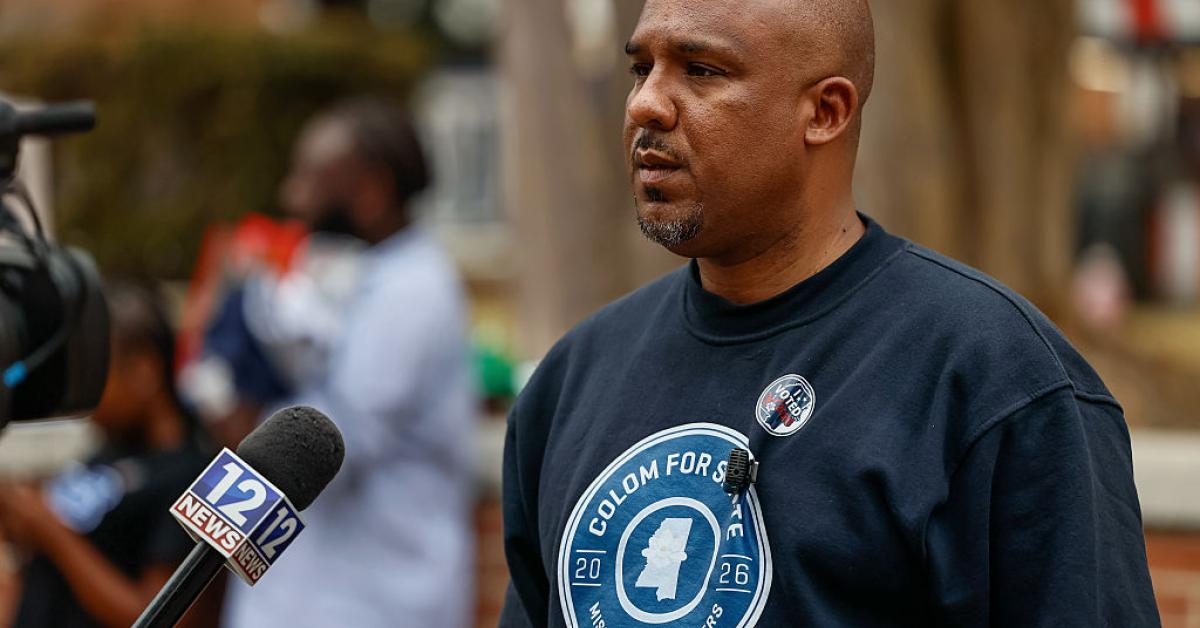
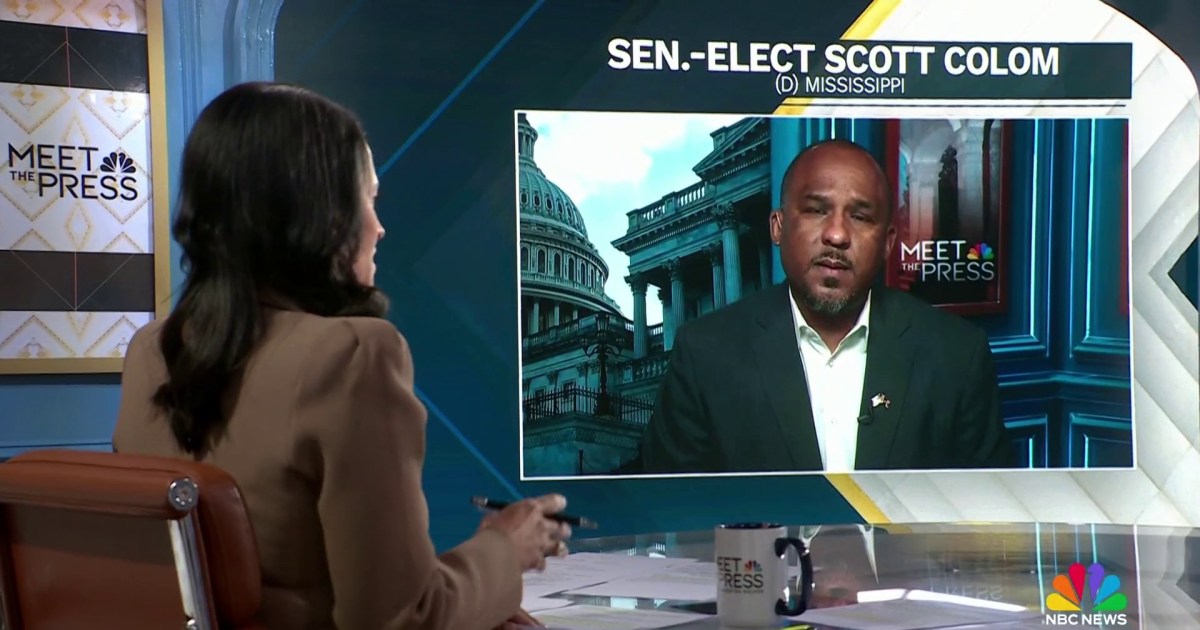
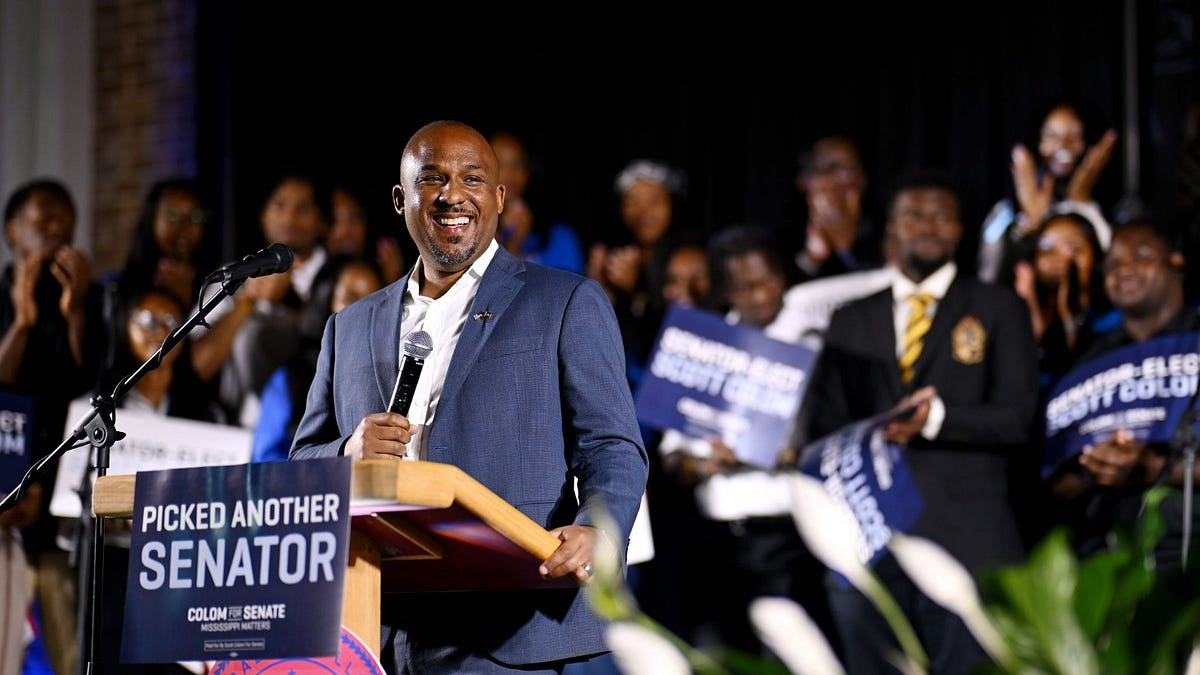
'Bigger than Barack Obama's election': Scholars reflect on Mississippi Senate race

Read the original at NPR ↗
Cite

Mosley, T. (2026, November 19). 'Bigger than Barack Obama's election': Scholars reflect on Mississippi Senate race. NPR. https://www.npr.org/2026/11/19/nx-s1-6047338/bigger-than-barack-obamas-election-scholars-reflect-on-mississippi-senate-race

Dated from the outlet's own feed. Check the original for its byline.

NPR · collected 2026-11-19 · by Tonya Mosley

Quick Summary

Scholars Eddie Glaude and Kiese Laymon discuss the historic significance of Scott Colom's victory in Mississippi's Senate race, marking the state's first Black U.S. senator in nearly 150 years. Colom defeated incumbent Cindy Hyde-Smith, who previously blocked his nomination to become a federal judge. The article delves into the broader historical context, including the suppression of Black political power post-Reconstruction and the more recent organizing efforts that paved the way for Colom's win.
Written by AI on 2026-11-20, from this article's own text only (the story summary below draws on all the coverage).

AI analysis

Story summary

Scott Colom, a Democrat and the first Black U.S. senator from Mississippi in nearly 150 years, won a historic victory in the state's Senate race. Colom, a seventh-generation Mississippian whose lineage traces back to an enslaved woman, secured the seat previously held by Cindy Hyde-Smith, who had blocked Colom's nomination to become a federal judge three years earlier. The win marks a significant milestone in a state where Black political power was once established but then dismantled after Reconstruction. Scholars and locals view Colom's victory as a pivotal moment in Mississippi's political landscape, drawing comparisons to Barack Obama's election in terms of its historical significance. Colom spent over a year campaigning across Mississippi to win over voters, demonstrating his commitment to representing the state's diverse population.

Written for “Mississippi Senate Race Reflects” on 2026-11-21, grounded in this article and the 0 other(s) covering the same event.

Compared with similar articles

This article reads leans left and hedges 5% of its claims. Each row says how that neighbour differs.
The Guardian
Leans left Hedges 7 of 71 claims Outlet record 64/100
“The articles discuss the significance of Scott Colom's election but describe different aspects and timelines of the event.”
NBC News
Leans left Hedges 0 of 22 claims Outlet record 78/100
“Article A describes an interview where Sen.-elect Scott Colom discusses the need for Democratic investment in southern states, while Article B covers scholars reflecting on the historical significance of Colom's victory. Although both articles relate to the same election, they describe different events occurring at different times.”
Just The News
Hedges 1 of 18 claims Outlet record 59/100
“The articles describe different aspects of the election and its aftermath, not the same specific event.”
The Dispatch
Hedges 1 of 2 claims Outlet record 61/100
“The articles discuss different aspects of the same election result but do not describe the same specific incident or moment.”
NBC News
Hedges 0 of 1 claims Outlet record 78/100
“Article A focuses on an interview with Scott Colom after his historic win, while Article B discusses the broader significance of the election with scholars and does not describe the same specific incident.”
Persuasion
Hedges 2 of 40 claims
“Article A describes the viral spread of a political ad for Scott Colom, while Article B discusses the historic significance of Colom's victory and his campaign activities.”
TIME
Leans strongly left further left than this Hedges 2 of 38 claims Outlet record 60/100
“Article A discusses the broader impact of voting rights on the election of Scott Colom, while Article B focuses on the historic significance and reflections on the election itself.”

Story

Mississippi Senate Race Reflects
Politics · 1 article(s) covering the same event.
How this article was measured signals, leaning charts, publisher record, byline, topics and claims

Signals How these are calculated →

Claims extracted
433
sentences that state something as happening or true
Uncertain
5%
21 of 433 hedged ("reportedly", "may", "according to")
Leaning
Leans left
of the writing, not the subject · beta estimate
Publisher signals
60/100
NPR's corrections and hedging, across everything collected from it. Not a measure of accuracy.
Outlets on this story
1
Politics
Same framing elsewhere
1
articles that frame the event the way this one does
Analyzed 2026-11-20 · how these are computed

How this is being covered How these are calculated →

Article leaning vs. publisher reliability
Source leaning vs. consistency

Publisher

NPR · 1372 article(s) · 5 correction(s) detected
Running correction rate · 5 correction(s)

Who wrote this

Tonya Mosley
5 article(s) here · 1 carrying a prediction
He spent more than a year traveling across Mississippi, trying to convince people he could win, and last week, he did.
Who benefits when massive AI data centers come to town? Audio will be available later today.
2026-10-29 · assertive framing · Who benefits when massive AI data centers come to town?
White House correspondent April Ryan reflects on reporting while under attack White House correspondent April Ryan reflects on reporting while under attack Audio will be available later today.
How Jared Kushner is mixing U.S. diplomacy with his billion-dollar business Audio will be available later today.
"Instinctively, as a Black boy, I didn't think they would believe me," Kaepernick says.
Also by Tonya Mosley
Nothing else under this byline is closely related to this article, so these are simply their most recent.

Topics

Black Mississippi Moss Point Senate U.S.

Subjects

Mississippi GPE · 10× Colom PERSON · 4× Black NORP · 3× Eddie Glaude PERSON · 3× Kiese Laymon PERSON · 3× Scott Colom PERSON · 3× Senate ORG · 3× Donald Trump PERSON · 2× TONYA MOSLEY PERSON · 2× U.S. GPE · 2×

Narrative

like, again, I grew up in that political class of people where, you know, my mother knew Scott's parents, and, you know, like, early on, I think some of the Democrats were a little questioning of Mr. Wilbur for you know, encouraging us to vote Republican, but that does not mean that those people who were critical wanted Black people in Mississippi to blindly vote Democrat.
framing: assertive · carried by 1 article(s) · first seen 2026-11-20
He spent more than a year traveling across Mississippi, trying to convince people he could win, and last week, he did.

Claims (433 extracted, 21 hedged)

'Bigger than Barack Obama's election': Scholars reflect on Mississippi Senate race asserted
Scholars → reflect → race
Scholars and Mississippi natives Eddie Glaude and Kiese Laymon discuss the historic significance of his victory. asserted
Scholars → discuss → victory
In the final weeks of Mississippi's Senate race, Democrat Scott Colom showed up outside a Donald Trump rally for his opponent and started talking to voters waiting to get in. asserted
Colom → show → voters
He spent more than a year traveling across Mississippi, trying to convince people he could win, and last week, he did. uncertain
he → spend → people
Three years earlier, his opponent, Cindy Hyde-Smith, had blocked Colom's nomination to become a federal judge. asserted
opponent → block → nomination
Now he's headed to Washington to take her seat in the Senate. asserted
he → head → Senate
Colom is a seventh-generation Mississippian, descended from an enslaved woman. asserted
Colom → descend → woman
It's a remarkable moment in a state where Black political power was once built, then violently dismantled in the years after Reconstruction. asserted
power → build → Reconstruction
During the Great Migration, generations of Black Americans, including my family, fled Mississippi to escape Jim Crow and racial terror. asserted
generations → include → Crow
Others, like Colom's family, stayed and fought for change. asserted
Others → stay → change
My guests today are two sons of Mississippi who have spent their lives examining the place they call home. asserted
they → spend → place
Eddie Glaude is a professor of African American studies at Princeton University and grew up in Moss Point, a small town on the state's Gulf Coast. asserted
Glaude → grow → Coast
Writer Kiese Laymon grew up in the state's capital of Jackson. asserted
Laymon → grow → Jackson
Well, Eddie, I want to start with you. asserted
I → want → you
When Colom won, you talked about being that little boy growing up in Moss Point, who never could have imagined a moment like this. uncertain
who → win → this
And I'm actually just wondering, at what point in this race did you start to believe that it was possible? asserted
it → wonder → race
When the state of Mississippi hinted that it was about to redistrict, that they were going to engage in that project of gerrymandering that Donald Trump called for, there were these marches all throughout the South, and they were organized under the banner, All Roads Lead to the South. asserted
Roads → hint → South
And Derrick Johnson gave me a call. asserted
Johnson → give → call
He's the president and CEO of the NAACP, and I think in addition to that, he is the former president of the Mississippi chapter of the NAACP. asserted
he → think → NAACP
So he gave me a call and asked me to come down to Jackson to participate in the march there. asserted
he → give → march
And I did. asserted
I → do → ?
I saw the organizing. asserted
I → see → organizing
I saw the infrastructure. asserted
I → see → infrastructure
I saw young people and older folk. asserted
I → see → people
And one of the things I did not hear was just this kind of nostalgic longing for the movement of the mid-20th century. asserted
I → hear → century
What I heard instead and saw was organizing. asserted
heard → hear → What
They were counting. asserted
They → count → ?
They were doing the math, Tonya. asserted
They → do → math
How many people do we need to turn out in DeSoto? asserted
we → need → DeSoto
How many people do we need to turn out in Holmes, in Jackson County, you know, in Hinds? asserted
you → need → Hinds
And what was so fascinating is that I knew then - and I was on stage with Congressman Bennie Thompson and Scott Colom. asserted
I → know → Thompson
And I heard Scott speak, and I believed at that moment that he had a chance. asserted
he → hear → chance
You know, he's a political athlete, that's clear. asserted
that → know → ?
They were coming after us, and they were about to see the full weight and power of Black voters in Mississippi. asserted
they → come → Mississippi
They were going to undermine the math that was informing the redistricting effort. asserted
that → go → effort
So I looked at Scott, and I looked at him closely, and I listened and, you know, I felt that Mississippi charm, and I said... LAYMON: (Laughter). asserted
I → look → charm
We about to shock the world up in here. asserted
We → shock → world
Kiese, how would you describe the mobilization, what it looked like on the ground there that maybe the national audience didn't really see? asserted
audience → describe → that
We just kind of - we know about the win and that there was a great mobilization. asserted
we → know → win
I think that's a great question. asserted
that → think → ?
…and 393 more, not listed.

Give feedback · no sign-in needed

No sign-in needed for now. Your note is sent without a name, so it cannot be answered.

History Support