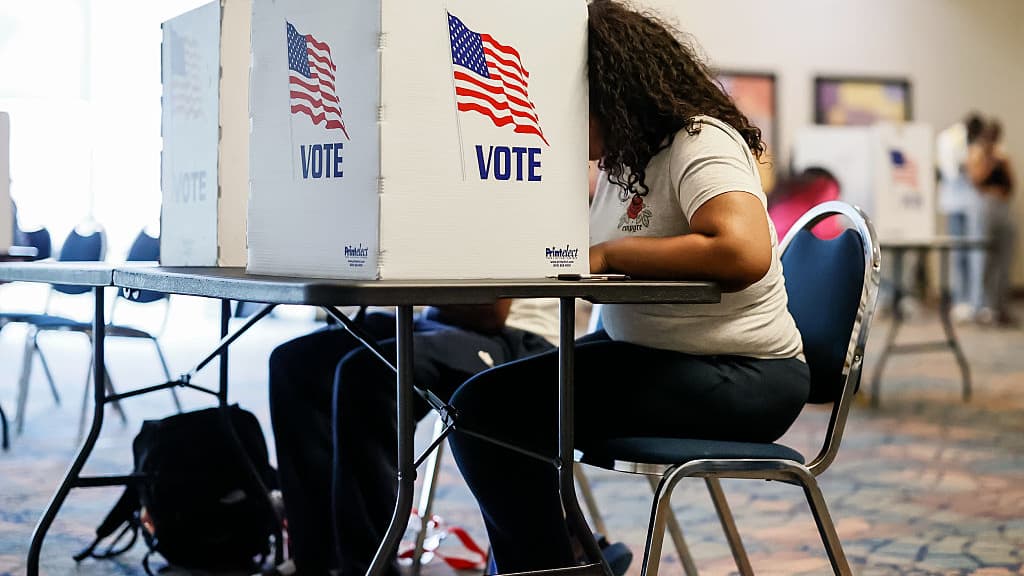
Though Democrats swept both the House and the Senate in the midterms, scientists and health professionals are divided over how much change the new Congressional leadership will have on health issues—owing to what Congress can and can't do to legislate change, and what elected leaders are most likely to do within those powers.
asserted
leaders → sweep → powers
Exactly how much traction health-related legislative proposals will get remains to be seen.
asserted
get → relate → traction
Even if they pass Congress, they face a possible veto by President Trump.
asserted
they → pass → Trump
But even if certain proposals are stopped at the White House, that doesn't mean they're pointless, experts say.
asserted
experts → stop → House
“The Democrats will road-test various policy proposals, and then when they hope to capture the White House two years later, they can implement them in that subsequent presidency,” says Chris Pope, senior fellow at the Manhattan Institute for Policy Research, since the legislation will have already passed Congress and the groundwork will have been done.
asserted
groundwork → test → Congress
It’s a common political tactic, says Pope, and was used by the Democrats during Trump’s first term as well.
asserted
Pope → ’ → term
“The most substantial thing for the Democrats now is trying ideas, floating them with Congress—and even if Trump vetoes them, if the public responds well to them, they will be ready to go if the Democrats take the White House in January 2029.”
asserted
Democrats → try → January
Here what experts say about some of the stated health priorities of the new Congress.
asserted
experts → say → Congress
Budget cuts to scientific groups
In 2025, the Trump Administration began terminating or suspending more than 7,800 grants for scientific research issued by the National Institutes of Health and the National Science Foundation and cut jobs across federal health agencies via its DOGE initiative.
One of the first actions that Democrats may take is to reinstate some of that funding, given that it’s a relatively small part of the federal budget and support for research behind new treatments generally has bipartisan support.
uncertain
support → begin → support
“They may even revisit some of the DOGE cuts, because those are low-hanging fruit politically” and were generally unpopular, says Pope.
uncertain
Pope → revisit → cuts
In 2025, the Republican-led Congress voted for the One Big Beautiful Bill Act (H.R. 1) without extending enhanced subsidies for Affordable Care Act plans, which raised insurance costs for many, forcing some to drop coverage.
asserted
which → lead → coverage
“I am cautiously optimistic that at least we will be addressing more constructively some cuts and other issues that have taken place," says Chris Van Gorder, president and CEO of Scripps Health.
asserted
Gorder → address → Health
"I am hopeful as a health care provider to see the reversal of [both] H.R. 1 and the removal of subsidies for the Affordable Care Act," he says.
asserted
he → see → Act
House minority leader Hakeem Jeffries, who is poised to become the next Speaker of the House, has pledged that he and the Democratic legislators will reverse cuts to Medicaid and will extend tax credits through the Affordable Care Act (though they will likely face opposition to that move.)
asserted
they → poise → move
“Having the wind in its sails, there will be rhetorical discussion of Medicare for All,” adds Pope.
asserted
Pope → have → All
Some Democrats in the House have been championing the policy, which would be a single-payer national health insurance system for all Americans.
asserted
which → champion → Americans
Pope says that the Democrats traditionally have a clearer position on health care than Republicans do, with many supporting increased spending on health care by expanding federal and state programs, benefits, and eligibility for health care services.
asserted
many → say → services
“We’ll see how much money there is,” he says.
asserted
he → see → ?
“It’s unclear how this plays out, and how much more deficit spending the markets will allow and how much more deficit spending people are going to be comfortable with.
uncertain
people → ’ → spending
Pushback to vaccine changes
Another strategy Congress could employ is its investigative authority via hearings to hold leaders accountable for decisions.
uncertain
leaders → employ → decisions
With more doctors and scientists elected to Congress, they could hold federal leaders to a higher standard for justifying health-related decisions on issues such as dismantled vaccine recommendations.
uncertain
they → elect → recommendations
“One of the frustrating parts of Robert F. Kennedy Jr.’s nomination and confirmation process, and tenure as Health and Human Services (HHS) Secretary, is that there did not appear to be any senators on the oversight committee who have expertise to challenge him on the evidence on vaccines,” says Michael Cannon, director of health policy studies at the Cato Institute.
asserted
Cannon → appear → Institute
That could change with new leadership.
uncertain
That → change → leadership
For example, Abdul El-Sayed, a newly elected senator from Michigan, is an epidemiologist who ran on a pledge to reform HHS, which oversees the Food and Drug Administration, the Centers for Disease Control and Prevention (CDC), and the National Institutes of Health.
asserted
which → elect → Health
HHS has been heavily influenced by Kennedy’s vaccine skepticism.
asserted
HHS → influence → skepticism
Dr. Annie Andrews, a pediatrician and incoming senator from South Carolina, has described Kennedy as her "professional arch-nemesis" and the reason she ran for Senate.
asserted
she → describe → Senate
Under Kennedy, federal health officials are conducting new research into vaccines and any connection to autism, which scientific studies have debunked.
asserted
studies → conduct → which
Policy experts say Congress could revisit that use of public funds if they are better able to counter Kennedy’s position that data are not conclusive.
uncertain
data → say → position
Having more qualified scientists and doctors in Congress could help to better inform lawmakers who vote on health-related issues.
uncertain
who → have → issues
Two bills have been proposed that would specifically address changes to the vaccination schedule: the Strengthening the Vaccines for Children Program Act, most recently reintroduced in April 2026, which would expand eligibility for access to federally provided free childhood vaccines, and the Family Vaccine Protection Act, introduced in 2025, that would protect evidence-based immunization policies and protect independent public-health committees.
asserted
that → propose → committees
That includes the advisory committee of the CDC, which makes recommendations on vaccines for the U.S., which was disbanded and re-convened with members handpicked by Kennedy.
asserted
which → include → Kennedy
If these bills pass, they may be vetoed by Trump, which is why Van Gorder says he is “optimistic, but not expecting a lot of beneficial change in health care over the next two years.
uncertain
he → pass → years
It remains to be seen if the Republicans will work at all with the Democrats.
asserted
Republicans → remain → Democrats
If they don’t, there might be solid gridlock positioning until the next presidential election.”
uncertain
they → do → election
 The Aporia