For the first time, United Nations climate talks are likely to conclude that the world will have to suck heat-trapping gases out of the air as well as cut carbon pollution because society has failed to keep Earth out of the warming danger zone.
asserted
society → conclude → zone
Doing that will cost tens of trillions of dollars and rely on still unproven technology, but it’s the best the globe can hope for because it is now inevitable that the world will blow beyond the safe temperature threshold set by the 2015 Paris climate agreement and confirmed by subsequent scientific reports, scientists and United Nations officials said.
asserted
scientists → do → reports
Earlier this year, a United Nations annual report acknowledged it’s certain that the planet will breach the Paris threshold of keeping long-term warming below 1.5 degrees Celsius (2.7 degrees Fahrenheit) since the mid 1800s.
asserted
planet → acknowledge → 1800s
While that key temperature threshold is measured over a couple decades, short-term warning signs continue to mount.
asserted
signs → measure → decades
October’s global average temperature set a record for highest above pre-industrial times for any month of the year, at 1.8 degrees Celsius (3.2 degrees Fahrenheit) higher, said scientists at Berkeley Earth, who also predict that 2026 will pass 2024 as the hottest year on record.
asserted
2026 → set → record
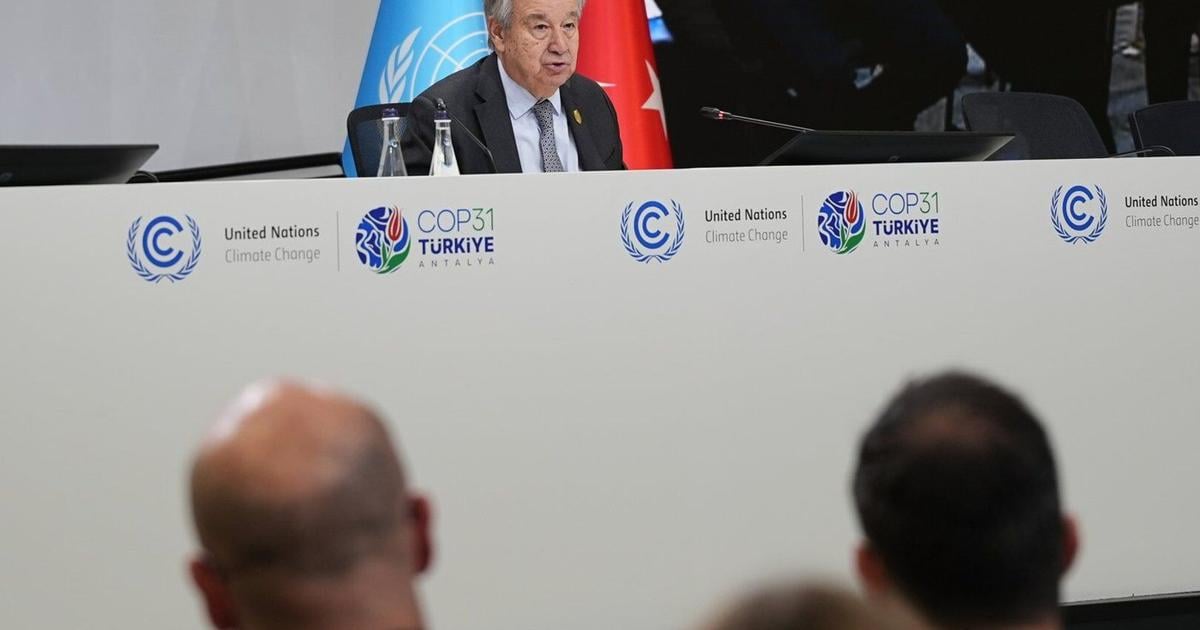
The U.N. climate negotiations, known as COP31, are scheduled to end Friday in Turkey, though they rarely finish on time.
asserted
they → know → time
Early drafts of the end-of-conference communique acknowledge that the world has failed at preventing 1.5 degrees of warming, will enter a period of decades of temperatures in a more dangerous zone and then somehow bend the curve back down below 1.5.
asserted
world → acknowledge → 1.5
Doing that requires sharp cuts in carbon dioxide emissions and the removal of carbon from the atmosphere, according to the drafts.
uncertain
Doing → do → drafts
Carbon dioxide emitted from the burning of fossil fuels such as coal, oil and gas traps heat in the atmosphere and causes the planet to warm.
asserted
planet → emit → atmosphere
“Carbon removal is the magic eraser we’re left with when we’ve busted the world’s carbon budget, such as the 1.5C target,” Stanford University climate scientist and emissions tracker Rob Jackson said in an email.
asserted
Jackson → leave → email
Is it likely to happen at the billion-ton scale needed to make a difference?
asserted
it → happen → difference
Hundreds of billions of tons must be removed
asserted
billions → remove → tons
The world needs to remove 320 billion metric tons (350 billion tons) of carbon dioxide from the atmosphere this century to bend the curve back down, United Nations Environment Programme Director Inger Andersen said at the climate conference this week.
asserted
Andersen → need → conference
That’s eight years’ worth of global emissions, she said.
asserted
she → ’ → emissions
Berkeley Earth climate scientist Zeke Hausfather calculated that it costs about $22 trillion to reduce global temperatures by every tenth of a degree Celsius (.18 degrees Fahrenheit) through carbon removal.
asserted
it → calculate → removal
Even if the world were to peak at two or three tenths of a degree Celsius (.36 to .54 degrees Fahrenheit) above the Paris threshold — the most optimistic scenario — it would cost $44 to $66 trillion by 2100 to get back underneath the threshold, Hausfather said.
asserted
Hausfather → peak → threshold
Planting more trees would not remove anywhere near enough carbon, experts said.
asserted
experts → plant → carbon
In the past decade, increased tree planting and other nature-based solutions removed, at most, 2 billion metric tons of carbon dioxide, Andersen said.
asserted
Andersen → increase → dioxide
So what’s needed are mechanical methods, such as huge devices resembling giant fans that suck carbon out of the air, some of which are being tested at pilot scale.
asserted
some → need → scale
This nascent technology currently removes as much carbon dioxide in a year as fossil fuel burning plants put in the air every half hour, said Johan Rockström, director of the Potsdam Institute for Climate Impacts Research in Germany.
asserted
Rockström → remove → Germany
And the current hope is that it could scale up to 5 billion metric tons by 2050, he said.
uncertain
he → scale → 2050
This type of carbon removal is different than carbon capture and storage technology that some industries use to prevent their own pollution from escaping into the air.
asserted
industries → use → air
The climate talks are also likely to encourage more of that type of carbon capture.
asserted
talks → encourage → capture
The world will need to remove massive amounts of carbon dioxide, “but there’s not much point of thinking about that until we have deep emission reductions,” Climate Analytics CEO Bill Hare said at the conference.
asserted
Hare → need → conference
That’s because unless policies around the world change, the world is heading for at least 2.7 degrees Celsius of warming by 2100, and there’s no way the world can remove enough carbon from the air to compensate for that, he said.
asserted
he → ’ → that
Still, the world has to seriously consider carbon removal “because there really are no good outcomes above 1.5 degrees, ” Andersen said, noting that warming is already causing stronger heat waves, droughts, floods and extreme storms.
asserted
warming → have → waves
She and others said carbon removal - sometimes called negative emissions - is not a replacement for steep emission cuts, but rather an addition to them.
asserted
removal → say → them
“We need deep emission reductions.
asserted
We → need → reductions
That is, and will always remain, the most important tool at our disposal,” said Denmark’s environment minister Samira Nawa.
asserted
minister → remain → disposal
That’s why Denmark is aiming for a 110% reduction of emissions, going beyond net zero emissions to putting 10% less carbon in the air than what oceans and forests naturally take out.
asserted
oceans → ’ → what
Denmark and Ethiopia, the chair of next year’s climate talks, are leading a newly formed coalition called the Group of Negative Emitters, or GONE.
asserted
Denmark → lead → Emitters
Balancing bad news and hope
Officials, analysts and scientists say humans have put the planet in a tough spot.
asserted
humans → balance → spot
Because society has not heeded years of calls for steep emissions cuts, they say the planet is essentially stuck with relying on carbon removal.
asserted
planet → heed → removal
“This is something I don’t think everyone has internalized yet.
asserted
everyone → think → ?
If you’re a champion of 1.5 degrees C, then you’re also a champion of reaching net-negative emissions,” said World Resources Institute’s global climate and economics director Melanie Robinson.
asserted
director → ’re → emissions
Even though he pointed out the difficulties in carbon removal, Rockström said, “we must keep this as our safe landing temperature, now that we fully understand how dangerous it is to exceed 1.5°C.”
asserted
it → point → C
 The Aporia