The Senate approved a long-sought bipartisan permitting reform bill on Thursday, following a major breakthrough on legislation that aims to cut costs by ramping up the speed of infrastructure and energy projects.
asserted
that → approve → projects
In a 62 to 33 vote, the upper chamber passed the measure on a bipartisan basis.
asserted
chamber → pass → basis
The bill now heads to the House.
asserted
bill → head → House
President Trump has expressed support for the deal.
asserted
Trump → express → deal
The vote follows years of on-and-off negotiations over how to speed up major infrastructure projects by streamlining the complicated permitting processes that can snag projects for years — an issue that has drawn more attention amid rising energy prices.
asserted
that → follow → prices
"This bill is years in the making," Senate Majority Leader John Thune said Thursday.
asserted
Thune → say → making
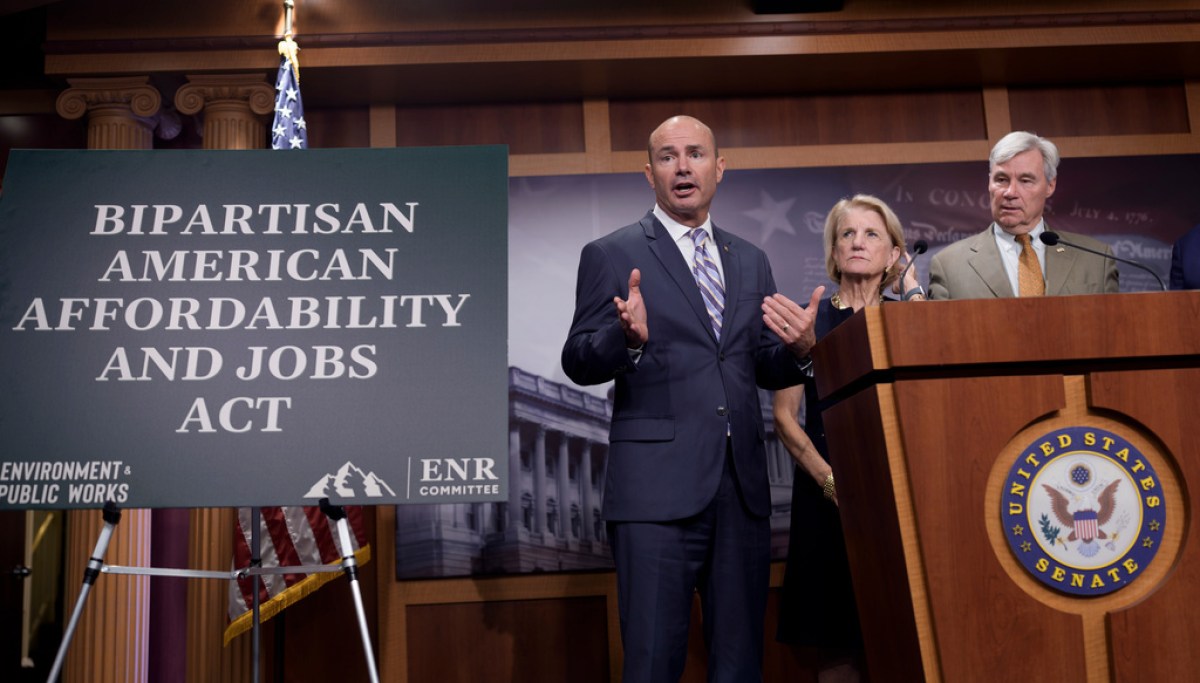
Supporters say the Bipartisan American Affordability and Jobs Act, or BAAJA, will make it easier to build both renewable energy and fossil fuel projects, along with the high-tension power lines that support them.
asserted
that → say → them
Negotiators announced a breakthrough on the legislation in September, touting a "historic, bipartisan agreement to reform America's federal environmental review and permitting processes.
asserted
Negotiators → announce → processes
"
"This is a major step toward making it faster and more efficient and easier to build infrastructure projects, certainly without giving up any of the strong protections for our environment," Republican Sen. Shelley Moore Capito of West Virginia said at the time.
asserted
Capito → make → time
Capito said the agreement represented "something that's become increasingly rare in Washington — Republicans and Democrats, sitting down, identifying a problem, and in this case a problem that has festered for at least a decade and more that impacts all Americans, and for us to sit down and work together to solve it."
asserted
us → say → it
She said the American people "sent us here to do big things."
asserted
people → say → things
"This is a big thing," Capito said.
asserted
Capito → say → ?
"It's monumental, and it's legacy-setting."
asserted
it → set → ?
GOP Sen. John Barrasso of Wyoming, who worked alongside Capito on permitting reform efforts for years, stressed the need for the legislation in a floor speech this week, saying, "If we want life to be more affordable in America, we need to make it more affordable to build in America, but also more convenient — more efficient."
asserted
it → work → America
The Wyoming Republican said, "In America today, it takes too long, and it costs too much to build," putting the blame on Washington for slowing things down, as projects are put in the "regulatory penalty box — waiting to act, waiting to build, workers sitting on the sidelines."
Barrasso lauded the bill for streamlining environmental and judicial reviews and limiting lawsuits, calling them common-sense reforms. He argued that the legislation represented a "responsible path" for producing more energy and protecting the environment, saying, "We can do both.
asserted
We → say → both
But some progressives have balked at the legislation, arguing it could erode environmental protections and doubting Mr. Trump will allow renewable projects to be built.
uncertain
projects → balk → protections
While the bill does have the backing of some renewable energy leaders and developers, it also faced opposition from environmental groups.
asserted
it → have → groups
Democratic Sen. Jeff Merkley of Oregon cited concerns about how it will affect states' rights to protect clean water and air, its implications for fossil fuel over renewable energy sources and how it could make it easier to build and power new data centers, along with its impact on the deficit.
uncertain
it → cite → deficit
Sen. Ron Wyden, also of Oregon, opposed the bill as well, and sought a vote on an amendment to ban data centers on public lands.
asserted
Wyden → oppose → lands
The two senators have also expressed concern about how the bill could impact tribal rights.
uncertain
bill → express → rights
"Embedded in this bill is a fundamental question about the direction we go regarding our responsibilities to this planet," Merkley said ahead of the vote Thursday.
asserted
Merkley → embed → vote
Merkley acknowledged the bill could "turn the faucet potentially on" for renewable energy, but he said he's concerned Mr. Trump will continue to block wind energy projects.
uncertain
Trump → acknowledge → projects
He argued that by allowing more natural gas and other fossil fuel projects, it will "open another floodgate for carbon that we won't ever be able to reverse."
After its passage in the Senate, the bill faces an uncertain future in the House, where opposition on multiple fronts has thrown into question whether the bill can make it through the lower chamber before year's end.
While some House Republicans have cited changes to the bill's provisions on transmission related to grid reliability, some House Democrats have also stressed that they would like to see the legislation altered.
asserted
legislation → argue → reliability
Rep. Jared Huffman of California, the ranking member on the House Natural Resources Committee, has raised doubts about the bill.
asserted
Huffman → rank → bill
In one all-caps X post, he argued the Trump administration could use the bill to approve fossil fuel projects while continuing to slow-walk renewable energy projects.
uncertain
administration → argue → projects
A spokesperson for House Minority Leader Hakeem Jeffries said earlier this month that he "supports the need for permitting reform," but argued the Senate's legislation "falls short in several areas.
asserted
legislation → say → areas
"
"Leader Jeffries will not rubber-stamp legislation that emerges from the Senate without more constructive involvement with our caucus as we fight to make life more affordable for the American people," the spokesperson said.
asserted
spokesperson → stamp → people
Some opponents have also suggested that Democrats could have more leverage to negotiate next year, when the party takes control of the House and Senate.
uncertain
party → suggest → House
Mr. Trump will ultimately need to sign any bill.
asserted
Trump → need → bill
But others believe the push is only possible with a GOP governing trifecta at the helm.
asserted
push → believe → helm
Thune told reporters on Thursday that he didn't know whether the House would be able to pass the bill as is, or need to make changes, noting that it's "been litigated now for months."
"The best way to get anything done around here is for them to pick up the bill and pass it," Thune said.
asserted
Thune → tell → it
"If it were to go over there and then come back over here, I mean, I don't know what I can't predict what happens.
asserted
what → go → ?
I don't know what else you can add to it or detract from it.
asserted
you → know → it
I think it's been through the full monty when it comes to the legislating process."
asserted
it → think → process

 The Aporia