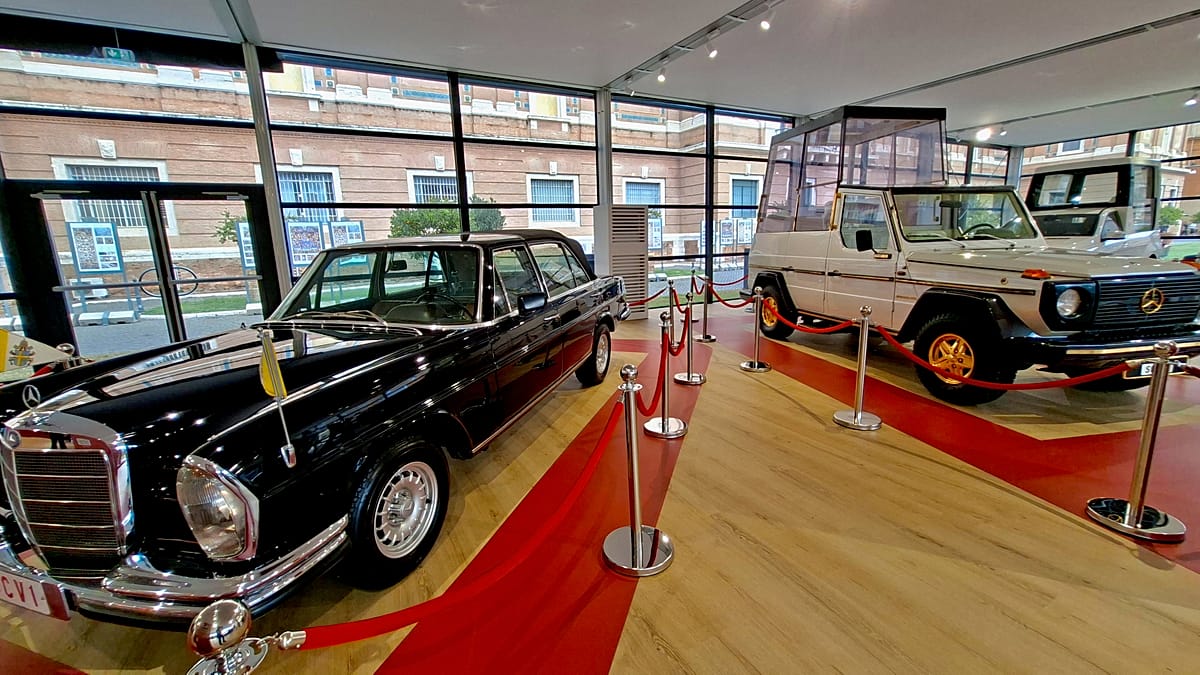
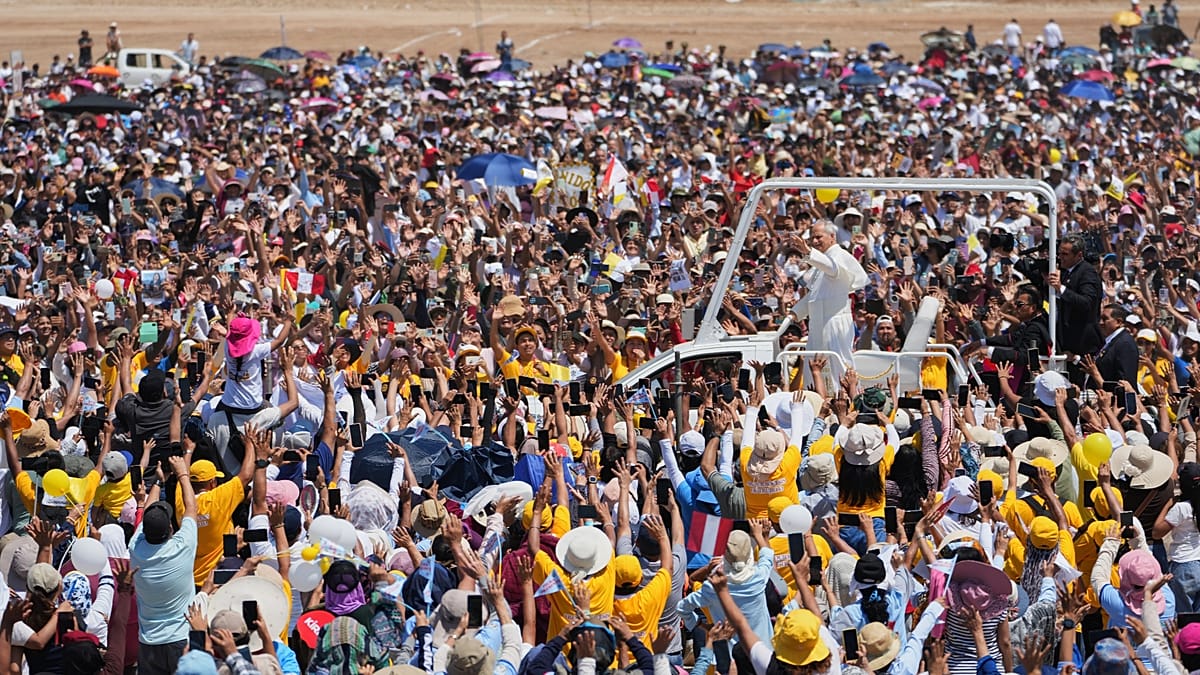
From Pius XI's Mercedes to John Paul II's Popemobile: eight historic cars show how Popes' vehicles have changed.
asserted
vehicles → show → Popemobile
The Vatican Museums exhibition retraces a century of history, between technology, curiosities and safety.
asserted
exhibition → retrace → technology
There once was a pope who could tell his driver when to accelerate, when to slow down and even when to return to the Vatican, simply by pressing a button.
uncertain
who → tell → button
Another, by contrast, had a car turned into an open-top vehicle so that he could be seen more clearly by the crowd.
uncertain
he → have → crowd
And then there was John Paul II, who had a barber's chair adapted as a papal seat, so that he could greet the faithful.
uncertain
he → be → faithful
The cars of popes tell a story that goes far beyond engines, bodywork and comfort.
asserted
that → tell → engines
They reveal the character of the pontiffs, the way they choose to be among people and, above all, how communication of the papacy has changed - from the solemnity of limousines to the search for direct contact with the faithful, and the growing need to protect those who travel under the spotlight.
asserted
who → reveal → spotlight
This is the journey traced by the exhibition "A century of Popemobiles", that's now on at the Vatican Museums (source in Italian).
asserted
that → trace → Italian
Eight historic Mercedes-Benz cars retrace almost 100 years of papal mobility.
asserted
cars → retrace → mobility
They are accompanied by a Benz Patent-Motorwagen from 1886, considered the first car in history, and a new Mercedes-Benz S-Class, broadening the view of how the automobile has evolved.
asserted
automobile → accompany → view
Sandro Barbagallo, curator of the Vatican Museums historical collections says each vehicle has its own story:
asserted
vehicle → say → story
"The message is very simple: papal mobility exists so that the pope can draw close to everyone, all over the world.
asserted
pope → exist → world
The use of cars is not just about moving the Pontiff around within Vatican City".
asserted
use → move → City
A story in which each pontiff has, in one way or another, left his mark, including by choosing how he wished to be transported.
asserted
he → leave → mark
Pius XI, the Pope who fell in love with his car
The relationship between Mercedes-Benz and the Vatican officially begins in 1930, when Pius XI receives a Nürburg 460 (W 08), a large limousine donated by the German car manufacturer.
asserted
XI → fall → manufacturer
It is the first Mercedes regularly used by a pope.
asserted
It → use → pope
Achille Ratti, elected in 1922, was a man of culture, a scholar and lover of the mountains, with a past as a mountaineer and explorer.
asserted
Ratti → elect → mountaineer
A Pontiff accustomed to looking far ahead, who did not shun the innovations of his time.
asserted
who → look → time
The car also became a tool for leaving the Vatican, after the long period of the so-called imprisonment of the popes, which began with the end of the Papal States in 1870.
asserted
which → become → 1870
The Nürburg 460 is far from a standard official car: the interior is customised with a single seat for the pope, upholstered in fine silk brocade, selected woods, metallic detailing and a decorated ceiling.
asserted
interior → customise → brocade
Some papal cars from that era had a 'backseat driver' function panel, allowing the pope to instruct the chauffeur using buttons labelled "Forward", "Slow", "Right" and "Return to the Vatican".
asserted
pope → have → Vatican
John XXIII, the "good Pope" who opens the windows
asserted
who → open → windows
The pope's public presence also changed with John XXIII.
asserted
presence → change → XXIII
Angelo Roncalli, a.ka. the "good Pope", had an informal style, a cheerful manner and a natural ability to relate to people.
asserted
Roncalli → have → people
His pontificate, shaped by the Second Vatican Council, led the Church into a period of greater dialogue and openness.
asserted
pontificate → shape → dialogue
The cars began to follow this transformation as well.
asserted
cars → begin → transformation
In 1960, the Mercedes 300 d Landaulet (W 189) arrived, with rear windows that can be completely removed to allow the pope to be seen more easily and better greet people during public outings.
asserted
pope → arrive → outings
The features are already those of a vehicle built around the needs of the most important passenger: an electrically adjustable central seat, controls for the air conditioning and communications within easy reach, automatic steps to make it easier to get in and out of the vehicle.
asserted
it → build → vehicle
Mercedes seems to have understood that the pope's car must not only take him to his destination: it must also allow him to meet people along the way.
asserted
him → seem → way
Paul VI, the travelling Pope who invents the papamobile
If there is one pontiff who turned travel into a fundamental part of papal communication, it is Paul VI.
asserted
it → travel → communication
Giovanni Battista Montini is the first modern pope to travel by plane and to make a series of international apostolic journeys, reaching places never before visited by a pontiff.
asserted
Montini → travel → pontiff
In 1964 he flew to the Holy Land, then to India in 1965, and in the following years to other continents.
asserted
he → fly → continents
His mission was to reach the faithful in Rome and beyond by going to their countries to meet people and let them see him up close.
asserted
them → reach → him
His Mercedes 600 Pullman Landaulet (W 100) from 1965 has a roof that opens at the rear specifically so that the pontiff can greet the crowds.
asserted
pontiff → have → crowds
In 1967, a Mercedes 300 SEL Pullman (W 109) also arrives, another of the cars that mark the evolution of papal automobiles.
asserted
that → arrive → automobiles
But the birth of the modern papamobile is above all linked to a practical need.
asserted
birth → link → need
As Barbagallo explains, "up until Paul VI, and then also with John Paul I, who as we all know had a very brief pontificate, the Pope went to audiences and even entered the Paul VI Audience Hall on a sedia gestatoria".
asserted
Pope → explain → gestatoria
That first vehicle was still a production car made available to the Pontiff.
asserted
vehicle → make → Pontiff
But it marked a decisive change: the Pope no longer simply had to be transported, he could now cross the square and be seen by all the pilgrims.
uncertain
he → mark → pilgrims
To grasp the difference between the traditional papal saloons and the papamobiles, Barbagallo retraces the evolution of these vehicles: "The way they have developed has constantly highlighted, on the one hand, the Pope's comfort, on the other his security, and on yet another the fact that the Pope can be seen.
asserted
Pope → grasp → another
…and 31 more, not listed.
 The Aporia