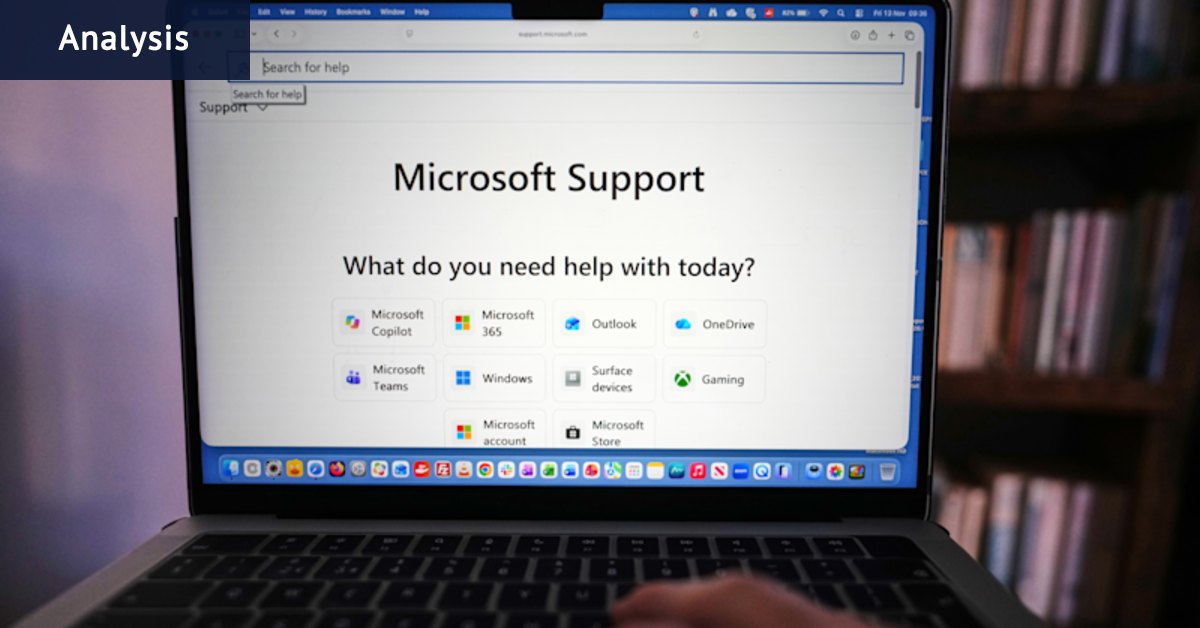
Last Friday, Microsoft went down.
asserted
Microsoft → go → ?
A global outage kept users from accessing the organisation's email system Outlook, its workplace messaging app Teams, its AI assistant and more.
It took more than 24 hours for services to fully recover, and in the meantime more than 7.4 million outage reports were logged worldwide.
asserted
reports → keep → meantime
By then, another incident was already unfolding.
asserted
incident → unfold → ?
The Federal Aviation Administration (FAA) had grounded flights across the United States, blaming a communications issue affecting all air traffic control centres.
asserted
Administration → ground → centres
It marked only the second time a national ground stop had been issued since 9/11 and thousands of flights were cancelled or delayed.
The root cause is still under investigation.
asserted
cause → mark → investigation
On Monday, local time, one of the largest banks in the US announced a software bug had sent parts of its system offline.
asserted
bug → announce → system
At the same time, cyber criminals used third-party software, Optimizely, to plant malicious code on multiple websites, including the BBC, CNN and Zoom.
asserted
criminals → use → BBC
Outages at tech giant Apple and US hotel chain Marriott International followed on Tuesday, local time.
asserted
Outages → follow → Tuesday
On Wednesday, the classified communications network of the US National Security Agency (NSA) confirmed it, too, was fighting a tech outage.
asserted
it → confirm → outage
Experts told the ABC the incidents, while unrelated and caused by different factors, highlight an unfortunate reality of the modern world.
asserted
incidents → tell → world
'We have to prepare ourselves' for online outages
Relying on digital services is not something the public can avoid anymore, according to Swinburne University computer science associate professor Ali Yavari.
uncertain
public → have → Yavari
"Several years ago, it was a safe box that you could lock, or you had your data stored somewhere physically," he said.
"
uncertain
he → lock → that
But these days, because we are using cloud services ... there is the possibility of exposure."
asserted
we → use → exposure
Instead, he noted, everyday users had to be prepared with a backup plan for when services went dark.
asserted
services → note → plan
"When you're building a building, you need an emergency exit, a physical backup that we use when a fire happens,"he said.
asserted
fire → build → that
"I think for digital services it's a very similar thing ... we have to understand that there is a possibility [of] disruptions, of cyber attacks.
asserted
we → think → attacks
"We have to prepare ourselves, train ourselves, be careful about what we're sharing."
asserted
we → have → what
Queensland University of Technology post-doctoral research fellow Ashwin Nagappa likened the situation to being ready for a natural disaster.
"
asserted
Nagappa → liken → disaster
We see public service announcements on ABC about bushfire preparedness, like keeping a radio at home in case of outages," he said.
asserted
he → see → outages
“We're aware of those situations, but in scenarios where Meta goes down, Google goes down, what is our plan?
asserted
plan → go → scenarios
"[These] companies are building Jenga blocks [of systems] and then putting a small link in.
asserted
companies → build → link
Then that tiny link breaks and it collapses the whole Jenga tower.
asserted
it → break → tower
Microsoft blames 'latent defect' as investigations continue
Microsoft's investigations have so far pointed to a "latent defect" for last week's outage, ruling out AI as the cause and finding its servers had become "overwhelmed and unresponsive".
asserted
servers → blame → cause
“There’s no sign of a hacker," said Walayat Hussain, an associate professor at the Australian Catholic University.
asserted
Hussain → ’ → University
"This looks like Microsoft's own systems tripping over themselves, and that is the real warning.
asserted
that → look → themselves
We need to find out what someone could do on purpose, before they do."
At the NSA, officials blamed a software update, finding no evidence of a cyber attack.
Loading...
uncertain
officials → need → attack
The only one so far attributed to a malicious force was the Optimizely incident, which affected visitors to the websites of 178 organisations.
asserted
which → attribute → organisations
The more that people rely on digital services, the more they adjust when things go wrong, Dr Yavari said.
"There will be a day [when] we get used to all these disruptions and find backup alternatives to use during the disruption," he said.
asserted
he → rely → disruption
"People will also become smarter in terms of cyber attacks.
asserted
People → become → attacks
"We have to accept that we need to invest [in] things that can reduce the frequency of these sort of disruptions, and the cost of cyber attacks for users.
asserted
that → have → users
"
But predicting whether or not the rate of outages or attacks will increase further is a more difficult task, Dr Nagappa said.
asserted
Nagappa → predict → outages
And for Australians, it could be a matter of fighting fatigue.
uncertain
it → fight → fatigue
"In Canada, Facebook is not showing news, so there are people developing alternatives," Dr Nagappa said.
asserted
Nagappa → show → alternatives
"In those scenarios, the trust is lost and [people] are already moving on to the next thing.
asserted
people → lose → thing
"In Australia, we're coming to a point of fatigue …
asserted
we → come → fatigue
we haven't started talking about building alternatives, but maybe the trust is getting to that point now."
asserted
trust → start → point
 The Aporia