Canadian Prime Minister Mark Carney is placing particular focus on renewing relations with China as he aims to deepen international trade ties and diversify from U.S. reliance amid a three-month-long trade war with the U.S.
When asked what cards Canada holds in its ongoing talks with Washington, Carney, who recently announced a new partnership with the E.U., pointed to the country's budding relationships elsewhere.
asserted
who → place → relationships
“Our cards are that everyone else in the world wants to deal with us,” he said Wednesday during a remote interview with the New York Times from Shenzhen, China, where he was among the world leaders attending the Asia-Pacific Economic Cooperation (APEC) summit.
asserted
he → want → summit
"If the U.S. doesn't want to do the deal, we're busy.”
asserted
we → want → deal
His remarks came in the wake of President Donald Trump's claim that the U.S. holds “all the cards” after trade talks collapsed in August, leading to both sides enforcing heavy retaliatory tariffs.
uncertain
sides → come → tariffs
Carney and Trump had a meeting on the sidelines of APEC, but aside from a commitment to “continue” negotiations and stay in close contact, no progress was made.
asserted
progress → have → contact
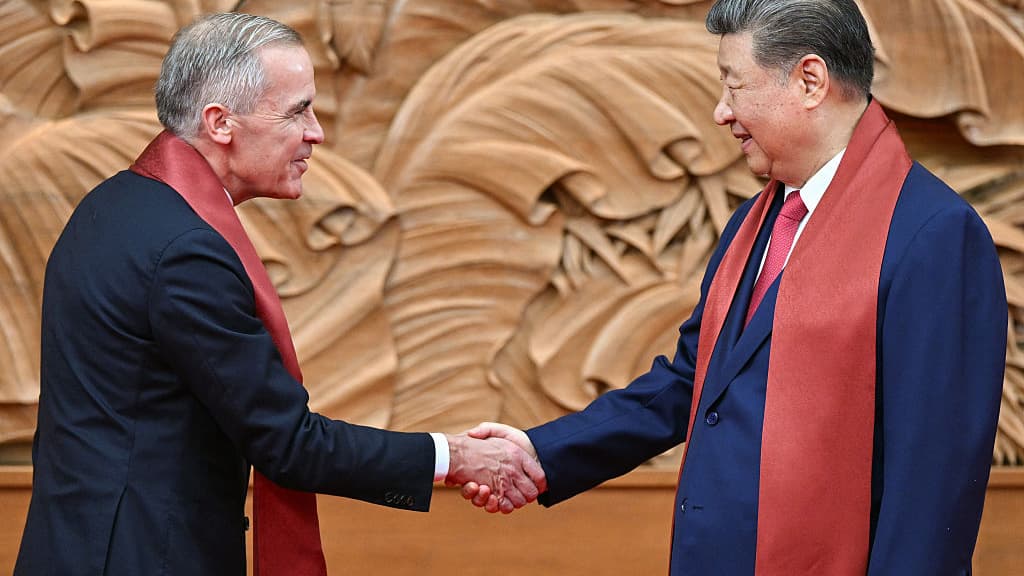
However, Carney painted his meeting with Chinese President Xi Jinping in a much more positive light.
asserted
Carney → paint → light
Ahead of the summit, Carney and Xi announced a Canada-China trade pact, which provided additional tariff relief on Canadian food and agricultural exports into China, and in return saw Canada agree to extend tariff exemptions for certain Chinese steel and aluminum products by two years.
asserted
Canada → announce → years
Carney, who is promoting a “Canada Strong” platform as he aims to build economic resilience at home, touted the expansion of the trade arrangement with China as something that will deliver “greater certainty and prosperity for all Canadians.”
asserted
that → promote → Canadians
He also praised the negotiation process with China, saying: “They’re very professional.
asserted
They → praise → China
They move forward in a very linear fashion.”
asserted
They → move → fashion
In an eight-day tour that took him from a European summit in Ireland to the Philippines, Cambodia, and finally China for the APEC gathering, Carney forged ahead with his plan to diversify Canada's economy away from its dependence on the U.S., which by far remains the country's largest trading partner.
asserted
which → take → U.S.
Experts say Canada's progress in deepening its economic relationships with China could challenge Trump's insistence that Washington holds the upper hand in trade negotiations.
uncertain
Washington → say → negotiations
“Part of the Trump Administration’s [belief] is that everybody needs the U.S. more than anything else, and therefore the U.S. has maximum leverage,” says Jennifer Hillman, co-director of the Institute of International Economic Law at Georgetown University.
asserted
Hillman → need → University
“What this is clearly saying is that Canada can afford to be less willing to give the U.S. whatever it asks for [in negotiations], because they have other options.
asserted
they → say → options
China has the world's second-largest economy, behind only the U.S., giving it the potential to become a much larger market for Canadian goods than some of the other countries Carney has sought to deepen relations with.
asserted
Carney → have → relations
“China represents a very big market and the potential of a really big trading partner,” says Lori Turnbull, a professor in the Faculty of Management at Dalhousie University, noting it could be a leverage point in U.S. negotiations.
uncertain
it → represent → negotiations
“Doing a deal with a country like China is something that [the U.S.] will care about because of the size of China's economy and its competitive relationship with the U.S.”
asserted
U.S. → do → U.S.
Carney's latest push to strengthen trade ties with Beijing forms part of a months-long effort to renew Canada-China relations.
asserted
push → strengthen → relations
In January, he met with Xi to forge what he called a “new strategic partnership,” agreeing to allow in up to 49,000 Chinese electric vehicles at a tariff of 6.1%, rather than the previous 100% levy.
asserted
he → meet → levy
China agreed to lower tariffs on Canadian agricultural products, including canola seeds, a major Canadian export.
asserted
China → agree → seeds
While Canada's closer relationship with China could strengthen its hand in negotiations, experts also warn that it could backfire.
uncertain
it → strengthen → negotiations
Turnbull points to the latest agreement to extend tariff exemptions on Chinese steel and aluminum as a potential source of tension with Washington.
asserted
Turnbull → point → Washington
“Things like reducing tariffs on select steel and aluminum products coming from China is something that might make the U.S. and not just Donald Trump, but also [U.S. Trade Representative] Jamieson Greer angry,” she suggests.
uncertain
she → reduce → China
Steel, aluminum, and auto tariffs were among the major points of contention when U.S.-Canada trade negotiations broke down in August, with both sides accusing each other of walking back commitments.
asserted
sides → break → commitments
Carney, however, has played down concerns that Canada's growing trade relationship with China is a major issue for Trump.
asserted
relationship → play → Trump
“In my conversation with the President, he’s tried to understand where we are with China, where we’re going with China,” said Carney during a news conference in Shenzhen.
asserted
Carney → try → Shenzhen
“I shouldn’t speak for him, but in his hierarchy of issues, it’s not the top issue at all.”
asserted
it → speak → issues
Meanwhile, some Canadian officials have voiced concerns on expanding trade with China.
asserted
officials → voice → China
Ontario Premier Doug Ford warned Carney on Monday against opening the door for more Chinese-made EV vehicles in Canada, arguing the “government’s focus needs to be on protecting Canadian auto workers, not undermining them by importing even more state-subsidized cheap Chinese cars.”
asserted
focus → warn → cars
Michael Chong, a lawmaker from Canada’s Conservative Party, during a press conference on Wednesday supported maintaining a dialogue with Beijing, but described Carney’s budding strategic partnership with China as a “risky gambit,” citing potential “national security” concerns.
asserted
Chong → support → concerns
In 2025, Ottawa identified China as one of the main perpetrators of foreign interference and espionage against Canada alongside other countries such as Russia and Iran.
asserted
Ottawa → identify → Russia
The Canadian government’s own analysis of Canada-China relations also points out that there are "associated risks” in broader trade cooperation in key areas, such as “prevalent and persistent intellectual property theft, and the risk of diversion of sensitive goods and technologies intended for civilian use for military purposes and applications.”
asserted
analysis → point → purposes
Carney said ahead of his Asia trip that he would raise concerns about foreign interference in his meeting with Xi.
asserted
he → say → Xi
"The advantage of these meetings is you can raise issues directly and frankly,” he told reporters in Montreal on Nov. 10.
asserted
he → raise → Nov.
Carney added that he would stress the importance Canada places on "the non-interference in our affairs by China and other countries.”
asserted
Canada → add → China
In a press briefing during the APEC summit, Carney emphasized that Canada's trade with China is largely focused on commodities, rather than sensitive technologies such as advanced semiconductors.
asserted
trade → emphasize → semiconductors
“We are exporting canola, we are exporting pork.
asserted
we → export → pork
We are exporting halibut,” Carney said, also citing liquefied natural gas and oil.
asserted
Carney → export → gas
Experts point out that Canada could pursue deeper cooperation with other international partners in sectors where a closer relationship with China would be more difficult, including defense and advanced technology.
“
uncertain
relationship → point → defense
[Canada] is not going to partner with China on defense, security, AI, and digital technology, things like that would be very difficult.
asserted
things → go → that
…and 29 more, not listed.
 The Aporia