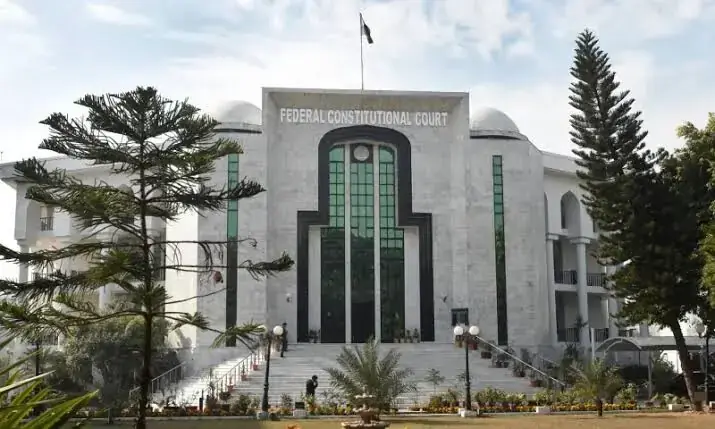
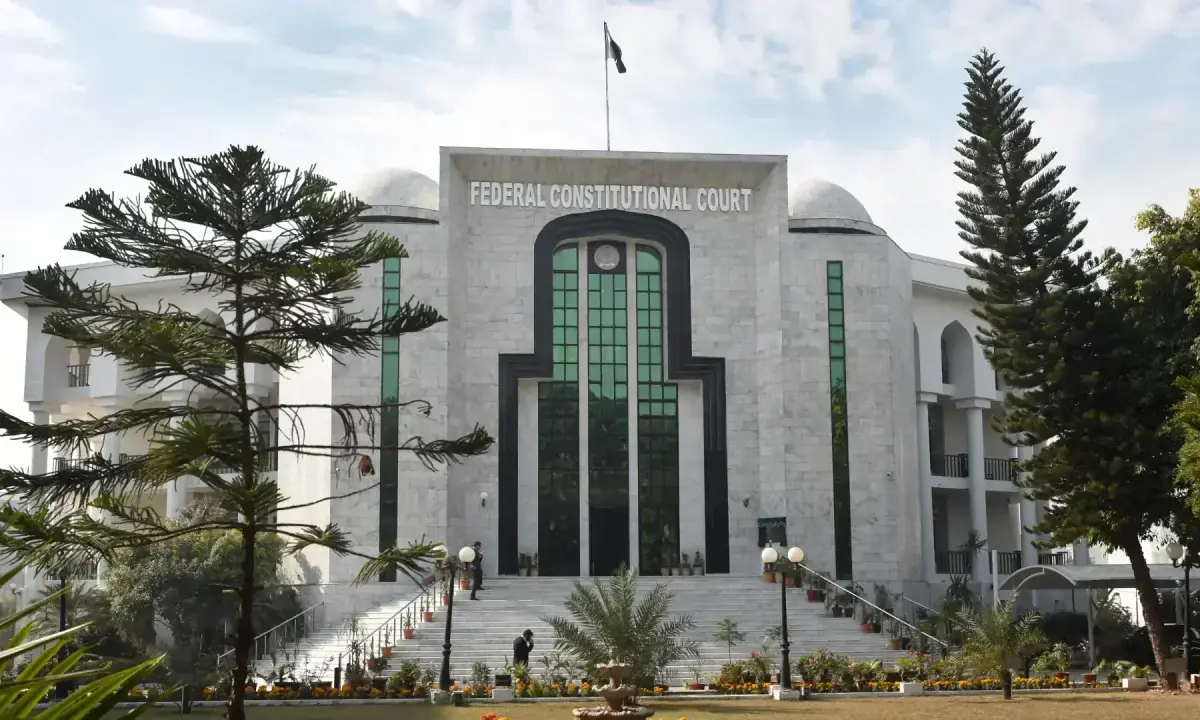
Photo via Dawn

Provinces cannot assume ‘unexercised’ federal powers: FCC

Read the original at Dawn ↗
Cite

Iqbal, N. (2026, November 20). Provinces cannot assume ‘unexercised’ federal powers: FCC. Dawn. https://www.dawn.com/news/2046013/provinces-cannot-assume-unexercised-federal-powers-fcc

Dated from the outlet's own feed. Check the original for its byline.

Dawn · collected 2026-11-21 · by Nasir Iqbal

Quick Summary

The Federal Constitutional Court (FCC) in Pakistan has ruled that provinces cannot assume federal fiscal powers that parliament has not exercised. Chief Justice Aminuddin Khan’s 59-page judgement stated that federal laws take precedence over provincial laws when there is a conflict, particularly regarding taxes on imports, exports, and interprovincial trade. The FCC’s decision came after taxpayers challenged cesses imposed by Sindh and Khyber Pakhtunkhwa provinces, finding these levies unconstitutional and void. The court ruled that provinces can still impose constitutionally valid infrastructure charges but cannot independently levy taxes that fall under federal jurisdiction.
Written by AI on 2026-11-22, from this article's own text only (the story summary below draws on all the coverage).

AI analysis

Story summary

The Federal Constitutional Court (FCC) in Islamabad ruled that parliament’s failure to exercise a fiscal power does not transfer that power to the provinces. Chief Justice Aminuddin Khan observed that when there is a conflict with a federal law, federal law prevails, and provincial laws become void in that area. The FCC’s decision came after hearing 568 challenges filed by taxpayers against provincial infrastructure development cess imposed by Sindh and Khyber Pakhtunkhwa. The court’s detailed 59-page judgement, issued on November 20, 2026, set aside the earlier judgements of the Sindh High Court (SHC) and Peshawar High Court (PHC), asserting that federal law should take precedence over conflicting provincial legislation.

Written for “FCC Warns Provinces Against Federal Powers” on 2026-11-23, grounded in this article and the 0 other(s) covering the same event.

Compared with similar articles

Nothing to compare against. No article is close enough to this one for the pipeline to have linked or judged the pair.

Story

FCC Warns Provinces Against Federal Powers
Politics · 1 article(s) covering the same event.
How this article was measured signals, leaning charts, publisher record, byline, topics and claims

Signals How these are calculated →

Claims extracted
17
sentences that state something as happening or true
Uncertain
12%
2 of 17 hedged ("reportedly", "may", "according to")
Leaning
withheld
no quote in the article backed the model's score
Publisher signals
65/100
Dawn's corrections and hedging, across everything collected from it. Not a measure of accuracy.
Outlets on this story
1
Politics
Same framing elsewhere
1
articles that frame the event the way this one does
Analyzed 2026-11-22 · how these are computed

How this is being covered How these are calculated →

Article leaning vs. publisher reliability
Source leaning vs. consistency

Publisher

Dawn · 3600 article(s) · 7 correction(s) detected
Running correction rate · 7 correction(s)

Who wrote this

Nasir Iqbal
36 article(s) here · 1 carrying a prediction
“An identified conflict with a competent federal law attracts the consequence prescribed under Article 142 of the Constitution, meaning that the federal law will prevail whereas the provincial law becomes void to the extent of that conflict,” observed FCC Chief Justice Aminuddin Khan in a 59-page judgement authored by him.
He also said that he would only be able to prove his innocence in the various cases against him “if I stay alive”.
However, today, the bench allowed the PHC to take up the cases on the condition that the high court would not hear pleas that challenged the Oct 11 proclamation of emergency and imposition of governor’s rule in KP, where the army had also been called in aid of civil power.
It also prayed that the FCC declare that the Constitution was the supreme law of the land and that no proclamation of emergency, assumption of provincial executive authority, deployment of the armed forces or other extraordinary governmental measure could confer upon any state authority unfettered power to disregard fundamental rights, constitutional safeguards or the democratic mandate of the people.
In May, though, CJP Yahya Afridi through a judgment elucidated the post-27th amendment judicial framework, by ruling that the constitutional scheme does not position either of the two apex courts — the Federal Constitutional Court (FCC) and the Supreme Court — as an appellate forum over the other.
“The FCC should declare that any action undertaken by the respondents if found to be motivated by political considerations or intended to frustrate the exercise of constitutional and democratic rights will amount to abuse of public authority or violation of the fundamental rights guaranteed under the Constitution,” the petition said.
In the fresh application, Dr Uzma has stressed the urgency in the matter due to reports circulating in the media that the incarcerated leader’s blood pressure recently rose to 192 and that there were serious concerns about his health. “If an early hearing of this matter is not granted, the applicant’s and Imran Khan’s guaranteed rights will continue to be prejudiced,” the application stated, arguing that his fundamental rights, particularly with respect to health and well-being, as well as access to medical advice and facilities and family members, would continue to be violated.
“And compliance with the judicial decision is not a matter of courtesy but a constitutional requirement, the non-compliance of which not only disturbs the delicate equilibrium between the prestige of the court and the enforcement of rights but also sets a dangerous precedent that could lead to an executive overreach,” Justice Najafi emphasised.
The petitioners had challenged their convictions in a 2011 double-murder case, upheld by the Lahore High Court (LHC) on May 18, 2022.
Expecting mathematical precision from eyewitnesses exposed to traumatic events is ‘unnatural and impractical’, Justice Ibrahim holds “In criminal jurisprudence, human behaviour should not be subjected to a fixed formula, nor should every witness be expected to react to, observe or retain events in an identical manner,” the judgement said.
2026-10-17 · assertive framing · SC questions ‘lofty expectations’ in criminal cases
Also by Nasir Iqbal
Nothing else under this byline is closely related to this article, so these are simply their most recent.
All 36 articles by Nasir Iqbal →

Topics

Article 142 FCC ISLAMABAD Sindh The Federal Constitutional Court

Subjects

FCC ORG · 7× Aamer Farooq PERSON · 1× Aminuddin Khan PERSON · 1× ISLAMABAD GPE · 1× Khyber Pakhtunkhwa GPE · 1× National Finance Commission ORG · 1× PHC ORG · 1× SHC ORG · 1× Sindh GPE · 1× The Federal Constitutional Court ORG · 1×

Narrative

Detailed order in provincial development cess case holds that federal law should prevail where it conflicts with provincial legislation While allowing the civil appeals filed by the taxpayers, the FCC set aside the impugned judgements of the SHC and PHC and declared that the corresponding charging provisions, along with all dependent rules, notifications, assessments and recovery measures, were unconstitutional and without lawful authority. “No demand, surcharge or penalty founded solely upon those charges shall be enforced,” the judgement said, adding that securities furnished solely for the invalid charges would be discharged upon verification and subject to any subsisting order governing their disposal.
framing: assertive · carried by 1 article(s) · first seen 2026-11-22
“An identified conflict with a competent federal law attracts the consequence prescribed under Article 142 of the Constitution, meaning that the federal law will prevail whereas the provincial law becomes void to the extent of that conflict,” observed FCC Chief Justice Aminuddin Khan in a 59-page judgement authored by him.
2026-11-22 · Dawn
Provinces cannot assume ‘unexercised’ federal powers: FCC · assertive framing

Claims (17 extracted, 2 hedged)

The Federal Constitutional Court (FCC) has ruled that parliament’s failure to exercise a fiscal power does not mean that the subject has been transferred to the provinces. asserted
subject → rule → provinces
“An identified conflict with a competent federal law attracts the consequence prescribed under Article 142 of the Constitution, meaning that the federal law will prevail whereas the provincial law becomes void to the extent of that conflict,” observed FCC Chief Justice Aminuddin Khan in a 59-page judgement authored by him. asserted
Khan → identify → him
The ruling came as a two-judge FCC bench, consisting of the chief justice and Justice Aamer Farooq, issued its detailed judgement on a set of 568 challenges filed by different taxpayers against the provincial infrastructure development cess imposed by Sindh and Khyber Pakhtunkhwa. asserted
bench → come → Sindh
Following the verbal order issued a day earlier, the detailed FCC judgement explained that although the statutory schemes and procedural histories differed, the matters raised a common constitutional question for determination: whether the impugned levies, in their true nature and operation, fell within provincial legislative competence or encroached upon parliament’s exclusive authority over imports, exports and interprovincial trade. asserted
levies → follow → imports
Detailed order in provincial development cess case holds that federal law should prevail where it conflicts with provincial legislation While allowing the civil appeals filed by the taxpayers, the FCC set aside the impugned judgements of the SHC and PHC and declared that the corresponding charging provisions, along with all dependent rules, notifications, assessments and recovery measures, were unconstitutional and without lawful authority. “No demand, surcharge or penalty founded solely upon those charges shall be enforced,” the judgement said, adding that securities furnished solely for the invalid charges would be discharged upon verification and subject to any subsisting order governing their disposal. asserted
securities → hold → disposal
However, the provinces remained free to enact constitutionally competent infrastructure or service charges on goods manufactured and consumed within their respective territories, the verdict ruled. asserted
verdict → remain → territories
It explained that Article 160 of the Constitution and the applicable National Finance Commission arrangements distinguish between the power to levy a federal tax and entitlement to its proceeds. asserted
Article → explain → proceeds
“A province’s share does not authorise it to impose that tax independently. asserted
share → authorise → tax
Equally, two competent levies are not unconstitutional merely because they affect the same goods. asserted
they → affect → goods
The defect in the present cases was legislative incompetence, not duplication; fiscal need could not supply the missing power,” the judgement said. uncertain
judgement → supply → power
The FCC observed that the impugned judgements had given controlling weight to the infrastructure purpose, movement of goods and asserted compensatory character of the cess without first establishing provincial legislative competence. asserted
judgements → observe → competence
None of these considerations provided an independent provincial basis for the challenged import, export and external-transit charges, it said. asserted
it → provide → charges
The FCC further observed that the abolition of the Concurrent Legislative List through the 18th Amendment had expanded provincial competence but had not transferred subjects expressly retained in the federal domain. asserted
abolition → observe → domain
Provincial autonomy must, therefore, be given full effect within its constitutional sphere while preserving parliament’s exclusive authority over matters reserved to it, the judgement said. asserted
judgement → give → it
During the hearing, the taxpayers had contended that the levies encroached upon parliament’s exclusive legislative domain and could not be sustained as fees or compensatory charges merely because the goods used provincial infrastructure. uncertain
goods → contend → infrastructure
They had also challenged the collection arrangements, discriminatory treatment, restrictions on trade and retrospective validation. asserted
They → challenge → trade
The provinces, meanwhile, invoked their residual legislative powers, infrastructure responsibilities and services provided to commercial users, distinguishing the cess from customs duties. asserted
provinces → invoke → duties

Give feedback · no sign-in needed

No sign-in needed for now. Your note is sent without a name, so it cannot be answered.

History Support