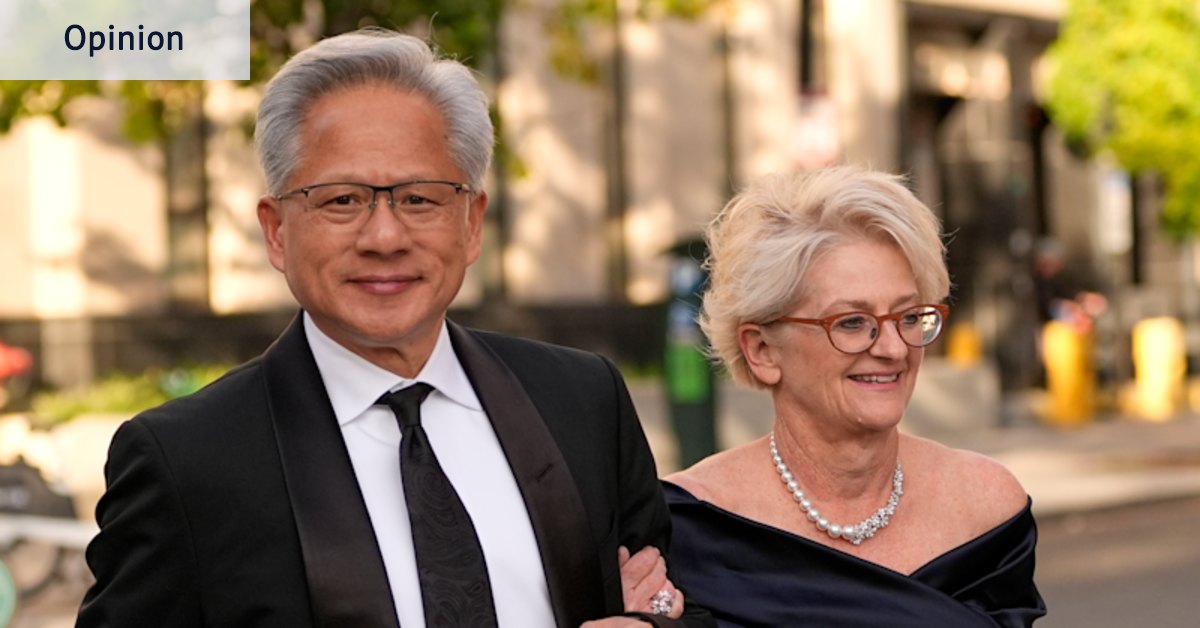
Photo via The Sydney Morning Herald

Jensen Huang could lose half his fortune. Who says it was all his to begin with?

Read the original at The Sydney Morning Herald ↗
Cite

Devine, V. (2026, November 21). Jensen Huang could lose half his fortune. Who says it was all his to begin with? The Sydney Morning Herald. https://www.smh.com.au/money/investing/jensen-huang-could-lose-half-his-fortune-who-says-it-was-all-his-to-begin-with-20261122-p61fwu.html?ref=rss&utm_medium=rss&utm_source=rss_feed

Dated from the outlet's own feed. Check the original for its byline.

The Sydney Morning Herald · collected 2026-11-21 · by Victoria Devine

Quick Summary

The article discusses the speculation surrounding Jensen Huang, co-founder of Nvidia, potentially losing half of his fortune in the event of a divorce following his resignation due to extramarital affairs. The author questions the assumption that the fortune is solely Huang's, highlighting his long marriage to Lori, an engineer who contributed to the family and the company's early struggles. The piece critiques the societal tendency to undervalue non-monetary contributions to a marriage, drawing a parallel to a listener's podcast question about unequal financial agreements based on who earns more.
Written by AI on 2026-11-23, from this article's own text only (the story summary below draws on all the coverage).

AI analysis

Story summary

Jensen Huang, the billionaire co-founder and former CEO of Nvidia, could lose a significant portion of his fortune in a potential divorce from his wife, Lori, after he resigned due to revelations about extramarital affairs. The couple has been married for over 40 years, meeting while studying engineering and raising two children together. Some financial analysts speculate that Lori could claim up to half of Huang's fortune, estimated at hundreds of billions of dollars. However, given their long history and her own professional background as an engineer, there is a debate about whether the coverage accurately reflects the complexities of their relationship and her potential claim. This situation highlights the public's tendency to focus on the achievements of successful business leaders while overlooking the contributions of their partners.

Written for “Jensen Huang Divorce Fortune Split” on 2026-11-24, grounded in this article and the 0 other(s) covering the same event.

Compared with similar articles

This article reads unscored and hedges 6% of its claims. Each row says how that neighbour differs.
Daily Mail
Hedges 0 of 16 claims Outlet record 69/100
“The articles discuss different aspects of the situation: one focuses on Huang's statement about potentially returning as CEO, while the other discusses potential financial implications of a divorce.”
The Independent
Leans right Hedges 2 of 22 claims Outlet record 59/100
“The articles describe different specific events: one discusses potential consequences of Jensen Huang's resignation due to personal issues, while the other reports on Trump's financial gain from Huang's reinstatement as CEO.”
The Dispatch
Hedges 0 of 2 claims Outlet record 61/100
“The articles cover different aspects of Jensen Huang's situation at Nvidia, with Article A discussing the potential financial implications of his divorce and Article B reporting on his return as CEO.”
Daily Mail
Leans right Hedges 2 of 27 claims Outlet record 69/100
“The articles describe different stages of Jensen Huang's situation at Nvidia, including his resignation and subsequent reinstatement, rather than the same specific incident.”
Daily Mail
Hedges 8 of 46 claims Outlet record 69/100
“The articles discuss different aspects of Jensen Huang's personal and professional life, including his resignation and potential reconciliation with his wife, but do not describe the same specific incident at the same time.”
CBC News
Hedges 0 of 3 claims Outlet record 60/100
“The articles discuss related events regarding Jensen Huang but describe different specific occurrences: one about the potential financial implications of his divorce and another about his reinstatement as CEO.”
The Sydney Morning Herald
Leans strongly left Hedges 7 of 52 claims Outlet record 61/100
“Article A discusses the potential financial implications of Jensen Huang's divorce, while Article B focuses on the culture of founder worship in the tech industry and Huang's immediate reinstatement after his resignation, which are different specific events.”

Story

Jensen Huang Divorce Fortune Split
Other · 1 article(s) covering the same event.
How this article was measured signals, leaning charts, publisher record, byline, topics and claims

Signals How these are calculated →

Claims extracted
52
sentences that state something as happening or true
Uncertain
6%
3 of 52 hedged ("reportedly", "may", "according to")
Leaning
not political
takes no side on a contested political question
Publisher signals
61/100
The Sydney Morning Herald's corrections and hedging, across everything collected from it. Not a measure of accuracy.
Outlets on this story
1
Other
Same framing elsewhere
1
articles that frame the event the way this one does
Analyzed 2026-11-23 · how these are computed

How this is being covered How these are calculated →

Article leaning vs. publisher reliability
Source leaning vs. consistency

Publisher

The Sydney Morning Herald · 8129 article(s) · 19 correction(s) detected
Running correction rate · 19 correction(s)

Who wrote this

Victoria Devine
3 article(s) here · 1 carrying a prediction
How much money could his wife get if they divorce?
While we might recognise inflation or higher mortgage rates as reasons for our depleted savings or an increase in debt, for example, studies consistently show that even when people know these factors are at play, they ultimately are still likely to blame their own spending habits for the fact that they are struggling to make ends meet.
But, it noted, if spending slows before the sector’s promises come to fruition, it could wreak economic havoc.
Also by Victoria Devine
Nothing else under this byline is closely related to this article, so these are simply their most recent.

Topics

Nvidia

Subjects

Lori PERSON · 3× Nvidia ORG · 2× Huang PERSON · 1× Jensen PERSON · 1× Jensen Huang PERSON · 1×

Narrative

We still have a tendency to celebrate the person with the impressive salary, the successful business or the enormous investment portfolio, while treating the work happening behind the scenes as something separate from the financial success. And I find that particularly frustrating because the value of that work becomes painfully obvious the moment someone has to pay another person to do it.
framing: assertive · carried by 1 article(s) · first seen 2026-11-23
How much money could his wife get if they divorce?
2026-11-23 · The Sydney Morning Herald
Jensen Huang could lose half his fortune. Who says it was all his to begin with? · assertive framing

Claims (52 extracted, 3 hedged)

The billionaire co-founder of Nvidia, the company powering much of the artificial intelligence boom, has resigned as chief executive following revelations about his extramarital affairs. asserted
founder → power → affairs
And while the technology industry has been busy debating what his departure means for the company, another conversation has caught my attention. asserted
conversation → debate → attention
How much money could his wife get if they divorce? uncertain
they → get → money
With Huang’s fortune estimated in the hundreds of billions of dollars, commentators are speculating about whether his wife, Lori, could walk away with half. uncertain
wife → estimate → half
There’s a particular tone to some of this coverage that I find fascinating, as though we’re witnessing a man potentially lose an enormous portion of everything he’s worked for. asserted
he → ’ → everything
They met while studying engineering, married years before Nvidia was founded in 1993 and raised two children together. asserted
Nvidia → meet → children
Lori is an engineer in her own right, and the family lived through the company’s early struggles long before artificial intelligence made her husband one of the wealthiest people on the planet. asserted
husband → live → planet
I don’t pretend to know the private financial arrangements of their marriage. asserted
I → pretend → marriage
There’s no confirmed divorce, and the existence or terms of any prenuptial agreement haven’t been established publicly. asserted
existence → ’ → agreement
But I find the assumption that this is entirely his fortune rather telling. asserted
this → find → ?
What I am questioning is why our instinct is to describe a potential settlement as a man losing part of his fortune. asserted
instinct → question → fortune
Because who decided that the person whose name is on the company is the only person who built the wealth? asserted
who → decide → wealth
Coincidentally, this week I answered a question on my podcast from a woman whose circumstances couldn’t be further removed from Silicon Valley billionaires, but whose story raised almost the same issue. asserted
story → answer → issue
Her husband wanted them to enter into a binding financial agreement stipulating that if their marriage ended, he would receive 70 per cent of their home, and she would receive 30 per cent. asserted
she → want → cent
His reasoning, as she explained it, was that he earned more money while she took responsibility for the domestic work. asserted
she → explain → work
I had a pretty strong reaction to that. asserted
I → have → that
Not because I think every couple should automatically split everything down the middle. asserted
couple → think → middle
There are plenty of legitimate reasons to discuss how assets would be divided, particularly where one person brings substantially more into a relationship. asserted
person → be → relationship
I’m a big believer in couples having honest financial conversations and getting proper legal advice. asserted
couples → ’m → advice
What bothered me was the suggestion that because her contribution didn’t arrive in the family bank account every fortnight, it somehow counted for less. asserted
it → bother → less
If one person is managing the household, caring for children, organising appointments, doing the school runs and generally keeping family life functioning, that frees up an extraordinary amount of time for the other person to focus on their career. asserted
person → manage → career
Time they can spend working longer hours, pursuing promotions, travelling for business or building a company. asserted
they → spend → company
That arrangement might suit both people perfectly. uncertain
arrangement → suit → people
But it’s still an arrangement in which both people contribute to the family’s financial position. asserted
people → ’ → position
And the person doing the unpaid work often pays a very real price for it. asserted
person → do → it
Reduced working hours can mean missed promotions, slower salary growth, smaller superannuation balances and fewer opportunities to develop a career. asserted
hours → reduce → career
Those consequences don’t disappear simply because the couple has agreed that one person’s job is to earn the money and the other’s is to look after everything else. asserted
other → disappear → everything
As someone who has worked in financial advice and now mortgage broking, I’ve seen how easily couples fall into describing money as belonging to whoever earns it. asserted
whoever → work → it
We discuss his salary or her business without always acknowledging the decisions and sacrifices that made those things possible. asserted
things → discuss → decisions
I also think we need to be honest about the fact that this isn’t exclusively a women’s issue. asserted
this → think → fact
There are men who put their careers on hold to raise children or support a higher-earning partner, and their contributions deserve the same recognition. asserted
contributions → be → recognition
The principle shouldn’t change depending on who’s doing the laundry. asserted
who → change → laundry
Australian family law, thankfully, takes a broader view than simply comparing payslips. asserted
law → take → payslips
When courts determine property settlements, they consider financial and non-financial contributions, including homemaking and parenting, alongside the parties’ circumstances and future needs. asserted
they → determine → circumstances
There is no automatic entitlement to a 50-50 split, and properly made binding financial agreements can alter how property is dealt with. asserted
property → be → split
That’s precisely why anyone considering one should obtain independent legal advice before signing. asserted
anyone → ’ → advice
But the fact that our legal system recognises unpaid contributions doesn’t mean our attitudes have caught up. asserted
attitudes → recognise → contributions
We still have a tendency to celebrate the person with the impressive salary, the successful business or the enormous investment portfolio, while treating the work happening behind the scenes as something separate from the financial success. And I find that particularly frustrating because the value of that work becomes painfully obvious the moment someone has to pay another person to do it. asserted
someone → have → it
None of these services is free when you outsource them. asserted
you → outsource → them
Yet when they’re performed by a partner, we somehow become reluctant to recognise their economic value. asserted
we → perform → value
…and 12 more, not listed.

Give feedback · no sign-in needed

No sign-in needed for now. Your note is sent without a name, so it cannot be answered.

History Support