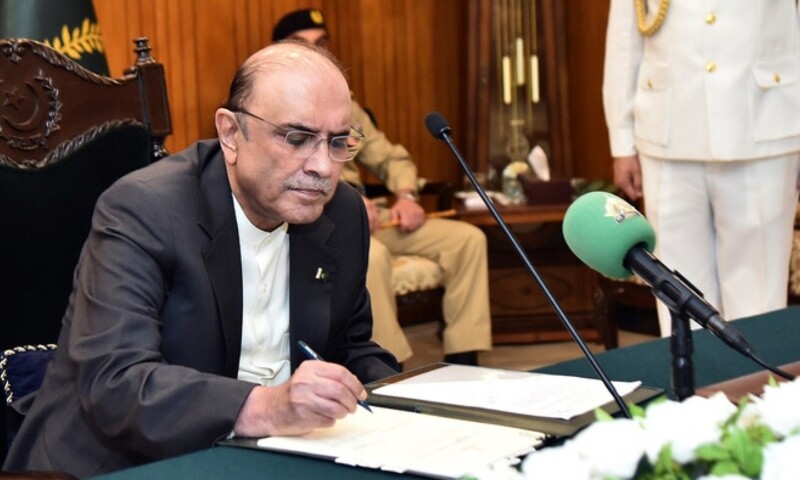
President Asif Ali Zardari has promulgated five ordinances, doing away with most of the “privileges” of the Khyber Pakhtunkhwa lawmakers, including protection against “preventive detention” and providing a legal framework for special initiatives in the designated 12 districts and other districts in the province.
asserted
Zardari → promulgate → province
With the imposition of emergency in KP on Oct 11, an Area Representative and Development Council (ARDC) was formed to oversee 12 districts that were deemed to face intense security challenges, including the merged districts.
asserted
that → form → districts
Two of the ordinances envisage setting up an executive committee, with wide-ranging powers, to oversee special initiatives including developmental schemes in the 12 designated districts and the rest of the province, respectively.
asserted
Two → envisage → province
The committee will have powers to identify and recommend the executing agency for special initiatives in the designated and other districts, including military formations.
asserted
committee → have → formations
In a statement on Saturday, President Zardari’s office confirmed he had promulgated five ordinances pertaining to KP.
asserted
he → confirm → KP
Of these, the following four had been published in the Official Gazette on Nov 19 after their promulgation:
- Khyber Pakhtunkhwa Societies (Registration) (Amendment) Ordinance, 2026;
- Khyber Pakhtunkhwa Special Initiative Ordinance, 2026 (specific districts);
- Khyber Pakhtunkhwa Special Initiative Ordinance, 2026 (other districts);
- Khyber Pakhtunkhwa Provincial Assembly (Powers, Immunities and Privileges) Ordinance, 2026 (XI of 2026).
The fifth was the Khyber Pakhtunkhwa Speaker and Deputy Speaker (Salaries, Allowances and Privileges) Ordinance 2026.
asserted
fifth → publish → 2026
Through the amendment ordinance related to privileges of MPAs, drastic changes have been made in the KP Provincial Assembly (Powers, Immunities and Privileges) Act 2026, as 21 of its 40 sections have been omitted, including those providing protection to the MPAs against “preventive detentions” and offences related to “breach” of privileges.
asserted
sections → relate → privileges
The schedule of offences related to “breach of privileges” of the Assembly, its members and committees has also been omitted, thus leaving them without significant privileges.
It may be mentioned that Sohail Afridi — whose role as the chief minister was rendered non-functional due to governor’s rule — Speaker Babar Saleem Swati and other lawmakers have been in “preventive detention” since emergency was imposed, according to police.
uncertain
emergency → relate → police
KP Governor Faisal Karim Kundi also said last month that they had been placed under house arrest.
asserted
they → say → arrest
The important provisions omitted through the ordinance include sections 5 (attendance of MPA detained or arrested), 6 (members not liable to civil or criminal action), 10 (preventive detention), 11 (permission of speaker before arrest, detention, etc. of a member), 15 (power to summon), 22 (power to arrest), 31 (breach of privilege), 32 (breach of privilege to be an offence) and 34 (cognisance of offence).
asserted
provisions → omit → offence
Special initiative ordinances
The two ordinances relate to special initiatives in the 12 designated districts and the remaining districts in the province, respectively.
asserted
ordinances → relate → province
Both the ordinances provide for the establishment of an executive committee comprising a chairman, vice chairman and other such members as nominated by the prime minister, in case of designated district, and by the governor of the province, in case of the remaining districts.
asserted
ordinances → provide → districts
For the designated districts, the Area Development Secretariat shall serve as secretariat of the executive committee, whereas for the other districts, the planning and development department shall serve as the secretariat of the committee.
asserted
department → designate → committee
Under the new laws, “special initiative” includes any work, developmental scheme, rehabilitation or reconstruction work, procurement of goods and human resources, consulting or non-consulting services or any other activity involving expenditure of public funds as determined by the executive committee.
asserted
initiative → include → committee
The executive committee, in both the ordinances, has extensive powers including:
- Identify an initiative as a special initiative of urgent or emergent nature;
- Scrutinise and approve proposals, concept papers and PC-Is for the special initiatives;
- Grant anticipatory approval for the initiatives, proposals, concept papers and PC-Is of the special initiatives;
- Identify and recommend the executing agency, including military organisations and formations, for the execution of the special initiatives;
- Provide a mechanism for the monitoring and evaluation of the special initiatives, including third-party monitoring and evaluation;
- Review progress of the special initiatives;
- Constitute committees or designate persons to carry out functions assigned to them by the executive committee;
- Perform any other act to carry out the purposes of the ordinance.
asserted
committee → have → ordinance
The ordinances provide that the executive committee should meet at least once a month or as and when required.
asserted
committee → provide → ?
The decisions of the committee shall be made on the basis of majority vote of its members, and in case of a tie, the chairman shall have the casting vote.
asserted
chairman → make → vote
The chairman is also empowered to co-opt any other member or technical expert, to offer advice to the committee, as required.
asserted
chairman → empower → committee
Both the ordinances have overriding effect on other laws, including the KP Public Procurement Regulatory Authority Act 2012 and the KP Public Private Partnership Act 2020.
asserted
ordinances → have → Act
Moreover, no civil court shall have jurisdiction in relation to an act done, order passed, and any proceedings done under the ordinances.
asserted
court → have → ordinances
The newly included provision provides that madressahs which are or may be registered with the Directorate General of Religious Education, Ministry of Federal Education and Professional Training, shall not be required to be registered under the Act (Societies Registration Act).
uncertain
which → include → Act
 The Aporia