Photo via Times of India

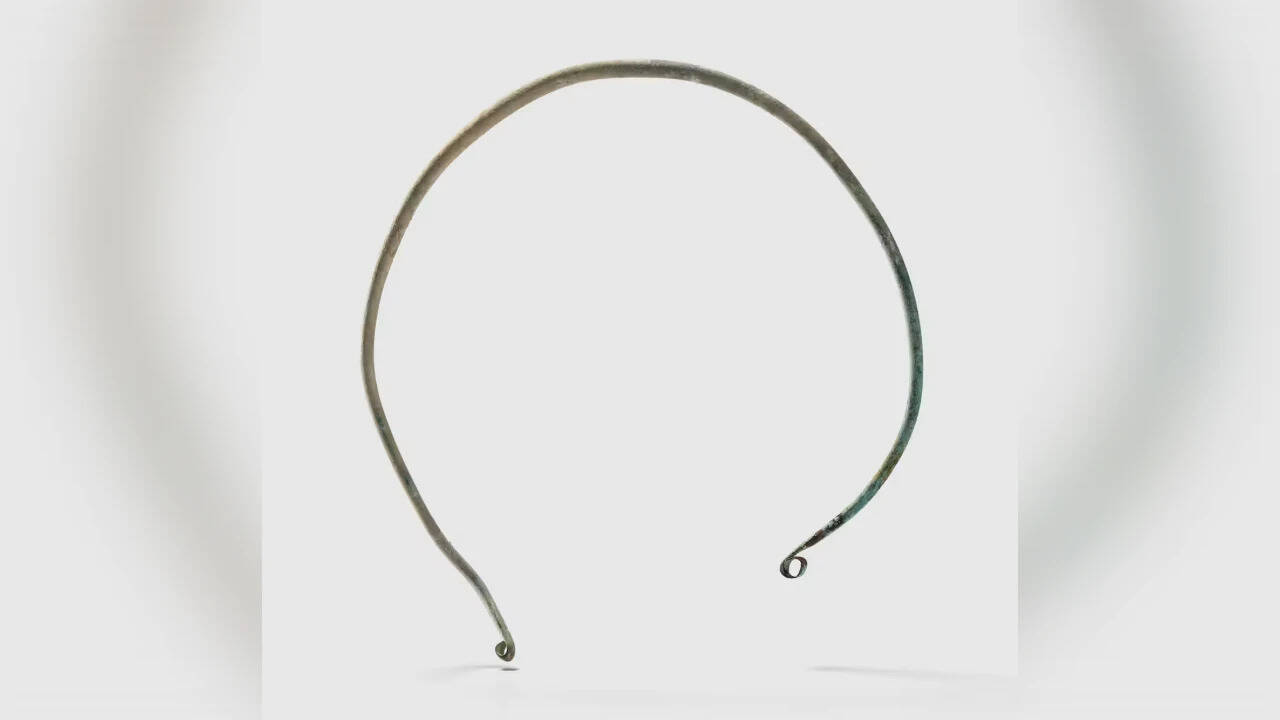
As ice receded on a Swiss Alpine pass, archaeologists discovered a 4,000 years old bronze neck ring

Read the original at Times of India ↗
Cite

TOI Lifestyle Desk. (2026, November 21). As ice receded on a Swiss Alpine pass, archaeologists discovered a 4,000 years old bronze neck ring. Times of India. https://timesofindia.indiatimes.com/science/archaeology/as-ice-receded-on-a-swiss-alpine-pass-archaeologists-discovered-a-bronze-neck-ring-estimated-to-be-4000-years-old-experts-say-it-is-the-first-early-bronze-age-jewellery-found-at-that-location/articleshow/136055916.cms

Dated from the outlet's own feed. Check the original for its byline.

Times of India · collected 2026-11-21 · by TOI Lifestyle Desk

Quick Summary

Archaeologists from the Archaeological Service of the Canton of Bern discovered a 4,000-year-old bronze neck ring at the Lötschen Pass in Switzerland in mid-October 2026. The ring, dating back to the Early Bronze Age between 2000 and 1700 BCE, is about 13 centimeters in diameter and in surprisingly good condition despite its age. This discovery is significant because it is the first larger metal object and the first piece of Early Bronze Age jewellery found on the pass. The Lötschen Pass, located more than 2,600 meters above sea level, has previously yielded artifacts such as Roman coins, medieval arrows, and Bronze Age wooden objects due to melting ice revealing items from the past.
Written by AI on 2026-11-23, from this article's own text only (the story summary below draws on all the coverage).

AI analysis

Story summary

In mid-October 2026, archaeologists from the Archaeological Service of the Canton of Bern discovered a 4,000-year-old bronze neck ring at the Lötschen Pass in Switzerland, marking the first recorded Early Bronze Age jewelry found in this region. The Lötschen Pass, located at an elevation of over 2,600 meters, has been a site of archaeological discoveries since 2011, with melting ice revealing various artifacts from the Bronze Age, including weapons and leather pieces. This latest find adds to the growing collection of historical items unearthed, which also include Roman coins and medieval arrows, providing significant insights into the cultural and technological advancements of ancient human civilizations.

Written for “Ancient Bronze Necklace Discovery Switzerland” on 2026-11-23, grounded in this article and the 0 other(s) covering the same event.

Compared with similar articles

Nothing to compare against. No article is close enough to this one for the pipeline to have linked or judged the pair.

Story

Ancient Bronze Necklace Discovery Switzerland
Science · 1 article(s) covering the same event.
How this article was measured signals, leaning charts, publisher record, byline, topics and claims

Signals How these are calculated →

Claims extracted
31
sentences that state something as happening or true
Uncertain
6%
2 of 31 hedged ("reportedly", "may", "according to")
Leaning
not political
takes no side on a contested political question
Publisher signals
58/100
Times of India's corrections and hedging, across everything collected from it. Not a measure of accuracy.
Outlets on this story
1
Science
Same framing elsewhere
1
articles that frame the event the way this one does
Analyzed 2026-11-23 · how these are computed

How this is being covered How these are calculated →

Article leaning vs. publisher reliability
Source leaning vs. consistency

Publisher

Times of India · 5630 article(s) · 8 correction(s) detected
Running correction rate · 8 correction(s)

Who wrote this

TOI Lifestyle Desk
89 article(s) here · 0 carrying a prediction
While the precise circumstances of her death remain unknown, researchers suggested that it may have been connected to ritualised killing or sacrifice, a practice associated with several Iron Age bog bodies discovered across north-western Europe.
The ruling was delivered on November 18, 2026, in the case of Benjamin Lee Bird v. William Eric Gill and Rhonda Marie Olivo Gill.
Cheeky as it may sound, the 68-year-old Californian has spent nearly four decades examining sharks and rays brought in by fishers, identifying 56 species previously unknown to science along the way.
Sometimes, all it takes is a little collective effort and a community willing to restore what has been neglected.
What initially began as a repair project grew into a $53.2 million renovation, with work that will continue into 2027, the center has reported.
The conservation easements will also allow the land to continue operating as a working forest while protecting it from future development.
That is what you would expect if their clocks were running behind.
Some chinchillas had eyes so swollen and filled with discharge that they could not open them.
The dispute arose when planning approval left important details of the subdivision unresolved, despite the seller having represented that the land would be divided into 15 lots.
The organisation, which was founded in 2019, has spent much of this time studying the conditions around City Island to understand whether native oysters could survive and eventually establish a self-sustaining reef.
Wire or desk byline, not an individual reporter.
Also by TOI Lifestyle Desk
Nothing else under this byline is closely related to this article, so these are simply their most recent.
All 89 articles by TOI Lifestyle Desk →

Topics

ADB Bern Roman the Archaeological Service the Archaeological Service of the Canton of Bern

Subjects

ADB ORG · 2× Bern GPE · 2× Valais GPE · 2× the Canton of Bern GPE · 2× Alpine NORP · 1× Roman NORP · 1× The Directorate of Education and Culture ORG · 1× the Archaeological Service ORG · 1× the Archaeological Service of the Canton of Bern ORG · 1× the Bernese Oberland GPE · 1×

Narrative

In mid-October 2026, a team from the Archaeological Service of the Canton of Bern found one more piece for this record: a bronze neck ring about 4,000 years old, making it the first Early Bronze Age jewellery ever recorded on the pass.
framing: assertive · carried by 1 article(s) · first seen 2026-11-23

Claims (31 extracted, 2 hedged)

The job of an archeologist is one that requires immense patience to find something worthy of being called a treasure over the years. asserted
that → require → years
The Earth’s geomorphic cycle has buried centuries of evidence of life on this planet, which is why one of the best sources of human history has been digging around the suspected archeological sites. asserted
one → bury → sites
At the Lötschen Pass, archaeologists have been digging through the same stretch of mountain for years, and the ground there keeps giving things back. asserted
ground → dig → things
The discoveries began with Roman coins and medieval-age arrows. asserted
discoveries → begin → coins
The epochs of the planet have buried secrets of our evolution into the layers of mud, rock, water and ice. asserted
epochs → bury → mud
Therefore, materials are not just buried under rugged rocks and mud, but in all kinds of landscapes such as underwater and under huge snow-covered glaciers. asserted
materials → bury → glaciers
This is best seen at the Lötschen Pass, more than 2,600 metres above sea level, where since 2011, melting ice has revealed artefacts from the Bronze Age, including bow, arrows, pieces of leather and a box made of wood chips. asserted
ice → see → chips
Meanwhile, graves at Gwatt, Einigen and Hilterfingen have yielded neck jewellery from the same era, worn by men and women. asserted
graves → yield → men
In mid-October 2026, a team from the Archaeological Service of the Canton of Bern found one more piece for this record: a bronze neck ring about 4,000 years old, making it the first Early Bronze Age jewellery ever recorded on the pass. asserted
it → find → pass
A valuable walk Staff from the Archaeological Service, known as the ADB, regularly walk high-altitude sites to check for prehistoric objects, and the ring turned up on one of those inspection rounds. asserted
ring → know → rounds
According to the canton, it is the first larger metal object from prehistory found on the pass. uncertain
it → accord → pass
The ring dates to the Early Bronze Age, between 2000 and 1700 BCE. asserted
ring → date → Age
It measures about 13 centimetres in diameter and ends in two small loops shaped like eyelets. asserted
It → measure → eyelets
The team measured where it lay, documented it and lifted it out with care. asserted
it → measure → care
It was then taken to the ADB laboratories in Bern, where conservators are treating it now. asserted
conservators → take → it
The Directorate of Education and Culture of the Canton of Bern announced the discovery on Wednesday, 18 November. asserted
Directorate → announce → Wednesday
The Lötschen Pass sits on the border between the Bernese Oberland and the canton of Valais, and archaeologists have worked there for some time. asserted
archaeologists → sit → time
Since 2011, the melting ice has also given up a Bronze Age bow, arrows, pieces of leather and a box made of wood chips. asserted
ice → melt → chips
These organic objects stayed preserved in the ice for centuries, and warming temperatures have exposed them. asserted
temperatures → stay → them
First, it lay away from places where the earlier finds have been made. asserted
finds → lie → places
Second, it is the first bronze object recorded on the pass. asserted
it → record → pass
And lastly, it is the first piece of Early Bronze Age jewellery found there. asserted
it → find → jewellery
Mobility through the Alpine passes Neck jewellery like this has turned up before, though in graves rather than on a mountainside. asserted
jewellery → turn → mountainside
Similar pieces come from the burials of men and women from the same period at Gwatt, Einigen and Hilterfingen, all in the canton of Bern. asserted
pieces → come → Bern
Sites from the era also exist south of the Bernese Alps in Valais. asserted
Sites → exist → Valais
The Canton of Bern has concluded the Lötschen ring as evidence that people in prehistory moved over long distances, and that Alpine passes have been walked for thousands of years. asserted
passes → conclude → years
The pass connects the two regions where these related finds were made. asserted
finds → connect → regions
A lost treasure or an intentional one The researchers do not think the ring was lost. asserted
ring → lose → treasure
They suspect someone placed it on the pass on purpose. asserted
someone → suspect → purpose
The canton lists three possible reasons: an offering to a deity, a request for a successful journey, or thanks for one that ended well. asserted
that → list → one
Nobody can say which it was, and the announcement does not claim to know. uncertain
announcement → say → ?

Give feedback · no sign-in needed

No sign-in needed for now. Your note is sent without a name, so it cannot be answered.

History Support