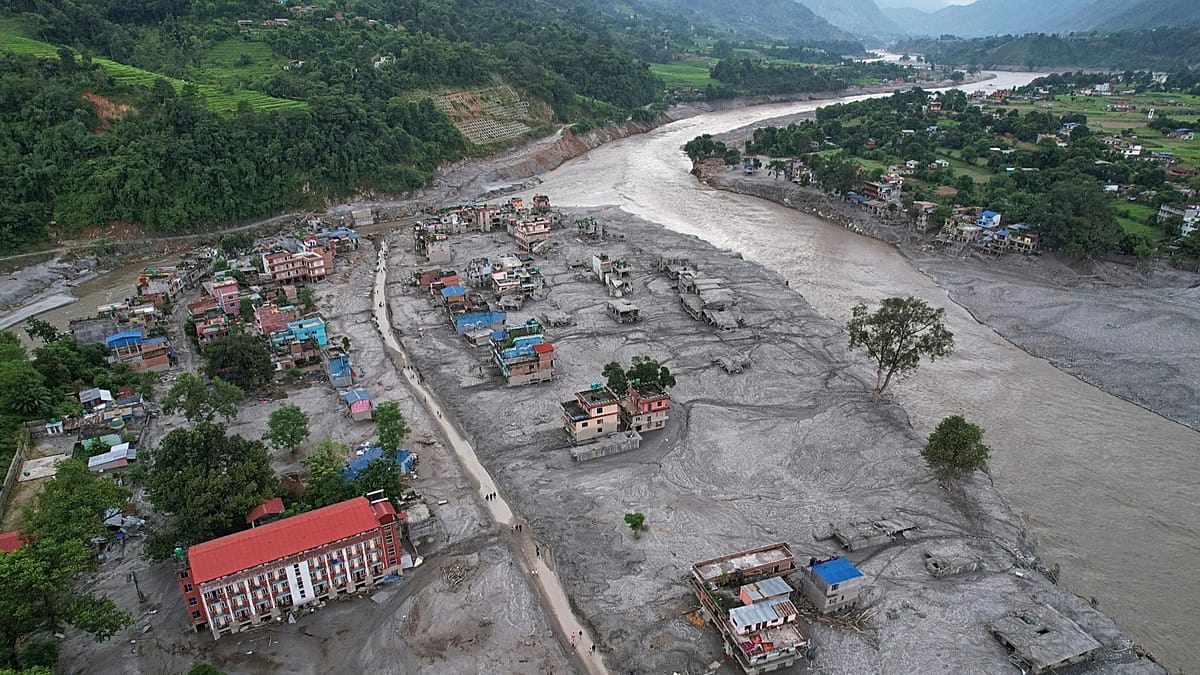
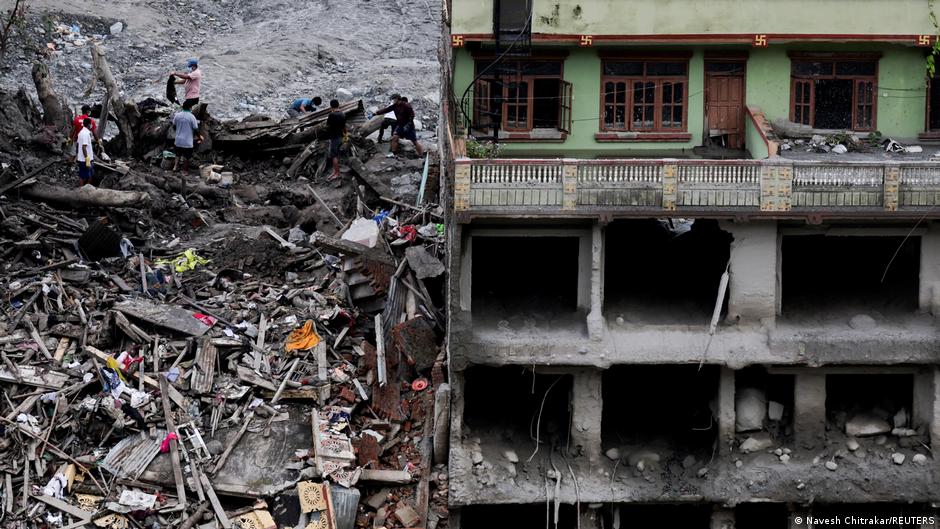
Photo via The Hindu

Nepal flash flood death toll surges to 1,410; over 6,100 still missing

Read the original at The Hindu ↗
Cite

Nepal flash flood death toll surges to 1,410; over 6,100 still missing. (2026, September 17). The Hindu. https://www.thehindu.com/news/international/nepal-flash-flood-death-toll-missing-persons-count-search-ops/article71478234.ece

Dated when The Aporia collected the article, usually within hours of publication. Check the original for its exact date and byline.

The Hindu · collected 2026-09-17 · by PTI

Quick Summary

The death toll from flash floods in Nepal has risen to 1,410 as of Thursday, September 17, 2026, with over 6,100 people still missing. The flooding was caused by an ice-rock avalanche near the Nepal-Tibet border on August 26 and affected northern and central regions, destroying homes, vehicles, infrastructure, and hydropower projects along the Bhotekoshi River. Rescue efforts continue, having already rescued 13,756 people according to Nepal’s National Disaster Risk Reduction and Management Authority (NDRRMA).
Written by AI on 2026-09-18, from this article's own text only (the story summary below draws on all the coverage).
See how they differ ↓

AI analysis

Story summary

In late August 2026, flash floods caused by a glacial collapse near the Nepal-Tibet border devastated central and northern Nepal, leading to over 1,450 deaths as of September 20. The floodwaters swept away homes, vehicles, roads, bridges, and hydropower projects in multiple districts including Chitwan, Rasuwa, and Nawalparasi. With more than 6,000 people still missing, recovery efforts are hampered by severe damage to infrastructure and the decomposed state of many recovered bodies, complicating identification processes.

Prime Minister Balendra Shah has declared an early warning system for natural disasters as a top priority in Nepal, acknowledging that such systems could have saved lives. Meanwhile, international experts suggest climate change likely contributed to the instability of glaciers and permafrost, triggering the devastating avalanche that caused the floods. The disaster highlights the urgent need for global action on climate issues, with scientists noting that without faster transitions towards zero fossil fuel emissions, similar catastrophic events will become more frequent in the future.

Written for “Nepal Flood Disaster” on 2026-11-20, grounded in this article and the 18 other(s) covering the same event.

How they differ

11 outlets covered “Nepal Flood Disaster”.

What each outlet says

One AI summary per outlet of its latest article on this story, written from that article alone and checked against it. Open the article for the outlet's own words.

The HinduThis outlet17 Sep

The death toll from flash floods in Nepal has risen to 1,410 as of Thursday, September 17, 2026, with over 6,100 people still missing. The flooding was caused by an ice-rock avalanche near the Nepal-Tibet border on August 26 and affected northern and central regions, destroying homes, vehicles, infrastructure, and hydropower projects along the Bhotekoshi River. Rescue efforts continue, having already rescued 13,756…

Nepal flash flood death toll surges to 1,410; over 6,100 still missing (this article)4 articles from The Hindu on this story

Al Jazeera20 Sep

The article reports on the aftermath of devastating floods in Nepal caused by a glacial collapse along the Trishuli River, which killed at least 1,386 people and left thousands missing. In Betrawati, a small riverside town, survivors like Anusa Thapa Magar find no trace of their homes or loved ones, as entire settlements were swept away. The flood debris includes personal items such as shoes and backpacks…

Photos: Nepal flood survivors find little trace of former lives →3 articles from Al Jazeera on this story
The Guardian17 Sep

A recent study led by Imperial College London links climate change to a catastrophic glacier collapse in Nepal and Tibet that killed over 1,300 people last month. Researchers found unusually warm conditions preceding the collapse of an ice mass, which released 110 million cubic meters of water and debris into rivers below, causing flash floods on an unprecedented scale. The study emphasizes how rising temperatures…

Climate crisis likely behind devastating Nepal-Tibet floods that killed more than 1,300, first study finds →2 articles from The Guardian on this story
Daily Mail23 Sep

Mita and Hemant Parikh, a couple from Georgia who were part of a pilgrimage group heading to Mount Kailash in Tibet, narrowly escaped a deadly flood in Nepal that killed over 1,000 people. They had taken an unplanned detour to see Mount Everest, which kept them away when the flood struck their hotel, destroying it and leaving many others missing or dead. The couple attributes their survival to divine intervention…

Couple describes the moment they cheated death to survive flood in Nepal that killed more than 1,000 →2 articles from Daily Mail on this story
South China Morning Post19 Sep

Young Nepalis are grappling with anxiety and emotional distress following the August glacier collapse in Nepal that killed over 1,400 people. A 21-year-old forestry student involved with Nepalese Youth for Climate Action described struggling to focus amid reports of death and destruction, highlighting the mental toll of climate disasters on youth. The article focuses on the psychological impact of climate change on…

Young Nepalis battle climate dread in wake of flood disaster →2 articles from South China Morning Post on this story
Deutsche Welle14 Sep

Three weeks after deadly flash floods triggered by a glacier collapse hit Nepal’s Bhotekoshi-Trishuli river corridor near the Chinese border, recovery efforts are underway amidst continued search operations for over 5,130 missing people. The disaster has claimed at least 1,386 lives and destroyed more than a dozen hydropower facilities. In Uttargaya Rural Municipality alone, 877 people remain missing and only 12…

Nepal: thousands still missing as flood recovery begins →
Show 5 more outlets
Time15 Sep

Floods in Nepal and Tibet have caused significant destruction, leading to over 1,300 deaths and leaving around 5,000 people unaccounted for. These floods destroyed infrastructure including bridges and hydropower plants. While climate change is a contributing factor, the article highlights that human activities such as unplanned urbanization, deforestation, and disrupted natural drainage also exacerbate flood damage…

Nepal Cannot Stop the Floods. It Can Stop Them From Becoming Disasters. →
Toronto Star17 Sep

A recent analysis by World Weather Attribution indicates that climate change contributed to the collapse of a Himalayan slope near Nepal’s border with China on August 26, leading to catastrophic flooding and over 1,300 deaths. While acknowledging that a large earthquake in 2015 may have initially weakened the rock, researchers found that rising temperatures have thinned glaciers and thawed mountain permafrost…

Climate change made deadly Nepal glacier and rock collapse more likely, according to analysis →
BBC17 Sep

A study published by the World Weather Attribution finds that climate change significantly contributed to a devastating glacier collapse near the Nepal-Tibet border on August 26, resulting in over 1,400 deaths and thousands missing. The event was triggered by rising temperatures and thinning glaciers, which combined with heavy snowfall and potential damage from a 2015 earthquake to create a dangerous compound…

Climate change helped trigger Nepal-Tibet disaster, study finds →
Euronews17 Sep

Scientists from the World Weather Attribution group have determined that climate change significantly contributed to a deadly flood near Nepal's border with China on August 26. The disaster killed more than 1,300 people and left over 5,000 missing when a mountain slope collapsed due to long-term warming effects such as glacier retreat and permafrost thaw, destabilizing the area and triggering a massive flow of water…

Climate change was key factor in deadly Nepal-China flood, scientists say →
CBS News22 Sep

Mita and Hemant Parikh, a Georgia couple, survived a devastating flood in Nepal while on a spiritual pilgrimage to Mount Kailash in Tibet. The flood occurred nearly a month ago and claimed the lives of 47 people from their group; seven guides are also missing. The Parikhs made an impromptu decision to visit Lhasa and Everest Base Camp before rejoining their group, which led them to safety while others were caught in…

Georgia couple who survived Nepal flood shares their story →

Where they agree and split

Agreed

AI · cited, from two or more outlets

  • More than 1,300 people are confirmed dead and more than 5,000 remain missing after the floods.23
  • The disaster was triggered by a glacier collapse near Nepal’s border with China.12

Disputed

Picked by our model, which is sometimes wrong

  • While some sources claim climate change played a significant role in the disaster, others suggest it may not have been the sole cause and that pre-existing geological weaknesses contributed to the collapse.34

Framing

How the first headlines put it

  • Deutsche Welle focuses on the ongoing search-and-rescue efforts and the number of missing people, while The Guardian emphasizes Nepal's demand for climate compensation from major polluters.12
  • The Toronto Star highlights the scientific analysis linking climate change to the disaster, whereas CBS News focuses on a personal story of survival and loss.35
Words to watch (4)

Nepal says big polluters must ‘wake up’ as it calls for climate compensation over flood disaster The Guardian

Scientists blame climate change for Nepal's devastating flash floods - and warn similar disasters are 'inevitable' as global temperatures continue to rise Daily Mail

Climate change helped trigger Nepal-Tibet disaster, study finds BBC

What the China-Nepal floods teach us about crisis communication South China Morning Post

The full story: what happened, how it changed, and all 19 articles →

Compared with similar articles

This article reads unscored and hedges 38% of its claims. Each row says how that neighbour differs.
The Guardian
Leans strongly left Hedges 3 of 34 claims Outlet record 64/100
Toronto Star
Leans left Hedges 5 of 37 claims Outlet record 64/100
BBC News
Hedges 6 of 18 claims Outlet record 65/100
Euronews
Leans left Hedges 2 of 25 claims Outlet record 60/100
Al Jazeera
Leans strongly left Hedges 5 of 16 claims Outlet record 60/100
The Hindu
Hedges 2 of 37 claims Outlet record 60/100
The Hindu
Hedges 1 of 15 claims Outlet record 60/100
Deutsche Welle
Hedges 1 of 35 claims Outlet record 95/100

Story

Nepal Flood Disaster
Environment · 19 article(s) covering the same event. Compare every outlet's account →
How this article was measured signals, leaning charts, publisher record, byline, topics and claims

Signals How these are calculated →

Claims extracted
8
sentences that state something as happening or true
Uncertain
38%
3 of 8 hedged ("reportedly", "may", "according to")
Leaning
not political
takes no side on a contested political question
Publisher signals
60/100
The Hindu's corrections and hedging, across everything collected from it. Not a measure of accuracy.
Outlets on this story
19
Environment
Same framing elsewhere
1
articles that frame the event the way this one does
Analyzed 2026-09-18 · how these are computed

How this is being covered How these are calculated →

Article leaning vs. publisher reliability
Source leaning vs. consistency

Publisher

The Hindu · 907 article(s) · 2 correction(s) detected
Running correction rate · 2 correction(s)

Who wrote this

No reporter is named on this article, beyond the feed's “PTI”.

Topics

Chitwan Himalayan NDRRMA National Disaster Risk Reduction and Management Authority(NDRRMA Nepal

Subjects

Nepal GPE · 3× Chitwan GPE · 1× Dhading GPE · 1× Gorkha GPE · 1× Himalayan NORP · 1× NDRRMA ORG · 1× National Disaster Risk Reduction and Management Authority(NDRRMA ORG · 1× Nuwakot GPE · 1× Rasuwa GPE · 1× Tanahu GPE · 1×

Narrative

The Bhotekoshi River, which flows south from the Himalayan border region, carried the floodwaters downstream, sweeping away homes, vehicles, roads and bridges and damaging hydropower projects.
framing: mixed · carried by 1 article(s) · first seen 2026-09-18

Claims (8 extracted, 3 hedged)

The death toll from the devastating flash floods in Nepal surged to 1,410 on Thursday (September 17, 2026), with over 6,100 people still missing, according to the country's disaster management authorities. uncertain
people → surge → authorities
Flash floods, triggered by an ice-rock avalanche near the Nepal-Tibet border on August 26, devastated towns and villages in northern and central Nepal. asserted
floods → trigger → Nepal
The Bhotekoshi River, which flows south from the Himalayan border region, carried the floodwaters downstream, sweeping away homes, vehicles, roads and bridges and damaging hydropower projects. asserted
which → flow → projects
According to the data issued by Nepal's National Disaster Risk Reduction and Management Authority(NDRRMA) on Thursday evening, 1,410 people have been killed in the floods so far, with 6,145 people still missing. uncertain
people → accord → floods
According to NDRRMA, 364 dead bodies have been recovered from Chitwan district, 232 from Nawalparasi East, 222 from Nawalparasi West, and 203 from Nuwakot. uncertain
bodies → accord → Nuwakot
Similarly, 199 bodies have been recovered from Rasuwa, 78 bodies from Gorkha, 72 bodies from Dhading and 38 bodies from Tanahu. asserted
bodies → recover → Tanahu
Two flood victims died in Kathmandu hospitals while undergoing treatment. So far, 13,756 people have been rescued from the flood-affected areas. asserted
people → die → areas
The joint command of security personnel continues to carry out search and rescue operations in the flood-affected areas. asserted
command → continue → areas
Give feedback · no sign-in needed

No sign-in needed for now. Your note is sent without a name, so it cannot be answered.

History Support