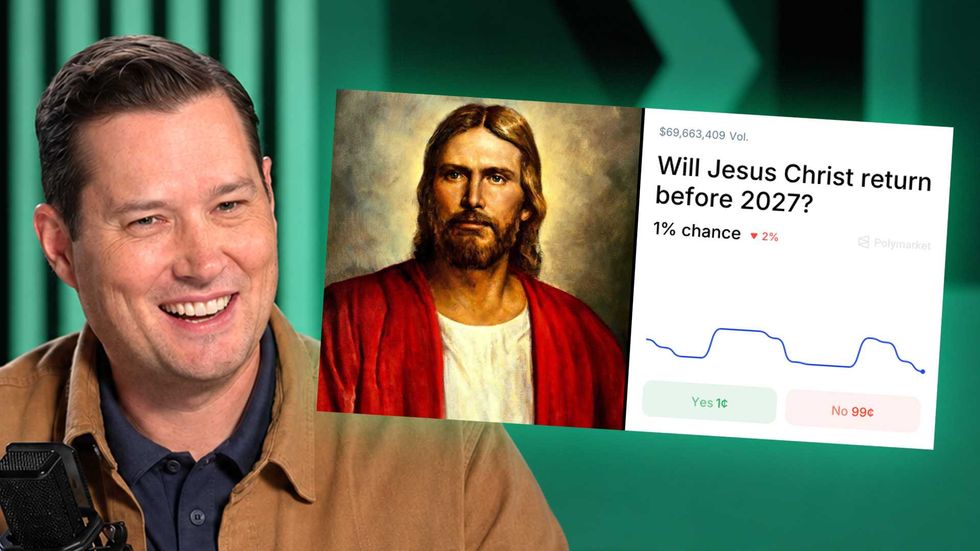
The culture has spent years demonizing masculinity.
asserted
culture → spend → masculinity
But preacher and activist John Amanchukwu says the real problem isn't men being too masculine.
asserted
men → say → ?
American culture has spent years telling men that masculinity is toxic.
asserted
masculinity → spend → men
But preacher, author, and activist John Amanchukwu and BlazeTV host Steve Deace believe the real problem isn't men who are too masculine — it's men who have abandoned the very virtues that make them men.
asserted
them → believe → virtues
“You can determine really the shape of a culture by the condition of its men.
asserted
You → determine → men
And you know, there’s this term going around today I completely reject called ‘toxic masculinity,’” Deace begins.
asserted
Deace → know → term
“I don’t think there’s any such thing as that,” he continues.
asserted
he → think → that
“I think it’s all male behavior that is not masculine.
asserted
that → think → ?
That that is what is toxic and that ultimately, to me, masculinity is defined by, I think, the mandate of three virtues: that you protect, you defend, and you provide, and that those are your three prime directives.
asserted
those → define → virtues
But as Amanchukwu points out, men often fall into traps that distract them from those responsibilities.
asserted
that → point → responsibilities
“They fall into pitfalls, you know,” he tells Deace.
asserted
he → fall → Deace
“Whether it’s trying to amass wealth, whether it’s the porn, whether it’s attention-seeking and wanting that side fling to make sure you still got it, right?”
asserted
you → try → it
Although “every man needs a moment to get a breather,” Amanchukwu warns that the wrong kind of escape “can be a trap that Satan uses to destroy us.”
asserted
Satan → need → us
Amanchukwu likens it to the biblical story of David at Ziklag, where his men returned from battle to find their city burned and their families taken captive.
asserted
families → liken → battle
“When they get back, they notice that there’s smokestacks coming from their city.
asserted
they → get → city
And they also see that their wives, their family, their children, their sons, their daughters have been kidnapped and taken away,” he explains.
asserted
he → see → ?
The men then became “angry with David” and wanted to “stone him.”
asserted
men → become → him
“They want to kill him because, you know, they figure that, ‘Hey, man, if we weren’t out fighting this battle, then we would have been here to defend the city and to protect our families,’” Amanchukwu says.
asserted
Amanchukwu → want → families
David sought the Lord's guidance, strengthened himself in God, and was told to pursue the captors and recover what had been taken.
asserted
what → seek → captors
“The story goes on to where David inquires of the Lord and what he should do, how he should respond, and then he ultimately encourages himself in the Lord, and God tells him to pursue and to fight and that he was going to reclaim everything that was lost,” he explains.
asserted
he → go → everything
“But there were a total of 600 men who were eligible to fight in that battle to reclaim their families.
asserted
who → be → families
But only 400 of the men were able to fight, because 200 of the men were too tired to fight,” he continues.
asserted
he → fight → men
“They were too wimpy to go a little bit further, to work a little bit harder, to dig a little bit deeper, to reclaim their own family.”
asserted
They → go → family
“To me, that’s toxic masculinity,” he adds.
asserted
he → ’ → me
To enjoy more of Steve's take on national politics, Christian worldview, and principled conservatism with a snarky twist, subscribe to BlazeTV — the largest multi-platform network of voices who love America, defend the Constitution, and live the American dream.
asserted
who → enjoy → dream
 The Aporia