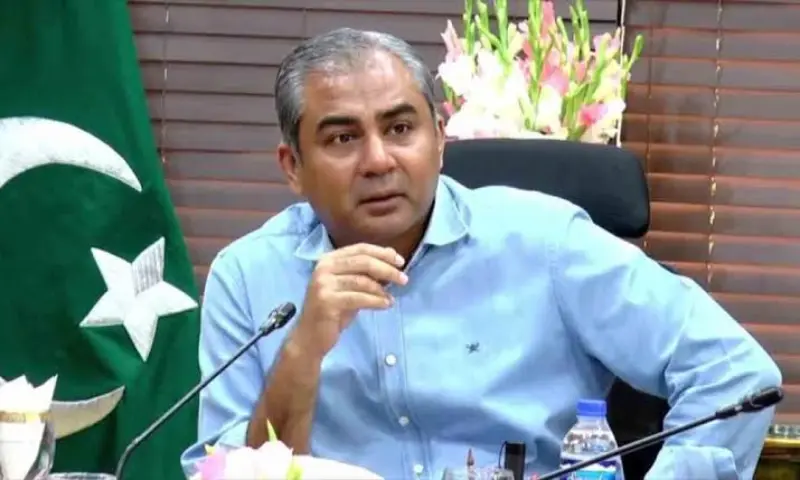
Federal minister Musadik Malik said on Sunday that any dialogue between Pakistan and India on terrorism must be “based on evidence”.
asserted
dialogue → say → evidence
Malik is in New Delhi on a three-day trip to attend the SCO Civilisational Dialogue Forum, making him the first Pakistani minister to visit the neighbour since former foreign minister Bilawal Bhutto-Zardari attended an SCO meeting in May 2023.
uncertain
Zardari → attend → May
Pakistan has repeatedly offered to hold talks with India to resolve outstanding disputes, including the water issue.
asserted
Pakistan → offer → issue
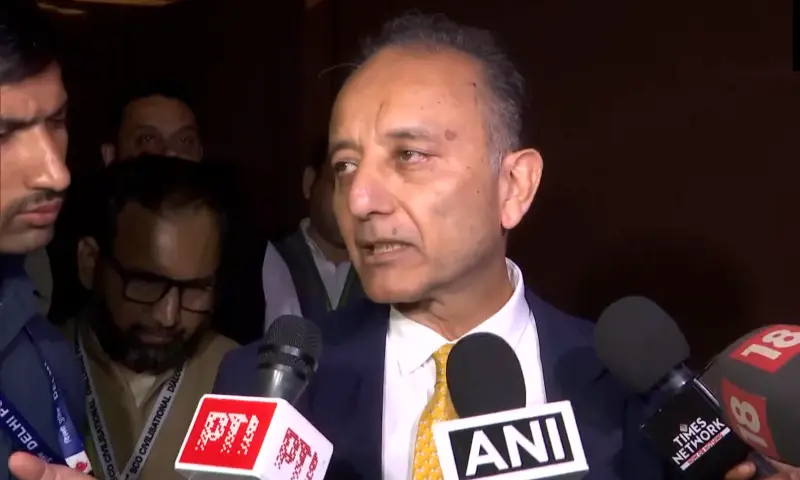
In video clips shared by India’s ANI news agency on Sunday, Malik responded to queries from Indian media and stressed that he had repeatedly presented Pakistan’s stance before the reporters.
“I am giving you a stable response that whenever discussions take place, they will be based on evidence, and they will certainly happen,” he affirmed, saying if New Delhi wanted a “lasting solution”.
asserted
Delhi → share → solution
“You must also have some issues, [though] our issues are much greater than yours, and we also need a lot of evidence […] Whenever dialogue takes place, it will be based on evidence,” the climate change minister reiterated.
asserted
minister → have → evidence
Malik said Pakistan had repeatedly stated that evidence relating to terrorism could be presented through both bilateral and multilateral forums.
uncertain
evidence → say → forums
“You may bring evidence; we also have evidence that we want to present,” he added.
uncertain
he → bring → that
India’s foreign minister had said in June 2024 that his country wanted to “find a solution to the issue of years-old cross-border terrorism” with Pakistan.
asserted
country → say → Pakistan
However, a military conflict between the neighbours last year has intensified tensions and escalatory rhetoric from India.
asserted
conflict → intensify → India
In May 2025, a four-day confrontation between Pakistan and India was sparked by an attack on tourists in occupied Kashmir’s Pahalgam, which New Delhi, without evidence, linked to Pakistan.
uncertain
Delhi → spark → Pakistan
Islamabad had strongly denied responsibility while calling for a neutral investigation.
asserted
Islamabad → deny → investigation
In another clip, Malik noted that India had invited a representative from Pakistan to attend the Shanghai Cooperation Organisation’s (SCO) Civilisational Dialogue Forum, a multilateral event.
asserted
India → note → Forum
You invited me to a specific forum; I am present before you.
asserted
I → invite → you
I answered all those questions you asked about this forum,” the minister said, remarking that he had conveyed the “voice of my heart” to the people across the region through the forum.
asserted
he → answer → forum
Malik stated, “You are today asking me questions for which you did not invite me.
asserted
you → state → me
When you invite me for that question, I will appear.
asserted
I → invite → question
However, you first ought to invite me and say ‘we want to speak bilaterally with you’.
asserted
we → invite → you
The minister was also asked about his remarks on the Indus Waters Treaty (IWT), but said he would comment on the matter when invited to do so.
asserted
he → ask → matter
“You have currently invited me to speak on topics about which I have already spoken, that when temperatures rise, climate is destroyed, Glofs happen.
asserted
Glofs → invite → which
Glofs and glaciers are blind, they do not know whether to fall on the right or the left,” he said, highlighting the shared threat climate change poses to both neighbours.
asserted
change → know → neighbours
He further said, “You have called me for culture and civilisation [discussions].
asserted
You → say → discussions
I am your guest, you are my host […] You have asked me the same question a 100 times and I have responded to it a 100 times.”
asserted
I → ask → it
In his remarks at the SCO forum on Saturday, Malik had termed climate change an “enemy” of civilisations and pointed out its impact on South Asian countries that bore the brunt of climate destruction.
asserted
that → term → destruction
Water and the IWT remain a contentious issue between Pakistan and India, following New Delhi’s unilateral abeyance of the accord in April last year after the Pahalgam attack, which was followed by the four-day military conflict between the two sides.
asserted
which → remain → sides
Following India’s move, Pakistan termed any attempt to suspend its water share an “act of war”, noting the IWT had no provision for unilateral suspension.
asserted
IWT → follow → suspension
It later argued that New Delhi’s action was a violation of the 1969 Vienna Convention on the Law of Treaties.
asserted
action → argue → Treaties
Backing Islamabad’s stance, the Permanent Court of Arbitration (PCA) on Aug 31 ordered New Delhi to uphold the IWT, declaring that the treaty remained fully in force, as India had no justification for ending or suspending the agreement.
asserted
India → back → agreement
The IWT, brokered by the World Bank in 1960, allocates the three western rivers — Indus, Jhelum and Chenab — largely to Pakistan, and the three eastern rivers — Ravi, Beas and Sutlej — to India.
asserted
IWT → broker → India
The treaty has survived wars, crises, and political tensions for more than six decades and is considered a rare example of durable water-sharing cooperation between the two neighbours.
asserted
treaty → survive → neighbours
 The Aporia