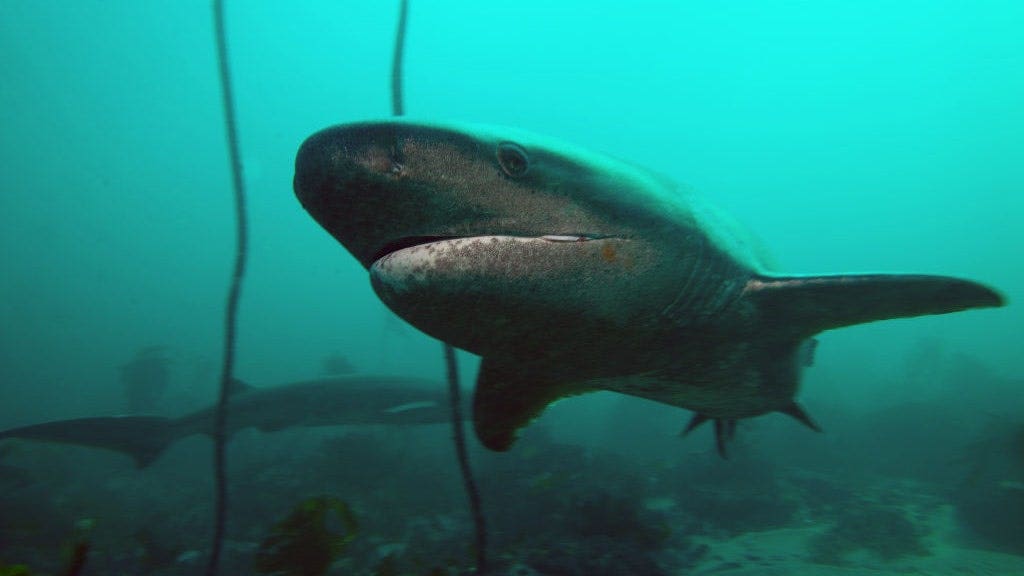
A video making the rounds on social media Sunday shows a massive deep-water shark getting up close and personal with a group of scientists inside a submersible.
asserted
shark → make → submersible
And when I say up close and personal, I mean it.
asserted
I → say → it
In the footage, the shark slowly circles the vessel, seemingly just as curious about its human visitors as they are about her.
asserted
they → circle → her
At one point, she swims right up to the viewing window and presses her snout against the glass.
asserted
she → swim → glass
The encounter actually happened back in June 2019, roughly 1,700 feet beneath the surface of the Atlantic Ocean near the Bahamas.
asserted
encounter → happen → Bahamas
The shark is a bluntnose sixgill, a deep-water species that can grow up to 20 feet long.
asserted
that → grow → ?
Researchers estimated that the particularly inquisitive female in the video measured about 16-17 feet.
asserted
female → estimate → feet
Scientists got more than they bargained for during deep-sea shark expedition
The encounter occurred during an expedition by OceanX, an ocean exploration organization working alongside marine scientists to study the bluntnose sixgill shark.
asserted
encounter → get → shark
The team traveled to the deep waters of Exuma Sound aboard the research vessel Alucia, hoping to accomplish something that had never been done before: attach a satellite tracking tag to a sixgill shark without bringing it to the surface.
asserted
that → travel → surface
Previously, researchers studying these animals had to capture them and haul them up from the depths.
asserted
researchers → study → depths
But that process can stress the sharks and disrupt their natural behavior, making it difficult to collect reliable data about how they actually live.
asserted
they → stress → data
Using OceanX's three-person submersible, Nadir, the team descended into the darkness with roughly 100 pounds of bait to attract the sharks.
asserted
team → use → sharks
After several unsuccessful attempts involving bad weather, equipment problems and even a grouper that interfered with the tagging process, the researchers finally got their chance on June 29.
asserted
researchers → involve → June
According to the Florida Museum of Natural History, scientist Gavin Naylor successfully attached a satellite tag to a male sixgill shark more than 1,700 feet underwater.
uncertain
Naylor → accord → shark
It was the first time scientists had successfully tagged one at depth in its natural habitat.
asserted
scientists → tag → habitat
But the team also encountered several other sharks during the dive, including the enormous female that stars in the viral video.
asserted
that → encounter → video
"She was studying us," Naylor told the Florida Museum.
asserted
Naylor → study → Museum
"It was delightful for me to see a shark being curious.
asserted
shark → see → ?
We'd be arrogant to think we were the only ones doing the evaluating."
Prehistoric giants are just casually lurking in the deep
asserted
giants → think → deep
Bluntnose sixgill sharks are among the largest predatory sharks in the ocean, although most people will never see one.
asserted
people → see → one
That's because these animals spend much of their lives hundreds or even thousands of feet below the surface.
asserted
animals → spend → surface
Some have been documented at depths approaching 6,500 feet.
asserted
Some → document → feet
They're also pretty much living fossils.
asserted
They → live → ?
According to the Florida Museum, sixgills closely resemble sharks that swam the oceans roughly 200 million years ago.
uncertain
that → accord → oceans
They spend their days hunting fish, squid and other marine life, occasionally scavenging larger carcasses.
asserted
They → spend → carcasses
And considering how little we still know about what goes on in the depths of our oceans, it's pretty fascinating to think about what else might be lurking down there.
Fascinating and utterly terrifying.
Love all things fishing and outdoors?
uncertain
what → consider → things
 The Aporia