Music was not something Ian Meldrum, who has died aged 83, ever just listened to.
asserted
who → die → something
Left on his own as a child, raised primarily by his grandmother, he would crank up the soundtracks of West Side Story, Oklahoma! or even a piece of opera on the family gramophone and madly flail away with a makeshift baton.
asserted
he → leave → baton
At the first Melbourne concert by the Beatles in June 1964, he and friend Ronnie Burns, a rising pop star, were tossed out of Festival Hall by over-zealous security men just before the final song, for screaming too loudly, and spent the duration of Long Tall Sally pounding on the back door in a tearful state of near-collapse.
asserted
he → rise → collapse
Shortly after, Kiwi chart sensation Dinah Lee, taken home for dinner one night by Burns and introduced to housemate Meldrum, was astonished to encounter the 17-year-old hiding, quivering and barely coherent under a bed.
asserted
Lee → take → bed
Over all the years of public life, Ian ‘Molly’ Meldrum remained in the thrall of music and its practitioners.
asserted
Meldrum → remain → music
Wearing a great many hats – cub reporter, television mimer, artist manager and publicist, record producer, television presenter and talent co-ordinator, disc jockey, magazine columnist, product endorser, government adviser, record label operator, television producer and confidant to the stars – the former Protestant altar boy became a highly visible part of Australian life, celebrated for his gushing effervescence and his ceaseless championing of Australian music.
Ian Alexander Meldrum was born on January 29, 1943, in Orbost in eastern Victoria, the son of Robert Meldrum and his wife Isobel (nee Geer).
It was while juggling law studies at the University of Melbourne with a job as an ace pop reporter on plucky Go-Set magazine that Meldrum covered the walk-out of the miming stars of the Kommotion pop television show and found himself recruited as a replacement.
asserted
himself → wear → replacement
The name Molly was bestowed by veteran DJ and fellow Go-Set contributor Stan Rofe.
asserted
Molly → bestow → DJ
It stuck, as a household name that rolled easily off the tongue.
asserted
that → stick → tongue
In time, it would come tumbling from the lips of Madonna, David Bowie, Elton John, Jon Bon Jovi, Kylie Minogue, Rod Stewart and Michael Jackson, among many others of note.
asserted
it → tumble → note
After travelling to London with popular chart entity The Groop and landing a short stint working within the Beatles’ Apple organisation at the end of the 1960s (when he gained the scoop of John Lennon declaring he’d left the Beatles), Meldrum was ready to stop promoting other people’s music and start creating his own.
He produced a hit for the Melbourne group Somebody’s Image and persuaded vocalist Russell Morris to pursue solo fame with a song by Johnny Young.
asserted
He → travel → Young
Before EMI Records had realised what was happening, Meldrum had spent $10,000 of their money (sufficient budget for two to three albums at that time) recording a wizard’s brew of swirling electronic noise and mesmerising chants – a spectacular six-minute epic that the distraught record company presumed to be a B-side.
asserted
company → realise → noise
Meldrum was sacked from the project but refused to let go and when a corporate decision was made to release the single in Victoria to cut costs, he hit the road to Sydney with Morris to persuade influential Harbourside disc jockeys to air the song.
asserted
he → sack → song
In April 1969, The Real Thing was No.1 around Australia, and by the end of the year, the pair had been awarded a rare gold disc.
asserted
pair → award → disc
Over his career, Meldrum produced recordings when the mood took him, his most successful endeavours being Smiley by Ronnie Burns, Day By Day by Colleen Hewitt, Don’t Fall In Love by the Ferretts (which he produccd under the alias Willie Everfinish) and I Like It Both Ways by Supernaut.
asserted
I → produce → Supernaut
“It’s the only talent I may have in my life,” he once said.
uncertain
he → ’ → life
“As a record producer, I always knew what people wanted to listen to, even though I was often faking it technically.
asserted
I → know → it
Meanwhile, the law dimmed as a pursuit as the young Meldrum became immersed in pop and the energy of the times.
asserted
Meldrum → dim → times
The front cover of the September 16, 1972, issue of Go-Set carried the headline “Bob Hawke Talks to Ian Meldrum – A Time To Change”.
asserted
Hawke → carry → Meldrum
The meeting with the ACTU leader in a pub and at the Trades Hall, was initiated by Meldrum against the wishes of the editor, who thought politics incompatible with pop.
asserted
politics → initiate → pop
In London, Meldrum had been arrested at the “Battle of Grosvenor Square” in March 1968, when police and protesters fought outside the American embassy in London.
asserted
police → arrest → London
“I hated the Vietnam War,” he would later say.
asserted
he → hat → War
The making of Meldrum as a national figure was the arrival in 1975 of the ABC television program Countdown, on which he’d landed the job of talent co-ordinator.
asserted
he → land → ordinator
He was not the compere, a role which fell to guest hosts, but he did seem to be always there, verbally stumbling over himself, ever exhorting “do yourself a favour” as he thrust this and that record or group forward for attention.
asserted
he → fall → attention
“I know nobody believes this but I’ve never been comfortable about being on television,” he would insist.
asserted
he → know → television
“In the early days of Countdown , I was told I had to do a rock report and I said no.
asserted
I → tell → report
In the end, it came down to paying the rent.
asserted
it → come → rent
The ABC employed me and they wanted a rock report.
asserted
they → employ → report
That’s how Humdrum happened.”
asserted
Humdrum → ’ → ?
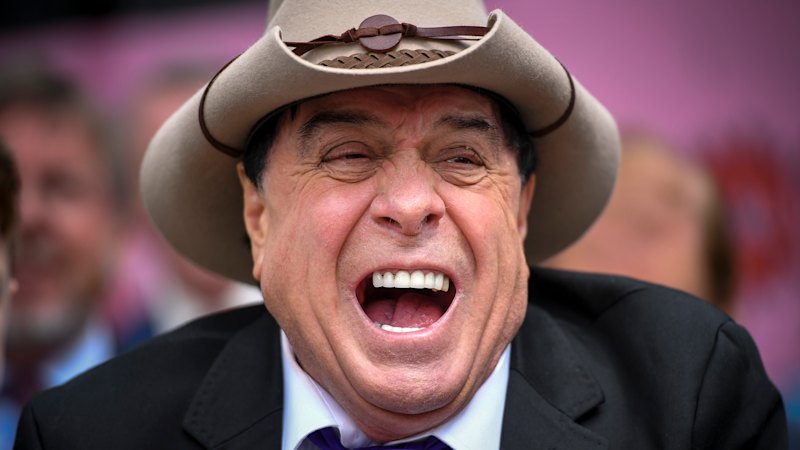
Countdown held court until July 19, 1987, followed by the 1986 Countdown Awards, at the end of which Meldrum appeared wearing a Stetson hat, which he doffed to reveal a shaved head, in imitation of Peter Garrett of Midnight Oil, who had steadfastly refused to appear on the show.
asserted
who → hold → show
Like the nickname, the hat stuck.
asserted
hat → stick → nickname
Many things about Molly Meldrum stuck, including his fanatical devotion to the St Kilda AFL team and, later, the Melbourne Storm in the NRL.
asserted
things → stick → NRL
A star all over again on television’s weekly Hey Hey It’s Saturday program, he had the ear of politicians and the pulse of the country.
asserted
he → ’ → country
He would be crowned King of Moomba on one hand and renowned for his fascination with the oft-visited Egypt and his vast collection of artefacts of the ancient realm.
asserted
He → crown → realm
Far brighter and more aware of global affairs that was realised, Meldrum managed the not-inconsiderable feat of winning half a million dollars for charity on Who Wants To Be A Millionaire?
asserted
Who → realise → charity
In 1986, the year after he hosted the Australian leg of the global telecast Live Aid, he was made a member of the Order of Australia for “service to the fostering of international relief and to youth”.
asserted
he → host → youth
In 1993, the Australian Recording Industry Association bestowed a Special Achievement ARIA award upon him.
asserted
Association → bestow → him
Though there was often much that merited it, Australia was pleased to never take Meldrum too seriously, accounting for why the country felt so comfortable with him for so very long.
asserted
country → be → him
He knew he was charmed.
asserted
he → know → ?
Booked onto the Air India flight that crashed into the Irish Sea in 1985, he was one of the few no-shows.
asserted
he → book → shows
“Rod Stewart and his old manager Billy Gaff after a lot of argument got me to stay over for a dinner party,” he would say afterwards.
asserted
he → get → party
…and 10 more, not listed.
 The Aporia