Photo via Times of India

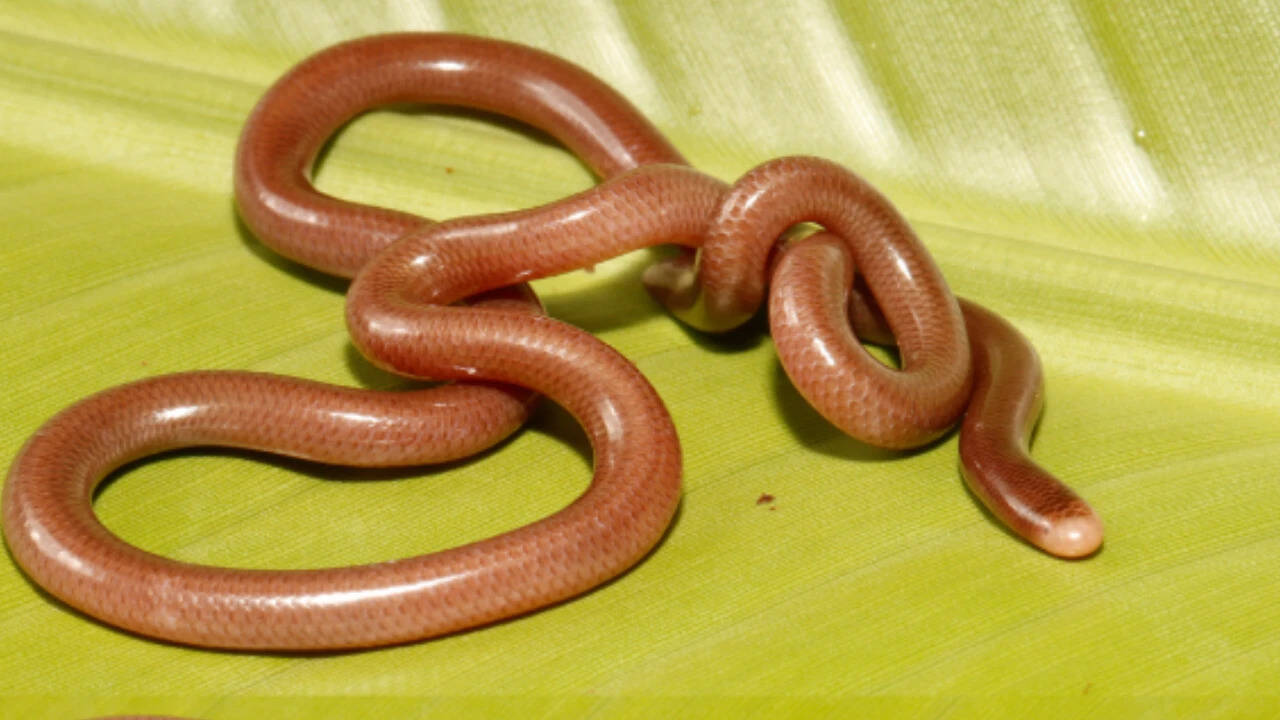
A new snake found near the China-Nepal border looks like an earthworm

Read the original at Times of India ↗
Cite

TOI Science Desk. (2026, November 22). A new snake found near the China-Nepal border looks like an earthworm. Times of India. https://timesofindia.indiatimes.com/science/wildlife/a-new-snake-found-near-the-china-nepal-border-looks-like-an-earthworm-and-has-eyes-hidden-beneath-its-scales-named-indotyphlops-gyirongensis-it-spends-most-of-its-life-burrowing-underground/articleshow/136055672.cms

Dated from the outlet's own feed. Check the original for its byline.

Times of India · collected 2026-11-22 · by TOI Science Desk

Quick Summary

Researchers have identified a new species of blind snake, named Indotyphlops gyirongensis, near the China-Nepal border. The discovery was made after examining a single female specimen collected in Gyirong Town, Xizang Autonomous Region, in August 2025. This snake, described in a paper published in ZooKeys on September 17, 2026, is characterized by its slender earthworm-like appearance and measures 265 millimeters in length with a body diameter of 3.5 millimeters. Scientists used physical examination and genetic analysis to confirm that it belongs to a previously unknown species.
Written by AI on 2026-11-23, from this article's own text only (the story summary below draws on all the coverage).

AI analysis

Story summary

Researchers have discovered a new species of blind snake near the China-Nepal border, published in the scientific journal ZooKeys on September 17, 2026. The snake, named Indotyphlops gyirongensis, was found in Gyirong Town, Gyirong County, in China's Xizang Autonomous Region. Scientists identified the species through a combination of physical examination and molecular and genetic analysis after studying a single specimen. The blind snake has a slender, earthworm-like appearance with eyes concealed beneath its scales, making identification challenging due to its underground lifestyle. The discovery highlights the importance of further research to establish how this species differs from other documented species.

Written for “New Earthworm-Like Snake Discovered” on 2026-11-23, grounded in this article and the 0 other(s) covering the same event.

Compared with similar articles

Nothing to compare against. No article is close enough to this one for the pipeline to have linked or judged the pair.

Story

New Earthworm-Like Snake Discovered
Science · 1 article(s) covering the same event.
How this article was measured signals, leaning charts, publisher record, byline, topics and claims

Signals How these are calculated →

Claims extracted
29
sentences that state something as happening or true
Uncertain
10%
3 of 29 hedged ("reportedly", "may", "according to")
Leaning
not political
takes no side on a contested political question
Publisher signals
58/100
Times of India's corrections and hedging, across everything collected from it. Not a measure of accuracy.
Outlets on this story
1
Science
Same framing elsewhere
1
articles that frame the event the way this one does
Analyzed 2026-11-23 · how these are computed

How this is being covered How these are calculated →

Article leaning vs. publisher reliability
Source leaning vs. consistency

Publisher

Times of India · 5630 article(s) · 8 correction(s) detected
Running correction rate · 8 correction(s)

Who wrote this

TOI Science Desk
345 article(s) here · 1 carrying a prediction
They found that temperature may have influenced when the snakes arrived, entered their shelters, and left in warmer weather.
Initially thinking it might be a kingbird, Jones stopped his car and reached for his binoculars, hoping to get a closer look.
It is a snake so distinct that it differs from any that you may have typically come across.
A string of amber flashes gives it away The first sighting was recorded on May 15, 2026, when an observer named Aljoscha Nern spotted male similar fireflies flashing over a meadow in Virginia.
What might look like a particularly crowded beach day is, in fact, a matter of survival for one of the Arctic's largest marine mammals.
Its vertebrae could have belonged to a prehistoric snake, an early relative of crocodiles or a young dinosaur.
The world today is such that we are able to track everything, from the flight of our loved ones to how long it would take for our food to arrive.
Under the project, the California Department of Fish and Wildlife along with the Yosemite Rivers Alliance will carve out four acres of new side channels and reconnect another sixteen acres of historic floodplain to the river.
They will be coming in raw excavated form with a lot of work still remaining to be done on them.
And while most people might hesitate before bringing home one rescued animal, Cramer once found herself looking after more than 600 baby turtles at once.
Wire or desk byline, not an individual reporter.
Also by TOI Science Desk
Nothing else under this byline is closely related to this article, so these are simply their most recent.
All 345 articles by TOI Science Desk →

Topics

China Gyirong Town Nepal Xizang Autonomous Region ZooKeys

Subjects

China GPE · 2× Bing Lyu PERSON · 1× Gyirong Town GPE · 1× Nepal GPE · 1× Qin Liu PERSON · 1× Songwen Tan PERSON · 1× Van Wallach PERSON · 1× Xizang Autonomous Region GPE · 1× Zhichao Zhao PERSON · 1× ZooKeys ORG · 1×

Narrative

Researchers have to establish how it differs from species that have already been documented, and this becomes especially important with blind snakes, whose broadly similar body shapes can make identification difficult.
framing: assertive · carried by 1 article(s) · first seen 2026-11-23
It is a snake so distinct that it differs from any that you may have typically come across.
2026-11-23 · Times of India
A new snake found near the China-Nepal border looks like an earthworm · assertive framing

Claims (29 extracted, 3 hedged)

All that is nestled underground comes to the surface one day. asserted
that → nestle → surface
And thus, the newly described blind snake species from the Qinghai-Xizang Plateau in China is one such animal, with its slender, earthworm-like appearance and eyes concealed beneath its scales. asserted
appearance → describe → scales
It is a snake so distinct that it differs from any that you may have typically come across. uncertain
you → differ → that
, researchers have now officially identified a new species of blind snake named Indotyphlops gyirongensis. asserted
researchers → identify → gyirongensis
The discovery was made following an examination of a single specimen collected in Gyirong Town, Gyirong County, in China's Xizang Autonomous Region, close to the Nepal border. asserted
discovery → make → border
The researchers combined physical examination with molecular and genetic analysis to establish that the specimen belonged to a previously undescribed species. asserted
specimen → combine → species
The study was conducted by Bing Lyu, Songwen Tan, Zhichao Zhao, Van Wallach, Qin Liu and Peng Guo. asserted
study → conduct → Lyu
A snake that spends its life out of sight With its largely underground lifestyle, the blind snake is a rather intriguing species. asserted
snake → spend → lifestyle
Unlike the snakes commonly encountered in grasslands, forests or around human settlements, these small, slender reptiles are adapted to moving through soil and leaf litter. asserted
reptiles → encounter → soil
Their eyes are greatly reduced and covered by scales, which means that they do not rely on sight in the same way as many other snakes. asserted
they → reduce → snakes
The blind snake has now been proposed as the Gyirong blind snake, with its scientific name referring to the town where it was found. asserted
it → propose → town
The specimen was collected in August 2025 at an elevation of approximately 2,262 metres and was discovered beneath a stone. asserted
specimen → collect → stone
It was an adult female measuring 265 millimetres in length, with a body diameter of just 3.5 millimetres at its midpoint. asserted
It → measure → midpoint
Its tail measured 7.5 millimetres, making the animal particularly slender in proportion to its overall length. asserted
animal → measure → length
The collection site itself offers an interesting glimpse into the kind of environment in which the species was found. asserted
species → offer → which
According to the researchers, the surrounding area is characterised by evergreen broad-leaved forest, with deep humus and a thick layer of fallen leaves, an environment where animals can rather easily remain concealed beneath the surface. uncertain
animals → accord → surface
Identifying a new species is not simply a matter of finding an animal that looks unfamiliar. asserted
that → identify → animal
Researchers have to establish how it differs from species that have already been documented, and this becomes especially important with blind snakes, whose broadly similar body shapes can make identification difficult. asserted
identification → have → snakes
In this case, the researchers examined several physical characteristics, including the arrangement of scales, body measurements, head shape and coloration. asserted
researchers → examine → scales
One of the distinguishing features of Indotyphlops gyirongensis is its light-coloured head cap, which sets it apart from several related species. asserted
which → distinguish → species
It also has 18 rows of smooth, glossy scales around its body and a distinctive arrangement of overlapping scales around the upper lip, described by the researchers as a T-V pattern. asserted
It → have → pattern
While these characteristics may appear rather technical at first, they are important in distinguishing one species from another, particularly when the animals being compared share such similar appearances. uncertain
animals → appear → appearances
The researchers also used genetic analysis to establish the specimen's relationship with other members of the Indotyphlopsgenus. asserted
researchers → use → Indotyphlopsgenus
Their findings placed it within this group while indicating a considerable genetic difference from its closest relatives. asserted
findings → place → relatives
The concluding analysis further revealed that this species forms a distinct evolutionary lineage. asserted
species → conclude → lineage
A discovery that leaves more questions While the discovery of the snake is remarkable, there are multiple things the researchers are yet to ascertain. asserted
researchers → leave → snake
Its overall distribution across the region, population size, dietary habits and more are not known. asserted
distribution → know → region
Moreover, understanding this snake species presents a challenge because of its tendency to remain underground, and therefore, its evolutionary history has not yet fully documented. asserted
history → understand → tendency
Lastly, this discovery highlights how much of wildlife diversity remains misunderstood, undocumented or simply concealed in plain sight, potentially opening up a plethora of curious questions. asserted
much → highlight → questions

Give feedback · no sign-in needed

No sign-in needed for now. Your note is sent without a name, so it cannot be answered.

History Support