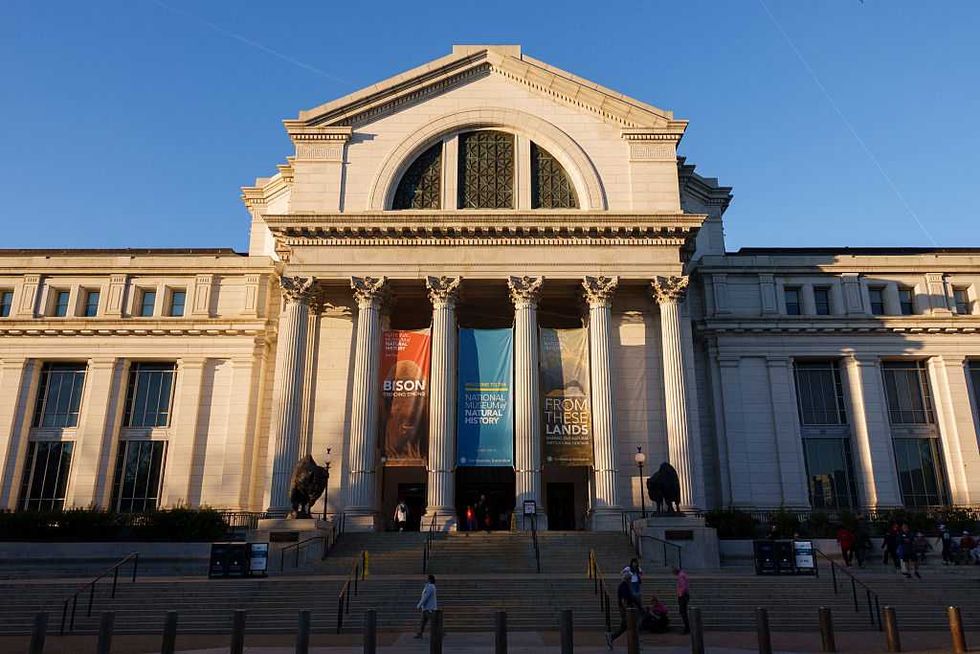
The once-great cultural institution has been corrupted by years of ideological leftism, writes John Fonte.
asserted
Fonte → corrupt → leftism
Lonnie G. Bunch III, who became Secretary of the Smithsonian Institution in June 2019, will retire at the end of this year.
asserted
who → become → year
One month before being sworn in, he told a New York Times interviewer his desire to help the Smithsonian “transform America.”
asserted
Smithsonian → swear → America
Despite his avuncular, friendly, and personal style that fooled some, Bunch has governed as a hard-core partisan of the progressive left.
asserted
Bunch → fool → left
During his tenure, he has advanced a strong progressive ideological agenda.
asserted
he → advance → agenda
The Smithsonian Magazine reported on “Bunch’s insistence that the Smithsonian support the New York Times 1619 Project,” which sought to “reframe the country’s history, understanding 1619 (the beginning of slavery in America, rather than 1776) as our true founding.”
asserted
which → report → founding
Bunch, Hartig, and their allies clearly repudiate American history, culture, principles, and people.
asserted
Bunch → repudiate → history
The 1619 Project asserted many falsehoods, yet Bunch “took pains to ensure the Smithsonian’s name would be publicly associated with it.”
asserted
name → assert → it
He expressed his desire for “the Smithsonian to legitimize important issues, whether it’s 1619 or climate change.
asserted
it → express → issues
Everybody…saw that the Smithsonian had its fingerprints on [the 1619 Project].
asserted
Smithsonian → see → Project
In June 2020 during the George Floyd riots, Secretary Bunch told the Atlantic, “I’ve always shown that protest is the highest form of patriotism.”
asserted
protest → tell → patriotism
Regarding the riots, he noted, “It is really about systemic racism throughout, not just the police department but many parts of the American system.”
asserted
It → regard → system
Bunch even tried to justify the rampant law-breaking that was a hallmark of the Floyd protests across the nation: “Well, that kind of protest is really one of the few ways the voiceless feel they have power.
asserted
they → try → power
And while I am opposed to violent protests personally, I understand that frustration sometimes pushes you over the edge.”
asserted
frustration → oppose → edge
Apparently for Bunch, $2 billion in damages, thousands of small businesses ransacked, countless livelihoods destroyed, and the deaths of two dozen Americans are simply collateral damage to the “clarion call for change.”
asserted
deaths → ransack → change
Bunch’s left-progressive agenda was implemented at the Smithsonian’s National Museum of American History under the direction of one of his chief lieutenants, Anthea Hartig, formerly president of the Organization of American Historians.
asserted
agenda → implement → Historians
Like Bunch, Hartig stated that she saw history as a “prime tool of social justice connecting…research and scholarship to activism and advocacy.”
asserted
she → state → activism
She declared that museum professionals would have “to figure out” how “we’re going to problematize” the 250th anniversary of the signing of the Declaration of Independence.
asserted
we → declare → Independence
Upon becoming director of the NMAH, Hartig instituted a plan that directed staff, “whatever the topic,” to address seven “core issues of our time”: race/identity, gender/sexuality, climate change, immigration/migrations, economic inequality, technological change, and nationalism/globalism.
asserted
topic → become → time
These areas are taught from a left-progressive viewpoint.
asserted
areas → teach → viewpoint
For example, race/identity emphasizes the horrors of “whiteness”; gender/sexuality highlights transgenderism; and immigration/migration advocates for illegal aliens.
asserted
migration → emphasize → aliens
The GOP lost young men.
asserted
GOP → lose → men
American Ascent wants to win them back.
asserted
Ascent → want → them
DesignRage/iStock/Getty Images
In 2019, under Hartig’s leadership, NMAH staff co-authored a document of more than 200 pages, “Museums as a site for Social Action Toolkit.”
asserted
staff → co → Toolkit
Its explicit goal was to “truly transform the museum space” that “privileges dominant Western ideals of race, class, and gender.”
asserted
that → transform → race
The toolkit informs American History Museum staff that these “Western ideals” are
linked with white supremacy, hetero-patriarchy, abuse of labor, colonization, imperialist theft of art and artifacts, destruction or absencing of alternative ways of interpreting or representing art and artifacts, structural racism and other oppressions.
asserted
ideals → inform → art
Indeed, the toolkit tells readers that character traits such as objectivity, individualism, a sense of urgency, and worship of the written word are indicative of “whiteness” and “white supremacy culture.”
asserted
traits → tell → whiteness
The NMAH has worked with illegal alien activists and advocated for their unconditional amnesty and citizenship.
asserted
NMAH → work → amnesty
A page on the museum’s website (since deleted) compared the illegal aliens’ demand for citizenship to the emancipation struggle of the anti-slavery movement and the civil rights movement’s efforts to end segregation.
asserted
page → delete → segregation
Museum staff have even traveled to Mexico City and conducted sympathetic interviews with deported illegal aliens, presenting them in a heroic light and promoting their demands for American citizenship.
asserted
staff → travel → citizenship
Staff from the Smithsonian Latino Museum Studies Program went to North Carolina to conduct favorable interviews with pro-illegal alien activists who had helped defeat a pro-enforcement sheriff in a local election.
asserted
who → go → election
On July 4, 2026, the White House Domestic Policy Council issued a scathing report denouncing NMAH’s leadership for instituting an “ideological capture” of the museum’s mission.
asserted
Council → issue → mission
Instead of “straightforward historical education and scholarship,” the museum has moved “towards an extreme political activism that seeks to transform our country.”
asserted
that → move → country
After the report was released, two House committees held hearings highlighting the Smithsonian’s political activism and ideological partisanship under Bunch and Hartig’s leadership.
asserted
committees → release → leadership
A Battle of regimes
As Angelo Codevilla famously put it, we are in a “cold civil war.”
asserted
we → put → war
We are in a conflict over ideological hegemony: Whose principles and ideas will prevail in American society?
asserted
principles → prevail → society
The Smithsonian is but one front in an all-encompassing philosophical-cultural struggle.
asserted
Smithsonian → encompass → struggle
Throughout history, leading political philosophers of all persuasions — from Aristotle to Gramsci to Italian elitism theorists Gaetano Mosca and Vilfredo Pareto to American conservative thinkers Harry Jaffa and Willmoore Kendall — have recognized that every regime has a core set of prevailing principles, ideas, values, and orthodoxies that ultimately determine the way of life of a people.
asserted
that → lead → people
Bunch, Hartig, and their allies clearly repudiate American history, culture, principles, and people.
asserted
Bunch → repudiate → history
They claim to want America to “live up to its ideals,” but their tendentious overview of our country’s past and contempt for how the American people have lived suggests otherwise.
uncertain
people → claim → past
…and 22 more, not listed.
 The Aporia