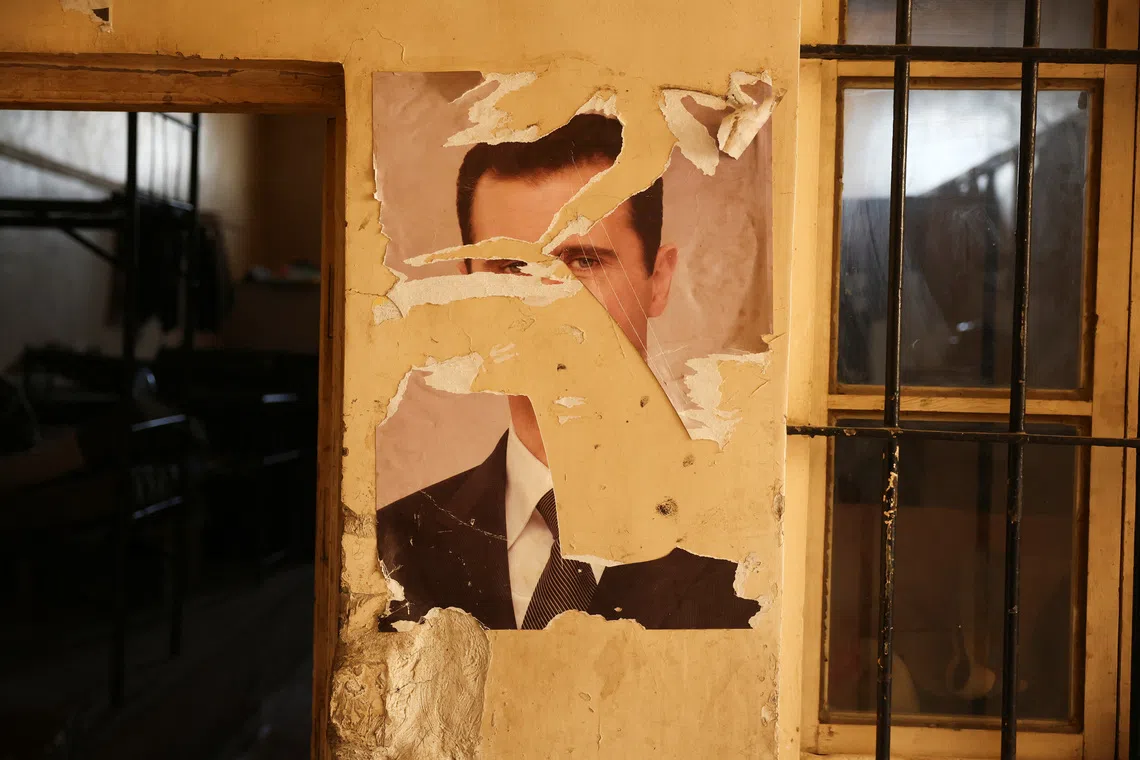
Photo via The Guardian

US court sentences ex-Syrian official who ran notorious ‘punishment wing’ to 60 years

Read the original at The Guardian ↗
Cite

Speri, A. (2026, September 18). US court sentences ex-Syrian official who ran notorious ‘punishment wing’ to 60 years. The Guardian. https://www.theguardian.com/us-news/2026/sep/17/court-sentence-ex-syrian-official

Dated when The Aporia collected the article, usually within hours of publication. Check the original for its exact date and byline.

The Guardian · collected 2026-09-18 · by Alice Speri
Content note This article describes violence described in detail.

Quick Summary

A US federal court in Los Angeles sentenced Samir Ousman al-Sheikh, a former Syrian official who oversaw torture at the Adra prison's "Wing 13" from 2005 to 2008, to 60 years in prison. Al-Sheikh, 73, was convicted of torture and lying on immigration forms after moving to the US in 2020. This is the most severe punishment a foreign court has handed down to an official from Syrian President Bashar al-Assad’s regime. Judge Hernan D Vera described the conduct as "unimaginably cruel." Al-Sheikh served as governor of Deir Ez-Zour province during violent protests and was arrested in July 2024 on immigration fraud charges, with additional torture-related charges later filed.
Written by AI on 2026-09-18, from this article's own text only (the story summary below draws on all the coverage).
See how they differ ↓

AI analysis

Story summary

On September 18, a U.S. federal judge in Los Angeles sentenced Samir Ousman Alsheikh, a former Syrian government official, to 60 years in prison for his involvement in torturing prisoners at the Adra Prison near Damascus from approximately 2005 to 2008. Alsheikh was found guilty of conspiracy to commit torture and three counts of torture against political dissidents under President Bashar al-Assad's regime, as well as lying on U.S. immigration forms to obtain a green card and attempt naturalization. Judge Hernán Vera described the crimes as "heinous" and "unimaginably cruel." Alsheikh oversaw the notorious "Wing 13," where detainees were subjected to severe abuse through surveillance cameras while he watched, according to testimony. This conviction marks the most significant punishment handed by a foreign court to an Assad regime official present in person, highlighting international efforts to hold human rights violators accountable.

Written for “Syrian Official Sentenced For Torture” on 2026-11-21, grounded in this article and the 5 other(s) covering the same event.

How they differ

6 outlets covered “Syrian Official Sentenced For Torture”.

What each outlet says

One AI summary per outlet of its latest article on this story, written from that article alone and checked against it. Open the article for the outlet's own words.

The GuardianThis outlet18 Sep

A US federal court in Los Angeles sentenced Samir Ousman al-Sheikh, a former Syrian official who oversaw torture at the Adra prison's "Wing 13" from 2005 to 2008, to 60 years in prison. Al-Sheikh, 73, was convicted of torture and lying on immigration forms after moving to the US in 2020. This is the most severe punishment a foreign court has handed down to an official from Syrian President Bashar al-Assad’s regime…

US court sentences ex-Syrian official who ran notorious ‘punishment wing’ to 60 years (this article)
Toronto Star17 Sep

Samir Ousman Alsheikh, a former Syrian military official, is set to be sentenced this Thursday by a federal judge in Los Angeles for his role in torturing prisoners at the Adra Prison during President Assad's regime from around 2005 to 2008. Earlier this year, a jury convicted him of one count of conspiracy to commit torture and three counts of torture. The potential sentence could span several decades.

Former Syrian official convicted of torture under Assad faces sentencing in the US →
The Straits Times18 Sep

A US federal judge sentenced Samir Ousman Alsheikh, a former high-ranking official under Syria’s ousted president Bashar al-Assad, to 60 years in prison on September 17 for his role in prisoner torture at Adra Prison from 2005 to 2008. Convicted of conspiracy and four counts of torture, among other charges, Alsheikh was the highest-ranking Assad-era official tried outside Syria according to US prosecutors.

Assad-era Syrian official jailed for 60 years by US court →
Al Jazeera18 Sep

A former Syrian military official, Samir Ousman Alsheikh, was sentenced to 60 years in a US prison for torturing prisoners while overseeing Syria’s Adra Prison from 2005 to 2008. The conviction stems from his role in systematic torture and abuse of detainees aimed at suppressing political dissent during the Assad regime. Testimonies during his trial detailed severe forms of torture, including prolonged suspension…

Former Assad officer sentenced to 60 years in US for torture →
The Hindu18 Sep

A former Syrian government official, Samir Ousman Alsheikh, was sentenced to 60 years in prison by a U.S. federal court on charges of torture and conspiracy related to his role at Adra Prison under President Bashar al-Assad from 2005 to 2008. The sentencing occurred on September 18, 2026, after Alsheikh was convicted earlier this year in Los Angeles for his involvement in prisoner abuse meant to suppress opposition…

Assad-era Syrian official jailed for 60 years by U.S. court →
Los Angeles Times19 Sep

A federal judge in California sentenced Samir Ousman Alsheikh, a former Syrian prison warden, to 60 years in prison for torturing inmates and committing visa fraud. The sentence was handed down on Thursday by Judge Hernán Vera after Alsheikh’s March conviction on multiple charges including conspiracy to commit torture and visa fraud. Prosecutors presented evidence that Alsheikh ordered the use of devices like the…

California judge sentences former Syrian prison boss to 60 years for torturing inmates →

Where they agree and split

The full story: what happened, how it changed, and all 6 articles →

Compared with similar articles

This article reads unscored and hedges 6% of its claims. Each row says how that neighbour differs.
The Straits Times
Hedges 0 of 13 claims Outlet record 64/100
The Hindu
Hedges 0 of 14 claims Outlet record 60/100
Los Angeles Times
Hedges 5 of 19 claims Outlet record 95/100
Al Jazeera
Hedges 3 of 26 claims Outlet record 60/100
Toronto Star
Hedges 0 of 2 claims Outlet record 64/100
The Straits Times
Leans strongly left Hedges 1 of 14 claims Outlet record 64/100
“The articles describe different events: one is about Syria's parliament voting to abolish an Assad-era terrorism court, while the other reports a US court sentencing a former Syrian official for his role in running a notorious prison.”
Al Jazeera
Hedges 2 of 16 claims Outlet record 60/100
“The articles describe separate court proceedings involving different individuals and crimes occurring at distinct times and locations.”
Al Jazeera
Hedges 3 of 14 claims Outlet record 60/100
“The articles describe different events: one is about sentencing a former Syrian official in the US, while the other reports arrests of five former air force officers in Syria.”

Story

Syrian Official Sentenced For Torture
Politics · 6 article(s) covering the same event. Compare every outlet's account →
How this article was measured signals, leaning charts, publisher record, byline, topics and claims

Signals How these are calculated →

Claims extracted
34
sentences that state something as happening or true
Uncertain
6%
2 of 34 hedged ("reportedly", "may", "according to")
Leaning
not political
takes no side on a contested political question
Publisher signals
64/100
The Guardian's corrections and hedging, across everything collected from it. Not a measure of accuracy.
Outlets on this story
6
Politics
Same framing elsewhere
1
articles that frame the event the way this one does
Analyzed 2026-09-18 · how these are computed

How this is being covered How these are calculated →

Article leaning vs. publisher reliability
Source leaning vs. consistency

Publisher

The Guardian · 3744 article(s) · 8 correction(s) detected
Running correction rate · 8 correction(s)

Who wrote this

Alice Speri
12 article(s) here · 1 carrying a prediction
Ocasio-Cortez, the millennial New York congresswoman whose improbable defeat of an establishment candidate eight years ago helped usher in a renaissance for the US left, has not declared her intention to run, saying recently that she will take some time to decide “privately”.
Two other young DSA members, David Morales and Yousef Rabhi, were elected mayors of Providence, Rhode Island, and Ann Arbor, Michigan.
Trump’s 11th-hour suggestion, on election morning, that he would cut military aid to Israel at the end of the year because, as he put it, “they don’t need it”, was condemned across the board – with pro-Palestinian advocates dismissing it as “desperate” and pro-Israel ones as “unserious”.
He was released after a federal judge found he had probably been detained in retaliation of his advocacy for Palestinian rights, which the federal judge said would render his detention unlawful.
Official motorcades heading to the UN were diverted as protesters sat down in the middle of the street for more than an hour, unfurling banners that called to “end the genocide” and flying a kite reading “Free Palestine” – a reference to Israel’s threat earlier this year that it would target Palestinian children flying kites, organizers said.
The month-long trial ended with a hung jury but Jeff Rosen, the Santa Clara county district attorney, immediately announced his intention to retry the case before a judge ordered his recusal in May over a conflict of interest that, the judge said during court proceedings, would “render it unlikely that the defendants will receive fair treatment”.
Immigration judges had also ruled the people should be allowed to stay in the US because of credible fears they may face harm if sent home.
“If you come to our country and break our laws, we will arrest you and you will NEVER return,” the spokesperson said.
Nonetheless he ordered and participated in the torture of his victims because he had the power to do so and because he thought he would never be held accountable.”
Erakat told the Guardian that she and other critics of the county’s investment in Israeli bonds had planned to make statements at the hearing but that when they arrived there, the county’s mayor, Sara Baxter, told those present they could only speak for one minute as opposed to the slotted three.
Also by Alice Speri
Nothing else under this byline is closely related to this article, so these are simply their most recent.
All 12 articles by Alice Speri →

Topics

Damascus Los Angeles Syria Syrian Wing 13

Subjects

Syria GPE · 5× al-Sheikh PERSON · 4× Al-Sheikh’s PERSON · 3× al-Assad PERSON · 3× Los Angeles GPE · 2× Bashar al-Assad PERSON · 1× Damascus GPE · 1× Samir Ousman al-Sheikh PERSON · 1× Syrian NORP · 1× Wing 13 ORG · 1×

Narrative

A US federal court in Los Angeles sentenced a former Syrian government official who ran one of the country’s most infamous prisons to 60 years in prison on Thursday – the most significant punishment handed to an official of ousted president Bashar al-Assad’s regime by a foreign court and to a defendant present in person.
framing: assertive · carried by 1 article(s) · first seen 2026-09-18
Nonetheless he ordered and participated in the torture of his victims because he had the power to do so and because he thought he would never be held accountable.”

Claims (34 extracted, 2 hedged)

- This article contains descriptions of torture. asserted
article → contain → torture
A US federal court in Los Angeles sentenced a former Syrian government official who ran one of the country’s most infamous prisons to 60 years in prison on Thursday – the most significant punishment handed to an official of ousted president Bashar al-Assad’s regime by a foreign court and to a defendant present in person. asserted
who → sentence → person
Samir Ousman al-Sheikh was the head of the Adra prison, on the outskirts of Damascus, between 2005 and 2008, when he oversaw an underground “punishment wing”, known as “Wing 13”, in which prisoners and regime opponents were interrogated and tortured as he watched through surveillance cameras. asserted
he → oversee → cameras
A federal jury convicted al-Sheikh last March of having tortured prisoners and then lying about it in US immigration forms. asserted
jury → convict → forms
“The conduct was heinous, unimaginably cruel and almost unspeakably violent and brutal,” said Hernan D Vera, a US district judge, before delivering the sentence. asserted
Vera → say → sentence
Al-Sheikh’s legal team and the justice department did not immediately respond to a request for comment. asserted
team → respond → comment
Following al-Sheikh’s conviction, Bill Essayli, first assistant US attorney, had said in a statement that the case showed the US “is not a refuge for criminals – especially criminals who engage in the brutality of the kind this defendant inflicted on his victims”. asserted
defendant → follow → victims
Al-Sheikh, 73, who also served as governor of Syria’s Deir Ez-Zour province in 2011, at a time of violent regime crackdowns against protesters, moved to the United States in 2020, obtained a green card and applied for US citizenship. asserted
who → serve → citizenship
He was arrested in July 2024 at Los Angeles international airport on immigration fraud charges and prosecutors later added four-torture related charges. asserted
prosecutors → arrest → charges
He is the first al-Assad regime official to go to trial in the US and the highest ranking regime official to be tried anywhere in the world in person. asserted
He → go → person
Al-Assad was ousted by a lightning rebel offensive in December 2024 which toppled the regime in just 11 days. asserted
which → oust → days
Since then, Syria’s new government has held a number of in absentia trials for former regime officials in connection to crimes committed during the country’s years-long civil war, which killed about half a million people and displaced half the country’s prewar population of 23 million. asserted
which → hold → million
In August, a court sentenced al-Assad and his brother Maher to death for crimes against humanity and war crimes, but the two men have been in Moscow since the regime’s collapse. asserted
men → sentence → collapse
Other factions in Syria’s civil war have also been accused of abuse of detainees, including insurgent groups and the US-backed, Kurdish-led Syrian Democratic Forces. asserted
factions → accuse → groups
During al-Sheikh’s nine-day trial, several victims and witnesses testified. asserted
victims → testify → trial
They described guards folding prisoners into car tires, restraining and beating them. asserted
guards → describe → them
Some they said, were cuffed by their wrists to pipes on the ceiling, beaten with cables, and left suspended for extended periods of time. asserted
they → say → time
Others testified that they were placed on a device known as a “magic carpet,” which consisted of two large wooden panels with hinges in the middle onto which guards strapped prisoners, forcing the panels together to cause excruciating pain. asserted
guards → testify → pain
One victim recalled al-Sheikh himself stomping on the device. asserted
Sheikh → recall → device
Another testified he was subjected to the “magic carpet” as punishment for writing a letter of support to a political prisoner and also forced to wear a red jumpsuit assigned to prisoners designated for execution, leading him to believe he was going to die. asserted
he → testify → him
“[Al-Sheikh] chose to serve the ruthless, repressive Assad regime in Syria throughout his professional life, including for four years as the warden of Syria’s largest prison,” prosecutors wrote in a sentencing memo. asserted
prosecutors → choose → memo
“[He] knew that what he was doing was wrong. asserted
doing → know → what
Nonetheless he ordered and participated in the torture of his victims because he had the power to do so and because he thought he would never be held accountable.” asserted
he → order → power
Several victims and witnesses also submitted written and video testimonies to the court ahead of the sentencing, in which they spoke of being haunted and traumatized by their experiences two decades later. asserted
they → submit → experiences
“I still hear the screams of others begging for mercy,” said one of the men, Nidal Shikhani. asserted
one → hear → men
“Even though 20 years have passed, I still live in the prison of my memory,” said another, Sultan Abdul Malek. asserted
another → pass → memory
“I suffer from sudden panic attacks and constant anxiety.” asserted
I → suffer → attacks
His brother, Khaled Abdul Malek, who was taken to “Wing 13” twice during his four years at Adra prison, spoke of the physical and psychological scars he was left with, including chronic back pain and mobility problems. asserted
he → take → pain
“My son Battal asks if he could ride my back and with a heart wrung with pain, I am forced to tell him I [am] no longer strong enough to carry him,” he said. uncertain
he → ask → him
Several witnesses also submitted testimony on al-Sheikh’s behalf, speaking about his age and frailty as they asked the court for leniency. asserted
they → submit → leniency
More than 50 people sent letters of support to the court, describing him as “a person of integrity, compassion, and generosity to his family and community”, his attorneys wrote. asserted
attorneys → send → family
Prosecutors had asked the court for a minimum sentence of 80 years; al-Sheikh’s attorneys had called for a five-year sentence, citing his poor health and noting that he was willing to be deported to Syria. “Whatever moral weight this case carries in the broader arc of history – however much the world, or the victims, or the public might wish the sentence to ‘send a message’ – that desire cannot be the foundation of a just sentence,” the defense team wrote in a memo to the court. uncertain
team → ask → court
“This case sends a message both to the new government of Syria and to other victims that justice is possible,” said Ela Matthews, an attorney at the Center for Justice and Accountability, which represented several victims. asserted
which → send → victims
“The transitional justice process that is happening in Syria needs to continue to evolve and bring individuals like this to account, but in the US this sends a message that the rule of law is still functioning and that these types of cases are possible.” asserted
types → happen → cases
Give feedback · no sign-in needed

No sign-in needed for now. Your note is sent without a name, so it cannot be answered.

History Support