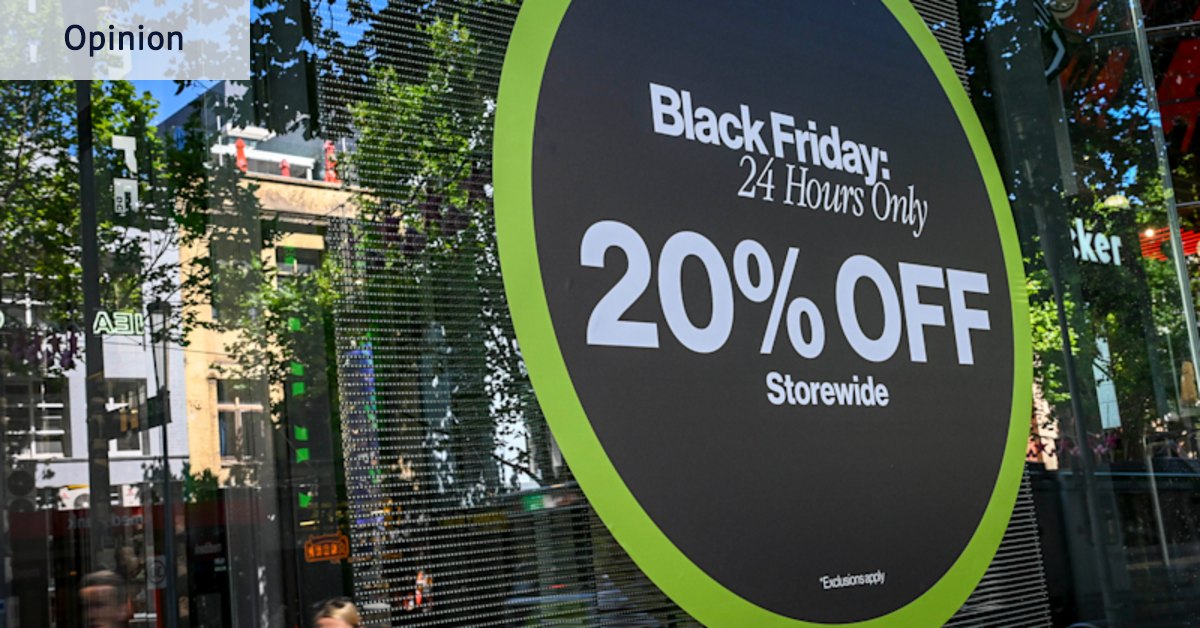
Last year, Australians spent $23.8 billion during the two-week Black Friday sales period – almost 20 per cent more than a normal fortnight, according to CommBank iQ.
uncertain
Australians → spend → iQ.
That’s around 2.5 times the annual GDP of Fiji.
asserted
That → ’ → Fiji
With Black Friday overtaking Boxing Day as the leading sales period, it has truly become a fixture in Australia’s retail calendar.
asserted
it → overtake → calendar
But if, like me, you intend to hunt for some good bargains this weekend, it might be worth stopping to think about who actually wins from these sales.
uncertain
who → intend → sales
There are two main ways that retailers can take advantage of us during Black Friday.
1. Making us spend more money than we wanted to.
asserted
we → be → money
First, it is important to think about how much you are going to spend, and compare it with how much you would have spent if there wasn’t a sale at all.
asserted
you → think → much
Economists call this a ‘counterfactual’.
asserted
Economists → call → this
If you were already planning on buying a Nintendo Switch gaming console as your child’s Christmas present, getting it at a 20 per cent discount is a huge win.
asserted
getting → plan → discount
However, if the Black Friday ads at JB Hi-Fi convince you to also buy a robot vacuum cleaner – that you otherwise wouldn’t have – they might be taking you for a ride.
uncertain
they → convince → ride
Black Friday can be a great way to save money on everyday staples.
asserted
Friday → save → staples
Just make sure you’re the one who is actually winning.
asserted
who → make → ?
Of course, you are now the proud owner of a robot vacuum cleaner – and it may prove useful.
uncertain
it → prove → cleaner
But if the item spends most of its life sitting in a cupboard instead of being used, that’s a good sign your impulse buy might’ve been a mistake.
uncertain
buy → spend → cupboard
I’m sure we can all recall times we overestimated how useful a purchase might be.
uncertain
purchase → ’m → times
Reflecting on these experiences can be a worthwhile exercise to keep us from repeating bad habits.
asserted
Reflecting → reflect → habits
The difficulty with counterfactuals is that they can be tough to observe.
asserted
they → observe → counterfactuals
Once we’ve seen an enticing offer – complete with a 40 per cent off discount tag, an ‘only five units left’ warning, or a one-hour countdown timer – it’s easy to convince ourselves that we needed the item all along.
asserted
we → see → item
Retailers sometimes use tricks to make us feel like we’re getting a better deal than we really are.
asserted
we → use → deal
It looks like an incredible 90 per cent saving – but in truth, it sells for $99 year-round anyway.
asserted
it → look → 99
This sales technique relies on what economists call “anchoring”.
asserted
economists → rely → what
The $99 sales price feels cheap relative to the listed cost of $1000.
asserted
price → feel → 1000
But, at the end of the day, it’s still an expensive $99 purchase regardless of the high ‘anchor’ price, especially when you compare it to cheaper Kmart or IKEA alternatives.
asserted
you → ’ → alternatives
Electronics store digiDirect was recently fined $99,000 for five infringements, including advertising a wireless keyboard for $149 (down from $229) despite it seldom being sold at the higher price.
asserted
it → fin → price
Other tricks include ‘sitewide’ sales with large exclusions, countdown timers with discounts that don’t end at the stated time, and false claims of low stock levels.
uncertain
that → include → levels
But just because the regulator is on the lookout doesn’t mean you should let your guard down.
asserted
you → mean → guard
So, what should you do?
asserted
you → do → what
First, write down a shopping list before you look at any sales.
asserted
you → write → sales
Include Christmas presents and staples you intend to buy regardless of any sales.
asserted
you → include → sales
Second, assign a budget based on what you can afford.
asserted
you → assign → what
This will help set your expectations on a number that’s more meaningful to your own financial situation.
asserted
that → set → situation
Third, try to recognise when retailers might be taking advantage of you.
uncertain
retailers → try → you
Retail marketing teams know every trick in the book, so being aware of their tactics can help us avoid falling for them.
asserted
us → know → them
If you feel like you’re getting anchored, compare a product across different brands and sellers.
asserted
you → feel → brands
Remember that the percentage size of a discount shouldn’t determine whether you buy something.
asserted
you → remember → something
All that matters is if it’s a good price for a product that you were already planning on buying, or it’s something you actually think you’ll use.
asserted
you → matter → that
If you feel like you’re being pressured into an impulse buy, step away from your device and think about whether you truly need that purchase.
asserted
you → feel → purchase
Forcing yourself to wait 24 hours before buying something can help with mental clarity.
asserted
Forcing → force → clarity
In summary, Black Friday can be a great way to bring forward purchases and save money on everyday staples.
asserted
Friday → bring → staples
Just make sure you’re the one who is actually winning – we don’t want any robot vacuum cleaners wasting away in the cupboard come 2027.
asserted
cleaners → make → 2027
He previously taught at Melbourne University.
asserted
He → teach → University
 The Aporia