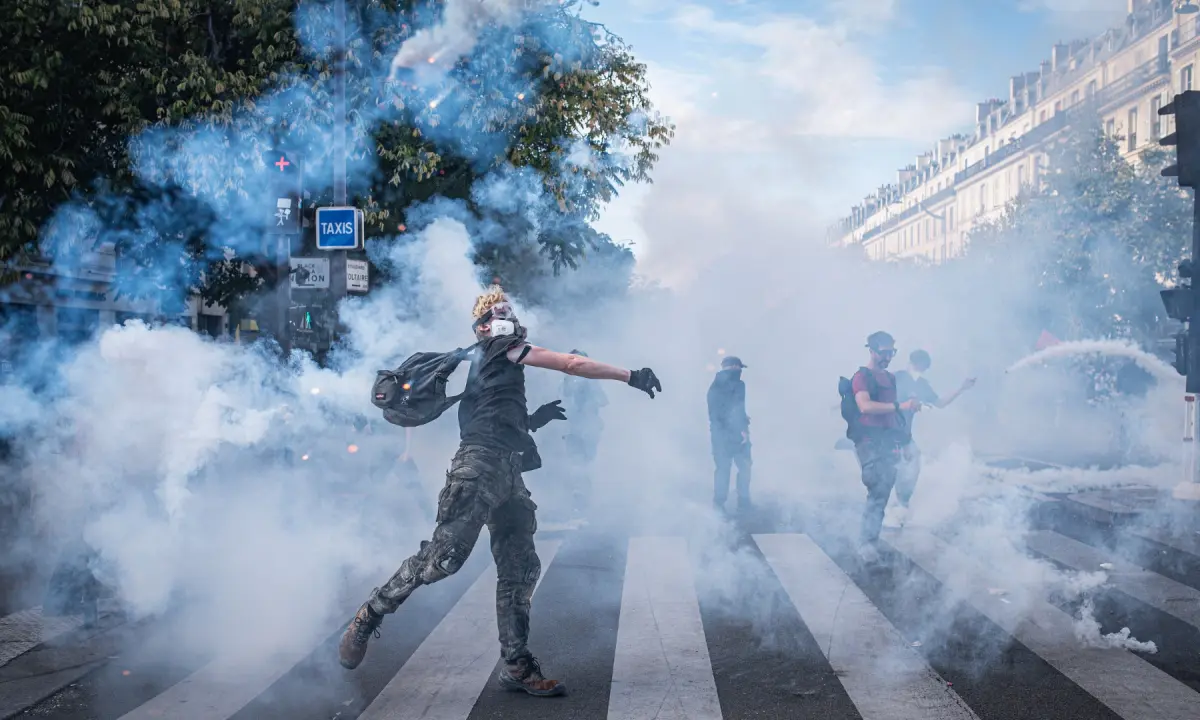
Calls for mobilisation on 17 October had been followed by viral videos, parodying Japanese anime and Marvel productions to rally the troops.
asserted
Calls → follow → troops
The streets had caught on: with each new day of mobilisation, walls became covered in angry, audacious graffiti, ranging from ‘F@ck the 17 (the generic number for the French police), bring on the 17th’ to ‘17 October, better than October 17 (the second of two revolutions in Russia in 1917)’.
asserted
walls → catch → 1917
When the day finally arrived, a perfect storm swept across France, from its largest metropolitan areas to its mid-sized towns.
asserted
storm → arrive → towns
High school and university students, who had been mobilising for weeks, took to the streets in large numbers.
asserted
who → mobilise → numbers
They were joined by demonstrators protesting the rising cost of living, including some associating themselves with the Yellow Vest movement, as well as by French and foreign far-left activists.
asserted
They → join → activists
All in all, between 550,000 and 800,000 persons went into the streets on that day.
asserted
persons → go → day
In the violence that ensued, some turned on police forces and official buildings, while others targeted small businesses and department stores.
asserted
others → ensue → businesses
Mass looting and damage to public buildings, including the town halls of Limoges and Marseille, led the government to impose curfews in several cities over the next few days.
asserted
looting → include → days
In each city, even in each neighbourhood, this day of mobilisation took on a different character, depending on the composition of the crowds and their interactions with the police.
asserted
day → take → police
In some parts of Paris, Marseille, Lyon, Nantes, Rennes or Bordeaux, the attacks against police forces and government buildings took a quasi-insurrectional character.
asserted
attacks → take → character
As law enforcement remained at a distance, the streets were left to jubilant protesters, often dressed up in costumes.
asserted
streets → remain → costumes
In this space wrested from the ordinary constraints of everyday life, the Republican motto of ‘liberté, égalité, fraternité’ (liberty, equality, fraternity) suddenly took a new meaning as protesters of different ages, classes and racial backgrounds revelled in the furious spectacle of their momentary unity.
asserted
protesters → wrest → unity
This subversion of the protest order — it was no longer the demonstration that overflowed, but the overflow that demonstrated — nevertheless remained contained within certain bounds.
asserted
that → overflow → bounds
In the parts of Paris that I walked through, at least, vehicles and shops were not set on fire and the forces of disorder remained somewhat contained, at least until the looting began.
asserted
looting → walk → disorder
This day of wrath and jubilation will probably not be repeated soon.
asserted
day → repeat → wrath
The stars that aligned on that day have since then changed their orbit.
asserted
that → align → orbit
Suburban youths, many of them first-time protesters, have not been durably integrated into street protests, while the intensity of repression deterred more privileged youths from repeating the experience of the 17th.
asserted
intensity → integrate → 17th
In the following weeks, the mobilisation thus took a less belligerent turn and returned to a more conventional social movement led by student and labour unions.
asserted
mobilisation → follow → unions
In many lycées, however, blockades persist and tensions are rising between mobilised students and parents worrying about the impact of a prolonged closure of the schools.
asserted
tensions → persist → schools
A clap of thunder in a troubled sky
Calls for a mobilisation against ‘la vie chère’ (high cost of living) started circulating on social media in September 2026, autonomously from the labour unions that traditionally organise demonstrations in France.
asserted
that → circulate → France
In September 2025, a similar attempt to ‘block everything’ across the country was a failure and French intelligence agencies did not take the hype around 17 October seriously.
asserted
agencies → block → October
They miscalculated the amplifying effect of the student movement, without which this call to action would probably have fizzled out.
asserted
call → miscalculate → action
In September 2026, a nationwide movement of high school and university students started calling for better teaching conditions, including increased teaching staff and renovated school buildings.
asserted
movement → start → staff
The mobilisation was also fuelled by a deep crisis within the French higher education system.
asserted
mobilisation → fuel → system
In 1980, only 40 per cent of a whole age group obtained the baccalaureate.
asserted
cent → obtain → baccalaureate
Today, 80 per cent obtain this prestigious school-leaving certificate, leading to severe pressure on higher education institutions.
asserted
cent → obtain → institutions
Rather than the increase of baccalaureate-holders per se, stagnant state funding of universities and limited vocational education options have severely constrained the access to higher education.
asserted
funding → constrain → education
While asking for 200,000 new positions in universities, high school students have also been asking for the suppression of Parcoursup, the pre-enrolment platform for first-year higher education programmes, which they see as opaque, discriminatory and stressful.
asserted
they → ask → which
By protesting underfunding of high schools and universities, mobilised students also defended an idea of public education as a public good.
asserted
students → protest → good
As Leila, a 12th grade student in the 9th arrondissement of Paris, told me while sitting on a dustbin during the blockade of her high school on 5 November, “We are calling for pay rises for our supervisors, our cleaners and our teachers.
asserted
We → tell → supervisors
We cannot expect teachers to work themselves to the bone if their salaries do not reflect the effort they put in.
asserted
they → expect → effort
The movement initially started in late August in Mayotte, an overseas department and region located in the Indian Ocean, before expanding to impoverished suburbs of the Greater Paris region, such as Créteil and Saint-Denis.
asserted
movement → start → Créteil
With a significant number of them of North African or Sub-Saharan African descent, local students denounced the unkept promises of the French meritocratic system of education.
asserted
students → denounce → education
By draping themselves in the national flag or singing the national anthem in protests, they reiterated their attachment to egalitarian ideals, while pointing out the systemic discrimination undermining the professed ideal of equal opportunity for descendants of postcolonial immigrants.
asserted
they → drape → immigrants
By early October, the protests expanded to more privileged sections of the youths, including the so-called ‘jeunesse dorée’ (golden youth) attending the most prestigious public schools.
asserted
protests → expand → schools
Expressing solidarity with suburban youths, students from city centres shared their concern with the clogging of higher education, their anxieties towards the possibilities of the far-right Rassemblement National coming to power in 2027, as well as more diffuse fears towards a future compromised by the compounding threats of climate change, armed conflict and artificial intelligence.
asserted
National → express → change
Even if it does not yet translate into joint structures of mobilisation transcending deep social, racial and residential divides, the sense of unity among this anxious youth is palpable.
asserted
sense → translate → youth
Besides shared concerns specific to this age group, it is rooted in demographic transformations.
asserted
it → share → transformations
In 2026, the number of people aged 65 and over became nearly equal to the number of those under 20, and this trend toward a demographic reversal will only intensify in the next decades.
asserted
trend → age → decades
In this ageing society, which it holds responsible for the current state of world affairs, the youth feel belittled and silenced.
asserted
youth → age → affairs
…and 78 more, not listed.
 The Aporia