The reluctance of some NSW public schools to set homework is exacerbating social inequalities as more privileged parents seek out tutoring to address perceived gaps in their children’s education, according to new research.
uncertain
parents → set → research
NSW schools have the power to decide whether to enforce homework, with a Department of Education policy document from 2012 stating “research regarding the value of homework is inconclusive”.
asserted
research → have → homework
Other academics have said homework doesn’t improve learning outcomes in primary school.
asserted
homework → say → school
But those claims are challenged in a new paper from academics at Western Sydney University and UTS, which says homework helps build study routines and students’ ability to read and perform mathematical tasks quickly and easily.
uncertain
homework → challenge → tasks
The authors said part of the problem with the hundreds of studies on homework is that its benefits were cumulative, often over years, so it was difficult to capture in academic research.
asserted
it → say → research
It is also difficult to separate academic outcomes associated with homework from other variables, such as a classroom teacher’s influence on a student.
asserted
It → separate → student
“Ensuring that students revise classwork and reinforce their conceptual understanding has compounding effects.
asserted
students → ensure → effects
This is also the case with the much-maligned rote learning,” the research said.
asserted
research → malign → learning
“On balance, with certain caveats, the weight of research indicates that homework is beneficial.
asserted
homework → indicate → research
The homework findings were part of a bigger research endeavour, Schooling, Parenting and Ethnicity: Asian Migration and Australian Education project, conducted by researchers across Western Sydney University and UTS as part of a three-year project.
asserted
findings → conduct → project
It was prompted by a need to better understand the growing impact of Asian migrant families on Australian schooling.
asserted
It → prompt → schooling
Lead researcher from Western Sydney University, Professor Megan Watkins, said repeated practice, particularly in the early years of school, helped students master what they had learnt, reducing cognitive load and allowing students to give greater attention to higher-order thinking.
asserted
students → say → thinking
“Many parents were quite upset their children didn’t get more homework,” she said.
asserted
she → upset → homework
Researchers interviewed dozens of teachers, students and parents about attitudes at six primary schools across Sydney at varying levels of social disadvantage and ethnic backgrounds.
asserted
Researchers → interview → disadvantage
Homework is just one prong of the major study, which also probed Asian parents’ attitudes towards Australian schooling as well as the impact of coaching centres and tutoring culture.
asserted
which → probe → centres
One teacher told the researchers: “Our kids are so bombarded with tutoring that they don’t need the homework.”
But parents had a different view, enrolling their children in tutoring because of insufficient homework in schools.
asserted
parents → tell → schools
The sample size of 500 parents revealed 20 per cent of respondents of an Indian or Chinese background spent 60 minutes or more on homework each night, compared to less than 2 per cent of the respondents from an Anglo background.
asserted
cent → reveal → background
However, many teachers could see the benefits of homework despite the push against it.
uncertain
teachers → see → it
“[They] thrive on this extra homework, especially the Chinese students,” one teacher said.
asserted
teacher → thrive → homework
Another teacher also favourably viewed homework, but her principal thought it was of zero importance.
asserted
it → view → importance
While some parents who could afford it sent their child to tutoring, one mother took it on herself to develop extra school work, visiting education bookstores regularly and planning her own homework based on the term’s classroom activities.
uncertain
mother → afford → activities
Students surveyed described their homework as “minimal and optional”; some said it was “too easy”.
asserted
it → survey → homework
Of those who were not given homework, many felt they should have been.
asserted
they → give → homework
The research ultimately found a case for homework.
asserted
research → find → homework
“Clearly, when schools don’t provide homework, many parents and students look for alternatives, such as academic tutoring, further exacerbating inequalities within school communities,” it said.
asserted
it → provide → communities
A NSW Department of Education spokesperson said the homework policy referenced by the academics was outdated and current guidelines did not refer to “inconclusive” research.
asserted
guidelines → say → research
“Setting homework is a common expectation in NSW public schools,” the spokesman said.
asserted
spokesman → set → schools
“Each school is required to develop homework guidelines that outline their approach and are tailored to the needs of their students.”
asserted
that → require → students
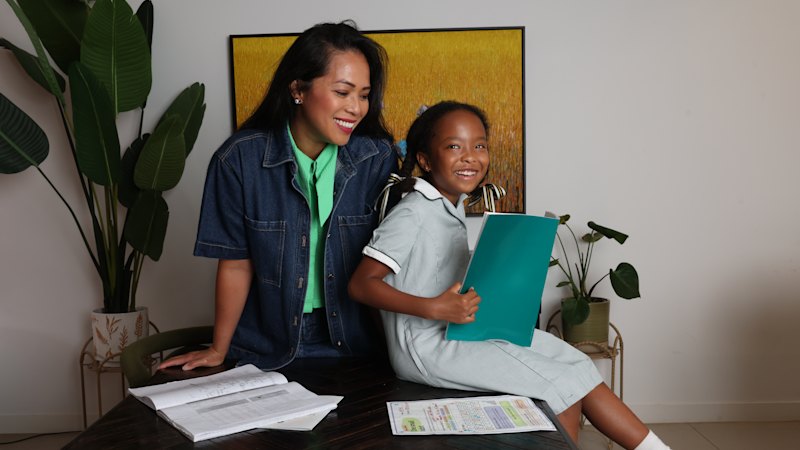
Delia Suteja Yeboah came to Australia from Indonesia in the 1990s where she learnt the discipline of doing homework every day from kindergarten.
asserted
she → come → kindergarten
“Whether you are rich, you are poor, you go to public school, private school, you are taught in the same similar discipline,” she said.
asserted
she → go → discipline
Her daughter Myla, 8, receives homework each week including a spelling list of 30 words.
asserted
daughter → receive → words
She adds a maths questionnaire every morning for her daughter to complete and quizzes her when they’re out of the house.
asserted
they → add → house
Recently, at a sushi restaurant, she quizzed Myla on the cost of the bill based on how many plates they had consumed.
asserted
they → quiz → plates
“Now I understand as a parent that I need to be able to make it fun and make it practical,” she said.
asserted
she → understand → parent
 The Aporia