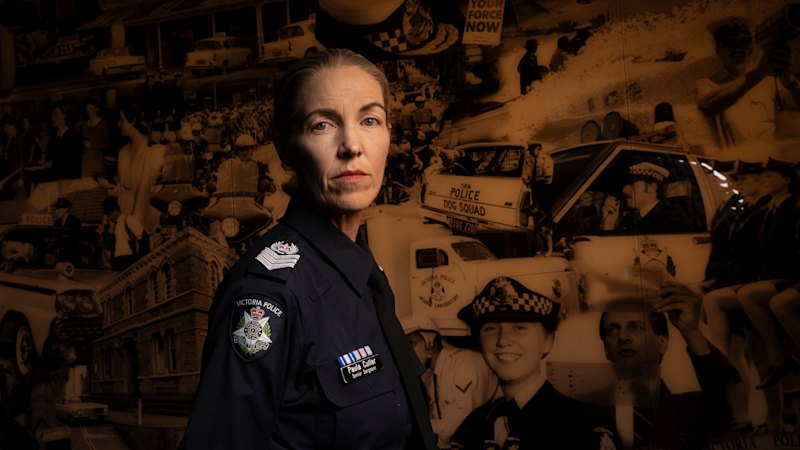
Even in a room full of safety experts, Paula Cutler’s revelation about how far sexual strangulation has filtered into school communities drew an audible gasp.
asserted
strangulation → filter → gasp
The Wangaratta senior sergeant floored her audience of police, family violence and health experts when she told them of a 12-year-old girl taken to see a Victorian school nurse after staff noticed bruises on her neck.
asserted
staff → floor → neck
“Teachers brought her in and said, ‘What’s going on?’.
asserted
What → bring → her
And she was proud of the bruises,” Cutler told a Victoria Police training forum with cross-community agencies on signs and harms of strangulation, attended by this masthead.
asserted
Cutler → tell → masthead
“It was a 12-year-old boy at the school [who left the bruises] and they were having sex, so it’s got to the point where there are some young people proud of the marks it’s leaving,” she said.
asserted
she → leave → marks
The death of a 16-year-old Sydney girl following consensual sex involving strangulation has prompted safety leaders across the community to call for urgent action to prevent young people and family violence victims from the risk of cumulative and catastrophic brain damage.
asserted
death → follow → damage
As the federal government continues to consider a proposed ban on strangulation in pornography, Cutler is among a growing group of family violence leaders, forensic experts and school nurses warning of, and attempting to fill a gap in awareness of both the frequency and risk of strangulation.
asserted
Cutler → continue → strangulation
So-called “choking” during sex has become so accepted – even expected – that workers in Melbourne’s Bayside sex industry report “suffocation” is requested as part of normal service, and police are seeing it turn up as early as young people’s first dates.
Detective Sergeant Guy Menhennitt, of Central Victoria Sexual Offences and Child Abuse Investigation Team, supported an 18-year-old woman who, on her first foray into online dating, matched with a young man who strangled her before any other intimacy had occurred.
asserted
intimacy → call → her
“She meets up with a 22-year-old male, they go for a drive and for a walk around a lake, they get back in the car, and he perceives the relationship is blossoming well and reaches over to and starts to strangle her and then kisses her,” Menhennitt said.
asserted
Menhennitt → meet → her
“The first time a new couple had a physical interaction or affection of any sort is him placing his hands around her throat.”
asserted
him → have → throat
His colleague Cutler is co-founder of a new alliance of 30 safety sector and government department leaders who will meet on December 3 to discuss what is required to tackle strangulation and better protect people, predominantly women.
asserted
what → meet → people
Young people think adults are overreacting to the risks of sexual strangulation, Cutler says, which Melbourne University research found 57 per cent of Australians aged 18-35 nationally have experienced.
asserted
cent → think → Australians
“We are facing an epidemic of young people who will potentially have long-term injuries that they don’t know about,” she said.
asserted
she → face → that
“There is an increasing debate about whether consent should be any defence to any form of strangulation – it’s a debate in the rest of the states that have strangulation legislation as well.”
asserted
that → be → legislation
People “cannot consent to serious injury, and you never know how serious the injury’s going to be inside the neck”
asserted
injury → consent → neck
says Meg Bagnall, a family violence leader at the Victorian Alcohol and Drug Association who helps run volunteer education sessions on the signs of strangulation for emergency departments.
asserted
who → say → departments
“This message is not getting through among younger people,” she said.
asserted
she → get → people
“It’s getting through at the pointier end when people are showing signs of neck compression in the context of sexual abuse … but only 15 per cent of our community will ever engage with police.
asserted
cent → get → police
Some victims with damage may not be identified because to get access to specialist forensic medical assessment in Victoria (unlike in NSW) “you need to go via police,” Bagnall said.
uncertain
Bagnall → identify → police
Such examinations can include scans looking for harm, including arterial dissection, which may later produce dangerous clots.
uncertain
which → include → clots
Louise Sheehan, of Bayside Peninsula Integrated Family Violence Partnership, is a co-founder of the new alliance and among many women’s safety workers who say strangulation is now considered a normal part of sex, especially among 18-34 year-olds, but risk information is not reaching them.
asserted
information → say → them
“We know from every conversation Paula [Cutler] and I have with different groups, the key ask is a desire for education,” said Sheehan.
asserted
Sheehan → know → education
Marks from neck compression had replaced “hickeys” on the neck as a sign of nascent sexual activity, another indication that far more prevention action is required.
asserted
action → replace → indication
School nurses are “desperate” for resources to help inform and support students, and are aware children are commonly engaging in sexual choking, she said.
asserted
she → help → choking
Sex workers should also be given accurate information about the risks posed by clients asking to perform it.
asserted
workers → give → it
“Sex workers are experiencing suffocation, clients are seeking out things like putting a bag over someone’s head and strangulation,” she said.
asserted
she → experience → head
“That is disturbing when you know the facts [about risks of permanent cognitive damage] and whether they understand the impact: I think that’s really unlikely.”
asserted
that → know → impact
Jessica Turnbull, president of the Victorian School Nurses Association, confirmed nurses are well aware non-fatal strangulation is being used by students, but she does not believe they understand the ramifications.
asserted
they → confirm → ramifications
We are facing an epidemic of young people who will potentially have long term injuries that they don’t know about.
asserted
they → face → that
“We all know it’s happening, we’ve all seen it in our health centres and sick bays and heard about it in ad hoc conversations … it’s that peer pressure, and they think it’s the norm,” she said.
asserted
she → know → conversations
National student consent educator Dannielle Miller said many young people see sexual strangulation imagery even before they become sexually active.
asserted
they → say → imagery
“In my work with teenagers, I’ve had girls tell me that boys have begun choking them during sex without any prior discussion, seemingly assuming it was a normal or expected part of the experience,” Miller said.
asserted
Miller → have → experience
Young people’s perspectives must be acknowledged or adults will lose their attention, “but I suspect many young people simply don’t appreciate how dangerous this practice can be”.
asserted
practice → acknowledge → attention
After volunteering for several years with Meg Bagnall and senior forensic physician Dr Jo Ann Parkin to run the emergency-worker training sessions, Bendigo policeman Menhennitt has concluded the ubiquity of choking in pornography means it is extremely difficult to reduce the incidence.
asserted
it → volunteer → incidence
“Porn is a major factor, some studies have shown a correlation between porn consumption and sexual aggression – 88 per cent of pornography contains forms of violence,” he said.
asserted
he → show → violence
“But strangulation is perceived as socio-normative, it’s expected behaviour.”
asserted
it → perceive → ?
Melbourne woman Julie-ann, a member of the government’s Victim Survivors’ Advisory Council, spoke at the recent police forum about the terror of experiencing violent strangulation.
asserted
ann → speak → strangulation
When her now-deceased partner lifted her off the ground by her throat, “it was like I’m about to die and there’s nothing I can do; all I could think of was that my little girl is going to come home and see her mum dead.”
uncertain
mum → decease → throat
Julie-ann wants women who experience strangulation to be aware they must seek medical attention.
asserted
they → want → attention
She wants victims to know that once they are strangled in a family violence situation, their risk of becoming a homicide victim increases by 800 per cent: “The next step is you’re dead,” Julie-ann said.
asserted
ann → want → cent
…and 2 more, not listed.
 The Aporia